Turntablism stalwart Kid Koala has announced his imminent return with 12-Bit Blues, a 12-track album that finds the DJ/producer recreating the blues in his own sample-heavy hip-hop style without any sequencing software. The record—which was apparently created “over three days… using the pads on [a E-mu SP-1200 sampler href=”http://en.wikipedia.org/wiki/E-mu_SP-1200”] and a multitrack [recorder]”—is scheduled to arrive on September 17 via Ninja Tune as a limited-edition “hand-powered turntable kit and flexi disc.” As you await the release date to come, you can nab the fifth tune from Kid Koala’s new LP by handing over your email address, here. The tracklist and artwork for 12-Bit Blues is below.
01. 1 bit Blues (10,000 miles) 02. 2 bit Blues 03. 3 bit Blues 04. 4 bit Blues 05. 5 bit Blues 06. 6 bit Blues 07. 7 bit Blues 08. 8 bit Blues (Chicago to LA to NY) 09. 9 bit Blues 10. 10 bit Blues 11. 11 bit Blues 12. Denouement
Taken from the first disc of Japanese artist Cuushe‘s (pictured above) recently released Girl You Know That I Am Here But the Dream, “Summer Night Sketch (Botany Remix)” is a jangly and reverb-addled reinterpretation of a softly mesmerizing tune from the artist’s debut LP, Red Rocket Telepathy. Texan beatsmith Botany nabbed bits and pieces of Cuushe’s barely there vocals for his rework, and intertwines them with his organic rhythms and percussive melodies, all of which culminates in a production that sounds not unlike some of our favorite tracks on Four Tet’s breathtaking There Is Love in You.
Before Canadian producer/singer Ango drops his free album, Serpentine, online next Tuesday, he’s shared this flickering clip for lead single “Paralyzed.” The video was directed by photographer Paul Labonte, and features heavily treated footage of Ango interspersed with layer upon layer of moving nature images. It all flits and glows as the bubbly tune—produced by Prison Garde and Eames—plays out Ango’s soulful melodies.
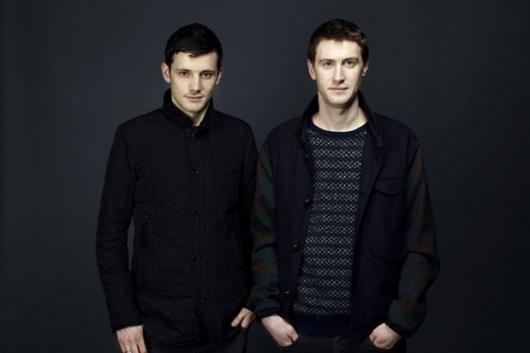
London duo CSY & Stripes (pictured above) has tried its hand at reworking over-the-top club banger “Beat Dun Drop,” the latest single to arrive from UK “creative collective” Machines Don’t Care. Thankfully, “Beat Dun Drop (CSY & Stripes Remix)” makes little use of the original vocal hooks (though its sporadic appearances throughout the tune are somehow more palatable) and does away with MDC’s bombastic sound palette, focusing instead on swaying garage rhythms, rolling basslines, and crunchy synth melodies to work out its club-ready groove.
The French soft-synth maker Arturia recently repackaged 10 of its most popular analog-modelling virtual instruments into what it’s calling Next Generation versions—featuring new packaging, 64-bit compatibility, improvements in MIDI assigment capabilities, and overall enhanced performance. Here, we take a look at three of the instruments to see how these new editions hold up.
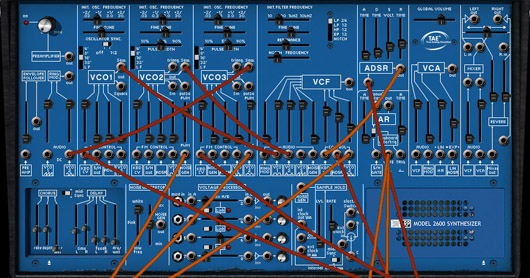
ARP 2600 V Modelled after the legendary mini-modular ARP 2600 synthesizer, the ARP 2600 V can be a handful to approach if you have no experience with modular synthesis. Fortunately, this soft-synth comes with a plethora of decent presets that will get you started making noise instantly and, after a while, serve as a sort of tutorial to help figure out how best to piece the synth together using the virtual patch cables that connect all the different components. Aside from the three oscillators, the 2600 V comes with all the same parameters as the original ARP, which includes just about everything one would expect to find on such an in-depth synth: full filter section, complete envelope control, ring mod, noise generator, reverb, and much, much more. Also included is a soft version of ARP’s 1601 Sequencer, which allows the user to further control their sounds with 16 completely MIDI-synced steps. Again, there are plenty of presets which utilize this aspect of the 2600 V, so you can get started with it quickly and then tweak to your liking later on. The range of sounds possible on the 2600 V is perhaps its most alluring quality. From rich and full pads to cascading arpeggios, bell-like melodies, and otherworldly bleeps and bloops, the only limit to the sonic possibilities are the user’s patience and understanding of the synth itself.
Jupiter-8 V The original Jupiter-8 is known for its full low end and trademark buzz, and the Jupiter-8 V delivers an amazingly comparable sound. Where a lot of soft-synths falter is in the higher end of the frequency spectrum, usually sounding flat or even harsh and causing producers to roll off the high frequencies while sacrificing a bit of brightness, but this synth is remarkably clear and present in that range. The filter section here is impressively responsive, the resonance is sharp and can even get a bit out of control (just like a real analog filter). There are quite a lot of options to tweak the sounds on the Jupiter-8 V—LFO, modulation, envelope controls, arpeggiator, detune, portamento, etc.—but it is nowhere near as complicated as the 2600 V, and if you turn enough knobs, you’ll usually end up with an interesting sound. There are also extra effects such as delay, reverb, chorus, and distortion which can be utilized via an extra panel found above the synth. But for the most part, you’re probably better off using whatever plug-ins you already have instead, or better yet, just staying out of the way of the rich tones one can easily conjure up from this virtual synth.
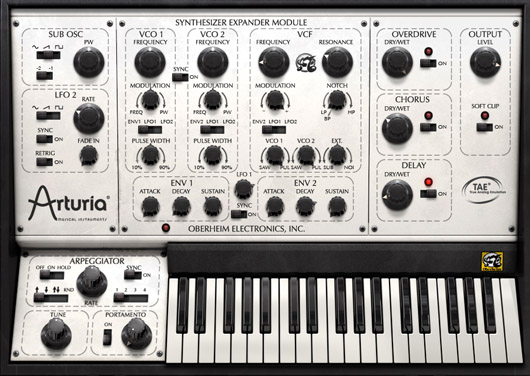
Oberheim SEM V (pictured at top) The Oberheim SEM V is one of the more recent additions to Arturia’s line of analog emulators. It’s a rather simple polyphonic synth with two main oscillators, a standard filter section, sub-oscillator, two LFOs, overdrive, chorus, and delay. The sound is somewhat comparable to a Moog in that the tones can be biting or, when dipped by the filter, rounded off and smooth. The large buttons and relatively simple design make this one easily tweakable and perhaps the most fun of the three presented here. The included arpeggiator is ridiculously basic but unbelievably entertaining once you get it rolling. The soft-synth also features extended access to certain parameters which are controlled by a panel above the main synth. Here, the sounds can be customized much further utilizing more detailed controls based on the section of the keyboard being played or which of the eight voices is being used at the time. This section allows for simpler patches to become much more complex if the user wishes, adding another layer of customization for the ambitious—or restless—synth nerd.
With these three particular virtual instruments as our indicators, it seems likely that the rest of Arturia’s Next Generation line is of an equally impressive quality. Of course, like all soft-synths, there are inherent limitations to these instruments: Obviously, there is no physical surface (although with most DAWs, assigning the various parameters to a MIDI controller is considerably easy to do) and the field of vision is limited to the size of your screen. Also, to say that these synths are indistinguishable sonic copies of the equipment they represent may be a bit of a stretch, but that does not necessarily take away from the fact that each of these three soft-synths are of an exceptional sound quality. Considering how expensive and rare (especially in working condition) the real pieces of gear are, Arturia has made access to these sought-after sounds more affordable and reasonable than ever before, furthermore utilizing all the flexibility of MIDI and modern DAWs as well. Truthfully, it’s hard to think of any synths on the market today—software or hardware—for under $100 that allow for as much customization or that feature as rewarding sonic capabilities as Arturia’s Next Generation virtual instruments.
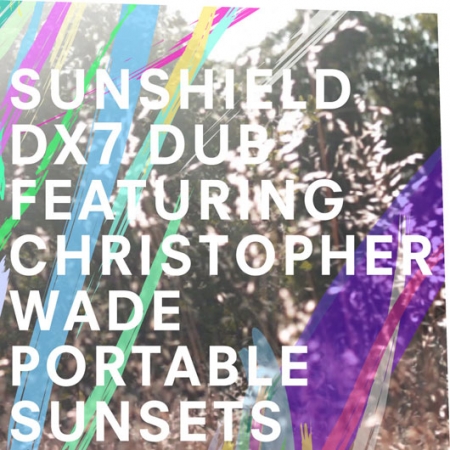
NYC’s Portable Sunsets dropped its Mercy LP just a month ago via Daedelus’ Magical Properties imprint, and follows that release today with this special version of one of its cuts, “Sunshield.” This “DX7 Dub” of that tune still features vocalist Christopher Wade, but exchanges the original’s jittery funk vibes for a more bulbous and subdued sound that bounces along at an easy pace. The results are about as close to an electro-pop tune as you’re likely to hear on XLR8R, albeit one more suited for bedtime than late-night revelry.
If there was ever any question as to whether Jacques Greene could continue to evolve and innovate after making such a big splash when he first appeared on the scene, his latest EP should go a long way towards putting any lingering doubts to rest. Landing somewhere in between the R&B-soaked burners which propelled his ascent up the bass-music ladder and the more elongated, introspective pieces (in particular the Koreless-featuring “Arrow“) which have come along more recently, the Ready EP is a lush, alluring collection of masterful club music.
The title track begins the EP in somewhat fresh territory for Greene, as the Montreal native builds a shuffling techno beat out of blocks of crisp drums. From the onset, “Ready” has a crunch to it—a thin (but not harsh) layer of distortion lines the track’s edges, and as Greene takes us through sequences of deep, undulating synths, the cascading notes and moments of buzz that rise to the forefront, along with the increasing pump of the kick drum, seem to almost become unwieldy. Still, Greene manages to stop off at two separate moments of calm, diverting away from the propulsive flow for two brief moments of rounded synths and incomprehensibly angelic vocal manipulations, assuring us that though he may push us to the edge, he’s still always in control. “Prism” comes wrapped with much of the same crunch, its opening moments placing distant pads and melodies underneath an overloaded kick. Eventually, this slight tendency towards distortion is veiled by the dense layers of synths, mainly a UK-indebted bassline and corresponding upper-register melody, which rise from the background to be joined with delayed glimpses of wordless, tuned R&B vocals. Around the minute-and-a-half mark, the bassline shows its full potential, morphing into a four-note pattern that, when aligned with the aforementioned melody (and later on, a spacious arpeggio sequence), makes for the kind of effortlessly catchy musicality Greene has proven able to yield with the most tasteful of touches.
The closing effort, “Dakou,” presents the most familiar sound when compared to Greene’s past work. Again, there are hints of warm crunch to be heard—especially from the drums—but the more frequent Jacques Greene trademarks are laid out early on: a soulfully re-worked vocal refrain, cascading bell-like arps, and seductive chords. The emotive components playfully weave in and out of the track for almost seven minutes, really doing no more than moving between the background and foreground of the sonic field but somehow still never feeling tired. It’s a shame that “Dakou” was made to be the “digital-only” cut from the EP (due, we’re sure, to the inherent time constraints of manufacturing quality-sounding vinyl) as, truthfully, it is no less essential an effort than the EP’s other offerings.
From beginning to end, the Ready EP is absolute quality, as Greene continues to find a unique and balanced voice amidst the constantly redefining scene that is bass music. What this EP may lack in instant accessibility and R&B hooks, it surely makes up for with its expert execution, sophisticated allure, and raw dancefloor potency.
Probably one of this year’s most unexpectedly gratifying records is producer David Douglas‘ ode to the North American horticulturist of the same name, Royal Horticultural Society, a track from which we posted about a month ago. Now, the Utrecht-based artist has unveiled a video for that record’s lead cut, the subtly funky and spacious “California Poppy.” As one might expect from a video crafted for such bucolically themed music, this clip features a lone figure draped in a purple shroud wandering through vaguely familiar landscapes, at least until things take a decidedly psychedelic turn. It’s a fine accompaniment to the dusty beats and organically alien soundscapes which Douglas offers on his new eight-track record.
If you’ve had the chance to check out this week’s XLR8R podcast, a jazzy and soulful jaunt through the realms of house and techno by Berlin’s Mike Shannon, then you’re at least acquainted with the work of DeWalta, a DJ/producer and fellow Berliner signed to Shannon’s Haunt label. “Jog Trot” comes from the artist born David Koch, and is a bonus tune that we’re treated to following the release of his latest LP, Wander. Much like Shannon’s excellent XLR8R podcast, DeWalta’s production is tasteful and jazzy, balancing on the line between upbeat dancefloor music and a contemplative instrumental groove.
Finally. The shadowy figure behind our favorite record of 2011, Holy Other is going to tour across North America this fall. The UK producer will have released his debut LP, Held, via Tri Angle by the time he hits the road on September 1, where he’ll be opening for Amon Tobin at Seattle’s WaMu Theatre. From there the two solo artists will hop around the continent until October 12, making stops in New York, Chicago, Atlanta, Boston, Austin, Los Angeles, and many other major cities. You can check out the full list of tour dates before then, below.
Sept 01 Seattle, WA – WaMu Theatre at Qwest Field * Sept 02 New York, NY – Roseland Theater * Sept 04 Denver, CO – Ellie Caulkins Opera House * Sept 06 Minneapolis, MN – Orpheum Theatre at Hennepin * Sept 07 Chicago, IL – Congress Theater * Sept 08 Long Island City, NY – MoMA PS1 Sept 09 St. Louis, MO – Royal Oak Music Hall * Sept 10 Toronto, ON – Kool Haus Sept 12 Boston, MA – House of Blues * Sept 13 Montclair, NJ – Wellmont Theatre * Sept 14 New York, NY – Hammerstein Ballroom * Sept 17 Philadelphia, PA – Electric Factory * Sept 20 Atlanta, GA – The Tabernacle * Sept 21 Lake Buena Vista, FL – House of Blues Orlando * Sept 22 Miami Beach, FL – The Fillmore * Sept 24 Dallas, TX – Palladium Ballroom * Sept 25 Austin, TX – Austin Music Hall * Sept 27 San Diego, CA – House of Blues * Oct 05 Berkeley, CA – Greek Theatre * Oct 12 Los Angeles, CA – Greek Theatre *