Los Angeles resident Brian Allen Simon has positioned himself as a somewhat unique figure within the current pack of budding electronic producers. Crafting lush, patient tracks as Anenon, Simon recently moved a step beyond many of his contemporaries when he unveiled the gorgeous (and XLR8R Pick’d) Acquiescence EP last month. The five-track endeavor showcased layers of virtually untouched, natural sound sources—mainly a grand piano and Simon’s own saxophone musings—alongside expansive and blissful soundscapes. Needless to say, we were curious how Simon managed to fit these disparate sonic sources together, both on record and in his largely improvised live sets, which usually feature the producer alongside his laptop, saxophone, and the ever-mysterious Monome. We caught up with the Non Projects label head in the weeks before the release of his debut LP, Inner Hue, in order to glean a bit of insight into his process.
XLR8R: What equipment do you utilize for your live set?
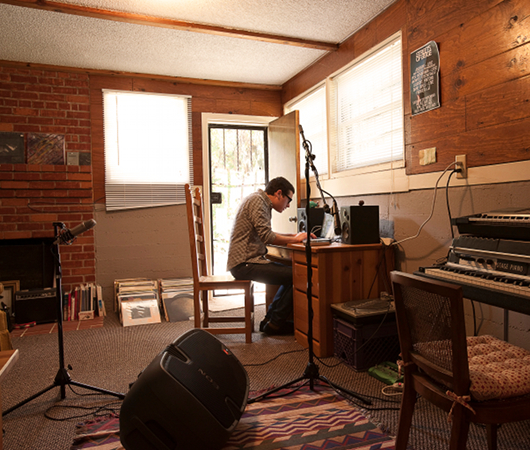
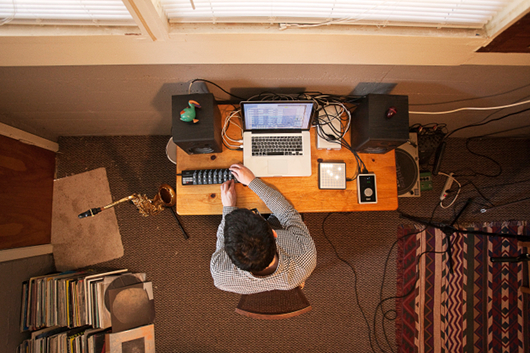
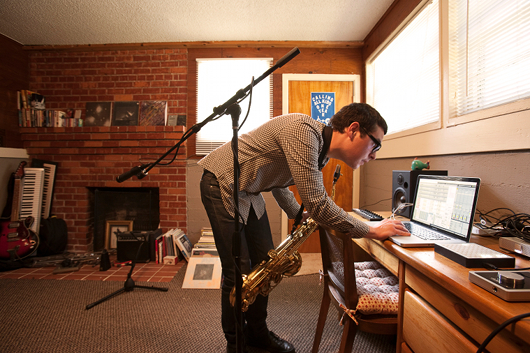
Anenon: The standard setup when I’m playing around would be the 64-button Monome, a nine-channel Korg NanoControl, the Apogee Duet 2 for inputs, and then Max/MSP and Ableton Live. I run Max into Ableton and do very minimal stuff in Live, just reverb, delay, and a couple of different plug-ins. And then, of course, I have the tenor saxophone. Live, I’m working with improvised material: playing the saxophone and running that into Max, live sampling and building new ideas out of what I play. With Max, I use a patch called MLRV, which I use to take a chord change or sound and layer it. I tend to think of things in four-part harmony, and the pitch-shifting in MLRV sounds really nice, so I’m able to build chords out of [single] sounds. I can take these sounds and build layers live with the Monome, and put together all these different things with it, build these new worlds. I like the MLRV patch because it’s very open-ended and it’s never going to be the same twice, no matter how hard you practice. [laughs] I come from more of an improvising background, and I like that I can just open this program, throw in audio and combine it with the live input of the saxophone, and blend it all together to build tracks.
When you’re building tracks live, are you starting with one instrument and then adding layers to it, building the songs piece by piece?
Basically. Sometimes, it’s not that obvious. I’m more concerned with the longform sense of it, rather than [it being] one track here, then I add this, and then I add that. I feel like that can kind of stuff can enter gimmicky territory, so, for me, it’s more about the longform set. If you’re willing to listen to me for a whole set, then you’ll hopefully hear the progression and hear what I’m doing overall. I think with both my album, Inner Hue, the [Acquiescence] EP, and the live set, it’s all about the journey and building a narrative from beginning to end. I think that’s kind of missing from live sets in general, and even for me, it was missing a year ago. There was a strong focus on my part to start building this as my live sound. It’s not like I’m making an album live, but it’s that same sort of idea of taking the listener on a journey and hopefully keeping their attention the whole time. [laughs]
How long have you been using the Monome?
Just over a year. I got it in December 2010, and it was a total impulse purchase. I think a friend emailed me and said, “These are on sale now, and they go fast.” [laughs] So, I got one.
Had you seen someone use it before?
Definitely. I’ve been aware of the Monome for a long time, but I didn’t—and I still don’t—fully get them. I just thought, “This thing looks really cool.” I’ve seen Daedelus doing some really cool stuff with it, I’ve seen Brian Crabtree [one of its creators] do some really cool stuff with it. When I got the Monome, there was a lot of investigation and reading on the internet, trying to figure out what I wanted to do with this piece of equipment.
That’s how you landed on the MLRV patch?
Yeah, I knew that you could do live-sampling on the Monome, and that’s what swayed me toward it. I was almost bored with how my live sets were going before. I was using an Akai MPD and I felt like a slave to it, rather than being able to do whatever I wanted. It was more like, “Okay, now I trigger this, now I trigger that.” It was very planned, and that was boring to me. I read that you could do live sampling with MLRV. I had to tweak the setup and use Soundflower to route the audio, but it came together kind of quickly. At some point, I realized I could do these live-sampling / improvised sets, and I think I’ve been refining the aesthetic and the technique with every show. That’s the thing with the Monome and MLRV: I don’t use it to loop, it’s more to build. Because of the pad setup on the Monome, you can play the sounds live and figure out new harmonies and ideas. I never have a tempo set on the Monome that it clicks to, so it’s more raw. The imperfection is what I’m trying to get, so that I can’t be lazy and loop it. I have to play it live. It definitely started out a bit rougher, but I think it’s starting to coalesce into this really nice sound that I can take control of. I’m excited to see where it goes, it’s constantly morphing.
And you use Ableton as sort of a mixer then? Controlling volumes and adding a few effects?
Totally. I don’t trigger anything in Ableton. I like the way the Max/MSP audio engine sounds, so it makes up most of the sound.
How about composing, do you use Ableton more for that?
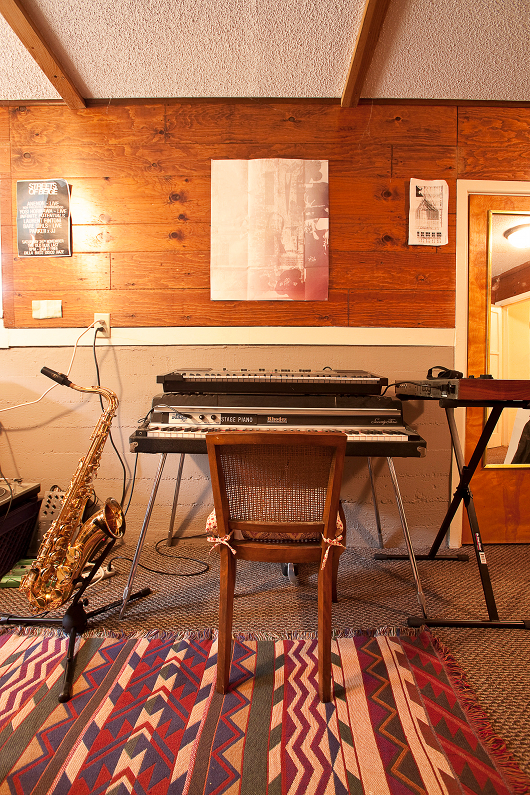
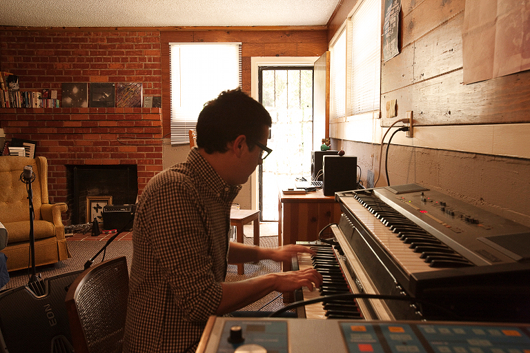
I’m actually hardly using Max when I’m composing, it’s almost entirely Ableton. But with that being said, I got the Monome right before I started recording Inner Hue, and figuring out this sort of harmonizing and sampling with it informed my production a lot. Even if I’m not using the Monome to record, the way I use the Monome live has totally informed the way the I now use Ableton in the studio. [Performing] live and [working in] the studio are becoming two entirely different things for me. I realize that a performance is never going to be perfect—you’re going to keep learning and keep getting better, and you’re going to realize you could have done this longer or you could have expanded on that idea. But in the studio, I like the fact that you can perfect things, and I take advantage of that. You have all the time in the world. [laughs] It’s like slowed-down improvising for me. I take a microscope and make things how I want them to be, because, why wouldn’t I do that? So, Ableton basically becomes the hub; I record everything into Ableton, and arrange and compose with it. For the LP, I made a conscious decision to minimize my recording setup. Pretty much 80 percent of the album is a Rhodes electric piano. I have a Juno 106 synth that I use very minimally on it, too, and then the saxophone fills it all out.
When did you acquire the Rhodes?
The Rhodes I got about a year ago. It’s the 73 Stage Piano. It doesn’t have the built-in amp, just the pedal and the legs.
Was there something in particular that drew you to that instrument?
I’ve always liked the sound of the Rhodes. Who doesn’t? But I had barely ever used one before I got it. When I was thinking about my album and thinking about the overall feel and what I wanted to convey, I just wanted it to be as personal as possible. I was drawn to the idea of starting with really pure tones. No sawtooth crazy waves, just crystal-clear tones. That’s what I was hearing in my head. And I went into this vintage instrument store in LA. The guy [running the store] was working on a Rhodes, and I asked him, “Can I get that?” [laughs] He said, “Well, I’m almost done working on it, but you’ll be the first in line.” I was working down the street from this place at the time, so I kept going in there and bugging him, “Is the Rhodes ready? Is the Rhodes ready?” [laughs] Once I got it, I went began recording with it immediately. I think I recorded the first full track with the Rhodes about a week later, “I’m Awake Tonight,” [the second to last song on Inner Hue]. It’s a straight-up, unedited, live solo Rhodes track.
You were just exploring what was possible with the keyboard?
It was more this idea of making the Rhodes the focus and giving this coherent feel to the record by using very stripped-down recording techniques. I just knew how powerful that thing was and you could just get such a range of sounds. I wanted to make the Rhodes not sound like a Rhodes, as well, and have different sonic ideas for each track.
How would you go about making the Rhodes not sound like a Rhodes? Was it mostly processing after the initial recordings, or were you changing things before the computer, like, running it through different amps?
I’d say it was more after the recording. Actually, there was only one amp that I ran it through the whole time. It’s actually not even an amp, it’s a JBL Eon PA speaker. That’s all I had, and it has a really clear sound, it doesn’t add any distortion. And I miked it up with an SM57. That’s the only microphone I used on the whole album. I would basically play and land on concrete chord changes, ideas, motifs—whatever I could come up with—and take small fragments and move over to Ableton and start building. I think more and more I start with minimal material in the beginning. I think a lot of producers and musicians have a tendency to overload and throw all these ideas out there. For me, it was a process. I wanted to start small and build from that, show restraint and build space, have the texture be generated from the actual instrument rather than from some sample thrown in.
You were more focused on working with what you had, rather than pulling from random sources for the sake of it?
Yeah, I could start with a chord change on the Rhodes and then layer that four times against itself, build harmonies, [make] sort of very simple, classical arrangement styles.
And how would you use Ableton to then mess with those sounds? Were you re-pitching and using plug-ins?
Reverse and reverb. [laughs] Those are my two “R”s of production. I use these Spectral plug-ins from Soundhack, which I highly recommend. Just going from there and trusting my ear, going on instinct. I kind of have to enter “the zone,” and not even think about this stuff while I’m working. With each track on the album and EP, I was able to zone in and enter these worlds, and it just kind of came. I only become cognisant of the process and all that afterwards.
Is the tenor saxophone the only one you play on the records?
Yeah, that’s the only one I own.
How long have you had it?
I only started playing saxophone in 2006. I was in college, and I became obsessed with jazz and improvising and I had friends who played. I always wanted to be able to just pick up an instrument and play. Something about the saxophone—the way it sounds so liquid and that there’s no defined attack, I always dug that. It’s a very personal instrument, almost like a voice. I’m not very good at singing [laughs], so that made the saxophone a big draw. At the time, I wanted to play jazz, but I realized it wasn’t for me. But I still take the improvisatory aspect of jazz, and incorporate it into my own productions. Again, I only feel like within the past year that it’s all come together naturally. It’s taken a while to be able to just play saxophone live with electronics. It’s definitely been an ongoing process.
There’s a real consistency to the drum sounds on both Acquiescence and Inner Hue. How did you land on those tones?
Another parallel to using strictly the Rhodes for consistency, on the EP and LP, every single kick drum is a 909. Different variations, but it’s always just a 909. I got into this idea of using standard drum-machine sounds along with my own personal melodic and harmonic contents. There’s just something about that aesthetic that clicked in my head and made sense. I used to be more into chopping up sampled drums, but there was something about using this idea of using drum-machine sounds with music that wouldn’t necessarily be associated with a drum machine—and it kind of went from there. I have a library of sounds that I’ve collected over the years of different drum machines and things like that, but I didn’t really even go too far into that. It was more just using this set of sounds and EQing them and changing them depending on the track. I like my drums to sound big and upfront. Again, that’s something I’ve only become conscious of after the fact. [laughs] My drums are pretty up-front compared to a lot of people.
Do you mix your tracks in Ableton, as well?
Yeah, I do all the mixing myself. For me, mixing is one in the same as making a track. I think it’s all part of the process. When I talk to people and they tell me they’re having someone else mix their stuff, I’m just like, “What are they talking about?” [laughs] When I’m making a track, I’m mixing. It’s always part of it.