
From runnin’ with shottas to inciting ghetto youth to rise above, Mavado tries to overcome his violent past.
You can take Mavado out of the gully, but you can’t take the gully out of Mavado.
For dancehall’s reigning king, the impoverished environment in which he grew up remains his foundation and source of inspiration. Success “is nice,” he says over the phone from Kingston, Jamaica, “but it doesn’t change me as a person. It change as a lifestyle… Having money alone can’t make you happy,” he explains. “Even when me seh, ‘Our dream come true,’ I’m still there in the gully with my friends.”
Coming up in the hardcore environment of Cuba, an infamous section of Kingston’s Cassava Piece neighborhood—a slum within a ghetto within a city—the singer, born David Brooks, spent his early years focused on survival.
“’Nuff youth grow up without a family,” he says, his voice surprisingly soft-spoken. “Me growing up, me have just fe do what I do. Something daily a gwan.”
Living in the ghetto, he says, “You have wrongful things and you have rightful things… We grow up knowing you haffi fight for what you own.” The undeniable reality of Cuba’s tenement yards and corrugated aluminum shacks surrounded him; instead of denying it, he accepted it as a birthright.
“Youth on the corner, we go through a whole heap a fight and a whole heap a tribulation, and we always come out on top,” he says, matter-of-factly.
Now 27, Mavado navigates around the details of his sordid past cautiously. However, a hint at his back-story emerges in his lyrics, as he reminisces about shootouts with enemy crews and police. When Mavado mentions “heartless killers” who “a Christmas never talk ’bout dem a sorry,” it’s unclear whether he’s referring to others’ misdeeds or his own.
So Blessed
Born on Christmas Day, 1981, and raised by his spiritual-minded grandmother, Brooks was expected to go to church on a regular basis as a child. Even after he began to trod the path of a young shotta, avoiding this obligation was not an option. “In Jamaica,” he explains, “if your grandmother go a church, you go a church.” He found sanctuary from the streets within the pews, and was captivated by the gospel choir—an influence that can be heard in his sound to this day.
Perhaps unsurprisingly, the church was where he first developed his appreciation for music. “Me grandmother, she was the first person wha mek David Brooks really love music,” he relates.
Music is Mavado’s biggest obsession, he admits; once introduced to the deejay business by his mentor Bounty Killer, his competitive nature drove him to overcome any and all obstacles in his path. Like the luxury watch from which his name is derived, he’s kept steady and accurate time, becoming as predictable as Swiss movement once he started to impact Jamaica’s dancehall scene.
“Each time Mavado do a hit song, it just influence me to do a next hit song,” he says (referring to himself in the third person, which is typical of dancehall DJs). “Me just believe inna me music. It just always get to the next level.”
The Line of Fiyah
After a five-year climb to the top of the reggae industry—an ascension furthered by big tune after big tune, from 2006’s “Wha Dem a Do” to 2007’s “Touch the Road” and “Top Shotta Nah Miss” to 2008’s “On the Rock” and “I’m So Special”—he’s become the genre’s brightest international star, and its most controversial.
A self-proclaimed “Gangsta 4 Life,” Mavado’s unvarnished tales of life, death, and struggle amidst the backdrop of Jamaica’s outlaws, criminals, and top shottas have focused attention on a side of the island the tourist board would just as soon have you forget. As the Jamaica Gleaner wrote in 2008, “his often violently graphic lyrics [have been] deemed in various quarters as just about the closest thing to Salman Rushdie’s Satanic Verses.”
Mavado’s hardcore persona isn’t just an act. Numerous run-ins with the law have only added to his outlaw appeal: Gun charges have prevented him from getting a visa to enter the United States until recently, and on one occasion, he was pushed through a glass window at a Jamaican police station. His father was murdered just before his 2007 debut album, Gangsta 4 Life: The Symphony of David Brooks, was released, and Mavado’s name frequently comes up when allegations of dancehall artists inciting violence are raised. (In 2008, Red Stripe withdrew its sponsorship of the Reggae Sumfest and Sting festivals due to these concerns). His 40-deep entourage has frequently had friction with police and other dancehall crews alike, and his conflict with Vybz Kartel has been the subject of much gossip, rumors, and chatty-mouth talk.
Tropical Storm
Yet attempts to curtail Mavado’s popularity and influence have proven as effective as stopping a tsunami with a sieve. It’s not uncommon to hear four or five songs by the “Gully God” in a row in dancehall sessions from Brooklyn to Tokyo, and high-profile collaborations with G-Unit and Jay-Z (as well as Hot 97 airplay, an appearance on Grand Theft Auto IV’s in-game dancehall station, and a VP Records-Nike collaboration with Jamaican sprinter Asafa Powell) have introduced him to mainstream listeners outside of dancehall’s core audience.
Asked how he linked with Jay-Z for “On the Rock,” Mavado says, “Real music, y’unnerstand? He hear the track and he just start saying something on it, because I’m saying ‘On the Rock.’” (It’s also worth noting that Jay-Z’s label is called Roc-A-Fella.)
Comparisons have been made between Mavado and late American thug life icon Tupac Shakur; the parallels go beyond just hyperbole. Like Tupac, Mavado sounds like he’s continually wrestling with inner demons, fighting a tortuous battle between good and evil in his own mind while living in a world in which survival trumps morality every time.
His pained, almost haunted, delivery—often augmented with minor-chord melodies—comes off as both unflinchingly brutal and undeniably authentic. “The place I am coming from [is] being a real youth from the gully,” he explains. “The people can feel the struggle,” he adds.
Mavado didn’t invent gun talk in dancehall music—far from it—but he’s redefined rude-boy lyrics with riddim-driven testimonials that are part confession, part boast, and part plea. Unrepentant to the point of defiance, Mavado has an uncanny ability to channel raw emotion and transcend the limitations of both dancehall artists and rappers with similar lyrical themes.
He chooses not to speak on his beef with Kartel (a former comrade in Bounty Killer’s all-star crew, The Alliance), but he does address the topic of competition in general. To him, there’s no distinction between the rivalries he’s encountered “in music, in life, in people out deh.” Such conflict is inevitable, he says stoically: “Each time Mavado fight…that is a part of it.”
Tomorrowland
Mavado’s second full-length album, Mr. Brooks… A Better Tomorrow, doesn’t sugarcoat his criminal past nor dilute his unique phrasing, delivery, or sound. But it does frequently attain an inspirational tone (and, his label VP hopes, the same kind of crossover appeal as labelmates Sean Paul, Shaggy, and Elephant Man).
“A better tomorrow—it means that me just keep up the struggle and the fight,” he says. “I’ve been through whole heap a things.”
On Gangsta 4 Life, Mavado reflected on his everyday hustle, his slightly off-key, half-sung ad-libs adding texture to the lyrical pictures he painted over hot stock riddims. His sophomore effort finds him musing not only on his past activities, but also on the effects of Mavado’s fame, fortune, and notoriety on David Brooks.
“Money don’t change we/We change money,” he sing-jays on “Money Changer.” On “So Blessed,” he emphasizes, “I will survive/Dem want me stressed.” Urgent, Jah Cure-like crooning informs “Don’t Worry”—a declaration of allegiance to the streets—while the “hey-hey-heys” of the percolating Rai Rai riddim underline razor-sharp rebukes directed at haters and rivals on “So Special.” In Mavado’s hands, what could have been a by-the-numbers track turns into a poignant, motivational discourse on the will not only to strive but to succeed:
Dem seh dem want me head pon block
But me bun di fire til it spread pon dat
Dem better help poor people with dem bed pon block
If you see a dutty heart you a go dead from that
Now dem seh a dat me fi mark fi death
And each time we walk dem seh we walk with death Dem lock me down but me cyaan forget
Charge it over didn’t die I seh me nah regret
Uprising
It’s probably no mere coincidence that this interview—postponed for a day after VP’s staff was initially unable to locate Mavado in Jamaica—eventually happened on Feb. 6, the birthday of another famous youth from the ghettoes of Kingston, Bob Marley.
What Marley was to the roots reggae audience in the ’70s, Mavado is fast becoming for today’s more urbanized version of the genre. For his part, Mavado fully understands Marley’s significance as the first global music superstar to come from the tiny Caribbean island. “We should always honor Bob Marley,” he says. “He made a certain international link. Bob died 30 years ago, and look at [the reggae industry] today.”
Having reached role-model status for ghetto youth all over the world as well as being a symbol of dancehall’s contemporary appeal and pop-cultural viability, Mavado remains focused on his mission to “take the root from out of the gully.”
In conversation, Mavado—whose recent hits include “Overcome” (a reworking of the Civil Rights anthem “We Shall Overcome”) and an Obama tribute, “We Need Barack”—appears much more conscious than his detractors have made him out to be. However, he says, stopping the violence that continues to plague Jamaica isn’t as simple as him voicing some positive tunes and declaring a ceasefire on his own.
“We can’t bring change until we change ourselves,” he says. “Even if Mavado seh he want peace,” he explains, “the same people out a road, dem gwan with the same thing. We need 100 more Obamas and then we can have peace.
“Music don’t determine nothing…” he says, pausing for emphasis. “People do.”
Ever Blazin’
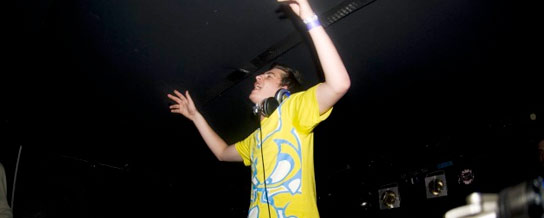
Three DJs on their favorite Mavado tunes.
Matt Shadetek
“My favorite new Mavado track right now is probably ‘Inna Di Car Back.’ The combination of Mavado and Stephen ‘The Genius’ McGregor, who is probably one of the most exciting producers out right now in any genre, is killer. I love Mavado’s funeral-singing vibe generally, but this one being more of a gyal tune makes it a nice DJ tool as well.”
Dennis Shaw
“Right now, ‘So Blessed’ is definitely my number one Mavado tune. There are so many in rotation but this one just stands out as something that’s going to last. Seems like when Mavado and producer Stephen McGregor link up, they just take dancehall to a next level.”
Max Glazer
“My favorite Mavado song right now is ‘I’m So Special.’ It’s a feel-good song, and I love playing it and singing along with it in my sets. It gets the crowd going.”