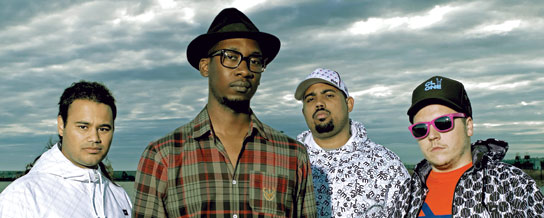
Artist Tips: Tittsworth

Jesse Tittsworth might reside in suburbs of Virginia, but the music that he makes is undeniably Baltimore. The breaks-driven, chopped-up bangers on his latest, Twelve Steps (Plant Music), combine club music’s heavy low-end with bits of pop, R&B, and old funk and soul, and play as well on the dancefloor as they do beneath vocals from The Federation, Nina Sky, and Pase Rock. So how does Tittsworth craft Baltimore club tracks that make MCs wild out and dancers shake shakeshake dat ass? Read on and find out.

1. Less is more
Keep in mind that B-more club music is generally pretty minimal. Not techno minimal, but my favorite club tracks of all time breathe really well. There’s room for the drums to be big and for the bass to sound mean. Try not to overcrowd the mix with tons of notes and instruments.

2. Break ’em
Don’t be afraid to tear the drum breaks apart and rearrange a specific slice or slices. Assign the different sections to a keyboard or drum pad and experiment with the groove or sequence. Loop a section of one break and maybe layer it with a piece of another. Take the groove and replay it with your own instruments.

3. Keep it natural
Keep in mind the milliseconds that separate the live drummers in many club breaks from beats made on a drum machine or with software. Programs like Ableton are really good for getting everything on beat. The result is something that’s easy to mix but might not groove right. To get it natural there are times where I will turn quantizing off altogether. Turn away from the grid and just beat your rhythm in real time. Any controller will do–I’ll pound a keyboard, mouse, or even my laptop directly to get those notes to sound right. Programs like Reason also have a percentage function so you can quantize something a little closer without snapping to a cold beat.

4. Low-end theory
A big part of Baltimore club music is bass, so your low-end has got to sound right in the club. This might mean a lot of back-and-forth mixing from the car to the club to the studio, but don’t rest until it thumps in all places. Try to make sure things aren’t fighting in the low-end (do your kicks and subs get clouded together?).

5. Do your homework
You can learn from programs, studio techniques, tutorials, and all that but there’s also going to be a lot you will only get from context. Take the time to learn where club music came from–what made the pioneers and classic records great.
Hits from the Blog

Six of our favorite web portals pick their best artists of 2008.

Cocaine Bluntson Killer Mike
“It’s almost cliché to call Mike the new Ice Cube at this point, but their shared penchant for simultaneously dropping knowledge and busting heads is undeniable. The former Outkast protégé has been quietly having the best year of his career with the I Pledge Allegiance to the Grind 2 LP and his weekly Sunday Morning Massacre internet series.”

20 Jazz Funk Greatson Salem
“Salem makes the sound discovered in a spinning black prism, nestled in the shadowy basement of a lifeless church looming above the grey treetops in a quarantined forest–ethereal and nightmarish, like The Cocteau Twins spinning dubstep 12”s at the Arctic Circle. They have left us spellbound this year with the ‘Yes I Smoke Crack’ 7” on Acephale, and will continue with more dark offerings soon on Merok.”

MNML SSGon Move D
“It seems strange to choose an artist who has been producing committed, sincere electronic music for longer than most of us have been listeners–D was already DJing in ’87. Move D has been with us all the way, but 2008 is his best year on record. His exceptionally diverse collaborative works, his intuitive understanding of depth, mood, and melodic restraint, and the staggeringly high quality of his thoughtful compositions make him the outstanding artist of the year.”

Palms Out Soundson Zombie Disco Squad
“This London duo has managed to stay three steps ahead this past year. With their brand of bouncy, malleable house music. They delivered phenomenal remixes for Fagget Fairys, Gameboy/Gamegirl, and The Touch, released their debut 12” (the untouchable baile house track ‘Vie’), and homo-eroticized Lil’ Wayne on the ‘Straight Boy’ edit.”

Blackdownon Joker
“Bristol producer Joker went clear in ’08 with a fresh approach to either grime, dubstep, or ruff modal p-funk, depending on your P.O.V. With detuned synths and raw street riffs, he was Kode9’s pick for the BBC’s Generation Bass show. Sell your legs: Buy ‘Gully Brook Lane’ and ‘Holly Brook Park.’”

Austin Surrealon Bavu Blakes

“The legend of Central Texas was on his worldwide grind this year, releasing a flow a week on 08issogreat.com and flooding the streets with his Extra Plair EP. His live backing band features Brannen Temple on the drums, blind multi-instrumentalist D. Madness on keys, bass, and sometimes drums, Gary Clark Jr. on guitar, and a cadre of lovely backup singers. His dynamic live show earned him a slot on the annual ACL Festival, where he performed for 3,000 people.”

The Largest Bird in the History of the Planet…Ever! Pigeon Funk

Pigeon Funk’s Kit Clayton and Sutekh never matured a day since their ’01 debut record, a micro-house affair inspired by how pigeons dance. The Largest Bird begins with a tune of warped, big-band-jazz blurts and splattered samples of pigeon calls (“Mess Call”), and finally ends up in a kindergarten-polka dance party (“Pom Pom Yom…”). This is digital funk that’s obese on kitsch, and completely refreshing in our age of trendy, forgettable minimal techno. Pigeon Funk often balances groove and delirium, best heard in the 8-bit synth riffs and drop-kicked beats of “Brukim Lo” and the cookware clangs that carry the otherwise sleepy R&B ballad “Alma Hueco.” Clayton and Sutekh once advanced San Francisco’s post-techno scene, and though The Largest Bird doesn’t break any ground, they still have a fearless messiness that’s sorely needed in techno.

Ezekiel Honig Surfaces of a Broken Marching Band

Ezekiel Honig’s second full-length solo release on his own Anticipate imprint is more confident, accomplished, and, best of all, darker and sadder than 2003’s melancholy ambient techno dub Technology Is Lonely. Honig sets the mood just right on the monochromatic “Porchside Prologue,” then bounces into a murky shuffle on both “Broken Marching Band” and “A Brief Visual Pattern.” On each track, he uses field recordings and studio effects, a progression of ascending synth chords and a surprisingly robust bassline to create strangely solemn narratives that leave you believing–like in a great film by Hitchcock or Lynch–that there are fewer things more compelling than mysteries contained in the human heart.

Jake One White Van Music

Even if you‘ve never heard of Jake One, the guest list on the Seattle producer‘s debut LP is enough to get your attention. White Van Music features underground A-listers MF DOOM, Little Brother, and eLZhi alongside mainstream second-stringers like Young Buck and Freeway. Jake crafts beats that compliment his partners well. The album’s highlight–two DOOM tracks–could almost be lost Madvillain or DangerDoom joints, but Jake lends his hardest beat to M.O.P. for “Gangsta Boy.” Even the unlikely pairings of Brother Ali and Freeway on “The Truth,” and Slug and Posdnous on “Oh Really,” produce positive results. But Young Buck’s and Keak Da Sneak‘s tracks could‘ve been left out.

Adidas Originals Turns 60

Besides a new president and a better economy (fingers crossed), 2009 also has something to look forward to where footwear is concerned, as Adidas Originals is celebrating its 60th birthday.

Founded by Adolf “Adi” Dassler (who apparently used to make his own sports shoes in his mother’s wash kitchen), the companyhas become synonymous with all things cool over the years, rolling out jackets, trainers, in-store events, and campaigns with the likes of Missy Elliot and graf artist Fafi.

So, to celebrate the iconic three-stripes mark, Adidas is holding a house party, and they’ve invited a star-studded cast of characters for the occasion that includes Method Man, Elliot, Young Jeezy, The Ting Tings, Red Man, David Beckham, and Estelle.

Date and venue details are yet to be announced, so while we await that information, peep the trailer below.

Mogwai “The Sun Smells Too Loud”

Mogwai‘s discography is so extensive it’s been given its own Wikipedia page. The latest edition to that long list is another full-length, this past September’s The Hawk is Howling, which finds the Scottish lads indulging in more lyric-less rock with lots of guitars and feedback for your ears to soak up. And though the album’s been out for a couple of months, its tracklisting is just too great not to post one more time.

The Hawk is Howling
01 I’m Jim Morrison, I’m Dead
02 Batcat
03 Daphne and the Brain
04 Local Authority
05 The Sun Smells Too Loud
06 Kings Meadow
07 I Love You, I’m Going to Blow Up Your School
08 Scotland’s Shame
09 Thank You Space Expert
10 The Precipice

Mogwai – The Sun Smells Too Loud

Pas Chic Chic Au Contraire

On first listen, Pas Chic Chic’s debut comes off as a lackluster take on vintage Francophone pop–all chirpy organ, martial percussion, and melodramatic tenors–like a poor man’s Stereolab. But after these tunes settle in, it’s clear that with ex-members of Godspeed You! Black Emperor and Fly Pan Am in tow, Montreal’s Pas Chic Chic has no intention of scoring your dinner party. Spooky static hugs every neat, right-angled melody; reverb envelops every bouncy synth. Occasionally, as on “Vous Comprenez Pourquoi,” Pas Chic Chic’s psychedelic dread bubbles over in a torrent of brittle organ and screaming mellotron. Beating just below Au Contraire’s smooth skin, is a wild, noisy heart.

Dave Aju Open Wide

Well, this should seriously confound “computer music” naysayers for years to come–a dance record, what you’d peg as “electronic,” composed entirely of sounds from Dave Aju’s mouth. Listening, you won’t believe it (I didn’t)–this is masterful by any standards, a broad-genre black hole that sucks in the most fuckable deep Chicago house (“First Love”); cheek-popping, bumpity hip-hop (“Bump”); busy, funky tech-house (“Crazy Place”); and other consistently warm, bouncy tracks that sit imperfectly in the “house music” slot (and give new meaning to the term “vocal house”). The record is so solid that even though Aju (né Marc Barrite) uses his mouth as the sole sound source, it almost seems an unnecessary gimmick. You might ask, why bother? For starters, because he can, and because dance music has a right to sound this human every now and again.

Buraka Som Sistema: Kuduro Masters

Kuduro is Portuguese slang for “hard ass,” which is what you stand to obtain if you dance long enough to the pumping Angolan house strain of the same name. Judging by the videos on YouTube–including one for Portuguese crew Buraka Som Sistema’s “Sound of Kuduro”–you’ve got a long way to go before that tight ass is yours; the clips showcase kuduro’s fast ’n�� furious rubber-legged breakdancing, including such show-stopping moves as a guy hitting himself in the face with his foot and a kid slapping himself before keeling over in a dead man’s fall.

Kuduro all started as a dance movement,” explains Buraka’s soft-spoken MC Kalaf Angelo. “To understand kuduro you need to understand the whole story about Africa. To get an emotion out of somebody in Africa is really hard, so dancers need to do some crazy stuff like break an arm or a leg to receive applause. For them to go to the limit is normal–the whole society is pushed to the limit.”

Buraka Som Sistema–a DJ/production team helmed by Rui “DJ Riot” Pité, João “Lil’ John” Barbosa, and Andro “Conductor” Carvalho–doesn’t make kuduro per se, but it would be impossible to write about them without mentioning the genre. They’ve been championing the music–which is popular in the African expat communities of their native Lisbon–since 2005, when they began making edits of kuduro tracks to play in their DJ sets. It’s not a weird fit. Like baile funk and kwaito, kuduro is bass-driven electronic dance music; underneath the incessant, harsh patter of the MCs and the unique pattern of the drums, it’s like tribal house on steroids.

“When kuduro first started it was very clowny and stupid,” explains straight-talking João. “There was a big wave of kuduro in the end of the ’90s and then it had the fastest fade out ever. But to be honest, while no one was listening to it there was a huge development in the instrumental side of it; DJs like Znobia were really pushing the genre. When we started listening to the new stuff that guys like him were developing we thought, ‘We definitely need to do something with this.’”

What BSS ended up creating were electro-house jams that maintain kuduro’s raw feel and dancefloor urgency while adding better production, DJ-friendly structure, and more developed melodies. While they caught the ears of DJs like Diplo and Sinden, they were also developing a live show that features plenty of drumming and a cadre of rappers and dancers.

“When we play live, we don’t want the songs to be there for nothing; every song has to make sense,” explains Kalaf. “The Prodigy shows were impressive for me–we like that energy and we want to produce that energy. We kind of represent this new face of Africa,” he continues. “Even if our songs don’t take you there lyrically, the whole attitude takes you there.”

Page 2803 of 3781
1 2,801 2,802 2,803 2,804 2,805 3,781