
Joseph Raglani’s recently released concept album, Of Sirens Born, follows the ebb and flow of a water theme. In his video for “Jubilee,” he gently awakens the viewer from an early-morning dream state with cooing, suspended chords and warm, transforming blurs of images. The haze of colors is interrupted intermittently by a distorted home video-style fireworks display and brief glimpses of the natural world in unusual hues. As soon as one ethereal image begins to reveal itself, another beautifully altered picture sneaks in to replace it. The only edge to the delicate ambiance of Raglani’s introspective, womb-like environment is a muffled record player scratch and a distant, winding bagpipe. Lulu McAllister
Pit Er Pat “Evacuation Days”

The number of disparate sounds and rhythms used here would spell disaster for some bands. Yet Pit Er Pat manages to exercise control over the myriad of musical instruments and influences that crop up in the trio’s latest album, High Time, which will drop next week via Thrill Jockey. Apparently the band holed up in the studio with everything from guitars to kalimbas, and if “Evacuation Days” is any indication, the entire release is likely a cross between free-form jazz and art-rock that required some serious musical mastery to pull off. Maverick Newberry. Photo by Melanie Schiff.
Zion I “The Rebel”

Brothers and sisters! Oakland-based duo Zion I (DJ Amplive and MC Zumbi) have got a genuine old-school mixtape (as in an actual cassette), The Search and Seizure, on the table while we wait for their January release, The Takeover. This fresh offering is loaded with re-envisioned versions of hip-hop classics (side A) and electro and indie-rock tracks (side B). “The Rebel” is a cut off the former, pairing glitchy soul and other glimpses of the original, Public Enemy’s “Rebel Without a Pause,” against Zumbi’s cutting lyrics and crystal delivery. Synth horns, Wurlitzer, and a frayed electronic underbelly combine the best of now and then. Lulu McAllister
Pit Er Pat Tour Kicks Off Tonight
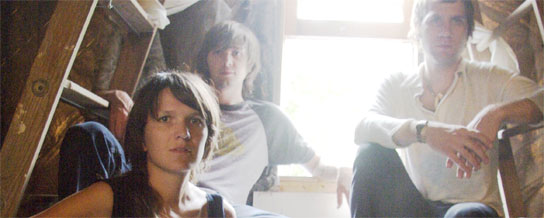
Chicago-based trio Pit Er Pat used quite the arsenal of sequencers, guitars, chimes, bells, gongs, and other sounds on their new album, High Time, and the three will round up the whole gaggle of instruments for a tour that kicks off today. The group will play the Midwest first, before heading to the east coast and ending the tour out west.
Dates
10/17 Chicago, IL – Abbey Pub*
10/18 Ann Arbor, MI – East Quad Music Co-Op
10/19 Columbus, OH – Cafe Bourbon Street*
10/20 Meadville, PA – Grounds For Change
10/21 Washington, DC – Velvet Lounge*
10/22 Baltimore, MD – Floristree Space
10/23 New York, NY – Barnard College*
10/25 New York, NY – The Annex (TJ CMJ Showcase)
10/27 Allston, MA – Great Scott
10/28 Montreal, QC – ZooBizarre
10/29 Rochester, NY – Bug Jar w/Science Vs. Witchcraft
10/30 Hudson, NY – Smog (Bard College)*
10/31 Philadelphia, PA – Danger Danger Gallery w/Chinese Stars
10/31 Philadelphia, PA – Starlight Ballroom w/Man Man
11/01 Buffalo, NY – Kitchen Distribution
11/05 Columbia, MO – Ragtag Cinema
11/06 Memphis, TN – Odessa
11/07 Austin, TX – Emo’s Inside
11/08 Lubbock, TX – The Foundation
11/09 Marfa, TX – Building 98
11/11 Los Angeles, CA – The Smell^
11/12 Isla Vista, CA – Biko Co-Op Garage^
11/13 Claremont, CA – Shakedown Cafe^
11/14 San Luis Obispo, CA – SLO Art Center^
11/15 Santa Cruz, CA – The Crepe Place^
11/16 San Francisco, CA – Hemlock Tavern^
11/17 Oakland, CA – Lobot Gallery^
11/19 Portland, OR – Backspace^
11/20 Anacortes, WA – Department of Safety^
11/21 Seattle, WA – The Vera Project^
* with DMBQ
^ with Hecuba, Lucky Dragons
Photo by Melanie Schiff.
Hip-Hop Producers Battle Cancer

Russian-born, U.K.-based hip-hop producer DJ Vadim, of Ninja Tune and One Self fame, and London’s Sean McCaffrey, a.k.a. Quincey Tones, who’s worked with the likes of Lil Wayne, Little Brother, Royce da 5’9″, Apathy, and Talib Kweli, have gone public with their battles against cancer. Vadim is recovering from ocular melanoma, while McCaffrey was diagnosed with a germ cell tumor and is now in remission.
According to a post on his MySpace page, Vadim found out about his condition at St. Bartholomew’s hospital in London on Friday, September 5, 2008, after flying in from a gig in Cologne, Germany the night before. He opted for surgery in a Liverpool hospital that removed his tumor and saved his eye. However, he has a long recovery ahead and is still in need of our thoughts and prayers.
Vadim has, graciously, and with a notable sense of humor, recounted his experience in a series of blog posts.
Producer McCaffrey was moved by Vadim’s situation, having also battled cancer, and recorded a track in his honor titled
“Don’t Go Away – An Ode To Vadim.” “Anyone that knows Vadim is welcome to record on this, as well as any MCs who have an ill loved one. Everybody else, please say a prayer,” McCaffrey said.
McCaffrey’s new Quincey Tones album is inspired by his illness. “The concept deals with the condition. When it’s completed, hopefully I can find a label that will be willing to donate some of the proceeds to cancer research.”
Sebastien Grainger “American Names”
Sebastien Grainger knows the language of rock music very well, and that’s not just because of his speaker-shredding work with the now-defunct DFA 1979. Like any good boy with a guitar, he shrieks and riffs his way through Sebastien Grainger & The Mountains, his first solo full-length, set for release October 21, and it’s refreshing to know an artist can easily switch from angry dance-punker to heartfelt songwriter. It really does feel like Grainger means every single word he sings and note he plays, as evidenced by this track, which Saddle Creek was kind of enough to leak before the full album drops in a few days. Jennifer Marston. Photo by Eva Michon.
Dinky “Mind”

Who says techno can’t have soul? If Dinky had her way, the whole genre would probably be populated with tracks like this one, which manages to sound emotional while still maintaining a minimal format. The key lies in the way she subtly sneaks in a synth line here, a minor chord there, and an understated loop of bleeps and blips that give “Mind” a rather hypnotic feel. No doubt the meticulous arrangements can be attributed to both Dinky’s musical upbringing, as well as her stint with the famed Martha Graham School of Contemporary Dance, where every little move counts. Maverick Newberry
A Guy Called Gerald Black Secret Technology

Thirteen years on and this album still sounds gorgeous. One of jungle’s groundbreakers, A Guy Called Gerald’s reputation would have been sealed with this album even if he never did another damned thing. Now he’s remastered Black Secret Technology, which, happily, gives an excuse to listen to it again. The tracks here could all stand alone, but together, they comprise a masterpiece. The simultaneously soulful and sparse “Finley’s Rainbow,” with vocalist Finley Quaye, was a stone classic then and will still be in 50 years; “Voodoo Rage” is shimmering and eerie. One of Gerald’s greatest gifts is his ability to blend beauty and technology, to make something human and yet not human. If it’s a secret, it’s one he clearly knows.
Fujiya & Miyagi Lightbulbs
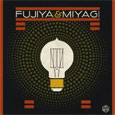
Fujiya and Miyagi’s postmodern machinations are populated by the meta-pop equivalent of J.G. Ballard’s Dr. Vaughan: Always searching for that ultimate Crash; the impact of technology that will allow a humanness to re-emerge. It’s music both literary and funny, critically challenging and set for the dancefloor or stadium. On 2006’s brilliant Transparent Things, the band performed on a precision catwalk between Finnegan’s Wake and a Burroughs’ cut-up; Kraftwerk, Krautrock, and The Fall. Lightbulbs continues this gorgeous perversity, with songs about Bobby Bresson and Bobby Fischer, Olympic sports and lazy summer ice cream, all set to tight-arsed breakbeats and circa-’79 synths. Little has changed since Transparent Things, and that’s the highest compliment F&M could receive.
God: The Game

Ever wanted to play the role of the Almighty Himself, shaping a world and its inhabitants, watching up on high as your creations thrive? Or, in many cases, destroy themselves? In development for the better part of a decade, Will Wright’s Spore allows you to do just that and then some. Essentially a mishmash of different gaming ideas that form into something altogether more interesting, Spore, in essence, attempts to simulate evolution.
Starting as a single-cell organism, you must navigate the primordial soup, devouring the weak and avoiding anything higher on the food chain. Soon, you are able to transform your little single-minded blob into a higher form of life by choosing from millions of combinations of body parts that will soon organize and form tribes of similar creatures that can operate in any manner you see fit. Are they peace-loving vegetarians that just want to hang loose? Are they bloodthirsty war-mongering barbarians? Entirely up to you. Your tribe will eventually form into a bona fide planet-ruling society complete with infrastructure, vehicles, industry, and, subsequently, global warming!
Should you survive any inconvenient truths, your civilization has the ability to head into the stars, to explore other planets–of which there are reportedly four billion (!)–and, if you are online, those created by other players.
Instead of creating a traditional game that is, essentially, linear beginning to end, Wright, who also created Sim City and TheSims, has made Spore “generative”; its experience is different for each person that plays it, taking on a life of its own as soon as you touch it.
Music is also a vital part of Spore’s charm, allowing players’ actions and decisions to essentially create the soundtrack procedurally. This means that if you create a creature that is all fangs and claws, for example, your music could end up a bit more aggressive and foreboding. Create fluffy little cuddlebugs and the tunes you hear may be a bit more whimsical. The music will then continue to evolve as your creations do, even leading up to your own “national anthem” once you’ve built a successful society of thingamajiggies.
This idea of a constantly changing soundscape was easier said than done, however, so Wright’s team sought out a man who could help bring this approach to fruition–none other than experimental- and regenerative-music pioneer Brian Eno, who created and oversaw much of the production.
Having spent most of his career creating all manner of ambient tunes, Eno was well equipped to bring this idea of “procedural” sounds into reality, and once he began speaking with the Spore team about the possibilities, it was obvious that the collaboration would not only work, but could possibly set a new precedent in establishing videogames as a legitimate art form while cementing Wright’s idea of crafting a unique experience for every single Spore player.
“Brian brought that experience to Will’s whole objective, which is to give the power of creativity to the player and allow them engage and have tremendous ownership over the game,” says Lucy Bradshaw, Spore’s executive producer.
Describing Spore as an “imagination amplifier,” Wright rewrites the rules of what games–if you can even call this one–can do as a creative medium by blurring the lines between art, social experimentation, and good old-fashioned fun.
But since we’re on the topic of fun, XLR8R decided to come up with our own little Franken-creatures using Spore’s Creature Creator. Check out the frightening results above.
