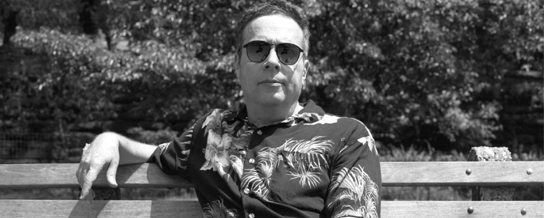
Excerpts from our interview with hip-hop mix legend Steve Stein, better known as Steinski. To read the full feature, download a pdf of XLR8R 119.
XLR8R: When did you first hear hip-hop?
Steve Stein: I heard it on a New York radio station called WPIX, which was an excellent station while it lasted (which was maybe two years). (Blondie’s) Deborah Harry and Chris Stein were guest DJs on one of the shows. They showed up and said, “We’re just gonna play some records that we heard at this party in the South Bronx last night, we borrowed them from the DJ.” And I was taping it and I wasn’t really listening… And the next day when I went back to the cassette, I was absolutely riveted. I was like, “What is this? This is great!” And I listened to it enough to figure out that one of the groups was called The Family, because they didn’t give any kind of names and labels or anything. I went into a record store that I used to shop at for seven-inches but they also had a 12-inch section and they actually had (The Family). There were so few rap records available on vinyl at the time that it isn’t so surprising they actually had this because there wasn’t much of a selection to have. I took it home and I listened to it, and I was like “Wow!” I went back the next day and bought everything else in the section–one of everything else.
What were some of the records that you bought in that huge load?
It wasn’t that huge, man. There were only like, eight. That’s all there was. It was probably a couple of the Enjoy records that Bobby Robinson was putting out, so there was the Funky Four on Enjoy before they were on Sugar Hill. I’m sure there was a Grandmaster Flash record in there and a couple of other things. There were no major labels at that point. Sugar Hill was maybe just happening. I don’t know if this was before or after “Rapper’s Delight.” It must have been before, because I had never heard “Rapper’s Delight.” This was before, and if there was a Sugar Hill record, it wasn’t one of the major ones. I still have some of that stuff. There’s something on Queen Constance [Records], some Fly Guy rap. It was some very early, idiosyncratic stuff. It was wonderful.
Do you remember the first hip-hop mix you heard that was based on samples?
There were samples in some songs, not hip-hop songs; they were in dance tunes. One of the samplers came packaged with the sound of a sheet of glass breaking. I forget the name of that dance tune but they used that and it was considered to be very innovative at the time. I don’t know if we made our records yet when we heard The Art of Noise. I’m not really sure.
At what point did you believe that you could make a mix just like the ones you heard on the radio or on a record?
We haven’t really heard anything like what we did. What we did was a remix of a song. Mixtapes back then were maybe the songs overlapped. If you were a disco DJ, maybe they were beat-matched, but there wasn’t all that crazy stuff in there. We were certainly influenced by a lot of other things but not by hip-hop mixes that used samples.
Do you consider “The Payoff Mix” to be more of a “break-in” piece like the records by Buchanan and Goodman [1950s pioneers who created novelty records using samples of pop songs]?
I’d say that it has a relation to it. But it’s definitely not the same thing. The break-in records had a structure where they would set up a madhouse scenario with call-and-response and that’s how they plugged everything in and made it happen. It was a three-minute drama or a funhouse ride, and ours was five minutes and nothing lasted very long. We didn’t have to outside announcers–the Buchanan and Goodman records all have voices telling you what was going on: “Well, here’s a DJ from outer space. Well, here’s a DJ from behind the Iron Curtain, and now here’s a bunch of nutty questions answered by popular records.”
Or “Mr. Jaws” [a 1975 Dickie Goodman track where the movie shark is interviewed about why he ate a swimmer].
Exactly, like Mr. Jaws!
I compared the Buchanan and Goodman tracks to the Steinski and Double Dee mixes and I sensed that the closest they are to the Buchanan and Goodman pieces are the punch-line samples.
Yeah, like the Marx Brothers. Which is probably right. That’s probably the most overt and direct relationship. Aside from making a record out of a bunch of different records, the difference is that we were going to be the hand that’s felt but not seen, whereas Goodman and Buchanan are in there, they’re players.
I understand that you and Double Dee first heard about a mix contest.
Whenever we did the first mix it would’ve been about…
’83?
If it was ’83 then we would’ve heard about it six months before we won the contest. First, the ad came out and Dave, a guy that Douglas had been working with, came in and said, “You and Stein should do this.” We did it a week or two after that to make the deadline. And then of course, Tommy Boy stretched out the judging for a month longer than they said. That’s when we found out that we won.
Since you were both in advertising at the time, did you use tricks of the advertising trade for that mix?
Douglas’s technical expertise came from years of advertising. He had to make musical segues in one-minute commercials where you could hear five or six new Eagles songs in 60 seconds or five or six of the new Motley Crüe songs in 60 seconds. He was amazingly good at mixing voices and doing music segues.I came in with the training of a couple years of advertising and just an instinct, more than anything, of how to make something interesting. So we were tossing ideas back and forth with a little bit more liberty than we might’ve had in an advertising job. Here, the constraints were: It needed to be five minutes long, it needed to be a remix even though ours was a touch-and-go remix on the original song, and after that it was pretty much do anything we wanted.
Were there any particular advertising techniques that went into the mix?
In that case, I would say that it was Douglas’s ability to work with all of the elements that we were using so well.
How about the catchy, ad-like sounds that pop up?
Whenever I tried to do an actual commercial that had a feel like that at the agency, it got shitcanned immediately because it was just way too crazy. I worked with Douglas on these neo-experimental, commercial techniques for clients like Atari because they couldn’t figure out how to do radio advertising. I was coming up with an idea and I remember a creative director once telling me, “If I heard that in a car, I’d drive it into a tree!” Yeah, there were techniques but they weren’t techniques you might hear on the radio from the agency I was working at.
What do you think makes a hip-hop mix truly click? Is there a logic to it?
It’s interesting because I’m not a very analytical person. For me, it’s really a gut thing. Of course, that makes for a dull interview because it’s one of those “I know it when I hear it” things, but that’s as good as I can get.
I find that humor plays a large role in your mixes.
Yes, it does. I really enjoy doing it because I not only like the content but I like the timing and being able to mess with stuff in that respect. But it’s not like I’d go, “It ain’t a hip-hop mix if it doesn’t a joke in it.” That is just one of those things that I tend to like. I sneak stuff in there because that, to me, keeps it interesting.
When the “Payoff Mix” won the contest, and you and Douglas made the “Lesson” mixes, what did you think of the reactions?
Oh God, it was gratifying beyond belief. It was fun to do, it’s not like you sat around and agonized about it. It felt really good and it was relatively easy to do the first mix, and the other ones were too but they just too longer. It was intoxicating. First of all, having people come up to us in clubs and go, “Oh, you’re the guys who did that mix? Boy, I really liked that.” But hearing our stuff on the radio–I haven’t even thought of that. I was a writer in an advertising agency… at least in my reality construct, they don’t get songs on the radio. And being able to turn on the radio and hear my songs, [thinking] “Oh, my God. This is such a rush, I can’t even begin to tell you.”
I noticed that the break doesn’t last too long in the mixes, but the rhythm is kept going.
Again, that’s Douglas being able to speed stuff up, slow it down, get it to happen right on the money. Once we started using digital material, I was able to contribute a lot more. But when it was just the first three “Lessons,” that was all Douglas.
I recently listened to Grandmaster Flash’s old mixes and Afrika Bambaataa’s “Death Mix”…
Oh my God. Is that the greatest record that ever was? Oh lord, I love that mix.
They would usually re-edit one break before moving onto the next, and they would spend half a minute on each break.
Obviously, you can see now how things have changed in party rocking where you have any number of people who can move from record to record between 15 and 30 seconds. The first time I saw anybody do that was J. Rocc playing at the Fillmore and my jaw dropped. I’d never seen that before, it was fantastic. Being able to fit that together live practically the way we fit it together in the studio. Obviously, I’ve seen a number of quick-mixing DJs since then, but the fact that people have evolved to that extent in their turntable skills is incredible.
A track that came to mind when I listened to your JFK piece was Paul Hardcastle’s “19.”
I think it’s quite possible that he heard the Kennedy record. The Kennedy record was distributed by the New Musical Express very widely in the U.K., so it’s possible that it had some sort of influence on him. They were fairly similar. By that time, Coldcut had already made one or two records so people who were doing spoken word stuff were figuring it out. It started moving in a lot of interesting, different directions.
As we speak of adding hip-hop rhythms to a piece on a historical event, what’s the challenge?
Getting the mood right, at least for me. I’m not really a musician. I kind of walk in there and kind of bang stuff together to see what works for me. A lot of times what works for me is some combination of things that don’t sound fully cooked and odd because I’m not a musician. But getting a mood right and making a thing cohere is a major battle for me.
Given that you started working with tape and we’re now in the age of digital mixing, do you think it added more advantages or complicated things?
Anything that gives you many more options is bound to complicate things if you’re weak-willed, and I am. When Douglas and I did the remix of “Jazzy Sensation” for Tommy Boy, that was a lot more complex and nuanced than the tape mixes. There was an infinite amount of tracks, you can shrink stuff and expand stuff very easily, you can layer stuff around and change the timing very easily whereas that’s really restrictive in a tape environment to have to keep something at different times or play something in a different interval. In a computer, it’s very easy to compose that way. It’s made a lot of denser stuff possible. That’s why it took me 18 months to do that record, Nothing to Fear. That was all Pro Tools.
When did you start digitally editing and mixing?
In the ’90s, I was working at a production house where I had the opportunity to learn Pro Tools. I already watched Pro Tools be adopted at the studio where I did all of my production work. I would say that I had a little bit of a head start on it. It was hard, man. I was basically saying, “I’m going to become an engineer/producer on this software!” I have to say that I owe a lot to some friends of mine who were getting a lot of panicky phone calls from me around dinnertime. “How do I do this?” [makes panic noises]. I always tried to be generous to people who called me up with similar problems because I feel like I’m paying forward to the people that helped me. That was rough, that was a heavy-ass learning curve, but I did it. I remember calling up a friend of mine and going, “Man, this is just like communism! The means of production are in the hands of the people now. Ha, ha!” That’s really what it felt like.
Since you sample people’s work, do you see yourself pointing listeners to those artists’ work?
In some ways, yes. This sounds a little like looking through my own belly button, but it’s recontextualizing stuff or making people see it in a different way. It’s not like I’m going to walk around and mumble to myself about having everyone see things in a different way, it’s just something that I do. It’s past a certain point where I don’t think about it much. Somebody interviewed me 10 or 15 years ago, and I said, “Legal or illegal, I’m going to make the records.” This is just something I do, it’s like breathing. It’s an instinct for me. I don’t sit around. Something will just strike me [and I think], “Oh yeah, that’s the right element I can work with that, let’s do something.”
I understand that your early mixes were not commercially released and were instead released as promotions. Do you believe that the impact of the “Lesson” tracks would’ve changed if they were commercially released after all of their samples were legally cleared?
That’s interesting, I don’t know. They’ve been bootlegged wildly over the years. Maybe they might’ve had a commercial impact outside of the hip-hop community, but within the hip-hop community, some of those records like “Lesson 3” have never been out of print, man. That’s been bootlegged constantly since it came out and there have been whole bootleg compilations like the Ultimate Lessons. I have a feeling that the “Lessons” have certainly affected a lot of people in the hip-hop and dance communities, and maybe they have seeped in other parts of the world. Although, I would have to say that digital editing, which makes something like [the “Lessons”] ridiculously easy, has done as much to spread it as any particular work. Any 14-year-old with a computer in the bedroom can sit around and make great music if he wants, and make all kinds of crazy-ass mixes and things. That’s a wonderful thing and that’s more due to the computer rather than how widespread the “Lessons” became.
There’s a cult following around the “Lessons.”
Yeah, it’s a sort of cut-and-paste aficionado thing. Which is dandy.
It’s interesting how the “Lessons” popped up in interesting places a decade later, such as DJ Shadow and Cut Chemist’s own versions of the “Lessons.”
That amazed me when I heard about that stuff. I was like, “What, those guys remember who we are?” I had not withdrawn from the scene but I’ve become a lot less involved in it and pretty much assumed we were history. That anybody remembered who we were was like, “What? We got name-checked on an album? By whom?” It was astonishing.
You eventually got involved with Ninja Tune and Stones Throw…
I got involved with Ninja Tune before it was Ninja Tune, when it was just Matt and John. I went and hung out with them in England, they were very generous with their time in shooting projects over. They are pretty great guys. The Stones Throw stuff came about a little later, I forget exactly how I met Egon but it was great when he called up and said, “Hey, do you want to do one side of a 12-inch, (“Ain’t No Thing”)? We’re going to have J. Rocc and on the other.” I was like, “Oh yeah, that will be fun.” To use all of this great material, [I thought], “Wow, this is great, man, whoopee!” That was fun to do.
What’s a card-carrying member of the American Association of Retired People now working on?
[Laughs] And I am! Advertising of course, the day job essentially. I’m trying to add a lot more stuff to my DJ set because I’m not going to be touring much during the summer or it doesn’t look like it. Hopefully, I’ll be back on the radio. I’ll be adding to my DJ set and working on that and also probably do a radio show again, which will be so much fun. That’s a whole other thing. That’s not cut-and-paste or techniques stuff, that’s now evolved into me in talking about stuff…Those shows are archived by the way, if you want to check them out. Some of them are pretty good. My last show was at WFMU.
Is there any music that you’re really into and have your ear on the ground listening for?
To tell you the truth, I don’t know how close my ears are to the ground. There’s a lot of stuff that I like a lot. I’m always listening to old funk stuff. I’ve been getting into Shorty Long, I like that stuff. I always listen to gospel. The other thing that I’m looking at, Douglas and I are going to release material, which more than amazes me. We opened the Hard Sell tour when it was in New York with Chemist and Shadow. We opened for them for two days and we have our set recorded, and I’m going to be selling that through my website. That’s a big deal. For one thing, getting my site set up for e-commerce is about as easy as chopping your foot off, but I’m almost there. That should be happening pretty soon.