Doseone gives me a hug, asks about my drive, and, satisfied, returns to his makeshift studio.
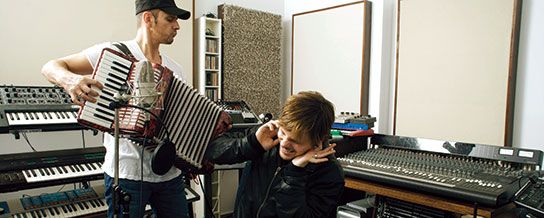
I’m pulled into the room by his wake. The computer is buzzing and around it are tiers of keyboards, a turntable, microphones, and effects pedals; twining wires and cords snake outward to ancient Dictaphones and around dozens of strange, small keepsakes. It smells like ash, but feels electric. Adam “Doseone” Drucker is buzzing too, like he’s been waiting, but the truth is, he’s been doing nothing but working for some time. He’s sporting a few days’ of stubble and a sloppy mohawk, and old baggy jeans that look like two suspended tubes slashed across the middle. We’re in his small studio apartment in a nicer slice of Oakland, adjacent to Lake Merritt. He sits back down in his command center, and begins to explain the inexplicable.
“The Long Vein of the Law has this wall that is this Amassed Black of All Fact, which he found through his final pursuit for The Un-godz.” He’s speaking a language from another world. “He had to go and find one of the Last Primal Hundred Somethings hatched from the Great Nothing Much, which was the Bush of No Ghosts. He actually comes back with the Highly Unlikely Rock, saying he didn’t find it, and the next time he goes out, he never comes back.”
I haven’t asked a question yet. An hour and a half goes by like this, but it’s fine. This is exactly why I’ve come. After a long line of notable moments and album-length feats, Subtle, the band that Drucker fronts, has hit a rare internal artistic synthesis. They’ve made a new album, their third, ExitingARM, and it’s gorgeous. On some nasty, guttural level, it’s music like you’ve never heard: a cold/hot combination of prog, rap, pop, rock, and electronic sound that swirls together as shapely solid and many-layered as a tornado. But at the surface, ExitingARM is easy–this is Subtle’s pop record, and it weaves odd melodic beauty through speaker-crushing electro stomp (“Gonebones”), complex musicality (“Day Dangerous”), heavily styled fast-rapping (“The No”), and multi-movement suites (“The Crow”).
Also quite worth mentioning, and what Adam was going on about earlier, is the album’s literary counterpart, The Ought Almanac of Amassed Fact, Vol. 1. It’s a 20,000-word tome outlining in unfurling poetry the key pieces and players of the complex myth that Drucker’s been spinning over six years of Subtle songs. The Ought also exists as a website that animates his paintings and features poems read over salvaged scraps from the record.
Lucked, Unlucked
Now Adam’s cooking fish in his tiny kitchen. With a physical wall between him and the story he’s created, his thoughts finally settle to earth. “I believe Subtle is evidence of something opposing the making and vaulting of all this music that’s been done before, all these ‘me/I/me’ songs. Everyone just going with the flow, filling up their iPod playlists instead of building collections like they used to.” His words are a spray of jagged lines, following several tangents at once and outpacing the casual listener; his pure energy not at all mitigated by the spliffs he’s been chain-smoking, the half-dozen Tsingtaos we’ve clinked, or the frying pan he’s tending to. “It’s just not hopeful, and I feel I violently want to change that.”
Drucker, who just turned 30, has always been this hungry. He climbed to the upper echelons of battle rap in 1997, famously dueling a young Eminem at Scribble Jam. He laid the groundwork for post-D.A.I.S.Y. Age art-hop via two seminal late-’90s groups (Deep Puddle Dynamics with Sole, Slug of Atmosphere, and Alias; and cLOUDDEAD with Odd Nosdam and Why?). He co-founded Anticon, the iconoclastic collective and label; and he’s averaged two full-length albums per year, solo or in collaboration, for a decade now. But not ’til the formation of Subtle have things unwound like this. It seems he’s found the perfect set with which to blow wide the avenues of art and inspiration. It’s hard not to picture him, mohawk flaming, gripping in his teeth the reins of some great chariot pulled by five talented and heart-strong men.
But that wouldn’t be fair. Subtle’s energy comes from the strength of its individual art warriors. Jeffrey “Jel” Logan, another Anticon founder, is a renowned master of the SP 1200 beat machine. Jordan Dalrymple is the consummate band hand with a producer’s ear, playing drums, guitar, synth, and singing. Dax Pierson, who first united the Subtle six, provides beatboxing, vocals, Autoharp, and programming. Alex Kort plays electric cello and double bass, often shredding the former like a Fender Strat. And Marty Dowers plays all manner of woodwinds. They are six men of different ages, levels of training, and influences. Each plays producer at some point, and their creative process hearkens back to the “instant compositions” of Krautrock giants Can, beginning with a series of improv sessions recorded several ways–tracked to computer and siphoned through Adam’s swap-meet Dictaphones–and ending with hours of assemblage.
Dinner’s served, so we take up residence in the living room, which is dominated by Adam’s bed and a spare-but-strong music collection: This Heat, Kate Bush, Boards of Canada, Freestyle Fellowship… If Subtle could be broken down to a recipe, this would be an apt base. Talk turns to the devil’s details. On February 24, 2005, touring their first album, A New White, through an Iowan winter, Subtle’s van hit a slick of black ice. Their world went into a barrel roll and Dax was left paralyzed from the chest down, arms included. Under a loving hail of benefit shows on either side of the Atlantic, Subtle swallowed self-pity and made an even stronger record, For Hero: For Fool, with Dax contributing every way that he could (for ExitingARM he uses a program that allows him to do all but perform live). Then, touring that record in Barcelona, $15,000 of equipment was stolen from their van.
“Our suppression has been ever-faceted,” says Adam, “so I don’t see how the inverse of that will be anything but complex and complete. I lost the raw almanac in Spain–my laptop was stolen and all I had left was an old draft I’d printed. I was drinking every day, and then I snapped and there was no more blank paper–I’d written the rest of the story. Our luck is the way it is and I’ll take it, because I’ll be damned if we didn’t triple-down to do ExitingARM. That’s why I’m writing this Narnia for real people… It’s like I’m supposed to be dead. We could have all died.”
Carving Fact from Fiction
Like their sound, the ongoing Subtle myth is equal parts contained and untamable. The protagonist Hour Hero Yes is a poet plagued by what seems to be vivid day-terrors, though he’s really a pawn in the machinations of two deities bent on sapping humankind of its want for choice. (The vinyl version of For Hero: For Fool folds out into the very boardgame by which the Un-godz determine Yes’ fate.) The Ought Almanac is the hero’s hidden journal; ExitingARM is his coded broadcast of the horrors he’s seen.
All told, this is an ongoing epic about art’s industrialization, the dumbing down of culture, addiction, bills, and day jobs, celebrity obsession, consumption, and caste. It even details the birth of human creativity, and portends its slow murder by a dooming apathy called The Great Nothing Much. Cutting through the fantastical imagery–demigods that look like demon doctors and reverends, swarms of flying forks, machines that read the dreams of blind children–is an obsessive concern with middle-classdom. On ExitingARM’s single “Unlikely Rock Shock,” Drucker repeatedly croons, “What’s working man’s hope?/They call it cope.”
Critics have skewered the Doseone oeuvre as so much artifice, but visit him where his gut lives, and the truth of the man is evident. Call it inspiration or some brand of insanity–this is all very real for him. Adam is of pure artist stock, which is to say he couldn’t work “normal” for food if he tried. He talks about his characters like they’re in the room. His words are manically exuberant. He can’t not go above and far beyond. These signs don’t lie. And neither does the modest apartment of mismatched furniture, nor the bare plastic bones of his emaciated refrigerator (and still he bought us food and beer). He doesn’t like to talk about this, but it’s late now–half past three in the morning–and there’s little ground left uncovered.
“Everyone’s saying that records are free now.” His voice croaks hoarse but it’s barely slowed. “I guess to me records have always been free. I’ve always just made rent selling my music. I am no man’s treasured son, and I do not have a trust fund. I just got a 15-day notice on the power, and I start interviews 15 days from now. I hate dealing with that shit, because it factors so seldom into my commitment. I don’t get depressed about money and stop working. I just work angry.”
Opening Doors
Whatever the fuel, Adam and his compatriots have boiled down what it is to be Subtle and rebuilt from that nucleus. They sample themselves to make albums, connect those albums with recurring motifs and structures, and re-make the songs therein afterward, inviting the like-minded to reinterpret myth and music. (Each new record is followed by a collection of collaborations with people like Mike Patton, Chris Adams of Hood, and TV on the Radio’s Tunde Adebimpe.) Likewise, Adam continues the myth by revisiting writings from across his career, plucking out unanswered phrases and letting them unravel.
Subtle has gone so far and so purely down their own path, they’ve created context unto themselves. What does your new Raconteurs record mean resting on a shelf next to ExitingARM? Who knows, but one just sits, while the other sprawls as far as imagination will allow. What Subtle makes has roots and branches, leaves fallen and leaves fresh. It’s “choose your own adventure” done right. And this is their truest accomplishment: a self-contained universe of art and exploration.
“We hoped Subtle to be big from the beginning and, for us, it’s as big as our art can get.” Sleep is approaching and Drucker’s words are showing signs of surrender. My lids are falling. “We do our best in every single way and, more than anything, I hope that’s what’s in the music. I think people hear this and, at the very least, there’s a little bit more of a door that’s ajar, and it don’t lead to nowhere but somewhere healthy.”
And so, we close our eyes and dream.
MP3: “Unlikely Rock Shock”