
On the hyped-up New Judas label comes Huoratron, a Finnish version of Boys Noize or Justice. For me, even better than the great original is the slightly more club-friendly Lars Moston and Duncan Whitely remix. Sounds like you’re play an old-school videogame over a pumpin’ beat. Listen to the breakdown, where it culminates in double-time gabba armageddon. Mayhem!
Dubstep Special
Poster boys Skream and Benga, Caspa & Rusko, and Cluekid and Cotti are just a few of the many names we feature in this definitive look at the scene. We also check in with Glass Candy, Valet, Dennis Ferrer, and Karizma, and then head across the world to get the lowdown on Brazil’s Sany Pitbull and Israel’s Kutiman. Pedestrian expounds on the genius of N.W.A., and we try to figure out what the hell is up with powerviolence.
5: Casey and Paul arrive at Yoni’s
Rhythm Nation Part 1: Skream


Deep, dubby, cheeky, metallic. For the next several weeks, XLR8R will profile eight young DJ/producers exploring different facets of dubstep, the low-end sound of the London underground. This week we sit down with Croydon’s boy wonder, Skream, to chat midgets, manic fans, and what’s next for the dubstep movement.
You can hear it in his voice. “I felt like a king,” Skream says, his mind racing back to that summer night last year in Barcelona. Just three years beforehand he would have been lucky to DJ to eight people. Now, as he looked over the decks at the Sonar festival, eight thousand people were going nuts in front of him, a sea of hands rippling like an earthquake in time to his sub-bass explosions. And the shockwaves don’t stop there.
Two years ago, early in 2006, a tiny, ignored offshoot of a London dance genre started expanding violently. At first locally, but soon internationally, the sound known as dubstep grew exponentially in popularity–and riding the front of the wave was Skream. “I felt like a king at Sonar,” he continues. “I really wasn’t nervous: I looked at it like a battle. I think it’s like a moment when you realize your career is getting where you’ve always wanted to be. For me, the bigger the crowd, the more the adrenalin.”
From Croydon with Dub
Skream was born Ollie Jones and grew up in Croydon, a grey commuter town south of London that has little in the way of adrenalin, save a reputation for lads who like to drink lager and fight on a Friday night. Skream left school at 16 and spent four years locked in his bedroom writing beats, day after day, alongside his friend Benga. Their music–with its clipped, dark electronic feel and ethereal melodic touches–found early fame when DJ Hatcha, armed with it, became one of dubstep’s original innovators with his seminal sets on Rinse FM.
Now Skream’s an international DJ (often described by the press as the “poster boy” of the dubstep movement); he’s released his eponymous debut album, made a mix CD for Rinse FM, and last year he spread his high-energy sound in clubs from Sweden to San Francisco. This month, he returns to Miami to make his debut as a promoter, putting on the first ever all-dubstep party at the Winter Music Conference at Laundry Bar with fellow dubstep royalty Mala from Digital Mystikz. Dubstep has arrived: Mr. Skream, would you please take its coat?
Coming of Age
Dubstep is an unlikely global phenomenon. Around 2000, the London U.K. garage scene, having tasted chart success, began to implode. Major labels got their fingers burnt by the flames of their own checkbooks and, following various tabloid-reported shootings, the hype evaporated as quickly as it had condensed, leaving the genre to fragment. Out of the ashes came grime, the dark dancehall- and rap-like variant that gave the world Dizzee Rascal. Equally dark–yet instrumental, DJ-focused and far more niche-y–was dubstep. So specific was its appeal that Skream did attend clubs (such as Croydon’s Blacksheep Bar) with audiences of eight people, all of whom were DJs or friends. And while the audiences grew a little, by and large it stayed like this for over five years, incubating quietly at the genre’s founding club, Forward>>, in East London.
Then, in January 2006, helped by a critical mass of exciting new tunes (the most prominent of which was Skream’s catchy “Midnight Request Line”), the scene’s key players came together on Mary Anne Hobbs’ Radio 1 Dubstep Warz showcase–and the rest is history.
Since then the sound has changed from a tiny community of London-based producer/DJs to a global movement. Burial’s albums top broadsheet newspaper polls and Skream has gone from hanging out with seven DJ mates to playing every weekend for months on end. And he sounds like he’s having the absolute time of his life.
“This year I am actually trying to become sensible,” confesses Skream. “Well …,” he pauses, before amusingly undermining all the good intent of his first statement, “sensible-er. If you’re gonna get messy–well, I haven’t ever followed this advice but I’ve got to start… that if you’re gonna get messy on one day, you take the next day easy. But it is really exhausting.”
Not to put too fine a point on it, but Skream has always had a bit of a reputation as someone who “gets messy.” Gigs, fame, global touring, fans, free beer–add in Skream and it really should be a good night, no matter where you live. “I have got that reputation as ‘Party Boy,’ so I can’t really blame anyone but myself,” he chuckles.
On the Move
The rapid expansion of dubstep, as actively pioneered by Skream, presents him and the other DJs with a whole new world. Fame was previously anathema to this scene; and even when the sound first migrated into big venues, through Digital Mystikz and Loefah’s Brixton-based DMZ rave, the position of the low-down DJ booth and the presence of all the scene’s big producers just mingling in the crowd sent out a message of unity and community, blurring the boundaries between “fan” and “producer.” But now when Skream visits Belgium or Boston, he’s undeniably dubstep royalty.
“When I go out in London, I don’t see it as anything different. I don’t see myself as ‘Skream’ and everyone else as whoever, I see myself as Oliver. So when you go abroad it’s quite hard adjusting, the way people stare.”
Anyway, fame does have its funny side. “When me and Plastician were in Belgium,” explains Skream, revealing his wicked sense of humor, “Plastican had just come off the decks and some guy came up to him and said to him, ‘I think your set was amazing…. but he, he is the king!’ He pointed at me and I could hear him and I am dying with laughter at this point. I had to hide, I’m laughing that much; it was hilarious. But it was like [about the fan], man. Fucking hell, get a grip. Now I wouldn’t say it, but I’d have that feeling if I was around Aphex Twin. I wouldn’t go up and say anything, but if I ever met him I’d be very humble because there’s shit he’s done that is pretty mindblowing. I know people might feel that about the dubstep thing but it’s different.”
Risky Business
When a sound explodes out of a community so rapidly, it’s not clear what will and won’t migrate with it. Sure, the music travels, but will the culture and the community, the extra elements that make it complete –this humility, this unity, the “difference” to which Skream refers–travel with it? “Someone was coming up to me and Mala and said they had a crew listening to dubstep from somewhere like Puerto Rico. And it was like, ‘Wow.’ They said there were only 10 of them but they were trying to spread the word. And what struck me was that the family element that everyone’s got in the U.K. with dubstep has spread with it worldwide. People tell their friends about it. It’s not like some boy listens to it on his own and not tell no one about it. You try and show each other the music.”
The hype around dubstep is for real, but it won’t be there forever. While the excitement of the new currently reigns, dubstep might need to draw on the experimentation and boundary-pushing ethos it was built on to sustain it. There was a sense at one time that dubstep could be something different: part urban, part dance, with tolerant audiences not just desperate to get their rocks off to every single tune but willing to listen to risky tracks too. Digital Mystikz called this phenomenon “meditation on bass weight.”
Yet in 2008, much of the meditation, and indeed the bass weight, is missing from dubstep sets. Certainly Skream’s vibe has been all energy and hype. Many of the sound’s original fans also find the music’s newfound hardness excessive and overbearing, though Skream seems unconcerned.
“A couple of [producers] … have gone real top-end, bass-less, like they’ve gone from jungle to drum & bass in the space of a year. Whereas I know for a fact I’m never going to end up like that. And no matter how mad Coki gets, there’s always going to be that sub-bass underneath. It’s okay, as long as it keeps that … what everyone loves, that whomp-whomp.” As for risk taking, he cites his amazing production “2D,” dubstep’s answer to Isolée’s melodic microhouse anthem “Beau Mot Plage,” as a brave element in his set.
Probably the most experimental move by the scene is the forthcoming U.K. Magnetic Man live tour, the secretive live project by Skream, his old Croydon mentor Artwork, and his best friend Benga. Together the three of them will take dubstep into its first truly live outing, with three synched laptops and limitless room for improvisation, their sights set on crashing the summer festival circuit. There’s talk of getting the audience to wear 3-D glasses and something, well, quite different.
“The funny thing we thought of was to get a midget dressed up in cling film, like a little robot, to walk back and forth on stage in time, but I’m not sure we can get a midget to degrade himself like that,” jokes Skream. “We could get the one off Jackass, he’d definitely be up
for it.”
Rhythm Nation
Part 2: Benga
Part 3: Caspa & Rusko
Part 4: Pinch & Distance
Part 5: Cluekid & Cotti
Free Mix from Jay Haze

April is a long way off, but fans of producer Jay Haze need not wait for new material from the Berlin-based American expat. Haze, who also records as Fuckpony and Sub Version, has prepped a 40-minute, DRM-free mix entitled Space Techno Episode 1, available now through TuningSpork’s website. Tracks here, which span his usual selection of house, R&B, hip-hop, and glitch, are exclusive to the mix.
Meanwhile, his anticipated double-disc Love & Beyond is slated for release on April 28. Check the album’s single, “Ass to Mouth,” for which Ricardo Villalobos contributed to the flip side.
Above: Haze in his studio. Photo by Ragnar Schmuck.
Atmosphere to Tour North America
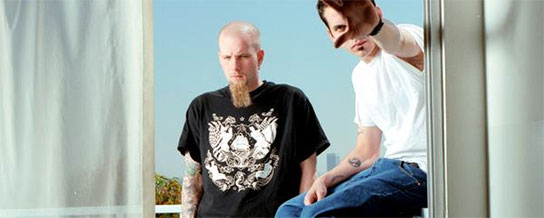

Besides readying their sixth full-length, When Life Gives You Lemons, You Paint That Shit Gold, making videos, and offering love advice, Slug and Ant of Atmosphere have been gearing up for a North American tour. The famously energetic, humorous, and sassy duo will perform material from the new album, in addition to tracks from their Sad Clown EPs and digital release, Strictly Leakage.
Those attending this year’s South by Southwest festivities will have a chance to hear When Life Gives You Lemons… at a listening party scheduled for Friday, March 14 at the Hilton Garden Inn, where food, drink, lemons, and lyric sheets are promised.
Tour Dates
04/22 Chicago, IL: The Metro
04/23 Chicago, IL: The Metro
04/24 Toronto, ON: Opera House
04/26 Boston, MA: The Roxy
04/27 New York, NY: Webster Hall
04/29 Washington, DC: 9:30 Club
05/02 Austin, TX: Emo’s
05/03 Austin, TX: Emo’s
05/05 Phoenix, AZ: Marquis Theater
05/06 Los Angeles, CA: Henry Fonda Theatre
05/07 Los Angeles, CA: Henry Fonda Theatre
05/08 San Francisco, CA: The Regency
05/09 San Francisco, CA: The Regency
05/12 Portland, OR: Crystal Ballroom
05/13 Seattle, WA: Showbox
05/14 Vancouver, BC: Commodore Ballroom
05/16 Salt Lake City, UT: In The Venue
05/17 Denver, CO: Ogden Theatre
05/18 Denver, CO: Ogden Theatre
Loading… Bathing Ape DS, Wii Fit

A Bathing Ape DS
I kind of hate the idea of Bape (A Bathing Ape), and most hipster labels in general. Just because a Japanese dude slapped a picture of a monkey on a t-shirt does not make the item worth $100. But then again, I wear the same jeans every day and am usually drunk, so what do I know?
But apparently Nintendo, loves Bape, because the company is allowing Nigo’s crew to design a DS featuring their monkey character, Baby Milo, along with a Bape’d version of Mario. Milio?
The Bape DS is out in April, and will be available in white and gold and probably cost you a couple weeks’ blow money.
Wii Fit in May
People like the Wii! It’s true! But a lot of those people are flabby and out of shape. Or they are in shape and want to stay that way. Like us! Whatever the status of you gut, Nintendo finally threw out a release date for Wii Fit, its eagerly awaited game-turned-exercise package that gets people to do any number of other activities to help tighten them up–May 19.
For “under $100,” Wii Fit will include a “balance board,” which will measure your weight (up to 330 lbs), center of balance, and even track your body mass index as you do yoga, step aerobics, push ups, and a ski jump.
The balance board won’t be a one trick pony either, as Nintendo also mentioned that there are at least 10 other games in development that will use the peripheral device.
Gears of War 2 in November
2006’s Gears of War was pretty good. Not Half-Life 2, mind-bendingly, “science is awesome” good, but still an above average shooter that looked pretty fucking amazing and just happened to sell a bazillion copies. So it should come as a surprise to absolutely no one that Gears of War 2 is on the way!
After months of speculation, Microsoft unveiled a trailer for the game at this week’s Game Developers Conference in San Francisco, and announced that it would be available this November exclusively for the Xbox 360.
No gameplay specifics were mentioned, but we just hope it’s a little more than “Shoot. Hide. Chainsaw. Repeat.” this time around.
Paint it Gold
Various Strictly Best 38
Genuine new talent and authentic music distinguishes annual reggae hits compilation STB 38 from the series’ previous 37 volumes. 2007 was immersed in classic reggae songwriting, evidenced here by Tarrus Riley’s rock-solid ballad “She’s Royal,” a universally embraced track that occupied international charts for months. A post-prison Jah Cure breathes a sigh of relief over Guardian Angel riddim-driven “To Your Arms of Love,” while songstress Tami Chynn–dancehall’s Gwen Stefani–rides the same melody on her playful “Over and Over Again.” Morgan Heritage, Beres Hammond, and Queen Ifrica offer their chart-worthy roots and lovers fare, but newcomers Etana (“Roots”), Duane Stephenson (“Cottage”), and Alaine (“Sincerely”) prove their stars are also on the rise.
R.I.P.: Legendary Reggae Producer Joe Gibbs Dead At 65
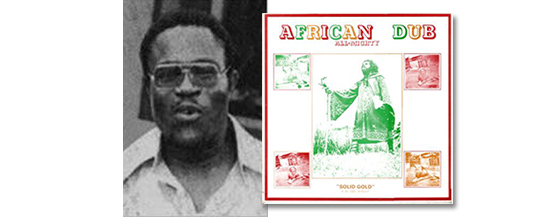
Joe Gibbs (born Joel A. Gibson), the producer responsible for Culture’s Two Sevens Clash, Althea & Donna’s “Uptown Top Ranking,” Trinity’s “Three Piece Suit,” and Dennis Brown’s “Money In My Pocket,” died last week of a heart attack. He was 65. Gibbs left an indelible mark on reggae music and his hits are staples at reggae dances to this day.
In addition to his pioneering vocal productions with artists, including Jacob Miller, Sylford Walker, The Mighty Diamonds, Gregory Isaacs, Prince Alla, and Junior Byles, Gibbs also produced the five-part African Dub series, which was recently reissued on VP’s 17 North Parade label.
17 North Parade A&R Fidel Luna states, “The legendary Joe Gibbs, to me, is one of the most humble, straightforward, and pleasant people I have ever encountered in the music business. His contributions to reggae as a hit-making producer and distributor are truly second to none.” Joe Gibbs, and the late Errol Thompson, had an exclusive worldwide agreement with 17 North Parade to re-release his complete catalog, including the Barrington Levy Collection (Apr. 26), Joe Gibbs Reggae Anthology (May 2008), and many more.
Gibbs’s many releases span the late ’60s and early ’70s rocksteady era, and through the early and mid-’80s dancehall and rub-a-dub periods. Times changed, but Gibbs always had memorable hits, like “Gregory’s Free,” Yellowman’s ode to Gregory Isaacs’ release from prison.
Gibbs is survived by sons Rocky and Gibbo. Carl ‘Rocky’ Gibbs, based in New York, was the first to reissue the elder Gibbs’ music on his Rocky One label. Younger son Stephen “Gibbo” Gibbs, also a producer, scored a massive hit with his 2004 Hard Times riddim (made famous by I-Wayne’s “Living In Love”).
