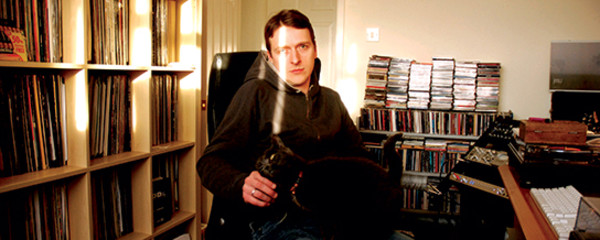
Justin Broadrick In The Studio

Since defining grindcore with Napalm Death when he was only 15, Justin Broadrick has made a career out of destroying and rebuilding the rules of heavy music. Best known for his role in the seminal metal band Godflesh, Broadrick’s many aliases mask a discography of genre-spanning experimentation. His work with Kevin Martin (a.k.a. The Bug) as Techno Animal predates the half-step pacing of dubstep; solo aliases like Tech Level 2 and Final explore everything from drum & bass to ambient drone.

Broadrick’s newest project, Jesu, continues with the singular vision that has always fueled his best work. Heavily layered and massively epic, albums like Jesu’s Conqueror are rooted in rock, but use few of the traditional tricks of the trade. In fact, Broadrick’s technique owes more to drum & bass and electronic music than anything rock music purists would ever try.

XLR8R: Why did you use a drum machine with Godflesh?

Justin Broadrick: I was in this band Head of David, where I was drumming, so by the time we formed Godflesh, I had a very clear idea of the type of beats I wanted to hear. And the beats I wanted to hear would take four arms, you know what I mean? I was just obsessed with making the sound as massive as possible. And when Godflesh was formed in ’88, it was after some of my favorite hip-hop records of all time came out: Eric B. and Rakim’s Paid in Full and the first two Public Enemy albums. I wanted beats that sounded like that, but I knew a drummer wasn’t gonna pull it off.

The new Jesu album sounds massive. How did you do it?

All the stuff I learned from producing drum & bass [as Tech Level 2] I’ve applied to Jesu. Everything was so reprocessed against each other; two of the same kicks, reprocessed back in and out. It’s the same concept of layering in drum & bass–filling in a certain dynamic with different breakbeats.

So you’re re-sampling a lot of material?

Oh yeah. I really swear by putting things into other things, into other things, and so on. Running a sound from [Native Instruments] Kontakt out to my Avalon 737 [pre-amp /compressor/EQ unit], and back in again. So many fucking layers of stuff. You know, some of the source material of these sounds are just crap. I’ve got a project open right now here in Logic, and nothing is the original source.

What do you usually lean on for recording?

The Avalon is universal for me. I’ll put a kick drum, snare drum, hat, or a bass guitar into that. Any stereo sources I’ll generally put into a TL Audio parametric EQ. And I’ll drive everything; usually get it in the red. Then that all runs into a Macintosh [G5] and Logic… loads of plug-ins from there. I’ve been using these valve-emulating compressors lately [from] the URS Compressor suite. They’re absolutely brilliant.

Considering all the processing you do, how do you feel about playing live as Jesu?

From the most basic drum machines up to a G5, I’ve had fucking millions of crashes in every group. When Godflesh first came to the States, we had this little Alesis HR-16 drum machine, and we had to use this American power transformer. We came up on stage with this big triumphant announcement, “GODFLESH FROM ENGLAND,” just full of metal kids screaming; they didn’t know what the fuck was going on. So we literally walked on–kids going mental–pressed play on the drum machine, and it blew up. We had to buy a new one and reprogram all the songs on it! But I haven’t had too many problems with Jesu–touch wood. These Mac laptops have just gotten so much more reliable, and I keep telling people… that I feel like I can finally make music without having to reboot the computer every five minutes.

Drum & bass has informed so much of your production style. Have you kept up with scenes like dubstep?

It’s a strange thing for me, that whole movement. When it was garage, I loved it at first: the whole slowed-down drum & bass element of it. But now it’s splintered into so many things, and I’m more interested in the dubstep end of it. But like… are you familiar with a guy called Milanese? I just heard him a few weeks ago and I thought, “Fuckin’ hell! This is stuff Kevin Martin and I were touching on years ago.” I really liked it a lot. It was actually a relief for me to hear something like that in dance music. [Milanese] might not even be aware of our stuff, but it was nice to hear something running in that heritage.

Now Playing At Peepshow: Stone Soup By Beryl Fine

San Francisco-based photographer Beryl Fine examines street life in her photo collection entitled Stone Soup. Images here reflect her foot travels in and around the world’s biggest little city, where she meets bike messengers, smokers, vandalized cars, dead animals, and a hospital patient who fell from a five-story building.

Stone Soup is playing now, only at Peepshow

Anthology Recordings Preps Albums

Kids nationwide may be enamored of the recent wave of new psych bands–the spacious drone of Sunn 0))), the noodling, mathy sounds of Battles, and the ethereal pop of Grizzly Bear–but Anthology Recordings, a digital reissue label consistently offering praiseworthy releases, is here to ensure a refreshing dose of psych-ancestry will also reach the ears of the youth. Here are a few forthcoming gems from the label’s digital-reissue vault.

Chickasha, Oklahoma’s Debris released its sole LP, Static Disposal, in 1976. This pre-punk trip through psychedelic mayhem, which radiates with the pissed-off energy of The Stooges, will be offered as a download with rare photos and an extensive biography of the band.

Germany’s Night Sun made prog-rock history with 1972’s Mournin’, an acid-tinged, organ-laced metal masterpiece. The band might draw comparisons to Deep Purple and Sabbath these days, but Mournin’ seems, to our ears, made up of far heavier stuff.

The Lucifer Rising soundtrack finds Bobby BeauSoleil and The Freedom Orchestra crafting psych-chamber instrumentals to Kenneth Anger’s legendary film that are as spellbinding as the drama surrounding both the film and the soundtrack’s completion.

Indiana’s Anonymous changed its name to J. Rider, and consequently offered up No Longer Anonymous to fans, a pristine, Fleetwood Mac-esque, studio pop-rock album that made 2001 a great year.

Prolific hardcore-punk legend Urban Waste–whose heyday took place in the early ’80s New York scene–sees another day with its highly sought-after, self-titled 12”. (Computer-friendly punks couldn’t be more excited.) This was the band’s the sole EP.

Future releases from Anthology will include The Lovers & The Chariot, Contraction, and The Operetta from Ya Ho Wah 13, a slew of releases from Finnish label Love Records, and collaborations with Illinois-based Lion Productions, a similar psych-reissue label.

All albums and tracks are available through Anthology Recordings

Voafose Voafose

This 20-track disc collates years of Jeremy Simmonds’ studio wizardry as Voafose. Simmonds, who has collaborated with Boymerang and AFX, is probably best known for 1993’s Weirs, a collection of abrasive, abstract techno he recorded with Luke Vibert. Less beat-oriented than that IDM classic, Voafose delves into unsettling ambience and imaginary sci-fi soundtracks festooned with bizarre timbres, psychedelic tone ripples, warped animal cries, and BBC Radiophonic bleeps. The disc includes a few maddening collages involving pitch-shifted and chopped-up voices recorded from TV and radio that you only need to hear once. Otherwise, Voafose is a revelatory archival excavation.

Twilight Circus Dub Sound System Rasta International

Ryan Moore has been on fire for 12 years now, creating the best, most authentic Tubby dub throughout the second half of the ’90s, mixing psych guitars and curious percussion with original basslines and wet-as-the-sea echo drums. Over the last three years he’s added a who’s-who of vocalists into the mix like Ranking Joe, Lutan Fyah, Admiral Tibet, and of course Luciano on a series of EPs. Rasta International collects the best cuts and adds some great new ones (unfortunately minus his collaborations with the brilliant Michael Rose). It’s pure dub bliss-a must for all next-century rockers.

Air Pocket Symphony

Air has spent the better part of the last 10 years finessing its own slow-motion descent into perpetual 3 a.m. The water-colored dream pop of 1998’s Moon Safari evoked images of robots buzzing happily along the Seine, but Nicolas Godin and Jean-Benoît Dunckel have since been loath to revisit that sunny terrain, preferring instead to soundtrack the administering of man-sized sofa indentations the world over. To that end, they hit their high-water mark with 2004’s Talkie Walkie, where they showcased their lustrous production skills (which recall the full-bodied mid-ranges of ’70s AOR) on 10 tidily composed songs. But with its source material too slow to remix and nothing as chart-ready as, say, “Kelly Watch the Stars” to keep it afloat, the sadly slept-on Talkie Walkie quietly slipped past most dance-music nuts unheard.

Their first album since Talkie Walkie, and their fifth full-length overall, Pocket Symphony reunites Air with producer Nigel Godrich (Radiohead, Beck), whose characteristically sparse sound choices match up nicely with the duo’s own filmic-pop sensibilities. It also incorporates a handful of ancient Asian instruments, such as koto and shamisen, which Godin apparently picked up under the tutelage of a Japanese master. But don’t let the exotic new ornamentations throw you; Pocket Symphony (a title that reads as a wink at the iPod generation and an acknowledgement of the incredible lightness of the music contained within) finds the duo stymieing conventional wisdom by heading even further down the rabbit hole, where they court quietude and chase after spacious holy moments.

This is Talkie Walkie under three more duvets. Meaning: The spiky little pop numbers (“Alpha Beta Gaga”) that once broke up Air’s regularly scheduled stargazing have been almost entirely erased from the equation, in turn paving the way for Godin and Dunckel to fully indulge their sleepier whims. Since this is hardly unfamiliar territory, when they find those little pockets, they sound beautiful as ever. Opener “Space Maker” sets the pace with a series of wood-block hits, yawning synths, and piano runs; “Left Bank” twists and turns on a gorgeous vocal melody; and “Photograph” plays like a brooding cousin to Talkie Walkie‘s “Cherry Blossom Girl.” Elsewhere, both Jarvis Cocker and The Divine Comedy’s Neil Hannon offer slightly muted, sleepy-eyed performances, their songs (“One Hell of a Party” and “Somewhere Between Waking and Sleeping” respectively) slotting snugly into the album as a whole.

But it’s a fine line between light as air and barely there, and Godin and Dunckel occasionally wander over the median. Tracks like “Mayfair Song” and “Redhead Girl” are so awash in watery notes and empty spaces they practically evaporate upon contact, while a couple of others pleasantly waft by without much drama or weight. There are ultimately too many beautiful moments here not to recommend it, but, unless they repeat themselves with ever-subtler variations on a theme, there’s not much more Air can do with this particular formula. The good news is that you’re probably not going to find a better soundtrack with which to ride out the last days of seasonal-affective purgatory.

Guilty Simpson “Money Motivated Movements feat. Four Tet”

While Guilty Simpson‘s name may not be imbibed in the minds of backpack-toting indie kids everywhere, he’s no stranger in Detroit. First laid to wax by the late J Dilla, Guilty Simpson has since signed to Stones Throw, and collaborated with fellow motor city staples D-12, Black Milk, and Phat Kat. Detroit has a new legacy and Guilty Simpson is at the forefront.

Guilty Simpson – Money Motivated Movements feat. Four Tet

Microfilm After Dark + Blueprints

Two men in love with German minimal techno, disco trash, early ’80s synth-pop is how the official Microfilm bio reads, and it pretty much predicts where After Dark is going. Meticulously regurgitated Spoonerisms and Speicher-esque tidbits, while cleanly executed, deliver little more than a safely enclosed tram ride through the same old theme park. Fortunately, the Blueprints portion of this double album successfully fucks shit up with some eclectic remix bombings. Kero rewires “Sex Education” with his disjointed IDM flow alongside a couple of mild tech-house remixes from Warmdesk and Soultek. Outsourced by Area injects their dry, shuffling snazz into “Cassingle” while Monologic transforms the yarble-deficient “Versus” into a seething, bottom-heavy 4/4 stomper.

Claw Money Book Tour

New York-based graffiti artist Claw Money is set to visit major U.S. cities in support of her recently released book, Bombshell: The Life and Crimes of Claw Money.

For the book, Claw Money, or Claudia (it’s been noted that her surname cannot be released for legal reasons), has gathered a collection of photographs, designs, personal letters, and various other documents that chronicle the 38-year old’s life and career–which has evolved from throwing tags on walls in the wee hours to designing clothing for the likes of Ice-T, Nike, and Guinness. Her signature claw symbol, which appears on many of her designs, has helped make her something of an icon in the street art world, or if you prefer the words of a recent press release, “the female graff King.”

The book tour kicked off in Paris on April 2, but you can still catch her in four other cities, beginning with New York on April 12. 

Bombshell: The Life and Crimes of Claw Money is out now, from powerHouse Books.

Book Signing Dates
Thursday, April 12: New York
Press Only
Signing 7 p.m., After Party 10 p.m.

Thursday, April 26: Miami
Arrive, 100 16th St. Suite 2
Signing 7 p.m. After Party 10 p.m.
RSVP for entry

Friday, May 11: Boston
Bodega, 6 Clearway St.
Signing 5 p.m. After Party 8 p.m.
RSVP for after party

Thursday, May 24, 2007: Los Angeles
Signing 7 p.m., After Party 10 p.m. at La Cita

Page 3189 of 3781
1 3,187 3,188 3,189 3,190 3,191 3,781