
Living on the edge of the earth in Wellington, New Zealand serves Matt “Recloose” Chicoine‘s creative juices well. His acclaimed 2002 release Cardiology brought the classic “Ain‘t Changin‘” (with Justin “Just One” Chapman) onto grateful dancefloors everywhere. Hiatus On The Horizon boasts another stellar single, “Dust” (featuring Dallas from Fat Freddy‘s Drop), also destined for legendary status. The strength of Hiatus lies in collaborations with Chapman, vocalist Genevieve Marentette and an immensely talented cadre of Wellington musicians. Overall, Hiatus lacks a little spark, but the exceptional musicianship makes it worth adding to your collection.
Vibezelect Simple Life
Farina doesn‘t play a set anywhere in the world that doesn‘t include a Vibezelect track. “Simple Life” will surely satisfy the crowds that like it deep, with a chugging bassline that rumbles your stomach and subtle keys to get you in a hypnotic boogie.
Natural Rhythm Politics and Greed
The track starts off with a deep, chunky bassline that draws the dancers in and then calms their souls with some soothing keys. Just when you think the song can‘t get any better, then enters the meanest muted trumpet I‘ve heard in any house track!
DJ Rod (Jamanta Crew) Poquito
Brazil is not only a beautiful country, but also a great place to find some of the finest Chicago-style house in the world. Yes, that‘s right, Chicago house! “Poquito” is a straight up chugger, with a touch of tracked out jazz guitar samples and horns. This is one of the many tracks currently in rotation in my bag.
Okai Bout That
Produced by Ayatollah, Okai‘s single should remind hip-hop fans of Gang Starr, Mobb Deep, and Black Moon‘s gritty OG sound-a welcome change in this bling era. Why? ‘Cause it means Okai (who reps East Flatbush) has to be as dramatic and lyrical as Ayatollah‘s funky beat. No monotone flow and an 808 here, son. “Face Off” features Planet Asia who informs us that he‘s “comin‘ with force,” which he does over a sample-filtered, low-slung groove.
Syndrome: Curing Ailing Wardrobes
I’ve spent more weekends than I’d like to admit aimlessly wandering city streets, searching for the item that will both affirm my connection to and set me apart from the masses. It’s part of the culture of the urban hunter/gatherer; it’s as significant, in its own way, as whittling fertility figurines of soapstone may have once been.
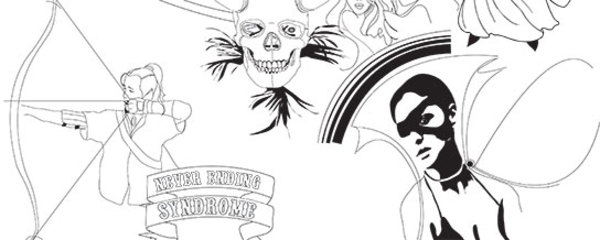
Certain brands, once discovered, can keep you forever one-upping your friends in the cool clothing department–Syndrome is one of them. Since 2001, the Chicago-based line has been making inroads in an industry dominated by the two coasts, shocking underground fashion heads with eye-catching graphics and close attention to fit and cut. The finished products subtly speak of a commitment to keeping tongue firmly in cheek, be it through smirking slogans (tees have read “I Love You In A Real Bad Way” and “Air. Help Yourself”) or color palettes chosen according to instincts rather than trend reports.
Syndrome founder Luke Cho and his right-hand man Adam Rajcevich have a full-on, vertically integrated studio set up in the River West neighborhood; they’re able to do everything from custom mixing screenprint colors to cutting and sewing garments from scratch. “It seems like we import everything these days,” says Cho, a staunch believer in doing it yourself. “I think it’s time to look for the ‘Made in the USA’ label and help our domestic economy.” To that end, Syndrome’s recent collections have used world-class Chicago designers including Creative Rescue Organization’s Ray Noland, Kelly Marie Breslin (Melk) and Cody Hudson.
Even with distribution in more than 100 stores worldwide and a women’s line on the way, Syndrome is still somewhat under the radar. But Rajcevich says he prefers a slow build to a meteoric rise: “We’ve been able to do really well [that way], whereas some brands come in real fast and die out real hard,” he explains.
Watchers: The Punk-Funk Gospel
While New Yorkers boast about the excess of talented bands coming from their metropolis, it wasn’t that long ago that Chicago represented the heliocentric center of the indie rock universe. And even though labels like Touch & Go, Thrill Jockey and Kranky are still releasing urgent and challenging music, ironically it’s New Jersey label Gern Blandsten that’s home to Watchers, one of Chicago’s most compelling and genre-killing quintets.
Formed in Chicago in the fall of 2000 by lead singer/keyboardist Michael Guarrine and guitarist Ethan D’Ercole, Watchers expands the borders of danceable, funk-informed rock. Their propulsive, intellectual angularity recalls Talking Heads, The Minutemen and perhaps most directly Trenchmouth, an influential yet largely unknown Chicago quartet that included Fred Armisen (Saturday Night Live) and Damon Locks and Wayne Montana of The Eternals. “We all love to listen to music,” says Guarrine of their influences, “[and] we’re always trying to freak each other out by finding a ‘new’ amazing band and bringing it to practice for everyone to hear. It’s a lot of fun.”
On 2003’s full-length To The Rooftops (Gern Blandsten) and this year’s “Dunes Phase” EP, Watchers successfully merge an entire dusty crate of styles–rock, dub, soul, Afrobeat, funk, disco and punk–into a successful and sometimes unexpectedly minimal creation. In the hands of a lesser band, a balancing act like this would certainly explode in overzealous cacophony.
It’s probably no coincidence that a visible superhero theme seems to be developing parallel to the four-piece’s growing audience admiration. From their LP title–which suggests a superhuman mode of urban locomotion–to The Hideout, one of their favorite places to play in Chicago, Watchers are about to undertake one of their most perilous and unlikely assignments yet: swinging the rock spotlight away from the East Coast and back onto the Windy City. “Being from Chicago is about being an underdog,” quips D’Ercole. “A lot of our friends that are making music are all over the map. There is no Chicago sound, just really tasteful people doing really tasteful things…and being supportive of your endeavors as well.”
Hefty Records: Looking to the Future
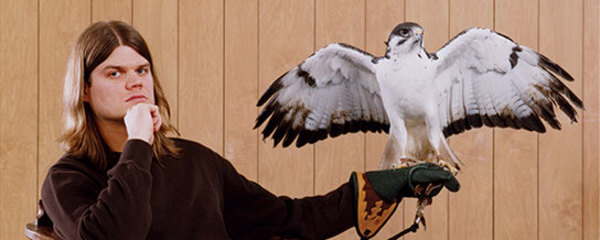
What’s not to love about a label bold enough to release records by jazz trombonist Phil Ranelin and dirty techno-meister T. Raumschmiere? Despite, or perhaps because of, brash eclecticism, John Hughes III’s Hefty Records has cultivated a dedicated following in the fickle world of independent labels. This year, Hefty celebrates 10 years of releasing records by bands like Telefon Tel Aviv, Savath & Savalas and Hughes himself as Slicker.
A self-described “studio rat,” Hughes has to find a quiet room to talk on the phone so as not to wake his one-week-old baby boy. When he settles down, he explains that he founded Hefty as a way to release his own music; it has since grown into a home for music that shares a common headspace, if not an instantly recognizable sound.
Growing up, Hughes relied on labels like Def Jam, Mo’ Wax, and early Warp Records for consistently good releases, but he doesn’t necessarily see modern-day parallels. “[Labels with a specific sound are] kinda missing right now, I think,” he says. “[But] for me personally, it’s all about longevity. It’d be very easy to make the direction of Hefty genre-driven and work on a specific sound, but I feel like if you do that you’ve got maybe five years and then you’re dried up.”
Still, there are sonic similarities (and shared band members) between Hefty artists like Telefon Tel Aviv, L’altra and Hughes’ new project with Shin Tasaki (Spanova), Some Water and Sun–namely, an obvious appreciation of hip-hop, a near-obsessive attention to instrumental detail, and a fractured love of melody.
It’s clear that, despite an ambitious schedule that will see four records released in early 2006, Hefty isn’t just churning records out as fast as possible; instead, they’re thinking about the long haul, something Hughes partly attributes to his hometown.
“Chicago is a pretty impressive city just to visit and I definitely think it brings something to Hefty, just knowing what sort of history there is to music here–it’s always in the back of your mind. I think it’s a hard city to impress anyone in, so it keeps you fighting.”
Pit Er Pat: Magic and Mystery

Pit Er Pat‘s music achieves a strange kind of alchemy. Their new album, Shakey (Thrill Jockey)–which follows last winter’s mostly instrumental “Emergency” EP (Overcoat)–pieces layers of bass, drums and keyboards into a skittering tableau that flits between post-rock, free jazz and indie rock influences without pledging allegiance to one. The effect is calming and frenetic at once, and at times somber, thanks to the plaintive vocals of keyboardist Fay Davis-Jeffers. How this bizarre rhythmic puzzle gels together is a mystery, but supernatural forces follow the band around, says bassist/vocalist Rob Doran.
“We’re seeing so many weird hauntings and having different awesome experiences,” Doran explains when I track the band down on tour with Need New Body in Texas. Pit er Pat had already run into a tow truck driver talking about the fifth dimension and a strangely powerful museum docent when they had to stay overnight in a haunted motel room 130 miles outside of Albuquerque, New Mexico. “We rolled into this town Truth Or Consequences at three in the morning; none of the places had vacancies except for this one motel. Jamie from Need New Body took a shower in [his room] and then all of a sudden he was like ‘Guys come here!’ When you looked in the bathroom mirror it was totally fogged up, and the only thing you could see was your eyes glowing with rings around them. All three of us were looking in the mirror together and you could only see your own eye–you couldn’t see the other people at all. It was far out.”
The band surmises that they are more receptive to such surreal experiences than most adults, and this openness, this childlike sense of unlimited possibility, is reflected in their work. And not just music–all three band members also make visual art (from Doran’s printed materials and textiles to Davis-Jeffers’ drawings and drummer/vocalist Butchy Fuego’s sound installations); they say the boundary between the two activities is, more often than not, a blurry one.
More than anything, Pit er Pat is interested in immediacy, in being able to capture the feeling of an exact moment in time. Most of Shakey was written within a month of recording it, and the actual recording of the album only took six days. “Recording the song when it’s really fresh gives it kind of an urgency,” says Fuego. “It kind of comes out easier because you’re not overthinking it.”
Pelican: New Millennium Metal
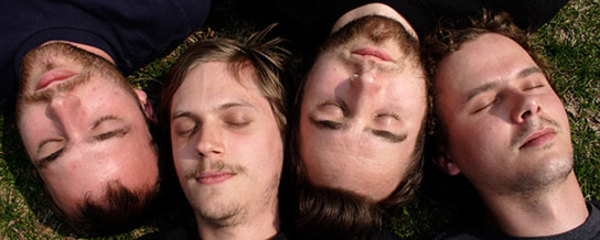
Lets get this out of the way: Pelican is a heavy metal band without a singer.
This has prompted journalists to create clever labels like “instrumetal” to describe them–and while such words aptly acknowledge broad themes in the music, they overlook the unique and defining characteristics of this band.
Pelican does subscribe to the high-decibel, aggressive performance ethos of the heavy metal canon, but the band members also concern themselves with structural concepts atypical to much contemporary music in general–like orchestral composition. The band’s two lead guitarists (Laurent Lebec and Trevor de Brauw) employ varied harmonic techniques, while the group’s non-standard song structure yields 1-minute tracks that are astoundingly intricate tapestries of sound.
But in the beginning Pelican was just a grindcore band, only it went by the name of Tusk. Lebec, de Brauw and drummer Larry Herweg met in 1996, while Lebec was an undergrad at Northwestern University in Evanston, Illinois. All three were involved in the punk and hardcore scene and had similar influences, so it wasn’t long before Tusk was born. Independently, Lebec began writing acoustic songs of a very different nature, and although his bandmates showed enthusiasm for the new music, it didn’t really fit with Tusk’s style. So they formed a new band, Pelican, and invited Herweg’s brother Bryan to join them as their bassist.
“At first I think that there was definitely an affinity with Isis and bands that are heavier but slower and have a more plodding nature to them,” Lebec says. “I think that as time went by we ended up going further back in time for the inspiration that’s moving us now.”
Now, with the release of their second full-length, The Fire in Our Throats Will Beckon the Thaw (Hydra Head)–which is not as categorically heavy as their 2003 debut, Australasia–Pelican is steadily accruing a base of fans from across music genres.
“We noticed right away, even playing in Chicago, that a really wide variety of people were coming–it wasn’t all metal heads,” says Lebec, happy that Pelican has avoided being pigeonholed. “Now that people have so many options for downloading music you’re really aware, as a band, that how you get categorized really has a repercussion on how your music will be interpreted by people who aren’t familiar with it. Especially as an instrumental band.”
