
Push/Get Back
Jenny Toomey: Defending Artists’ Rights

Jenny Toomey can’t seem to sit still. I can hear all manner of clanking and shuffling in the background as she answers my questions over the phone. But that’s the kind of activist she is: never resting, never quitting. It’s how she was raised: “My parents were very political,” she confides. Since those formative years, Toomey has gone from a Georgetown grad to the manager of DIY-friendly indie label Simple Machines to an artist in her own right (with records released on SubPop, 4AD, and other heavyweights) to a journo at the Washington Post and the Village Voice to the foremost defender of the independent music industry as the current executive director of the Future of Music Coalition. And she’s dedicated to keeping you and yours from getting screwed by corporate consolidators.
XLR8R: What do you feel the most pressing concern is for the music industry?
Jenny Toomey: There are tons of things to worry about. The House just passed a piece of legislation that fines performers for violating indecency on the airwaves. Before, if an artist said “fuck” on a song and the broadcaster played it, the broadcaster was liable. But under this legislation, the artist can be fined. What’s crazy is that the artists have no control over keeping their so-called indecent material off the airwaves. To hold them accountable for something they can’t control is simply insane.
So what happens to the broadcaster?
They still get fined, along with all of their affiliates. Another big issue of the day is the Supreme Court’s consideration of Grokster, which could have serious ramifications for the peer-to-peer networks. They might not even be allowed to exist in the future. As for sampling, it’s already nearly impossible to legally license samples without paying more than the artist would make. Which means that the majority of artists who want to use samples can’t do it legally without signing a major label deal.
Talk about the Future of Music Coalition.
We’re a nonprofit, and for that reason we’re making partnerships around ideas rather than basing our activity on what groups or parties we’re aligned or associated with. When democracy is working properly, people respect those who have different ideas and can build coalitions around areas of common interests. What’s so frightening about the structural divisions that are taking place in our society today is that it is becoming more and more difficult for those across the aisle from one another to agree or disagree on issues in ways that are reasonable.
Are we in trouble with the rampant consolidation of the media?
It’s incredibly dangerous, and not just for musicians but for the entire country. The fact of the matter is that radio stations and conglomerates operate under different rules than other businesses. They are required to serve the public, and serve them in a diverse manner. It’s a shame. I don’t know how we’re going to recapture what we’ve lost over the last six years.
Tell us your favorite book, film, TV show, and historical figure.
I read Don DeLillo’s book Underworld three times–although not all the way through. I usually made it to page 600 before putting it down–I did eventually finish it. DeLillo has such amazing insight into where the country is going and where it has been. I love the feminist French filmmaker Catherine Breillat. She made that controversial film, Romance, which I didn’t find controversial at all. She’s one of the only directors I know of that actually understands the way young girls feel. And they are usually the subject, not object of her films. TV show? Probably Project Runway. It’s just fascinating to watch people who can be given grocery supplies and in five hours make dresses that actually look like dresses. And I admire Walt Whitman–his idealism, generosity, grace, and joy. Many artists build their work from a place of sadness, but all of Whitman’s work, even that which is overtly melancholy, is optimistic.
Technarchy: Exploiting Technology
William Gibson, an original cyberpunk, once stated that “the future is already here, it’s just not evenly distributed.” But if it’s already dropped, who exactly is making it? Gibson would probably say it’s bubbling up from “the street,” like this issue’s reggaeton and baile funk. But some of the most radical and significant works of today are hurtling in from other trajectories besides the music world, including places such as galleries, laboratories, and the net.
Art has always been political. So it should come as no surprise that as it catches up with itself, it draws new material from new media. Splice together an artist and a technologist and you seem to wind up with new creatures: the hactivist, the tech-prankster, the cyber-joker, the collective–all with new methods of attack and response and 3D-rendered middle fingers in the air.
From Natalie Jeremijenko’s packs of hacked robot dogs to Cory Arcangel’s Nintendo cartridges, from Critical Art Ensemble’s anti-GMO enzymes to the Yes Men’s internet-fueled PR stunts, these artists are flipping technology, popular perception, and the information age in upon itself; they’re directly harnessing the vast energies that corporations use to sell their image and products and transforming these energies into creative, humorous, and refreshing experiences. A new kind of mobile artist/activist has been born, one who realizes that hacking technology is art, that making art is inherently political, and that politics is an artform unto itself. Abe Burmeister & Daniel Perlin
neuroTransmitter
Artist collective neuroTransmitter is working to reclaim radio broadcasting technology as a guerilla means for criticizing corporate control of the public airwaves. By building portable radio transmitters and teaching people how to make their own low-power pirate radio stations (among other projects), neuroTransmitter’s artistic mission is to “[create] tools that seek to enable communication and amplification of voice and action.” Think of it as radio-wave graffiti for the post-modern city.
Using historical military communications devices as inspiration for their latest project, neuroTransmitter created a portable radio station in a bag; a self-contained, battery-powered, backpack radio transmitter. This device, called com_muni_port, allows an individual to travel freely while broadcasting a stream of live audio commentary, interviews, or pre-recorded segments that can be received by anyone within range; this allows “[for] potential use[s] within public rallies, mapping of audio frequencies within a city, spontaneous interviewing, information dissemination, and public participation.” While the federal government controls the airwaves, regulating those who are allowed to broadcast over the FM dial, “these regulations allow for very few voices to be heard,” according to neuroTransmitter–hence the need for their low-tech but highly effective intervention. The com_muni_port, built using standard Radio Shack parts, is not only small and light but also cheap enough to allow anyone with access to a soldering iron and a will to bend the laws to build a version of their own.
neuroTransmitter also envisions their device as a way to create “sonic spatial interventions in the urban environment”–a sort of street theatre. During the Republican National Convention last summer they staged one such intervention, entitled the Low Power to High Power Broadcast Media Tour. They toured the sites of major media conglomerates in midtown Manhattan, using the com_muni_port to broadcast site-specific bits that highlighted the way those companies monopolize mass media, influence the FCC, profit from the war in Iraq, support conservative policies, and otherwise act to keep the power of the media in the hands of the powerful. Ben Godsill
Institute for Applied Autonomy
Taking a military model “and flipping it on its head,” The Institute For Applied Autonomy asks you to take control of your environment. Their earliest work, the Graffitiwriter–a robot that can be remote controlled to write graffiti of your choice on the ground–is a key introduction to their approach. Combining real autonomous engineering (the robot itself) with hacked technologies (the interface is a modified graphing calculator), the IAA starts with the premise of the hactivist: take what’s there and appropriate, then tweak it to make your own statement. Member John Handy aligns their activities with those of Critical Art Ensemble, calling for a new generation of “contestational robotics.” “It’s great when Girl Scouts and businessmen make graffiti,” says Handy of the robot-driven spectacle. “Maybe they’ll rethink the legislature afterwards.”
The Institute for Applied Autonomy’s work questions how Americans are being pushed and surveilled, then challenges the user to subvert the everyday methods of control that dominate their lives. For instance, the IAA’s iSee is a web-based application that charts the locations of closed-circuit television surveillance cameras in urban environments, allowing the public to avoid detection.
Their TXTmob project takes a different tack. Launched at the Democratic National Convention, this distributed cell-phone network allows users to share their experiences and observations through text-based contributions, keeping protesters and observers linked continuously with the latest information. By teaming up with zeraz.org, Text Mob was harnessed to support the Ukranian revolt against the recent elections and, of course, protestors at the Republican National Convention in New York took advantage as well. Another example of IAA’s desire to help you adopt then adapt. Daniel Perlin
Natalie Jeremijenko
The setting is the near future, Mission Bay Landfill, San Diego. A pack of feral robot dogs is on the prowl. They roam the landscape sniffing for toxic waste, letting out a digital howl as they cluster towards the sites of intensity. This is not a scene from science fiction–rather, it’s the latest installment of an ongoing project by tech artist Natalie Jeremijenko. Working with engineering students at Yale and junior high schools in the Bronx, she has developed technology to hack commercially available robot dogs (whose prices range from $39.99 to several thousand dollars). As she is happy to point out, these products of the military industrial complex and consumer culture are literally “sniffing their own bottoms,” mapping out sites of industrial pollution in urban environments.
Jeremijenko freely admits to “exploiting the economies of scale” with judo-like moves. It’s because of mass production, for instance, that robot toys are cheap enough for an artist like Jeremijenko to “add in a brain.” This act liberates the toys, bringing them to the point where “they are no longer following the corporate imagination” and instead serving an open-source public. Watching her pack of robot dogs sniff out and cluster around toxins illustrates environmental issues in ways that statistics in the morning paper never will.
For her Ooz project, Jeremijenko moves onto robot geese, creating “artwork for birds.” Take these robot geese down to the park and you can try and “talk geese” to the real thing. The results get uploaded into a database and merged in a mind-boggling attempt to use “distributed intelligence” to finally learn the animal tongue.
Meanwhile, her Onetrees project tackles genetics, carefully placing cloned trees across the landscapes of the Bay Area in a deft illustration of the limits of genetic determinism. With the magazine she edits, Biotech Hobbyist she goes one step further, empowering readers to do it themselves. This is creativity in the spirit of Da Vinci–art and science collapsed into one. Abe Burmeister
Cory Arcangel
Cory Arcangel hits you when you’re not looking. By taking the everyday language of videogames and turning it in on itself, Cory makes the user and the viewer take stock of their current situation, taking the fun out of games and making them funnier.
Arcangel sounded less like an artist than a DJ when I asked him what inspires his work. “Do you know Screw music?” he said, referring to Houston DJ Screw’s now-ubiquitous technique of dropping tracks down to 80bpm and below, with voices pitched so low they sound Robitussin sweet. “That was the idea behind the Tetris game [I made]–[I tried] to “Screw” a videogame because time is the most important part of the game. And I also thought it would be a funny endurance video for the blocks to take hours to fall.” The Tetris pieces drop so slowly that instead of reaching a goal, you get to see the process of the game.
In another piece, based on the Mario Brothers game, Arcangel challenges the viewer to ask the question “What happens if you leave poor Super Mario sitting in the clouds, on a cube, all alone, with nowhere to turn?” “Mario is so sad, tragic,” Arcangel says of his work with the Nintendo icon, which both displaces the everyday image of Super Mario from its game environment and, like his Tetris work, slows the game to a painful grind.
Cory’s m.o. is to grab an image or icon, and then twist it so the user or the viewer has to do a double take. Engaging with his work forces us to both identify and separate ourselves from familiar icons, reminding us of our stake in the game as the viewer, user, and maker. Daniel Perlin
Yes Men
About five years ago, around the Seattle World Trade Organization meeting of the minds and the mindless, a core of hackers, activists, and programmers-at-large banded together to toy with the evil-doers in power. The Yes Men were born, and our comforting, blind trust in the information age has never been the same.
Like a Trojan horse, the Yes Men created a website that appears to be run by the World Trade Organization; they called it GATT.org–an acronym for that General Agreement on Tariffs and Trade that the big boys throw around–and watched the hits roll in. Subsequently, Yes Men members were asked to speak around the world as WTO experts, and the group’s stone-faced attacks against the lies of big business, corporate globalization, and general corruption were not met with hostility but with applause. The people attending these events are so trained to applaud that they didn’t notice the ruse until after it was all over.
After all the hype–even the release of a documentary film called The Yes Men in theaters around the world–you’d think that the corporations would have had enough. But wait! Who was that on BBC news on the morning of December 3, 2004? Why, it’s DowEthics.com being asked to talk about the 20th anniversary of the Bhopal tragedy in India. “BBC television came to us! They set us up in their own small studio in Paris,” says Andy Bichlbaum, co-founder of the Yes Men and sometime faux Dow spokesman. Stocks plummeted as the Dow rep calmly stated that the company was liquidating $12 billion of their stock in Union Carbide, and giving the funds to India for clean-up and healthcare. “We were trying to give reporters an excuse to write about it,” Andy said. It worked, again.
Drawing attention to the obvious fallacies of those in power is one of the Yes Men’s central goals. As SNAFU, a member of the YesBushCan campaign (a fake pro-Bush bus that traveled the country during the previous election) points out, a lot of the Yes Men’s power is documenting the aftereffects of those who’ve been tricked. What’s up next? According to Bichlbaum, some trips to India and another documentary on what’s going on for the residents of Bhopal and beyond. Daniel Perlin
Critical Art Ensemble
An article from The Buffalo News reads “A University [of New York] at Buffalo professor was accused last June of illegally scheming to obtain bacterial agents that he used in art exhibits sponsored by the Critical Art Ensemble. That group has protested policies of the federal government.” What the fuck? That’s right. Homeland Security has attacked the work of Steve Kurtz and his five-person collective, Critical Art Ensemble. It has confiscated his computers, his equipment, and plunged him into a quagmire of legal battles.
But why? CAE’s work, centering on Fuzzy Biological Sabotage (getting in where science and law haven’t fully defined the terrain), is meant to challenge the spaces between public and private control. CAE focuses on genetics, bacteria, genetic alteration, and the immortality claims made by popular genetics and science, and challenges us to question our positions on issues such as cloning and bacterial warfare.
Based around New York state, CAE is comprised of contestational biologists who turn science into art. “They attack traditional perceptions of biology with performances, posters, screen-based media, and large installations, many of which ask the question “When is a risk too high?” One performance/installation, “Gen Terra,” allows participants to actively engage with transgenics, organisms whose genetic makeup has been permanently altered by genetic engineering. Sound complicated? It isn’t. According to Kurtz, using the PCR (polymerge chain reaction) that amplifies DNA extremely fast is relatively simple. “Easier to use than a computer,” he says. “When I visited the Human Genome Project, I was surprised to find a political science major operating the machines.”
CAE engages a new field, ripe with controversies over cloning, stem cell research, and the US government’s billion-dollar investment in bacterial warfare. Kurtz says he wants his pieces to “change the cultural landscape, to make a difference, reveal hidden mechanisms of power, and to say ‘No‚ authority.’” Daniel Perlin
Jared Buckhiester’s Eerie World
It’s a special moment when a person’s art makes you step back and say, “Whoa, what the fuck happened to this dude when he was a kid?” Jared Buckhiester’s illustrations and photographs tell the story of that kid. But the tale he weaves isn’t one of pain and suffering, and he doesn’t wallow in clichés, despite growing up gay in a suffocating Southern Baptist community near the North Georgia Mountains. At 27 years old, it appears that he’s already fully digested the reality of his identity–not surprising, since he’s labeled himself queer since age 5.
Buckhiester relocated to New York in 1995 to study at Pratt Insitute and much of his early professional work was in photography. His photos have been on display at Rare Gallery and Steuben East Gallery (both in Brooklyn, NY) and published in Nylon Magazine, Mass Appeal, and Intervista. His subjects range from beady-eyed suburban misfits and lonely houses in the middle of nowhere to over-the-top prom disasters (think a sequined gown with train patterned after the American flag) and Deep South shitkickers at tailgate parties. The documentary style of his photos suggests an emotional distance from his subjects, but one look at his drawings and you feel as if you’ve accidentally walked in on something that you shouldn’t have seen.
In his black-and-white sketches, Buckhiester reveals moments of his past with a sense of humor and playful eroticism, spinning a possibly damaged childhood into a world of dark humor that, in his own words, revolves around the subject matters of “family, adolescence, church, faggots, queers, and Satan.” Whether he is intentionally exorcising demons or just poking fun at the antics of pre-pubescent queers, the intimacy and vulnerability of his drawings hints at a maturity that only a veteran of adversity could know.
XLR8R: Your experiences as a kid growing up gay in the South play a large role, if not the main role, in your art. How do you identify yourself and the work that you do?
Jared Buckhiester: I am a gay Caucasian from Dahlonega, GA. I was fortunate enough to have accepting and loving parents who happened to find comfort and happiness in a Southern Baptist church community. They didn’t really think that their gay son might not find that same comfort and happiness. My work is a combination of elements that are familiar to me. Overall, it leans toward a darker side, but if you have a sense of humor you can find acceptance in each composition.
How did the church’s homophobia affect you?
I went to church three times a week from birth until I was 16. Although my parents were very liberal for their surroundings–when I first told them I was gay at age 11, they asked me, “What do you want to do about it?”–what was said about my kind in church carried a greater weight with me. It definitely shaped how I felt about myself; I guess “alienated” is a good word.
Your drawings are filled with homoerotic innuendo, but nothing about the church. It’s surprising, considering it played such a big role in your upbringing.
[In my work] I have little to say about the Southern Baptist Church. My art is not so much about ignorance as it is about human emotion.
If you depicted violence in your drawings, would you be the victim or the assailant?
I am the assailant, armed with a Freddy [Krueger] glove and buckets of fake blood.
What did you draw when you were young?
Unicorns and dragons, skateboarders and still life; I was very 8th-grade-art-class material.
Many of your characters wear masks, even in your photos. What are they hiding?
They aren’t so much hiding as [they are] being whoever they want to be. If they are hiding something it would be the obvious, those secrets that fill you with so much shame you have to puke.
What role does the absence of color play in your drawings?
There is a sensitivity and nostalgia in basic pencil drawings that contrasts the subject matter. Plus, I have not yet found the colors that will contribute to the work.
Did you ever really get it on with boys in a tent made from a confederate flag, like in the drawing “If You Show Me Yours”?
The tent was from Sears. I don’t think they ever sold one made from a confederate flag. If they had, my best friend’s father would have had it.
You are evading my question about whether you actually got it on with boys in that tent.
Not intentionally. The tent in question was not that tent. It was a Sears tent, and of course we fooled around in it.
Do you ever worry that living in NY will kill the backwoods connection to your work?
Not really. I find inspiration in absurd moments of realness, stereotypes, and people who are parodies of themselves–New York is full of that.
Your past seems to have a strong grip on your present. Do you think your work will eventually break away from your past?
The influence my past has on my present feels very comfortable and natural. I’m sure my work will represent something apart from my past once I feel I’ve said enough. There is a lot of rich material and humor there, so I’m not sure if and when the latter will happen.
Did you decide early on that your art would be your career?
I guess. I really only found the confidence to believe it in the past four years.
Was there anything specific that gave you that confidence?
Just making work, really. I hadn’t drawn for so long, I surprised myself each time I completed a drawing. It is fun, feels right, and people respond to it.
You cite your favorite photographers as Bruce Davidson, Eugene Richards, and Helmut Newton, all of whom were born before 1950. Do you relate better to older men as artists or in general?
Not particularly men, but older artists and art.
If Helmut Newton were alive today and decided that he wanted to go back to doing nudes, would you pose for him in nothing but stilettos and a dog collar?
Of course.
What would be your dream collaboration with either Richards or Davidson?
To document the daily life of homosexual Filipino guerrilla soldiers.
Say VH1 decided to put a halt to their current reality smut programming and got back to quality shows like Driven: Jared Buckhiester. What would be your daunting moment, when the music fades and you’re suddenly alone, at an all-time low?
First of all, the music wouldn’t fade; it would just blend into a slow ballad by White Lion. I was in the 6th grade and Andrew Roy would no longer talk to me because I had given him a gift on Valentine’s Day. It was an oil pastel drawing of the cover of Hysteria by Def Leppard. I guess he was uncomfortable with that.
Hungry Man
Beatfanatic: Salsa, Drums, and Hip-Hop
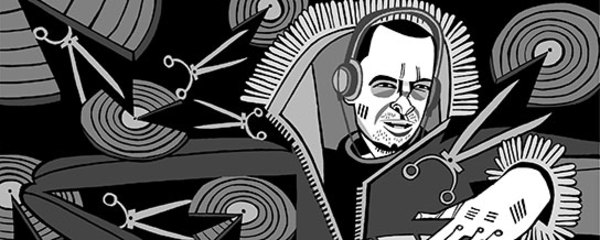
How do you start out playing guitar inspired by The Clash and end up releasing cut ‘n’ sample masterpieces that win fans as varied as Bobbito Garcia and Thievery Corporation? If you’re Beatfanatic, you can blame it on Run-DMC. Bucking the trend for solo producers to head up a one-man band with rotating guest instrumentalists, Beatfanatic (born Jonas Ture Sjoberg) sticks to the vinyl trickery that formed the basis for ’80s hip-hop. He whips up a frenzy of party-rocking beats and samples on his second full-length, The Gospel According To… (Soundscapes).
Even in faraway Sweden, the sea change heralded by the heyday of labels like Def Jam was strong enough to send Sjoberg out of bands and into record stores. He soon began refining his tastes, amassing an arsenal of rare grooves that were chopped, manipulated, and harnessed to the groove. 2003’s “Cookin’” was one result, a banging blend of Afro-Cuban hip-hop that landed on compilations from the aforementioned Bobbito and ThievCo.
Despite his sophisticated rhythms, Sjoberg’s musical technique is fairly straightforward. Building up from the bass and drums, he works in Cubase SX and Soundforge. “No fancy, top-of-the-line stuff but it works great,” he explains from his home in Stockholm. “It is all based around a computer and a pair of M-Audio monitors. It is all very no-fi.” (Hence the name of his first album, Adventures in No-Fi.)
Sjoberg’s no-nonsense approach to his gear is paralleled by his relationship with his records. When pressed for some rare gems he’s digging, he offers Bobby Valentín’s Fania release Let’s Turn On–Arrebatarnos and “Soul Freedom” by Ray and His Court, but insists he’s not trying to out-collect the collectors. “I guess these records are rare but my main focus is never how rare a track is, it’s how good is it? I am not a stamp collector, if you know what I mean.”
This emphasis on the good over the unusual is reflected on The Gospel According To… The disco drums and snatches of vocals on “Like A Sound” aren’t earth-shatteringly new, but it’s impossible to ignore the effectiveness of their call to get down. “Holdin’ Out (No More)” is at first blush just some rolling percussion, a wicked bassline, and a devastating vocal hook, but it keeps revealing layers of aural balm, a ‘Saturday night and everything’s all right’ track if ever there was one. Ask Sjoberg and he’ll tell you that’s his goal. “[When people hear my songs] I hope they feel happy, dance, and maybe even forget that a madman is trying to rule the world.”
Charles Spencer in the Studio
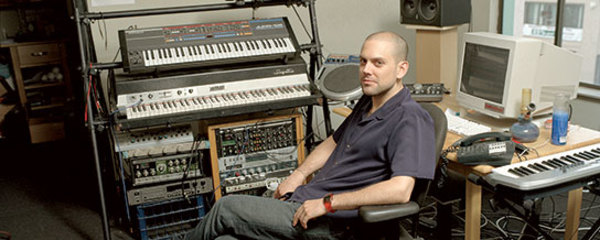
Charles Spencer’s studio–a few doors down from Jay J. Hernandez and Chris Lum’s famed Moulton Street complex in the Polk Gulch district of San Francisco–also houses a medical marijuana dispensary. Out on the street, the pedestrian traffic turns from midday casual café dwellers to nighttime bar revelers and finally, around 1 a.m., to a myriad of multi-gendered sex workers. In this environment of change and extremes, Spencer and business partner Jessie Singer have carved out Loveslap!, a house label that is similar to New York’s King Street, issuing both blazing vocal numbers and deep instrumentals by Jaymz Nylon, Julius Papp, K. Hand, and Nick Santillan. Spencer has contributed 11 singles to the label and has additional releases on Grayhound, Frisky, and Society; he’s also remixed soulstress Goapele and chopped it up with rapper Capital A on Mantis Recordings. So what does this broken beat aficionado and disciple of classical composer Chopin use to get his hi-hats crisp and vocals resonant? Soft-spoken Spencer gave XLR8R the word on his studio essentials.
XLR8R: How did you get your start?
Charles Spencer: I grew up in Seattle and have studied classical piano since I was a kid. I moved to the Bay Area in ‘97 and was working in Silicon Valley doing network firewall security programming, but didn’t start making electronic music until later.
When did you set up your studio?
Loveslap! started renting office space in the [Moulton] building in 2000 and we set up the studio in 2001. I’m recording my own projects and doing engineering for other artists like Julius Papp.
Who are some artists seen regularly around the Moulton/Loveslap! complex?
Chris Lum, Jay-J, Miguel Migs, Ruben Mancias, and Kaskade. I just did some work with [singer] Kenny Bobien, which was pretty memorable.
What equipment is in the studio?
For keyboards, there’s a Juno 106, Fender Rhodes, and Studio Electronics SE-1–kind of like an analog Moog type of deck. I also use an Apple Macintosh G5, Mackie HR-824 monitors, Edirol keyboard controller, Hammerfall Audio Card, and the Sherman Filterbank. Software-wise I’m mostly using Ableton Live 4.0 and Propellerheads Reason. Previously I was using Logic [sequencing software], which was cool, but once I started using Live it was a lot easier to get things done. For vocals I record them to ProTools and bounce the file down and bring it into Live.
What is the best feature of Ableton Live?
Never having the music stop while you are developing a groove.
Any other software?
I use Spectrasonics Trilogy for bass and Audio Hijack Pro (which lets you record the sound output from any program), iTunes, DVDs, etcetera.
Does your computer set-up handle everything efficiently?
Yeah, I don’t really use a lot of plug-ins. I just make sure things are placed properly in the mix and EQ’d well.
What music is important to you?
I listened to a lot of jazz–Herbie Hancock, Oscar Peterson–and also classical music growing up. Now I’m pretty into the broken beat thing. I’m doing some tracks with Capital A on the broken beat tip that should be coming out eventually. I really wanted to get better at making house music before I moved on to other things. I feel like every style has a bunch of things you have to learn before you can work with it.
What other projects are you involved in?
I’m about halfway done on a downtempo album with [producer] Gregory DelPiero. I also work on tracks with Ruben Mancias–that stuff is a bit more mental.
Give some advice for young producers just starting out (something you had to learn the hard way).
Finish the track before getting too critical of it. It’s easy to move really slow if you always second guess yourself.
What’s you favorite recent cinema screening?
Super Size Me.
Verna Francis: A London Diva
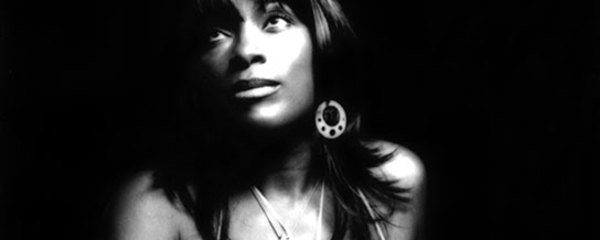
Singing, dancing, acting, and all that jazz–Verna Francis can do it. From playing Miss Sherman for two years in a West End production of Fame to giving Nathan Haines’ “Earth Is the Place” its distinctive vocal flair, Francis’ talent is as big and broad as her rich voice. Her range and emotive delivery make her sound like a house or broken beat cousin of Whitney Houston or Chaka Khan. And her new album for Chillifunk, Down to Earth, is an appropriately varied outing that takes in equal amounts of soul and uptempo nu-jazz grooves, all the while focusing on that voice.
At turns bold and brassy, smoky and sultry, bright and beautiful, Francis’ instrument is not some fragile, auto-tuned studio wonder, but the hearty voice of a woman who undoubtedly shook her head in dismay at Ashlee Simpson’s SNL fiasco. She got her start early–as Cinderella in a school production– and is now “old enough to do whatever I want and young enough to remember doing it!” But her musical path hasn’t always been a fairy tale. Instead, Francis worked her way through the performance ranks, including taking on plenty of roles that required six to eight shows a week. She says that these experiences have in turn fed her live PAs at London clubs like Cargo and Fabric. “I think that my stage acting more influences my live performance than my recording style,” explains Francis. “When I’m in the studio, it’s me and I pretty much do what I feel at the time. When I’m performing live, then my stage experience allows me to relax and not be nervous and just enjoy what I am doing.”
Though seeing her in the flesh may be the only way to take her proper measure, Down To Earth is an intriguing introduction. Horn and keyboard player Scott Baylis (Reel People) and producer-engineer Felix Hopkins (who’s worked with Ashley Beedle and is part of Restless Soul) wrote the basic tracks before Francis came in and brought the subtly nuanced grooves truly to life. From the sublimely swinging house of “Look” to “Twilight” and its haunting take on R&B (which will soon see a Blackbeard remix) Francis’ singing is clearly from her heart–not from her inner diva.
Recalling the genesis of “Keep On Dreaming,” an ode to love set to a half-time 2-step beat, Francis remembers drawing on her own experience. “I was thinking of my husband when I wrote the lyrics for the verse, and the way that you have to work at relationships in order to sustain them. That’s a challenge!”
Mars Volta vs. Jaga Jazzist: Boiling Points
Although they hail from relatively opposite ends of the earth, The Mars Volta’s Omar Rodriguez-Lopez (Hollywood, CA) and Jaga Jazzist’s Lars Horntveth (Oslo, Norway) share quite a bit in common. Both are highly esteemed musicians, fronting genre-shredding outfits that offer up elaborate and cerebral musical explorations. Both released debut solo efforts last year–Omar’s A Manual Dexterity, Volume 1 and Horntveth’s Pooka–and are following suit with their respective bands in 2005. Indeed, Frances the Mute, The Mars Volta’s newest exercise in Naked Lunch-like lyrical assault and mind-warping soundtracking, could be the hyperactive cousin to Jaga Jazzist’s newest deconstruction of jazz conventions, What We Must.
Although the two hadn’t met or talked at length before this interview, they share a record label in common. Rodriguez-Lopez’s forward-looking indie imprint Gold Standard Labs–home to outstanding acts like !!!, 400 Blows, and GoGo Airheart–first picked up American distribution for Jaga’s Animal Chin EP in 2003. Add to that both artists’ dislike of purists, their dedication to ensemble work, their numerous side projects, and their jaw-dropping live shows, and you have a cross-cultural affinity not often seen.
XLR8R: Both of you released solo albums last year. What kind of opportunities did that provide?
Lars Horntveth: When I work alone, I don’t have to think about the other band members wanting to play this or that. My solo album was more about competition and ego. When you’re in a band, however, you have this democratic model, which is often a good thing but can sometimes be exhausting.
Omar Rodriguez-Lopez: I agree, Lars. For me, it was about not having to think about the others. Everything was looser; I was able to approach music the way I did when I was a kid recording at home on a four-track. While our band is not a democracy at all, I still make it a point to take others’ feelings into consideration and think about the overall group dynamic. But when making my own album, it was more of a talking-before-you-think scenario: getting the work out without too much in the way of refinement or analysis.
Omar, your solo release is a soundtrack for your upcoming film, and both Jaga and Volta’s work are equally cinematic in their breadth and sweep. How has film influenced your respective bands?
OR-L: It’s the main form of inspiration for me. As much as I love music, it’s nice to have something like cinema that seems so completely unrelated to it. It’s a different thing for me to derive inspiration from watching a movie, reading a book, looking at a painting, or thinking about a friend I really love. To take that energy and twist and turn it into a piece of music that makes me feel the same way is far more challenging sometimes than just listening to music I like.
LH: Cinema is also my biggest influence. When we started making What We Must, I was also scoring music for a film in Norway. This was very freeing; I didn’t have to think that much about anything other than just making music.
Are there any directors that either of you would want to work with? I know both bands have an affinity for David Lynch.
LH: Yeah, of course. We’re watching David Lynch’s work all the time. The video for “All I Know is Tonight” was inspired by Twin Peaks, as well as some of Tim Burton’s stuff.
OR-L: Definitely Lynch. David Cronenberg is another director I love. Takeshi Miike would be a really interesting one.
Those directors have stretched the envelope on cinema convention, similar to the way your bands have stretched the envelope on rock and jazz. Is there a conscious decision on your parts to redefine sonic territory, or is it just an organic thing that happens as you’re working?
OR-L: It’s both. There are times where it’s just automatic writing, and there are other times where you’re listening to your work and really putting the microscope to the art that you realize things aren’t as interesting as you first thought.
LH: The way I handle it is to have many bands working at one time; that way I am able to do something different with each one. With Jaga, we’ve always tried to come up with new ways of combining instruments. Sometimes you get lucky, but sometimes you just do the same thing all over again.
Has either of you run into a situation where you’re over-thinking everything rather than allowing spontaneity to dictate the work?
LH: Of course. For What We Must, we wanted to be spontaneous and not think too much. It’s very important to keep spirits up that way.
OR-L: I sometimes have a hard time doing that with Mars Volta. It’s hard to be totally spontaneous, because everything is so structured. But I think I find small ways to make the process spontaneous. Sometimes I’ll limit myself to certain equipment, or even sabotage myself with problems that will force me to think in different ways.
LH: I think it’s important to make it sound easy and not constructed, but still have enough details to sound impulsive.
Does performing live offer respite from that?
OR-L: Absolutely. For Mars Volta, performing live is a way to escape and counterbalance the constraints of structure. There is quite a bit of improvisation in our live show because it’s everyone’s time to speak and get away from the guidelines. For us, improvisation is the last true form of democratic expression. It’s also a hot medium, whereas recording music is a cold medium. In the studio, you can be methodical, change the picture, twist things around over and over again until the writing is perfect and all the actors know their lines. But live performance is our theater. It’s the moment where anything can happen, where the people forget their lines and have to make up new ones. It offers us a unique opportunity that I think other bands throw away.
LH: We try to reconstruct onstage what we’ve done in the studio, but still allow plenty of room for improvisation. For this tour, we’re improvising much more. And I’ve seen Mars Volta play once in Oslo. Do you remember that concert, Omar?
OR-L: Was it the one we did just recently?
LH: No, the one before, about a year-and-a-half ago.
OR-L: Oh yeah, I know which one you’re talking about.
LH: That seemed like a really improvised performance!
OR-L: [Laughs] They’re always changing, and much of it depends on the mood at the time. Generally, there’s a different mood happening at the beginning, middle, and end of a tour. Sometimes around the middle of the tour, you get bored and come up with new ways to keep yourself interested. And then towards the end of a tour, when you feel like you’re about to go home, perhaps you start to tighten up again.
How does either of you feel about the idea of purity of convention? There’s still this attitude about what constitutes so-called authentic jazz or rock, especially in regard to the use of electronics, drum machines, and such. It seems to me an anachronistic, if not fascist, attitude.
OR-L: I hate all that. I’m so sick of people saying that we don’t have songs, or trying to impose guidelines on what music is and can be. They’re choking the life out of it because they don’t want it to evolve into anything beyond their own understanding. People who say that rock music should only be verse-chorus-verse, that jazz shouldn’t contain electronics, or offer up similarly lame rules are purists–and purists are boring. Purists are the same people who got down on Miles Davis and Bob Dylan for going electric.
LH: We’ve never tried to purposefully combine styles, but rather make music that doesn’t conform to one style. In a way, the more you work with music, the less you can think like that. Mars Volta has been on the top of the charts in Norway for awhile now, and people are saying that it’s so intense. And I can see that, but I don’t know why people wouldn’t want music to be intense. It should involve you. That’s the great thing about your band, Omar. It’s like listening to Bitches Brew: there’s lots of information to absorb, but when you listen to it you get deep into it. That’s the point.
America supposedly has a rep for being a forward-looking place, but challenging music like yours, Omar, is pretty much banned from mainstream pop culture.
OR-L: I don’t mind, because I find all of that incredibly boring. If the music is boring, it’s because people want all of their music to sound the same. They want their Social Distortion or Green Day played over and over again. People who don’t have an open mind to different forms of music are so archaic. If music was a country, they’d be the Republicans. [All laugh] Music is a form of expression and freedom that we can all share, and these people are only interested in telling us how we can share it, how it can be expressed, and how it has to be regulated.
