Jazztronik: Piano Samurai

Last year a track from Japan found a home abroad in the playlists of DJs as disparate as Derrick May and Kenny Dope–Jazztronik’s “Samurai,” released on Neil Aline’s Chez imprint. A stunning marriage of jazz grand piano and rough broken beats, “Samurai” won the expected fans–like Gilles Peterson’s Worldwide audience–but also unusual acclaim from producers like Jazzy Jeff, who included it in his house mix album for Defected. Not too shabby for a track with decidedly humble origins.

“The piano phrase in the track comes from a warm-up practice melody I use for my fingers,” explains 28-year-old Ryota Nozaki via email from his home in central Tokyo. “All I did was to keep that melody and add some drum programming.” A typically unassuming response from Nozaki, but one that belies the banging energy packed by his particular mix of jazz and electronics. While so many producers are content to mine jazz records for key hooks that drive their songs, Nozaki’s productions show a more natural integration, a fluency borne of years of both classical and modern training.

Nozaki was first motivated to make his own music by fellow countrymen Yellow Magic Orchestra and Ryuichi Sakamoto, but he found inspiration for his rolling key style from players like George Duke. With his Jazztronik guise first appearing on essential Japanese label Flower, Nozaki has gone on to release a half dozen albums and remix the likes of Modaji and Fertile Ground.

Nozaki’s new album, also titled Samurai (Pantone), carries through on the promise of the single with songs like “Arabesque,” which pairs crunchy beats with staccato strings and kaleidoscopic turns at the keys, and “Nana,” a driving bossa jam. Though a few of Samurai’s tracks, like the techno homage to Detroit “Phoenix,” are credited only to Nozaki, the entire album features half a dozen instrumentalists ranging from multiple violinists to a cellist and flutist. And these aren’t just studio players, they’ve performed on stage with Jazztronik. “We’ve done many gigs in Japan,” Nozaki elaborates. “The response of the audience has been really positive which is very inspiring for me as a musician and producer.”

So what does this busy producer and performer really get excited about? “Would you believe me if I told you it was record shopping? I have some great second-hand record stores close to my place in Tokyo and I love digging for records and discovering new sounds and styles.”

Crazy Titch: A Repeat Offender

He’s just an arsehole/He’s just an arsehole/He’s Dizzee Rascal/He’s just an arsehole.” The original Taz-produced bassline of Dizzee Rascal’s anthem “Jus’ A Rascal” thunders over Britain’s airwaves with a raucous new vocal from 20-year-old East London MC Crazy Titch. Tim Westwood, the legendary BBC Radio One hip-hop DJ, is giving Crazy Titch’s Dizzee Rascal-dissing dubplate a third reload. “Dizzee man, maybe you should ‘low it with this guy,” says Westwood. “He sounds scary.”

For those who don’t know about his wicked sense of humor and shrewd character development, Crazy Titch would seem pretty fucking scary. Titch became notorious amongst underground UK garage heads in winter 2003, when a clash with Dizzee Rascal on pirate station De Ja Vu–in a studio packed with brand-name MCs including Titch’s half-brother Durrty Doogz (now called Goodz)–ended in a scruffy brawl. A member of Roll Deep (Wiley and Dizzee’s original crew) filmed the escapade and released a DVD called Conflict, which brought Crazy instant hype “on road.”

Crazy followed up the street buzz with a classic interview about the incident on the documentary, Lord Of The Decks, the first professionally presented mixtape and DVD package to come out of East London’s garage scene. From a bleak highrise stairwell, he vented about what happened after the fracas at De Ja Vu, his fierce monologue accompanied with wild gesticulation and contorted facial expressions. “I had loads of stuff to get off my head,” says Titch. “I’d just come back from [Ayia] Napa, [the summer haven for UK garage heads]. I’d lost about three stone. I was not a happy boy at all.”

Coinciding with this, Channel U, the UK’s underground cable music channel, began showing his ‘I Can CU’ video. Shot round the estates of Titch’s hood, he gets up in viewers’ faces whilst a pack of hyped young men do East London’s souped-up version of skanking, a dance style that, to outsiders, looks like unruly mob fighting.

Sitting in his family home in Plaistow in South East London, Titch shows me a collection of pictures of his baby nephew then starts explaining the Dizzee beef. “Everyone was writing sly bars about each other,” he begins. “I don’t care about sly bars. I just say your name. Let’s get the clash on.” Clashing is a way for UK MCs to get recognition on the streets; they take place between individual MCs or entire crews live on pirate stations, on mixtape DVDs, and occasionally at raves. The winner is not often clear–kids in the scene will debate “who slew who” for months after the battle.

Fidgeting manically on the sofa, Titch continues. “It kicked off with Dizzee ‘cos he touched my arm. I was fresh from the bing (Young Offenders Centre). There’s not much personal things in the bing, so you have to respect your personal space. He invaded mine. I flipped on him. But I don’t care about all that now. It’s just air.”

If it’s just air, why release “Arsehole?” “That was last year,” says Crazy. “I’m all about making tracks now. Dizzee dissed me on Westwood. I can’t have that so I wrote the bars and laid it down. I didn’t know how I was gonna get my tune played so I was like, ‘Well, I know where Radio One is, I’ll just go there.” Westwood didn’t play it the week I left it but then the following weekend he started rinsing it. I went down the studio a few weeks after that.”

Appearing on the UK’s biggest legal popular music station was a massive achievement for Titch, but airtime didn’t always come so easy. “I used to ring Rinse FM and be like ‘Yeah man, I wanna spit some lyrics’ and they’d be like, ‘You’re good but, er, too violent for radio.’”

As he remembers his 1998 lyrics, he’s concerned he might have also offended some ladies. “Alright as long as your cool,” he warns, before delivering me a sample. “Suck my dick/Gnaw on my cum/Shit, shit with a bang you’d better run/Suck on my balls/choke on my pubic hair, ‘cos you know I don’t care. I’ll run your house and take the hi-fi and the TV/See me. No one was spitting like me in them times.”

Laughing at the memory, it’s clear Titch always knew what he was doing when he spat flow this hardcore. “It was a joke, a style. None of it was serious. I was young and gone. I knew what would make people laugh. I talk about real life situations now. I’m off the violence. Just don’t push me,” he says with a maniacal grin.

As UK garage thrives, the number of wannabe MC is exploding. Stages at raves are crammed with up to 20 people grappling for the mic. Few impress Titch, though. “They lack character,” he grouses. “You have to be a product people wanna buy into. You have to have unique ways. You don’t just grab the mic, put up your hood, and spit. You’re meant to be an entertainer. Jesus.”

Despite his pending leap from local hero to professional artist, Titch is adamant he’ll still be a face on the scene. “I’m like a top boy in my [postcode]. You should never be gone. If you leave the hood totally, you’re gonna have problems coming back.”

Yanking at his Evisu jeans, he concludes, “If you look at anyone from England that’s made a name for themselves, they came through garage: Lady Dynamite, Craig David, Daniel Bedingfield. But they used our sounds and cut out. That’s rude. I can’t ever turn ‘round and say I’m not garage. Never.”

Ellen Allien: Thrill Seeker

As a kid, Ellen Allien idolized David Bowie. She learned his pop star language–the art of reinvention–early on. More explicitly, he taught her English: “My teacher said we should begin learning English from the translation of our favorite band texts. Bowie was thereby the first pop star for me. He has enchanted me because of his constantly slipping into other roles.” Not surprisingly, Allien is probably the closest person techno boasts to Bowie–an ambitious innovator and powerhouse, she shapeshifts nearly as often as she packs a crate of twelves and jumps on a red-eye.

An internationally renowned producer, DJ, independent label head, and soon-to-be fashion ingénue (she’s starting a line called Thrills), Ellen Allien is a pop star for the post-millennium. She’s also visually unforgettable: her album covers depict a fierce, intelligent lady lording over imaginary computer landscapes, and they’re often analogies for what’s going on inside. Her last album, Berlinette–designed by Berlin collective Pfadfinderei–showed her fixing a steely gaze skyward; the record explored being a native of Berlin and a citizen the world. The cover of her third full-length, Thrills (released in Europe in May), shows a two-headed Ellen Allien (realized by Steffi+Steffi) whipping her hair all around, free, while a mini Ellen peeps out from under her armpit. Clearly, Thrills is a philosophical record about self-discovery, an exploratory mission of uncharted internal landscapes–perhaps Allien’s version of Ziggy Stardust? “I am still on the search for me,” she explains. “Meanwhile my self-definition comes, to a large extent, from my work [and] my creative output. That also means discovering new in old and [vice versa]—like Bowie does and did.”

Growing Up Allien
Allien grew up with her mother in West Berlin. “I learned to play flute,” she says, referencing her musical background, “and in the corridor of our flat stood a small organ, on which I always hammered wildly. But I lost making music over the years until I was 19. Then I tried out all possibilities; I had a practice area, where I played drums and saxophone. I [did] that for three years, until I noticed something else was happening. When I bought my first vinyl, my saxophone sunk into dust.” Living with her boyfriend in a squat on Berlin’s Westside, she became addicted to mixing. Luckily, her “hobby” jumped off around the time techno was really starting to pick up in the ‘90s–just about the time she was getting bored of Berlin’s chauvinist hip-hop scene. “The main reason I moved from hip-hop to techno [was] it was the first time that [sex] really played no role [in the scene]–whether you are man or woman, whom you love, the way you love, why you are doing it,” she explains. “The only thing which counts is the love for the music, and thus a special [bond] of respect and friendship is created.”

This bond forms the modus operandi of Bpitch Control, the label she founded in 1999. It’s one of the more successful independent labels in Berlin, releasing a host of boundary-pushing techno, electro, and breaks by European producers like Sascha Funke, Smash TV, and Sylvie Marks, but it’s structured like a family. She and Funke listen to all the demos together and release albums by consensus–it’s less a collection of employees than a group of friends collaborating on an art project. No doubt her new Bpitch offshoot, Memo, will operate in the same way.

Bpitch’s mentality derives quite a bit of influence from the collectivity of Berlin counterculture. The label’s offices–comprised of two simple, loft-like rooms in an old building on Oranienberger Strasse–even have the air of a squat, albeit one with a lot of records. “I lived five years in an occupied house [squat],” Allien explains. “The exercise area [practice space] was in the cellar, the studio in the dwelling, and a Brazilian cultural center was on the ground floor. That was the first time my life that I could out-rave myself in an artistic and social way.” Though Allien has moved on, she holds on to the ideals of the underground. “We are all a little bit similar to street kids at Bpitch,” she says in her press materials, and she’s quick to clarify: “This refers to the fact that we are always out on the streets, on the roads of life. We carry the key around our necks so we can decide for ourselves when and where to return.”

Heartcore
As if an extension of Allien’s street-wise philosophy, Bpitch albums share the trait of being incredibly human. Beneath all the floor-pounding synth rhythms is always the frisson of vulnerability, even among Kiki’s Bauhausian grumblings and agoraphobic beat snapping. Allien’s affection for great melodies undoubtedly affects what artists she chooses as much as it does her own work.

Melody was the real grabber on Berlinette; with its glitchy breakbeats gracefully layered with swathes of guitar, synth, and vocals and its discernible hooks, it was as much a pop album as a dance one. “Berlinette tried to integrate my inspirations and influences from other people, nations and musicians,” Allien explains. “It had noisy, experimental elements and poppy, ravey melodies. Thrills is so much clearer in contrast to it. I found a way to concentrate on me. Now depth, fat basslines, clear beats, electro, and techno are simply merging.”

Allien says it was necessary to do some personal rejiggering to get into the mood to make Thrills. “In January [2004], I canceled all gigs and went instead to the studio each day,” she explains. “It is such a beautiful feeling from my ‘on the go’ life to return from traveling and DJing and so many humans around me to make music, to finally get out the ideas which accumulated themselves in my head in the course of time.”

Thrills presents another side of Allien, one more in touch with “elechtech”–the moniker she’s given her own music. Bookmarked by the deep sound of her new keyboard, an analog Arp 2600, Thrills is a dark, heavy, and isolated-sounding sojourn into the impermanence of self and time. “Future is dust/flesh makes me blind,” she sings, the vocals ground down and heavily processed to sound like the voice inside her head. “Don’t break me down” she implores on “Down,” as a chorus of snipped-apart breaths crest over cable-shock twitches of electro.

“[The darkness on this record] is not [meant to represent] emotional darkness,” she explains. “It’s the opposite. I just love melancholic music, it eases me…but the mourning I feel over the destruction of our world flows into my work and my music. The political situation is a drama for me; the history of mankind consists only of violence and wars. Nuclear policy, Bush, and [all] the prohibitions make me sick.”

Getting Her Kicks
Though influenced by global living and the precarious nature of our planet, Thrills is an album about Allien more than any of her past works; there’s practically Buddhism behind itslaser breaks and ping-pong sequencing. It’s full of self-reflection, allusions to a dual-self, and wire-tight production and EQing (thanks to Smash TV). It’s less obvious and immediately compelling than Berlinette, but much deeper, the sound of a woman taking stock of her accomplishments and unpacking who she’s become. “It’s a journey of the head into the heart, an ‘emo wave,’” she affirms.

“Music is my isle and my wave at the same time,” she professes. “I was always on the search for something that creates a thrill,” says Allien, “and it’s completely simple: it’s music!”

On Pitch
Four BPitch artists sound off on their fearless leader.

Sascha Funke
“As a producer, Ellen’s music is surprising, never standing still and never sounding the same–it’s constant musical change. And it’s always interesting [working with Ellen]. She’s not only the BPitch boss, but also a good friend; our constant musical exchange is very important.”

Tomas Andersson
“I really like Bpitch’s open-minded, across-the-board approach to music. It’s not like other labels, where every record sounds more or less the same regardless of who made it.”

Kiki
“We first met in a club in Berlin when we were accidentally booked at the same time. We ended up playing back to back for six hours! It involved a lot of fun and vodka, which gave me the name for my first release on BPitch, “Vodka Lime.” [Ellen has] the guts to try new things and to push things forward, and actually makes it all work on a big scale.”

Feadz
“[Ellen puts] a big touch of sensitivity into this dancefloor shit!”

DJ Hell: Just a Gigalo

Who’s that gigolo on the street/With his hands in his pockets and his crocodile feet.” –Neneh Cherry

It’s 10AM, Brazil time. I’m given the hotel alias of DJ Hell (born Helmut Geier), the mastermind behind the International DeeJay Gigolo label, and told I’ve got a one-minute margin to get the call through or he’s going swimming. South America’s long been a hotspot for German tourists, but Hell doesn’t have much time to rest. He’s come to rock Rio: promoting his company, his recently re-released album, NY Muscle, and, as always, “looking for new Gigolos.” Brazil is where he’s found the label’s third Gigoletta, Romina Cohn, and he’s always on the prowl. “I don’t know what will happen once I stop travelling,” he nervously projects. “I found most of the artists on the way.”

Hell didn’t just pull up to Gigolo’s first release: David Carretta’s 1997 “Innerwood.” There was a lot of fahren auf die Autobahn before becoming an A&R man and label owner. It started with Hell driving to Munich from the bumfuck town in Bavaria where he was born in 1962. By the late ‘70s, he was a teenage punk rock DJ, and eventually he was exposed to the experimental yet automated sounds of Detroit techno, Chicago house, and UK acid. Hell’s irreverent sets earned him a reputation, and a slot at Berlin’s Love Parade 1992, where he unveiled his first single, the self-pressed white-label “My Definition of House.” Showing off a fascination with Juan Atkins’ style of motor-booty bass and Jeff Mills’ “punishing beats,” Hell says he “liked the idea of funk being raw, but also being new and futuristic.”

Offered an album deal with Disko-B, Hell constructed the full-length, Geteert & Gefedert (1994), with Gigolo-in-waiting Richard Bartz. Hell continued to perfect his industrial and darkwave-inspired techno but his sophomore release, Munich Machine (Disko-B),four years later, showed an artist who had loosened up enough to admit his love of Euro-disco (via an updated version of Barry Manilow’s “Copacabana”). “[The stage] was already set for [Gigolo’s] silly/serious approach,” he declares, “but we had no idea how seriously people would take our silliness. It’s okay to be comedians, but we never sacrifice the art.”

Overexposed But Underground
“In the beginning we started [International DeeJay Gigolo] with a ‘from a DJ to a DJ attitude,’” Hell explains. “We were trying to [make] exclusive material that DJs really appreciated and played in clubs.”The zeitgeist began in the year 2000. Hell was simply following his instincts, putting out the new wave of electronic pop artists, but by 2001 his stable looked like the Superfriends of electroclash. “We had Miss Kitten, Fischerspooner, Mount Sims, Vitalic, and Tiga,” he says, listing each with the pride and prejudice you feel for a pair of kicks that may have been the rage last year, but you’re now reluctant to flaunt.

After electroclash exploded, Hell and NY promoter/impresario Larry T exchanged public quotes and criticism over who created it and why it should be killed, though much of the hype/bickering seemed contrived. “I don’t want to say the name,” Hell starts in on you-know-who, “but if you look at the artists they were trying to push, some of them don’t even exist anymore. You can’t fake the funk. You need something more than just a cover of a magazine.”

“There’s no sellout shit,” testifies Canadian DJ/producer Tiga, a former Gigolo. “That’s a big deal for a label that got as much hype as Gigolo did. Other labels would’ve been doing that cheesy Eric Morillo mix,” he says, recalling the success of his electro cover version of Corey Hart’s “Sunglasses At Night,” “but Hell makes music that’s not fucked with.”

Even though Hell used T’s Williamsburg club Luxx to film his video for “Keep On Waiting”–and got dissed even more for including P.Diddy and Princess Superstar in the clip–he is keen to prove that Gigolo has always been about the music. He insists that, for every accessible dance track he’s put out, you must also “talk about The Residents, Throbbing Gristle, Tuxedomoon, or D.A.F.” And he hopes listeners won’t buy into the pigeonholing. “I hope that after the electroclash hype, especially in America, they don’t just focus on the big names,” he states. “There’s always something avant garde behind the door.”

The Gigalo Factory
While they call theirs the “Gigolo style,” it’s hard to pin down. An artist like Savas Pascalidis plays a sort of neo-Italo, in-house producer Abe Duque makes jacking, Newcleus-meets-EBM techno, and Mount Sims is on a concept album desert trip. And that’s not even considering rock acts like Psychonauts and Crossover–shit, they play guitars. “Every artist has their own fantasies,” confirms Hell, “but I can recognize what’s right for us in two seconds, and we all believe in the [concept of the] ‘Gigolo Factory.’”

Greatly inspired by that other “Factory” foreman, Andy Warhol, Hell’s a collector of characters in the best sense, right down to his transsexual muse/mascot Amanda Lepore, who he’s sure “would’ve been a ‘Factory Superstar’ if she was around in Andy’s time.” He’s also got Warhol’s prolific work ethic: now approaching 160 releases, he promises a lot more in 2005; “We’re putting out a new record almost every week!” he says.

In German, the name Hell doesn’t have anything to do with the devil; in fact, Geier’s moniker closer translates to something that shines brightly. Perhaps this Gigolo’s future is so “hell,” he’ll have to wear shades…at night, of course.

International Sin Set: Six Essential Gigolos

Abe Duque
A former Marine Corps mechanic, producer Abe Duque now calls his Hollis, Queens garage his studio. Duque was in on the ground floor of NY techno and met Hell through notorious DJ/drug dealer Lord Michael when he had a residency at the Limelight. His new album, So Underground It Hurts, collects the singles he released on Abe Duque Records, and he describes it as “jacky techno and electro that’s on the bang-bang tip.” He also produced and contributed to Hell’s NY Muscle.
On Amanda: “Hell’s got something for her, but all I got is conjecture”
On Miss Kittin: “She once told me she was a supermarket checkout girl.”
Pick This Gigalo: “Because I skip the bullshit and cut to the good stuff!”

Amanda Lepore
David Bowie and Bryan Ferry had cabaret diva (and rumored hermaphrodite) Amanda Lear. Andy Warhol had the first transsexual movie star. Candy Darling. DJ Hell’s in good company with Amanda Lepore as his muse. This former Pat Fields employee/club kid likes the fact that her face has replaced Sid Vicious as the new label mascot. “Hell knows that I dress like a movie star, but have punk sensibility,” she says. “I’m an icon, too.
On Hell: “He’s never pimped me out, but he’s got good taste.”
Pick This Gigoletta: “Because I’m the most famous transsexual in the world with a fully functional vagina!” [And one of NY Muscle’s bonus tracks is “I Am Amanda Lepore.”]

Play Paul
Paul de Homem-Christo–the younger brother of Daft Punk’s Guy Manuel–has his own achievements to tout (“I found some polyphonic ringtones of [my single] ‘Be Right Part 2.’ What an honor!”). He also cites differences between his and his brother’s music: “I quit sampling, like, five years ago. They didn’t.” His “Lalaland” single (Gigolo #142) will hopefully inspire a whole album. Paul enjoys “being paid to travel around the world, playing clubs, and sometimes going back to the hotel with girls.”
On Savas Pascalidis: We once had a contest making phrases out of his name in French: How are you? = Savas (Ça va?); Don’t play the vinyl! = Pascalidis (Passe pas les disques).”
On XLover: “Their singer has the longest nails ever!”
Pick This Gigalo: “Women, if you’re looking for some action with a tiny, firm butted young boy, call Play Paul at 1-555-TINY-BUT”

Miss Kittin
She may be an Astralwerks artist now, but Caroline Herve will always be remembered for her Gigolo turn. Her collaboration with The Hacker, “Frank Sinatra,” helped tip an avalanche that is still claiming victims.
On Meeting Hell: “We met in Marseille when we played together in a rave. In the afternoon we went swimming and Hell cut his feet on a mussel. He was bleeding and limping all night. The next day Hell drove my diesel car to David Carretta’s house in Toulouse, where we spent the week playing petanque and eating BBQ.”
On David Carretta: “He taught us how to have style and dress up.”
On Hell: “He’s more like an electro Don Corleone. Like the father of the family, he’s protective, convincing, and always has the last word.”

Mount Sims
With a show that rivals those mythic Klaus Nomi at the Pyramid performances, Matt Sims is hoping his Ultra success won’t tarnish him for good. Spending a lot of time in his head, the desert, and Brian Eno’s Before And After Science, Sims says of his follow-up, Wild Light, “It’s a far more personal album. I was going through a lot of things when I wrote it.” While he insists he’s “nobody’s bitch,” he concedes Wild Light has that “dark edge that all Gigolo artists have in common.” Sims met Hell over the Internet.
On David Carretta: “He’s the future of hard, dancier, more industrial music. He references Front 242’s Geography but applies it to Italo-disco, taking that industrial edge to people with large mustaches doing cocaine off mirrors on a yacht off the coast of Italy!”

XLover
Not many producers can say they’ve worked for the master of sleaze-pop, Prince–in his Paisley Park studios, no less. Bryan Black brings what he learned in Minneapolis to a new crew of sexy muthafuckers, XLOVER. They’ve got vocalist Nina Rai’s stage antics, a drummer and bassist who are adamant about touring the world, and a new debut, Pleasure & Romance. With Princess Superstar guesting on a cover of “Darlin’ Nikki,” Black promises to bring back “that perverse, yet classy pop” that Prince once mastered, and says the rest of the material is “about the rush of experimenting with your sexuality, the thrill of the chase, and the devastation when it’s over.”
Pick These Gigalos: “If nothing else, because we have the sexiest singer and we’ll lead you on, until suddenly it ends with a bang!

The Living Legends’ Hip-Hop Masterpiece

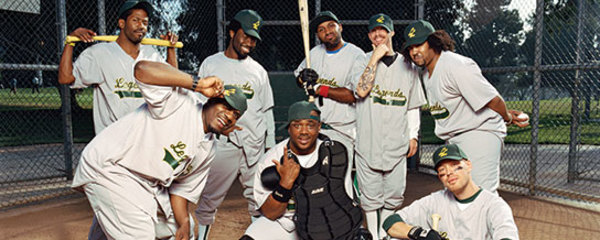
What a long, strange trip it’s been. The Living Legends have grown considerably since 1997, when they germinated in the now-famous San Leandro Avenue “Outhouse” in East Oakland’s Fruitvale District. Now numbering nine members–Sunspot Jonz, Luckyiam, Eligh, The Grouch, Bicasso, Aesop the Black Wolf, Murs, Arata, and Scarub–they’ve been called a West Coast Wu-Tang, more for their Voltron-like collective philosophy than stylistic similarities. Like the Wu, they’ve branched out into various subgroups (including CMA, Mystik Journeymen, G&E, and 3MG), yet they might have more in common with indie comrades Hieroglyphics, Rhymesayers, and Def Jux, who, along with the LL crew, have defined quality underground hip-hop for the last decade.

“That’s not bad company,” says Luckyiam, over the phone from LA. Yet while the Legends have turned their crew name into a self-fulfilling prophecy, they’re far from done. “We want to take it even farther,” says The Grouch, adding that their efforts up to now have merely been “laying the groundwork for what is to come.”

The next phase in their quest to manifest their own destiny is Classic, a group album recorded the way few people record group albums anymore. The entire crew holed up in a beach house in Maui for a month to create what is easily their finest artistic statement yet. The album’s title is perhaps best outlined on “Blast Your Radio,” which explains that retro doesn’t automatically mean classic, and that classic doesn’t necessarily mean old.

Amazingly, for an album with nine distinct voices on it (plus some outside production by Madlib, DJ Epic, DJ Khalil, and Beam One), Classic resonates with the kind of solidarity that only comes from a concerted group effort. “This one was a lot more cohesive” than previous efforts, The Grouch notes, the main difference being “the actual experience of everybody being in the same house at once.”

Luckyiam mentions that making Classic took the group back to their humble (i.e. hella broke) beginnings in the Outhouse days, when their creative juices first flowed. Perhaps most importantly, it renewed their camaraderie–not just as recording artists, but also as friends. “Everyone has their own unique place in this,” he says. To the Grouch, what makes the Legends special is their normalcy; “people get the feeling that our group is made up of real people,” he notes. And, as the saying goes, real people do real things.

Sly & Robbie: Real Drum and Bass

Outside Sonic Sounds studio, Robbie Shakespeare is gesticulating wildly as he shouts a string of expletives into a mobile phone. Someone owes him money somewhere, and he’s apparently unhappy about it. He’s a big guy with a hefty frame who once served time in a notorious Jamaican prison on a gun charge, so whoever’s on the other end of the line must be sweating. Inside the studio, Sly Dunbar is the essence of calm as he adds some live percussion to a new computer rhythm; once the basic structure is in order, Robbie plugs in his instrument and deeply locks into the groove.

Reinventing Riddim
Sly is the yin to Robbie’s yang: if Robbie represents the sonic brawn of the partnership, Sly clocks in as the mechanical brains, a human machine virtually driven by the drums. Their unique chemistry has made them one of the greatest rhythm sections in the world.

Robbie says the two first met in the early 1970s while working the Kingston nightclub circuit. “First time I see Sly was on Red Hills Road where there was one club named Tit For Tat and one named Evil People. I was playing with the band Big Relation at Evil People and when we finished [keyboardist] Touter Harvey said he’s going to check this band named Skin Flesh and Bones. I go over there and see Sly and it sound wicked. We was doing a lot of recording and I was one of the main man with the Aggrovators band, so I call in Sly and we build a lot of tracks; everybody say Sly Dunbar sound wicked and the two [of us] together sound good. After that, I was one of the main Peter Tosh bass players, so me just draw fe Sly and there was no looking back.”

“I always liked Robbie’s bass,” adds Sly, “because when we start meeting in sessions down by Randy’s studio, we talk and ask questions. In those times, every musician used to respect each and every one, so we go and check one another, sit down and work out some music, design a few chords and things. That was then in Jamaica, but it doesn’t exist no more.”

After Sly appeared with Robbie on early Aggrovators sessions, Robbie was often a feature of hit-bound sessions held at Channel One studio with Sly’s in-house band, The Revolutionaries. Sly names a 1976 concert at London’s Lyceum ballroom, in which the duo backed the Mighty Diamonds and U-Roy, as a defining moment in their evolution. “They said that dubwise music couldn’t be played live, so when we came and start doing it live–went to drum and bass and worked it–the people said ‘No, I can’t believe it! They’re really playing it!’”

The following year, producer Derrick Harriott released Go Deh Wid Riddim, the first album to credit Sly and Robbie as artists. A natural next step was entering the production field as a duo, but Robbie says the initial recordings for the Taxi label, which they relaunched as a team in 1978, met with much resistance. “We got some free studio time for ourselves and nobody didn’t want to play at first. I remember I even stand up and cry and Sly said, ‘Cool it, Robbie man, everything will just work out.’ Then one day Gregory Isaacs came and give us six songs, and in those six songs was ‘Soon Forward,��� our first hit.”

Synthetic Pleasures
It quickly became clear that Sly and Robbie were changing reggae forever. Previously, reggae was limited to strictly roots styles with spongy rhythms. Sly and Robbie slowly began to infuse harsh, mechanized action behind innovative beats, adding a rougher, more metallic edge to the music. Sly’s early tinkering with drum machines and Simmonds electronic drum pads was soon copied by others, ultimately presaging dancehall music’s computer-driven production values.

Sly’s growing obsession with synthetic sounds coincided with a fruitful reconnection with harmony trio Black Uhuru, leading to a contract with Island Records. Sly and Robbie’s dynamic backbeats helped make Uhuru the world’s most popular reggae act in the wake of Bob Marley’s death, and the Island link also saw the Rhythm Twins provide beats for three albums from androgynous funk chanteuse Grace Jones, including the backbone of her groundbreaking single “Pull Up To the Bumper.” Working solidly at Island founder Chris Blackwell’s Compass Point studio in the Bahamas, the team had state-of-the-art equipment at their disposal, leading Sly to experiment further with semi-electronic drums and basic drum machines.

After Michael Rose left Black Uhuru (following the group being awarded the first-ever reggae Grammy in 1984), Sly and Robbie delved further into the international arena. They made a series of collaborative recordings with genre-bending pioneer Bill Laswell in New York, resulting in the multi-textured Language Barrier, a landmark release featuring guests as diverse as Doug E. Fresh and Bob Dylan. “The Bill Laswell connection starts when we were in Compass Point and I was using the Simmonds drums,” recalls Sly. “We had done this song that was really made for the James Bond soundtrack Never Say Never Again, but I don’t think it came out too good, so we used that rhythm track to create something else and that song became ‘Language Barrier.’ Then Chris [Blackwell] mentioned Bill Laswell; I don’t remember if he was in Nassau at the same point, but we got turned on to him and we shared ideas. We did that album and the second album, Riddim Killers, which had that hit song ‘Boops.’ He hooked up people like Bootsy Collins, Mudbone, and Bernard Fowler on that album. It was great–he’s a very creative person.”

Dancehall Nice
Because they had spent so much of the ‘80s abroad, Sly and Robbie’s status had taken a knock in their homeland; by the dawning of the 1990s, they were seen as out of touch and passé. But Sly is never one to sit still for long, and his ongoing fascination with technology meant the duo was able to bounce back with innovative dancehall beats, based largely on the bhangra form made prominent by Asian musicians in the UK.

“Me realize that everything was changing,” Sly explains. “Most of the records coming out in America, they was programming beats. To get the sound that they were getting on the records, there’s no way you could get it by live instruments; the whole sample thing came in and everybody start use drum machines, so we get to change too. When I was in England, I heard bhangra and, being a percussionist, I said ‘This will be wicked to work with.’ So I went back down and we cut [Chaka Demus & Pliers’ anthem] ‘Murder She Wrote.’ When I first used the bhangra thing, I used it on a song called ‘Almshouse’ with Capleton–used the tabla, but in Jamaica they call it the water drum. I’m pretty much into the Indian and Arabian sounds.”

After re-establishing their credentials in Jamaica, Sly and Robbie reached greater international glory with Strip To The Bone, their 1999 collaboration with ambient mix man Howie B. “I don’t know if Howie B’s a musician, but Howie B is very creative–more creative with this than I would think,” says Sly. “We never met him before, never really listened to his work, but once there’s music to go in and make, we just go in and make it, do what we have to do. There was no ego: Either it work or it don’t work, but you’re not going to know until you try.”

Awarded Orders of Distinction by the Jamaican government for their services to the music industry, Sly and Robbie show no sign of slowing down. After presiding over a Black Uhuru reunion in Jamaica, they recently released The Dub Revolutionaries and Version Born. The former, cut in London, is a finely crafted album with dubmeister Mad Professor featuring live instrumentation; the latter is another star-studded, multi-dimensional Bill Laswell collaboration. So what else is next for the Rhythm Twins? As I make my way out of Sonic Sounds, Drumbar and Basspeare assure me there is plenty more to come. “I think the future of reggae depends on Jamaica,” says Dunbar, “but we need different sounds. With good songs and good singers to sing them, the future for reggae is great.”

Official Website

Various Artists Soul Jazz Records Presents Studio One Disco Mix

“Disco Mix” has a dual meaning on this vintage Studio One collection. First, it refers to the popular early ‘70s Jamaican 10″ and 12″ single format, where a song plus its dub or a DJ version would be included in one extended mix. Then there‘s the American soul genre, which inspires some of the music contained here. Seventies and ‘80s icons Alton Ellis and Sugar Minott feature here alongside lesser-known acts like Norma White, who shines on her remake of Chic‘s “I Want Your Love.” But it‘s Willie Williams‘ top-ranking tune “Armigideon Time” that still lives on, albeit mostly as an x-rated dub plate for warring sound-systems (“A lot of sound-boy nah get no p–y tonight.”) More bang for your buck, indeed!

Page 3490 of 3781
1 3,488 3,489 3,490 3,491 3,492 3,781