Silkie Fractals

London producer Solomon Rose’s creative work as Silkie has always wobbled to a different groove than many of his other dubstep contemporaries. His sound embraces a brighter, soulful, synth-driven aesthetic that often has more swagger and charisma than today’s bombastic big-drop tracks.; he also favors concept albums that tell futuristic narratives through complementary and smoothly composed tracks. His two previous full-length solo works, ’09’s City Limits Vol. 1 and 11’s City Limits Vol. 2, did exactly that, and saw Rose’s sound develop from pristine, fusion-y modes to a plethora of electro, post-garage and R&B-soaked numbers. Those two albums charted Rose’s travels through earthbound streets and urban environments—and what comes next launches his music into another galaxy entirely.

His third proper album, Fractals, is presented as the second chapter in a “space opera” series on producer Distal’s Anarchostar label. That conceit aside, what Rose may have achieved instead is dubstep’s first dystopian Afrofuturist concept album—think Janelle Monet making beats for London club FWD>>, or a cosmically-revitalized George Clinton retooling his P-Funk agenda for the EDM generation. While keeping to the album’s premise—that Silkie is “broadcasting lost music from a re-appropriated military pod…as a platform of hope for the people left on a dying planet”—Rose interprets R&B traditions from the 1970s to present—funk, electro-boogie, New Jack Swing, contemporary soul and garage house—on tracks saturated with elegant synths and taut rhythms.

The results often blend soul nostalgia with a hyper-futuristic groove. On tracks like “Love Affair” we hear echoes of Janet Jackson’s Control-era Jam & Lewis productions mingling with shuffling reggae-style keyboard riffs and smacking half-time snare patterns. “Majik” starts with gospelesque piano riffs that hint at Blaze or Ten City’s classic house moods as between-the-sheets R&B vocal snippets are layered atop; electro number “Moda” feels like a Newcleus cover done by Bugz In The Attic, its steady, robotic beat is augmented with loose jazzy instrumentation that gives this android unit a funky soul.

Despite its arty aesthetic, this is still a dubstep album, albeit an evolved, 2015 future-soul version of said genre. Tracks like “Swank” are perfectly club-primed; strutting slowly with subtly distorted bass loops while its melodics do the electric slide. “Entrapment” is the album’s sole moody number that utilizes arpeggiating synth patterns without sounding tired, while “Limits” threads R&B diva vocals into a spacious, sub-bass tune that has all the markings of an Anti-Social Entertainment (Silkie’s DJ and production cohorts) classic.

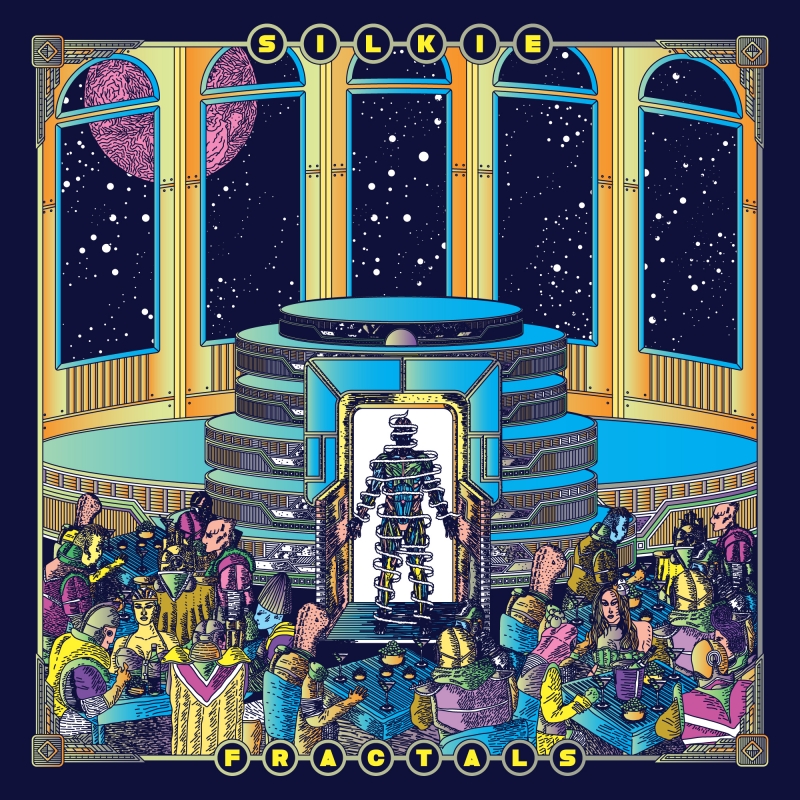
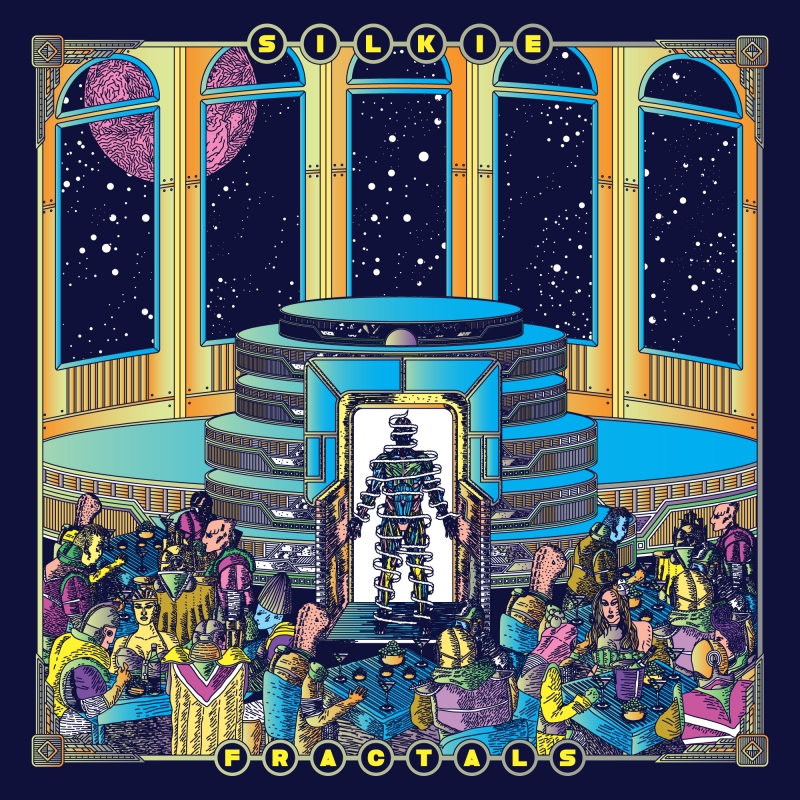
Fractals features corresponding artwork by Argentinian artist Freshcore; these drawings reinforce the spacey narrative and also are a tip of the hat to both P-Funk sleeve artists Pedro Bell and Overton “O-Dog” Lloyd, as well as Tony McDermott’s dense cartoon treatments for dub producer Scientist (see Scientist Meets the Space Invaders on Greensleeves). These images not only visually complement the music but take us deeper into the universe and messages Rose is conveying.

Like a urban-galactic graphic novel with a correspondingly badass soundtrack, Fractals offers listeners something more colorful and conceptual to digest. And in an era of growling, interchangeable brostep bangers, raging as they do with imagined menace, Rose’s art and music delivers an exhilarating, soulful alternative.

Premiere: Hear a New Kenny Larkin Remix

Later this week, Mobilee will release the Rao Del Rani EP from Mannheim-based artist Ray Okpara.

The three-track EP features two Okpara originals, “Rao Del Rani” and “Close To Me,” and a remix of the title track from Detroit legend Kenny Larkin. Working in his typically heady style, Larkin stretches out “Rao Del Rani” into a 12-minute steamroller, applying and releasing the tension throughout with his trademark swirling synth flourishes thrown in for good measure.

You can stream the Kenny Larkin remix of “Rao Del Rani” in full below, with the full EP arriving on July 24.

50Weapons Closes Label After 10 Years

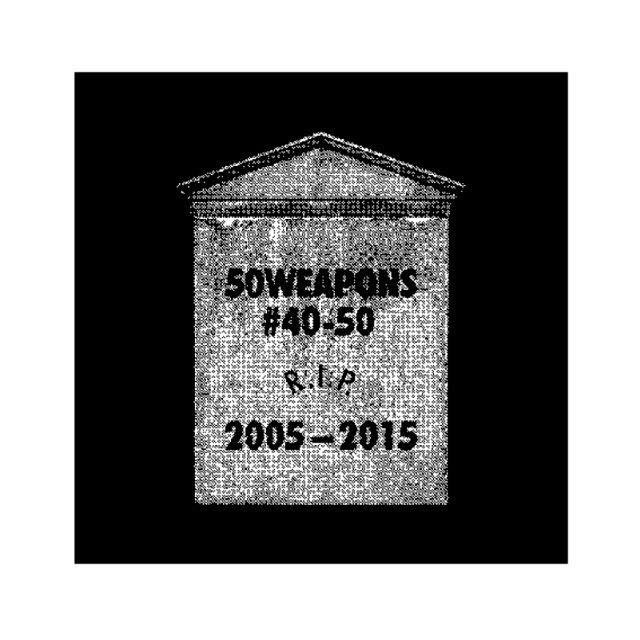
About an hour ago, the Facebook page of 50Weapons, the Berlin based record label created by Gernot Bronsert and Sebastian Szary of Modeselektor and Moderat, that was home to artists such as Marcel Dettmann, Cosmic TRG, and Shed, posted a farewell message that closes with “R.I.P. 50Weapons 2005 – 2015.”

In the video, we see a 10-year album cover retrospective, with clips of tracks and bleeps put together to form a very fitting farewell to the label and it’s art direction over the years. We will report more news as it comes in, and we would suggest getting your hands on any of the 50Weapons records that you can as they will now become much harder to come by. Check out the video below for the official farewell. Thanks for all the year of great music by everyone involved. You will be missed.

Ascetic “Dreams Of Burning Cities”

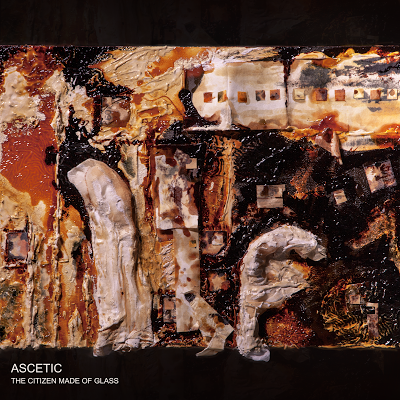
Getting his start in breakcore under the Machinochrist moniker, UK-born, now Berlin-based artist Ascetic lands on Planet Terror Records with his latest full-length, The Citizen Made From Glass. Deconstructing techno’s framework, Ascetic takes an experimental approach to the genre, incorporating deep ambient elements with more upfront, industrial-tinged textures. Opening with muted drums and flickering, noise-like percussion, LP cut “Dreams Of Burning Cities” takes us on a dark ride through the mind of Ascetic. Dense layers swathe back and forth like waves, underpinned by the insistent low-end thuds which keep you locked in for the six-minute run. You can download “Dreams Of Burning Cities” for free below, with the LP available at Planet Terror.

Dreams of Burning Cities

Watch a New Video from Scuba

Hotflush boss Scuba (a.k.a. Paul Rose) has revealed the third and final installment in his Claustrophobia video trilogy. Soundtracked by “Black on Black,” Rose’s newest single that comes backed by a Len Faki remix, the video is said to follow a “sinister psychonaut and his unwitting supplicant to a chilling end in the discothèque.” Watch it in full below, and find the preceding video in the series, “All I Think About Is Death,” here.

XLR8R Couldn't find the embed function for type: "vevo" and source: "<iframe src="http://cache.vevo.com/assets/html/embed.html?video=USQY51584834&amp;autoplay=0" width="575" height="324" frameborder="0" allowfullscreen="allowfullscreen"></iframe>".

Axel Boman 1979 EP

Pampa Records’ favorite Swede, Studio Barnhus co-boss Axel Boman, returns to the fold for his first release on the Hamburg-based label since “Purple Drank”, an effort widely being considered to one of the tunes of 2010. His follow-up on Pampa is 1979, a two-track EP that’s everything we hoped it would be from Boman: sentimental and convention-busting, and a fitting follow-up to label boss DJ Koze’s prior release on the imprint, the standout slow-burner “XTC.”

The EP leads off with title track “1979”: a pensive, cool-toned house track that takes its time and breathes with a restrained touch, gently soothing with shimmering chords and bare bones percussion across its ten-minute meditation. On the flip, “Nokturn (Gran Finale)” is a grand carnivalesque affair with endless movement and dominant looping Latin rhythms. Ever the master manipulator, Boman leads us through a screeching ascension that seems primed for takeoff, before cooling down the groove and allowing the robust double-bass phrase to take the fore in what will likely be another big release for Pampa.

DJ Spider and Phil Moffa Psychic Surgeons

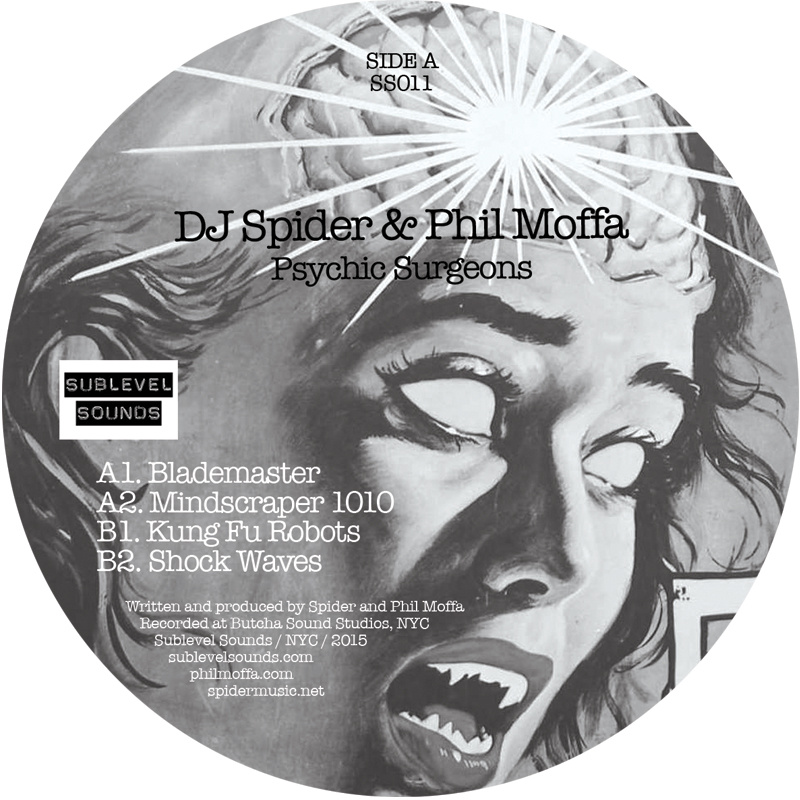
Sublevel Sounds label boss, DJ Spider, and The Corner recording artist and studio master Phil Moffa are dropping a new 12″ titled Psychic Surgeons on August 1.

DJ Spider is no stranger to hammering out releases and collaborating with long time NYC techno producers and record junkies, and he has a work ethic like no other when it comes to the studio by the number of records he is pressing. The Night Gallery EP was the first collaboration we noticed between the two producers to come out on Sublevel Sounds in 2013, and that was followed up later on by the Underground Sounds Vol. 2release on Plan B Recordings which saw the showcasing of these two artists on the same record.

Phil Moffa’s record releasing has been on a rampage as well since 2012. He’s released one solo EP and two collaborative EPs with Anthony Parasole on The Corner in the last 3 years, he’s seen two records on Plan B, and he’s now on his third collaboration with Spider in as many years. He’s also staying busy mastering records for release on The Corner like the recent Civil Duty album, and hanging out with Parasole at Old Miami in Detroit for Movement this year.

Check out the clips for the upcoming Psychic Surgeons 12″ on Sublevel Sounds, and find out more about the label by clicking here.

Preview a New Album from Donato Dozzy

OLYMPUS DIGITAL CAMERA

Italian techno abstractionist Donato Dozzy has a new record forthcoming on Further, entitled The Loud Silence. Set for an official release on October 2, the LP finds him making use of a mouth harp, which (according to Resident Advisor and the label), has been “calling to Dozzy ever since childhood, when he had discovered the marranzano on a holiday in Sicily with this parents.” The album was recorded in April 2013 both “indoors and outdoors, halfway up mountains and on the edge of the Mediterranean sea” in Italy. More complete details are available here, and two tracks from The Loud Silence can be streamed below.

Exclusive Interview: Mark Barrott of International Feel Launches Drip Subscription Service Plus New Weekly Ibiza Sunset Residency from July 23

Mark Barrott, founder of International Feel and the producer behind the acclaimed Sketches from an Island series, launches a Drip streaming service from Monday July 20 to tie in with the release of his Sketches from an Island 3 EP.

This innovative service will offer a unique insight into the daily working life of an artist and feature regular content in the form of exclusive music, back catalog, unreleased cuts, work in progress and demos, stems for budding producers, exclusive mixes, videos, invites to tour dates, photos, merchandise discounts and much more from the founder of the notorious Balearic label that brought us albums from DJ Harvey and Jose Padilla.

From Thursday July 23, Barrott will also be starting a weekly sunset residency at La Torre, Stella Maris, Ibiza. La Torre is one of Ibiza’s hidden gems, frequented by those in the know for it’s stunning sunset views and recently taken over by the people behind Cafe Mambo.

In advance of the launch of the service, XLR8R spoke with Barrott to learn more about the inspirations behind it, while a track from the new Sketches from an Island 3 EP can be streamed in full below.

So let’s begin on the Drip subscription service. Can you just describe how exactly this subscription service will work? How do people subscribe? Is there a fee involved? 

Drip is, for me, the way forward. When I released my first album 20 years ago artists played live or DJ’d and managed to break even doing it, to promote their record. Fast forward to recent times and it’s completely changed: you now release records that break-even as a “calling card” to promote your DJ and/or live career.

But what happens if you don’t want to play live or make a certain type of records to get gigs? For studio based musicians, this is a very real conundrum and one that Drip goes some way to answering. As I am (mainly) a studio based musician, I can generate income from that in a number of ways – the obvious one is by building a catalog and searching out “sync” licensing for tv adverts etc. But in the absence record sales income, Drip is a possible replacement for this lost income and that, combined with the control I have over how to curate it, is an interesting and exciting prospect.

I also believe strongly that the “free content” bug that’s become so prevalent in recent times is wrong, wrong wrong. My job is to make music for you to write about, so why should I also provide you with free content to promote your website/magazine/blog etc…thats your job. Also, what happens in the studio is the starting point / source of everything – if people like me don’t make music, then DJ’s have nothing to play, journalists have nothing to write about and yet I get the sense that studio musicians are getting pushed aside for the fame and glamour of being a DJ and this is a big mistake and very short-termist (kind of like a Government / Country deciding to move into the service industry and stopping manufacturing cos people don’t want to get their hands dirty anymore). People don’t seem to have the patience or concentration (or desire) to learn a craft these days.

The bottom line is that I am absolutely 100% against free content and illegal downloading. I don’t come into your house and walk out with your TV, so if you want my music and all the energy and love that goes into making it then please pay for it – hence Drip.

In terms of the practicalities, anyone can do it – even your cat. It’s $7 a month.

And besides access to your back catalogue, unreleased music and tour tickets etc, briefly describe the benefits of subscribing?

What you’re getting is direct access to what I call my “Musical Consciousness.” Not only do you get all the music I make in the future and a large part of my back catalogue (released and unreleased), you also get to see the process of how I make music – so when I start making the new album in Sept/Oct, I’ll be posting demo’s and work in progress. It’s what I call a big and beautiful experiment: some of it feels like running down the street naked, but thats part of the excitement as well.

So you’ll be getting everything I ever make from here on in, ahead of time, as well as back catalogue, unreleased stuff, exclusives, demo’s, work in progress, photo’s of my daily life around ibiza, stems to make your own versions, videos, gig invites etc. As the idea grows so will the depth and variety of content.

How is this content going to be managed? Is this something you plan to do yourself, or will it be delegated?

No this is 100% me day by day – it won’t work if someone else was involved. In fact, a simple way to look at it, is as a audio/multimedia diary of my life.

While social media unquestionably offers an invaluable tool for artists/labels etc to interact with their fan base, it can detract attention from what is actually important: the music. Is this something that you are aware of?

I think social media for the sake of it (i.e. generating numbers to impress people like bookers or editors / journalists) is vacuous and a road to nowhere and this is another reason for starting a Drip. It’s like a private social network that gives you direct access to an artist and his/her musical and wider life.

I understand that the announcement is set to tie in with the release of his Sketches from an Island 3 EP – but is there any other motivation for launching the service now in particular?

Well there’s a lot going on at the moment and it’s been on my mind for a month or two to do this, so it seemed like a good time, with the new EP, two DJ Residency’s, a couple of new video’s etc. With all this going on it, it is better than launching it in, say, September, when I’m about to head back into the studio and there’s no release/news to ‘hang’ it around. I also wanted it up and running before the work on the new album starts, so it’s there to be able to document the process, which is something I find really exciting and hopefully others will too.

The use of social media by artists/labels and other key figures in music has long been discussed. Besides International Feel’s official website, there is also a Facebook page, a Twitter account and a SoundCloud page. By starting the Drip streaming service, what do you hope to achieve that you cannot do already via social media outlets with which you’re currently already engaged?

Its important to be clear that the Drip service is about is me as an artist, not, at this stage, International Feel as a label – even though the two are very interlinked.

But even with the International Feel Facebook, it’s really only used to keep people up to date with releases and other associated bits n bobs (as is S.Cloud and Twitter), so this is entirely different: this is me as an artist opening up both myself and my music without reservation, which is exciting, scary and liberating all at the same time and will, hopefully, motivate my lazy ass into actually making more music to fulfil the ‘moral obligation’ of having people pay a monthly subscription.

Will there be content shows via the Drip service that will not be readily available via the label’s social media outlets? If so, how do you find this balance without alienating those fans who follows the label on social media?

The current International Feel Social Media channels will stay exactly as they are and quite a bit of stuff on my Drip will be available to members and non members alike, as I’ll be using it as a hub for any news etc that gets generated around my artistic life. But if you want direct access to me as an artist and to a degree as a person living in Ibiza, then you’ll have to subscribe to the Drip and get all the Member Only stuff / exclusives etc.

Looking forward, do you anticipate other artists/labels incorporating such an innovative system, or do you perceive this system to be something unique to your fan base and brand of International Feel?

Well I think that for ‘niche’ artists like myself, this is the way forward, as opposed to say Spotify. As you can probably imagine, I’m not a fan of streaming at all – it devalues/cheapens what we do, so I think that a Drip is the perfect balance between artist and listener. It allows studio musicians to generate an income again from their music and allows fans / subscribers / like minded individuals, a chance to get direct access to that artist in a new and exciting way.

Drip.com already has artists like King Britt and labels like Ninja Tune and Domino, so I’m not the first the see it’s potential.

Onto other things, let’s discuss your weekly sunset residency at La Torre. It’s a beautiful location to play and I imagine you’re very excited to get started. How are preparations coming on for it?

I went for sunset there last week and before I got there I was thinking, ‘Do I really want that commitment?’ And then I got there and was so inspired that I put my iPod headphones on and started DJing the sunset to myself !!

I think there’s the possibility of building something really special there over the coming months and years, recontextualising the Jose Padilla blueprint for modern times. Ibiza has lost it’s way: sunsets are special and unique and should not be soundtracked by tech-house just because that’s what sells more drinks, so I intend to the bold in what I play and if that doesn’t connect with people, I’ll just disappear back to the compound with my synthesisers!

Preparation wise I don’t just want to DJ – it’s not something I’m good at or feel comfortable doing, so I’ve built myself a little rig with a laptop, dub delay, loads of speech samples/nature sounds, a synth and two DJ decks. It’s kind of partially live, partially DJ, partially soundsystem. I tried it out at the Sunrise Sessions we did at the Garden Festival in Croatia two weeks ago and it worked really well and was great fun, so roll on Thursday and my four hour sunset!

To sign up for the subscription service, follow this link.

Q&A: Mike Servito

Photo: Seze Devres

In academia, the term “publish or perish” refers to the pressure that professors are under to to get their research, discourse or literary output into journals, books or anywhere; it’s a near-necessity if you want to attain tenure, or even just keep your job. Substitute produce for publish, and you have a pretty good approximation of what the modern DJ faces. This wasn’t always the case. Many, if not most, of the foundational DJs barely released any sonic product beyond the occasional recording of a club set, and even those that did produce to some extent—Larry Levan, for instance—are remembered more for their nights behind the decks than their days in the studio. But for a myriad of reasons, productions have become de rigueur for the modern jock.

There are exceptions: Veterans like DJ Harvey and Craig Richards, for instance, spend far more time standing in the booth than they do sitting behind the mixing desk, and yet manage to score major-league gigs. But old-schoolers like them tend to come with a built-in rep; for non-producing younger jocks without a release to serve as a calling card, life is tougher. Happily, there are some who manage to buck the trend, managing to build a career from skills, selections, and sheer force of personality alone—and one of the best is Mike Servito. Nurtured by Detroit—where, among other things, he served as one of Ghostly International’s go-to DJs—and based in NYC, Servito currently serves as resident of the Bunker, the venerable, trailblazing shindig helmed by Bryan Kasenic. (Coincidentally, two other Bunker residents, Derek Plaslaiko and Eric Cloutier, have also managed to forge DJ careers without heavily relying on recorded output.) He’s long been considered of clubland’s semi-hidden secrets, serving up neck-cracking, body-jacking sets that draw from classic forms of house, acid and techno, but that transcend genre to become beastly creatures ready to ravage the dancefloor. The secret is out, though, and the past few years have seen the world catching on to Servito’s appeal: He’s been plying his no-holds-barred trade everywhere from San Francisco to Berlin and beyond, and on July 31, he’ll be on the decks, record box at his side, at Amsterdam’s Dekmantel festival.

It seems that DJs from the Detroit area always seem to know their shit, both in their selections and their technique. Do you think that’s true? And if so, why do you think that is?
I think when you come from a city like Detroit, music automatically becomes an integral part of your life. I think it was all in our subconscious, doing the work and looking into the history and learning about what we were getting into. It was a fun hobby, and an exciting one, to find any material we could on an artist or band or producer, pre-Internet—learning about underground Detroit and DJ mixes, listening and embedding mixes into our brains, reading magazines, reading liner notes and thank-yous and connecting artists. It always felt very communal in Detroit. You could connect any Detroit DJ-producer to another. Rick Wade to Mike Huckaby; Theo Parrish to Kenny Dixon; Jeff Mills to Mike Banks; and so on. I think my generation kept dibs on it all…the labels, the artists, the accolades. There is a strong sense of pride and music appreciation, because to some of us, it’s really all we had. It was a means to dream and escape for me.

Are there any Detroit DJs who you would consider to be particular role models?
Mike Huckaby and John Williams, a.k.a. Bileebob. Those two were the first ones that made me take notice of the technical aspects of DJing. The blending and the EQing were new and super fascinating to me. I already had the concept of mixing music, courtesy of the Electrifying Mojo and the Wizard, Jeff Mills, but only in the context of radio. To see it in the clubs and watch these guys play records was complete magic to me. The Derricks were hugely influential. Derrick May and Derrick Carter were like the end all be all for me, as far as DJs go. They took risks, and were daring, and messed with my head—a lot! I think getting to hear Theo Parrish as much as I did…that was something special.
I felt inspired by all of them, honestly, but I never aspired to be like any of them. Everyone was pretty original and had their own techniques and secret weapons, and they stood out. It was a very individual thing compared to today. Everyone had their own way of doing things, and it was acknowledged.

You’ve been an official Bunker resident since 2012. What role do you feel the Bunker has played in your current success? Do you feel it’s important for a DJ to have a home base like that?
The Bunker rebooted my DJ career, single-handedly. Bryan Kasenic backed me 100 percent; it’s like he almost had no qualms about bringing me on board. He brought me out of this weird techno limbo that can happen to DJs. He took a risk and invested in me and believed in my abilities. Bryan and Seze [Devres] were always pushing me and supporting me and booking me for their parties for years and years. I always appreciated that, even when I wasn’t feeling my own DJ self. Things started to evolve literally the day I became me one of their residents. It was a turning point and an affirmation for me.
I don’t think it’s necessarily a prerequisite to get a DJ residency, but it’s nice to belong to something and have that support and structure and a sense of family behind you. It’s nice to have some consistency and someone looking out for your best interest. I really lucked out with the Bunker. It’s been nothing but positives.

“I always want the sound to be dynamic and give me goosebumps and make me think, “Wow, I cant deal!” because the music is so good, you know?”

Your sets generally seems to be pretty jacking, with a lot of old tunes—both classic and obscurities—tossed into the mix. Do you consider yourself to have a “sound?” And if so, how did that sound develop?
I don’t know that I ever really had a sound. I just played what I played and blew all my money on records I liked. Of course, it’s become more refined and I do favor a more jacking sound. I just like things at 110-percent full-party mode. I want people to feel it. I don’t have time for dull moments. I always want the sound to be dynamic and give me goosebumps and make me think, “Wow, I cant deal!” because the music is so good, you know?
I was always into everything! Jeff Mills was doing his Wizard shows in the late ’80s, and would play all of it. Detroit techno, Miami bass, Chicago acid and hip-house, New York house and disco, and even U.K. bleep— all these sounds, all at once, really had some impact on my young mind. I always said I was one part Detroit and one part Chicago.The first twelve-inch record I ever bought was Wee Papa Girl Rappers‘ “Heat It Up,” which had an Adonis mix and a Kevin Saunderson mix. That record made me excited about dance music and about acid house and about Detroit and Chicago. I’m showing my age, but I bought that record when it came out in 1988. It’s a very special record from a very special era for me. I’m always giving a nod to the past. ’88, ’89 was magical in regards to house music and techno, and it was a big part of my youth. I guess that excitement never went away.

 Photo: Seze Devres

The past couple of years have been great ones for you, traveling the world and playing some of the world’s best clubs and festivals, with gigs at places like Berghain and the Dekmantel fest. Do you feel that puts pressure on you in any way, or do you welcome the challenge?
I am definitely feeling the pressure—but I’m rolling with the punches. It’s a lot of self-analyzing, but I try not to give too much thought and just take it on as it comes. It’s a weird position to put yourself in when all eyes are on you and you just want to play this music, and everyone has some sort of expectation and idea of what you do and who you are. It’s a very strange thing, to put yourself out there. I grew up very shy as a kid. A small part of that shyness still exists in me, but once I’m behind those decks, I know what I need to do. There is comfort in realizing your own talents and embracing that. It took a long time for me to get there.

Do you find yourself changing your set at all when you’re playing a large-scale event like Dekmantel, as opposed to, say, playing at Trans-Pecos for a Bunker Limited party? Or do you just do what you do and let the chips fall where they may?
Honestly, it just kind of happens. My whole thought process planning for gigs is a bit crazy, and borderline mental at times. I generally look for something new, or I’ll hear something new in an old track. I get fixated on a certain sound and just build it in my head from there, pulling records and kind of piecing it together. But it’s never planned—until I’m behind the turntables doing my thing. I guess I think about it more thoroughly when I am traveling. Sometimes, there is a point of procrastination, and then I am left to scramble last minute and fill my bag with too many records.

“The art of combining sounds and extending mixes to make something cohesive always fascinated me and fucked with me.”

You’re probably sick of talking about this topic, but how much more difficult do you think it is for a non-producer to make it as a DJ then it is for one who does produce?
I think it’s all in the timing. There are still only a few that are getting by on just DJing alone, but I definitely see that changing. It was always easier for the producers to get the gigs. Having a record out just kind of automatically gave people credit. You get on a somewhat respectable label. You get some press. There’s a buzz about you. Skilled or not, you have a record out and you are going to get the “DJ” gigs based on your affiliations—and not necessarily your DJ talents. That’s the sad truth. It’s a slap in the face when I hear the phrase “everyone can DJ.” It perpetuates that myth—the myth that all producers can DJ, and all DJ’s are producers. That’s how it always was, and that always irked me a bit. It’s changing though. The appreciation and respect for the DJ has grown, and people are getting bookings based on our DJ talents alone.

Having said all that, any plans to produce in the short- or long-term?
I’m thinking it is inevitable. I don’t know when that time will come for me, but I definitely don’t rule it out; I think it can happen for me one day If I choose to take that route. I feel like it would be strange for me to not make a contribution. I’m really happy with DJing as a musical outlet, and I don’t think I would ever stop. I get a lot of requests to do remixes and collaborations. It kills me to turn it away, but I’m still growing and I don’t think it’s ever too late to learn something new.

Finally, what is it about playing music for other people to dance and party to that you find so appealing?
Part of it is about escape and letting go, and another part of it is just fucking with the mind a little bit. Music messes with me, and time signatures mess with me, and mixing music and blending all these sounds…I was always riveted to the DJ mix as long as I can remember. The art of combining sounds and extending mixes to make something cohesive always fascinated me and fucked with me. So a lot of it is just that—messing with the mind and moving the body.

Page 1034 of 3781
1 1,032 1,033 1,034 1,035 1,036 3,781