Last year veteran German DJ/producer Move D released a five-track EP of archival material recorded between 1992 and 1996 entitled The KM20 Tapes. Now, word has come that a second volume of tracks produced by Move D in the same time period will arrive next month via Jordan Czamanski’s (of Juju & Jordash) Off Minor imprint. Said to consist of “unreleased gems unearthed from the deep vaults of the KM20 studio in Heidelberg,” The KM20 Tapes Volume 2 EP will present a trio of unreleased Move D constructions, with its opening 12-minute track described as a “dubby minimal space-funk epic,” while the following pair of EP cuts are respectively characterized as a “monotonous, diabolical groove” and a “delicate, low-slung groover.”
Move D’s The KM20 Tapes Volume 2 EP will see an official 12″ release on November 14. In the meantime, the forthcoming record’s artwork and tracklist have been included below.
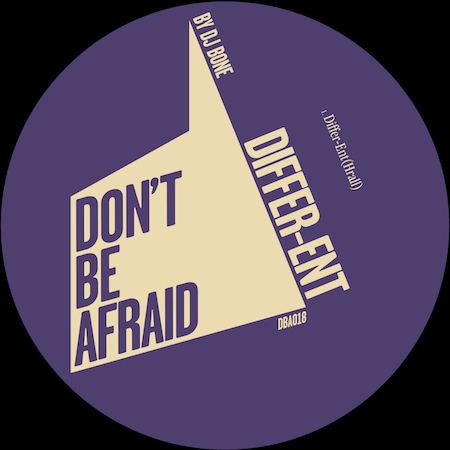
Burgeoning Bristol-based label Don’t Be Afraid has announced a trio of releases scheduled to land before the end of the year, with the first arriving next month from San Francisco native Jack Murphy via the DBA Special Editions series. Following that will be a DBA Dub 10″ single from newcomer Lily, that sees Workshop signee Madteo deliver a typically hazy remix, while material from Detroit veteran DJ Bone‘s new project—DIFFER-Ent—will be issued via the main imprint in early December.
All three releases are available to preview below, where their tracklists have also been included.
Anonymous production project Arandel is set to return to the InFiné label next month with its second full-length record, Solarispellis. A 12-track expedition through various shades of electronic composition, the album is divided into a variety of sections and movements including “Section 12,” a slow-building production that coyly laces a loping four-on-the-floor with gaseous synths, floating melodies, and highly detailed bits of percussion and manipulated electronics. Said to consist of “no MIDI, no digital takes, or quantizing… [only] live recordings through analog synthesizers,” Arandel’s Solarispellis LP officially arrives on November 24. in the meantime, after grabbing “Section 12” below, those interested in heading on another of Arandel’s sonic adventures can check out “Section 11” after the jump.
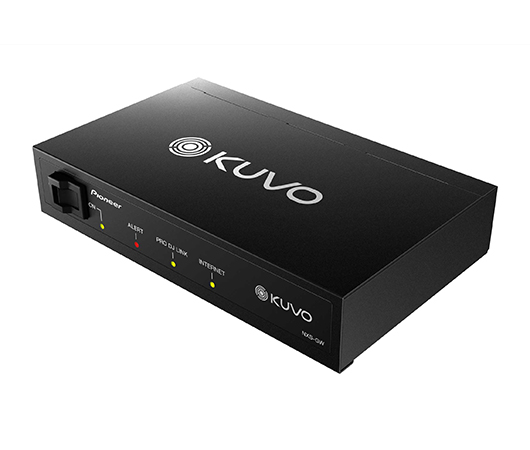
A few weeks ago, Pioneer DJ took advantage of the sprawling Amsterdam Dance Event to announce the launch of Kuvo, a new, cloud-based social platform and app that enables DJs to automatically broadcast a tracklist of what they’re playing in the club. (The system also allows users to log in to Kuvo and follow along in real time, or to check out a particular DJ’s playlist after the fact.) Although Pioneer primarily framed the product as a new sharing tool and even claimed that Kuvo could be utilized to help artists get paid royalties when their music is played in the club—check the launch video for a more complete rundown about what the system is supposedly designed for and capable of—many people (ourselves included) were left wondering about exactly how Kuvo would work, what its impact on the club environment (and the larger music industry) would be, and what Pioneer’s motives were in introducing this product. In search of answers, we headed down to the company’s pop-up space at ADE and spoke with Rik Parkinson from the product development team. His answers may not have satisfied all of our concerns about Kuvo, but they did shed a bit more light on what motivated its creation and how Pioneer hopes to implement it, both now and in the future.
XLR8R: For anyone that’s not familiar with it, can you describe what Kuvo is? Rik Parkinson: So Kuvo is a play on words. “Kumo,” in Japanese, and we’re a Japanese company, means “cloud.” So we played on the word there, and basically all Kuvo is, is connecting all of Pioneer’s decks that are in clubs across the world together. And why can’t we share that information with the club and the clubber via an application? So it’s just a cloud-based system connecting to our decks and sharing the track information back to the end user.
And Pioneer has already struck agreements with several clubs around the world to have a Kuvo system in it? Yeah, so for the past year, we’ve been in a beater stage so we could populate the system. We didn’t want to launch today, for example, and have nobody signed up, because what’s going to be the fucking point? So we’ve got—some clubs off the top of my head: Ministry of Sound London, Pacha Ibiza, Space Ibiza, some clubs in the States like Marquee New York, Las Vegas Marquee, Surfcomber Miami. So 276 venues signed up, and we’ve got a nice global spread starting to happen. The majority of the installs have been in Europe, and we’ve got about maybe 30 or so in the States and about 40 or so in other areas of the world, Japan, Asia, and such.
So, the way that it works is a DJ is playing, and Kuvo reads the metadata… Yup.
Do they have to be using Pioneer decks? At the moment, the system is limited to using just a Pioneer DJ. A DJ has to make a Kuvo profile, where they put their picture in, their bio, their SoundCloud links, whatever. They link it into their Rekordbox, which is Pioneer’s piece of software for exporting music, and then when they export their music next time, it will also take this little Kuvo profile as well. So when that USB key goes into the Ministry of Sound London, who signed up [for the system], that pings up to the internet, and it can match it, and then you can come back down into the system as well.
What about people that are using Serato or Traktor or… We hate them and they can’t be anything to do with us. [laughs]
Or vinyl? RP: Yeah, interesting. We understand the importance of opening it up to non-Pioneer DJs, and we are working on solutions that will be available at the end of December for non-Pioneer DJs. The last thing we want is Laidback Luke using the system, all Pioneer, everyone’s getting all this track information, then Luciano comes on who’s Allen & Heath and Traktor, and the system goes down. So we want everybody to be a part of this, not just a Pioneer fan or a Pioneer user.
What about for DJs that don’t keep neat metadata? So if you’re buying a track—let’s say, for example, on Beatport—then hopefully the metadata will be a good match. But yes, good question. If a DJ does mess all the metadata up, it’s going to be difficult for the system to identify what tracks are being played. Having said that, a system we did adopt to try and overcome this is our CDJs will now read the ISRC code, which not many DJs can edit via metadata unless they’ve got an advanced ID3 tag editor and they’re digging deep into the tag. So that is maybe one solution and we do understand the issues behind that, and hopefully stores such as Beatport, iTunes, etc. could come up with an intelligent file format that locks this all out. But yeah, there are variables in the chain there and we are aware, and we hope that—why [would] DJs want to trick the system if they want to give something back into the system? So hopefully people can be more transparent.
A lot of DJs get promos, or might make a demo and it’s labeled poorly, and they’re not going to take the time to then go into Rekordbox or go into iTunes or Serato or whatever it is… And learn what album it is…
Yeah and change it. Because some files are labeled like, “_WAV_premaster726.” So what you could do with that track is you could actually mark it secret. We understand that not all DJs want to share all of their tracks, so you can mark it secret. So it will go “track track track track,” and then all of a sudden it will go “secret.” That might be a solution around it. But yeah, poorly labeled tags at the minute, we don’t have a solution for.
Is Kuvo recording anything besides the metadata? Is it actually recording the music? No, it’s just data.
Is there any kind of analysis of the waveforms, kind of like a Shazam system to identify music? Not at the minute, no. Our system purely is based on ID3 tags and the information that’s visible on the CDJ. That’s kind of the strong point of the project, I think. If you’re in a club with Shazam and it’s gloomy and there are bad acoustics and the DJ has pitched it down 10 percent, Shazam kind of struggles a little bit. But this is completely, 100 percent accurate, because it’s reading it from the source. So in a club environment, which is where Pioneer is from—you know, the DJ booth—we think we’ve got a good advantage there.
What’s the major impetus to make something like this? RP: Well, it’s 20 years of Pioneer this year, and we’ve been very successful the past 20 years, releasing lots of products, and why can’t we connect all of our DJ booths together? It was a concept created about three years ago, and it’s taken us three years to get here. We just want to give something back to the industry. We’ve taken a lot of [criticism]—we’re expensive, all that type of shit, the bad press, you know. We want to give something back and why can’t we share that? We’re not profiting from this, we’re not selling this. This is an added value for the customer. So we just want to enrich the experience for a user.
Don’t the clubs have to pay for a Kuvo box? No, it’s free. We want no barrier to entry to this system, we want to populate this system. So if I start charging the Ministry 500 euros a box, they’re going to say, “What the fuck?” So it’s free. Free boxes.
Has there been any kind of collaboration in designing this with the royalty collection organizations that exist around the world? No. So initially, the performing rights side of the project was a byproduct of this product. And it wasn’t until maybe a year ago, a year and a half ago, that we sat down and went, “Okay, so we’re going to connect all these DJ booths, why the fuck aren’t we talking to [the performance rights organizations]?” So it’s kind of been a bit of a byproduct. But of course, as the hardware develops, we’re of course going to look at new ways to report data.
How is Richie Hawtin involved in the project? We worked with Richie Hawtin to understand his RADR technology, and we’re possibly going to work with Richie in building the application that connects non-Pioneer DJ users. So that’s where that’s come from. And we also wanted to work with Richie because he’s a great spokesperson, and I think it’s even better because he doesn’t use Pioneer equipment. Because this isn’t all about Pioneer DJ. Hawtin uses X1s, F1s, LME-92, and [Ableton] Push and stuff. What a great ambassador to talk about this project, [someone] that isn’t a Pioneer user, who wants to ensure that artists are getting paid. So that’s why we work with Richie.
What about DJs that don’t want to share any of their music? Don’t sign up. Don’t make a Kuvo profile and it won’t be broadcast. Or just make your tracks secret.
This is theoretical, but do you think some clubs might make it mandatory for DJs to use the system for, say, performing rights purposes? From my point of view, I’d love it if that was the case… It’d be great to see that. It’d be great to see the performing rights agencies make it mandatory installation, when you get your license for the year.
How much of the development of Kuvo has to do with trying to monetize things as much as possible? Maybe not for Pioneer, but for the industry. We have no agenda here to monetize. I mean, we don’t even know what this project is going to be at the minute. That’s not saying in 10 years time if there’s 5000 clubs around the world using it, we might have something special and powerful there, but we don’t have any agenda with this at the moment. We don’t have any quantities to sell, it hasn’t got an SRP price, it isn’t shipping next week. We see this as a marketing project, and not a sales project.
Part of the Kuvo experience is that there’s an app that users can put on their phone, correct? Yes.
What sort of information will they be able to access with that app? So let’s say I’m stood on the dancefloor at the Ministry of Sound and Solomun’s playing. I really like that track he’s playing. I can pull it out on my phone and basically see the track. I could be walking through the streets in Amsterdam and see which clubs are live on Kuvo, and go to them and see what music is even being played. But, we also understand that not all venues want people to have their phones out. So, this is all retrospective as well. You could go and dig into the archives of your night when you were back at home, and see what happened, so you don’t ruin the vibe and take your phone out of your pocket.
Don’t you think having something like this encourages people to have their phone out at the club, which most DJs… Hate. Uh, yeah it probably does encourage people to do that. But that’s why we’ve got another solution there, which is where you can check it out retrospectively. And let’s be honest, [phones] aren’t going away. We just have to deal with it and make a better solution. And when wearable [technology] is more popular, you know, it’s going be stuck on your wrist anyway.
Is making more information available about every song a DJ is playing necessarily a positive thing? From a clubber’s point of view, or from a DJ’s point of view?
In general. I think from a clubber’s point of view, of course [it ‘s a positive thing]. How many times have you stood on that dancefloor going, “What the fuck is that record he’s playing?” You want to know. You don’t have to get your phone out, you can check it out later. If the DJ wants to push new music and monetize—you know, there’s nothing more powerful than being on the dancefloor, and that point of pleasure where you’re buzzing and the track’s been played and you’re like, “Oh shit, I’ll star that, and get that track later.”
People can theoretically buy music through Kuvo, yes? Yes.
Will Pioneer be taking a percentage of any of those profits? No kickback.
And right now you guys have partnerships with Juno… Just Juno, yeah.
Are there any plans to expand that? Yeah, we are in discussions with other people at the moment, so hopefully later on in the year we’ll have a bigger catalog of music available.
Do you think a system like this takes something away from the idea of the artistry of being a DJ? Sure, yeah. Some artists are very protective about their set, but I just think it’s a bit of a hurdle in the industry that we’ve got to go through. Do you remember when BE-AT.TV started sticking cameras in decks and stuff? People hated that. But it’s part of it now. They’ve got to monetize, they’ve got to market themselves. We’re just giving tools here to help people communicate better. So get in and get off. If you don’t want to use it, don’t use it!
Do you guys worry about the responsibility of creating something like this, and just putting it out there, and then seeing what happens with it? It seems like having a hands-off approach leaves the music industry people to use it to push commercial stuff, instead of maybe what’s best for the atmosphere of a club. We’re not hands off with this at all, I think we’re quite connected to what’s going on. I think we’ve just got to be careful over the next year and monitor what happens with this. And if we do see things go in a way that we don’t necessarily enjoy, then maybe we can start to review it.
In a way, a system like this is kind of removing a barrier between what the DJ is doing and what the clubber is hearing, so to speak. And sometimes when those barriers get taken down, there’s a notion that says, “Oh, people can have access to everything and make more choices and there’s more freedom.” But then what ends up happening is [different]. Let’s say a track is charting really highly on Kuvo, because you’re going be able to track stuff like that. Do you think there’s going to be more pressure [along the lines of], “This track is charting really well on Kuvo, so we should play it,” or, “This a DJ has more likes on Kuvo, so they got to get booked.” It just seems to me like most of the applications are very commercially oriented. Uh…
Imagine getting a press release about a DJ that’s… Rated number one on Kuvo, right?
Exactly. Well, from a Pioneer point of view, that would be unbelievable if that happened.
From a music fan point of view, do you think that’s unbelievable? Well, why not? There’s nothing more accurate than what’s actually happened. This isn’t Beatport top 10 here, we don’t know how that track’s going to the top 10 on Beatport. This is actually undisputable fact that’s happened. These tracks have been played this many times by these DJs, and yeah, like I said, if you don’t wanna use this, you don’t have to use it.
As we reported last month, longstanding Panorama Bar resident Steffi has a new album on the way via respected Berlin outpost Ostgut Ton. Now, the DJ/producer has shared the title track from the LP, Power Of Anonymity, which is set to see a release on November 24. A vintage slice of electro, it packs punch whilst retaining the melodic sense found in her first full length from 2011, with a mournful synth line acting as the main refrain. In support of this, the artist will also be hitting the road for a lengthy tour, with all confirmed dates posted below.
01 NOV UK, London, fabric 08 NOV DE, Berlin, Panorama Bar 14 NOV DE, Munich, Bob Beaman 15 NOV DE, Cologne, Heinz Gaul 21 NOV IT, Milan, Dude 22 NOV IT, Rome, Rashomon 28 NOV NL, Utrecht, Tivoli 29 NOV UK, Glasgow, Sub Club 05 DEC NL, Amsterdam, Trouw 06 DEC DK, Copenhagen, Culture Box 12 DEC FR Paris, Rex 13 DEC DE, Offenbach / Frankfurt a.M., Robert Johnson 14 DEC DE, Berlin, Berghain 27 DEC IRE, Dublin, Twisted Pepper 28 DEC FR, Lyon, Le Sucre 31 DEC NL, Rotterdam, Maassilo 01 JAN DE, Berlin, Panorama Bar
Over the past few months, Ask the Experts has quickly become one of our most popular series, probably because it gives our readers the chance to speak directly to some of their favorite artists. Even better, it affords them the chance to ask for a bit of insight or just solicit some advice. This month’s edition features wise words from Finnish producer Vladislav Delay (a.k.a. Sasu Ripatti), who will soon be releasing Visa, his first ambient album in more than 10 years, via his own Ripatti imprint. While we usually expect our “experts” to answer just a handful of the questions submitted by our audience, Ripatti went the extra mile. He may not have answered them all, but he certainly answered a lot of questions, touching on his studio set-up, mixing and mastering techniques, the role of nature in his music, the difference between natural and urban environments, and much more. Those interested in his live set-up—and based on the inquiries we received, it seems like there are a lot of people in this category—should especially make sure to read all the way to the end, as Ripatti combined several of these questions and delivered an extended answer about how he approaches live performance.
How has your move to [the sparsely populated island of] Hailuoto changed your music/creation process? Maurice
I think that surroundings play a big role in creation, at least it does for me. We all are individuals and should challenge ourselves to find out what works for each of us, what are the real needs and requirements, etc.
I need space and solitude around me when creating, so I was looking for a place that would deliver that. Having found that, I think it has changed things quite a bit. Of course, work develops over time, but besides all that, I think the suitable surroundings have above all else allowed me to focus on my work and find out what it is I want to do and what that would sound like. When there’s no external noise and pressure and advertising and trade talks and all that stuff, it’s much easier to think without such incentives and distractions playing a role, thus [allowing you to go] more towards to your own self and needs and visions.
Also, when it’s physically quiet around me, I find it’s much more relaxing for the ears, which is important when one spends half a day in the studio using their ears. If they function well, it’s easier to mix and master and so on. And I find it’s easier to “listen/hear” inside what it is that I want to create when I don’t have millions of [sounds] coming in all around me.
“Organic” is an adjective always related to your music. I think you have your own special relationship with nature and you enjoy and get inspired thanks to a tight contact with it. How do you feel about your relationship with the natural environment and its contrast with human/urban development and do you see it reflected in your music? Thanks in advance. Mikel
I believe I’m in a little bit of conflict myself in regards to this issue. I don’t pretend to be a nature person. I hardly survive there without tools. But I do like nature and animals a lot, it’s a great inspiration. On the other hand, I have always had an urban side and I guess there’s a huge amount of inspiration and input from having traveled around the world and seen all the cities and what they have to offer, what the Western world has to offer in general in consumerism and all that.
But there’s a contrast between the urban and nature and maybe it’s bigger than before or maybe I just see it more clearly now. In the end, it’s a conflict/battle like anything else… but there’s definitely a conflict of interest between urban development and nature. It’s pretty obvious and hard to disguise anymore.
I think the contrast and distraction is around us and I very much find that not only an inspiration but the one main fundament you can’t avoid. I guess I feed a bit from frustration and observing the problems and things that don’t work. It’s easier to see them in urban, man-made society than in nature. For now, I could not imagine living in complete solitude somewhere in the nothingness, though it’s got a lot to do with having a daughter and wanting to do certain things with and for her.
But also, I doubt I’d have a need to make music—at least nowhere near as much—if I was surrounded by complete natural beauty. Personally, I find it hard to imagine interesting stuff being created from only positive experiences and comfortable surroundings. This urban Western world certainly provides the anger and the edge—it reaches me even though I live quite remotely already. But yes, ultimately it comes down to having the “best” of both worlds in my opinion and situation, which I admit is also a quite egoistic way to look at it. But I try to be quite selective on the urban side these days, and that seems to work better for me.
What is the difference between a well-finished song and a not well-finished song? What are the technical requirements for a well-produced track? Moustache Artist
I can only talk about my own stuff; it used to be something I’d have to think about, but I’ve just now realized that I don’t do that anymore. I guess it has become just an intuitive, feeling-based thing already, knowing when something I’m working towards feels right and is ready or not. It’s never a technical thing though, but a musical thing, be it arrangement, rhythms, melodies, harmonies, or sometimes also sounds or such. Usually I find that if I end up working on a mix for a long time, technically speaking, there’s usually something musical wrong you can’t really fix technically.
I guess one of the things is that I have learned to know myself somewhat and what I can do and achieve musically and technically, and what I can not. I’m not [under the illusion] that I can make miracles happen and keep working at something far past the moment where extra work begins to be counterproductive, creatively speaking. Then again, if I know something will work eventually, I’m happy to keep at it for as long as it takes. I have some ideas here in the studio where I have made dozens of versions and I’m not happy with any of them. Usually, it means throwing most of [the work] away and trying to find another way to make the particular nice elements work, instead of changing any technical details.
It’s pretty painful in the end though. Having to admit that while you know it could be done much better, you just can’t do it better at that particular point, and [anything you can do will only take] very small steps towards [making it] better, with each one taking a lot of work. I can’t really put it more simply, but I will just say it’s extremely hard to control audio technically, nevermind putting emotion on top of it. At least I struggle a lot with all that, constantly.
What do you think is most crucial when creating music and a body of work, music theory or technical knowledge? When you decided to start making music, from where did you decide to begin and acquire knowledge? Guilherme
I very much think music should be the focus, not the technology. Then again, I wouldn’t feel comfortable with too much theoretical knowledge, as it seems to easily block freedom to play free when you know it’s technically wrong. In the end, I think the world is full of music which is (traditionally thinking) technically and theoretically perfect but musically completely worthless. I’d leave both music theory and technical knowledge second and focus on creativity and originality first.
I started with instruments and studied a lot of music, and then I spent a lot of time trying to un-learn and forget what I had learned. It’s strange, but that’s exactly what happened and I think both steps were very important. When I made the decision to change over to production and electronics, I had absolutely no technical knowledge. If anything, I had quite a strong aversion and even a slight uncomfortable feeling towards gear. Even in the band/instrument days, I’d avoid all that technical stuff because I never understood them. I get quite easily distracted and bothered by technical stuff, both by the limitations and how complicated it is. But anyways, when I started and basically since then, I’m self-taught. It takes a lot of time, but it definitely gives you your own view and take on things. I’d not go to any school of electronic music or creative anything for that matter. I wouldn’t believe much what people say or write, either. Just spend some time trying to figure out things the hard way. I believe that brings interesting results.
Just curious if you’re ever planning to release (or at least tour) The Only Copy again. While I have the utmost respect for the idea behind it, I find it a shame that so many people out there will never be able to hear it (and thus be inspired to do something good or innovative themselves). Also, what’s the reason for the end of Luomo and your aversion to keep making (interesting) “pop” music? I always found Luomo, Uusitalo, and AGF/Delay to be a glimmer of hope and innovation amidst an ocean of cheap and uninspired pop music, and it always seemed like a nice contrast to your more spaced-out productions too. Just curious to hear how and why your opinion on it has changed over the years. Georg
If The Only Copy were to be released, it would defeat its whole purpose. For the “pop” music question, I guess the industry/scene/etc. totally killed my interest to participate personally in the more pop/club/commercial medium. I like the music, but not much of the rest that it involves. Then again, I’m working on a really wide range of things in the studio, which keeps me musically and creatively happy. [Some of it is] also on the pop/club end, but currently I’m not releasing much of that kind of work.
What was the inspiration for the track “Tessio” from the Luomo album Vocalcity? Thank you! Sam
Personal problems.
What DAW do you use? Do you mix and master your own songs? Thanks. Arturo
Logic Pro, but I’m thinking of switching to Reaper, as I’m quite fed up with the direction Logic is taking. I basically mix and and master at the same time, or let’s say I finish the mix through the mastering chain. I’m quite disappointed if I have to change something afterwards, or do some bigger corrections in the mastering process. Though sometimes, when admittedly having to gain up the levels quite a bit to somehow stay audible in the loudness wars, the balance [of a track] might change. But I usually then just back down the levels in the mastering chain and don’t change the mix.
I basically think if the mix is good and you are not aiming to get a mad-loud product, there should not be a need to master unless it’s about making an album and putting it together with the fades and codes and such. I use Waveburner to compile albums, which is quite silly, but it’s worked okay for me.
When you master a track (obviously depends on the format), if you use the K scale for monitoring, let’s say the middle one (K-14), what would be the ideal RMS and peak value for a good master? I know we judge this mainly by ears, and this should be the only way, but if I do not like to squash things and prefer to stay in the yellow zone with the RMS values, have you got any tricks or advice to satisfy the industry standards? Or should I just ignore them and do it as I feel? Thanks a lot for your time, Emanuele
I think if you try to compete with industry standards, K-14 won’t work or you’re constantly going to be working in the red zone. I have a feeling things will change slowly for the better though, with automatic leveling being added to iTunes and Spotify, [meaning] the loud stuff sounds really crappy and that will trigger a change eventually.
I guess there are some tricks to make things loud without bringing in too many artifacts. One of them is to mix through the mastering chain so you can gain up levels in ways so that the actual end-result is not changed too much by the leveling. Anticipate the artifacts, so to speak, in the mix. Using several pieces of gear and gaining up and limiting in several stages helps a lot too. Driving the analog stages without actually limiting or compressing is another one.
But all of this works only for somewhat “normal” music with rhythms and steady things. The more strange the music, the more I feel it tends to suffer from trying to make things loud and I just don’t bother even trying. That’s mainly because in my case it’s ambient stuff and sometimes quite dynamic stuff and it just won’t work if pushed too hard. Then again, sometimes it’s nice to really drive the analog stages and it helps some tracks, musically speaking. I guess the main thing is to try figuring out what you want to achieve and where the line goes between what you want and how much you’re willing to sacrifice and compromise your sound for other things.
I think now that there’s no money involved, it should be easier to focus on the quality of music and take pride in that stuff, but unfortunately, people seem to push levels even further and care less about the quality because it’s only going to be blogged on laptops anyway and nobody hears the details through iSpeakers. That’s not a reason to not do what you think is good though.
Do you completely rule out digital synths in the process of creation? Also, how important is audio quality? Are you more interested in an artist’s creativity, or rather the quality of their production? Many thanks. Michal
Well, I hope I never completely rule anything out. But lately, I have at least momentarily given up on the software digital synths, but not digital hardware synths. There’s a huge difference in my opinion. I can’t get good-enough results with software-generated sounds. I find I have to keep working on them forever and it never feels right and you end up processing it with outboard and so on to try to make it sit and feel right. Even if it’s digital but hardware and you record it physically, then that by itself and with the character in conversion and possibly different processors on the way works better in the end. It’s partly just the thing that [with hardware synths] you end up making decisions. You don’t just keep tweaking a candy-looking interface on the screen and changing things. But even without that, I find it very difficult to mix in-the-box virtual synths. I just find hardware-generated/processed stuff much easier in that sense. It seems to find its space in the mix much more easily.
Well-produced audio is nice to listen to, but in the end, I think the beauty is in the ear of the listener. We all hear things differently. The same goes for the creativity of course, but for me, creativity wins every time. There’s too much good-sounding and well-produced commodity music that just has nothing creative or interesting in there.
I want to ask how much you improvise when making music in the studio or playing live. I believe that your music is full of logical passion! Stelios
Thanks. It’s really just how I see things and what works for me. I don’t think when I improvise, so I can’t really say how much I improvise in a given situation. It’s deeper than that, [something] intuitive or natural or whatever. But let’s say I try to find a good amount of space to improvise in whatever it is I do, and I try to find different ways to improvise as well. The word itself is a bit of a cliché and maybe [a better descriptive] word would be creative, which is equally cliched though.
I believe if you do intuitively what feels right without incentivizing yourself, then the result should be the most logical and the most passionate one. “Logical passion” is a good one.
Do you approach synthesis and composition with live performance in mind? How do you organize your live set around such an impressive collection of hardware tools and techniques? Cheers, Zachary
What was your set up on the show that you did for URSSS? Specifically, I want to know how you were routing tracks to the console, including sends and inserts. It is never easy for me to move my settings from my studio to live shows and after watching your presentation, I really liked the control that you have on the console. The result is very organic. Pablo What are some of the intermediate steps you take in recording music for live performance? Like what sort of programs/amplifiers/mixing equipment do you use? I would like to play ambient music live and am just trying to learn the necessary steps. I was also wondering if your mixes live are just modifications of previous tracks for your different projects like (obviously) Vladislav Delay, Luomo, Uusitalo, and others. Jake
Your music incorporates analog synths. I assume you cannot use all of those patches live. So the logical question would be, what does the live performance look like? Is it you composing out of recorded samples using a controller? Does your live performance require a lot of work? How do you make sure you do not lose any data? Michal
I really don’t think about the live situation when I make music, it’s really not how I approach [things]. Usually, I take a completely free view on the live sets. It’s a complete afterlife for all the music I’ve made. I’m not trying to pretend I make music live when I perform, nor do I have any interest to try and replay or reproduce something on stage that I have worked out in the studio. Physically and otherwise it would just be impossible and not worthwhile.
The material I perform with has been done already; in a live situation, I’m trying to find a way to play with that material in interesting ways and create something new from it. I often go back to compositions and rework the material to take tracks into certain directions I found interesting during a live performance, to give them new life. I’m also not in a position where I’d have to replay hits to an audience wanting to hear “that song,” so it’s pretty free in my case.
I’m often playing unreleased stuff I’ve been working on in the studio, reflecting on it from different point of view. I tend to hear things very differently when listening in front of a crowd. Usually, I’m in principle trying to find loops and audio from existing music created in the studio to play [live] with computer software like Live or Bitwig. It takes a lot of time and effort to figure that out, and given how little I play live anymore, it begins to be completely crazy thing to do, but that’s how it is.
I use a lot of hardware for live sampling and looping when playing live, and I guess so-called dubbing effects. I’m just playing with the mixing desk and feeding stuff to various effects and loopers and samplers back and forth, and I’m playing a lot with faders to recreate stuff that way. Basically, I’m trying to recreate something interesting from existing material by whatever means I have available. I often get really bored and also disappointed in what I have created or have played live for some time and usually come up with better and more interesting things for tracks that have already been released, so I just keep going at it. I like the fact that my productions nowadays often don’t have a definite beginning or at least an end—stuff just lives around and onwards.
I have a mixer with 16 faders, split half between eight sources from the computer and eight channels of effects (usually delay, reverb, a distortion or two, sampler [OP-1] and loopers [TC Ditto, Eventide Time Machine]). Sometimes I bring in extra sound sources, like chaos oscillator stuff or noise makers, or instruments that have a contact mic and so on. I have six AUX sends for sending stuff back and forth to create quite complex effects chains with what is basically quite a simple set-up. I always try to use the same mixer and layout, so I can play with it without having to think what’s where and how it’s connected.
I’m not worried about back-ups too much to be honest. I keep one in the studio, but I don’t travel with the back-up unless it’s something really important or a long tour for example. The main thing lately has become trying to make it all fit into a very small space so it can be all carried in hand luggage, which is an art form in itself.
With a single EP to his name this year, 2014 has been somewhat quiet on the release front for London DJ/producer Ossie, who appeared on the Hyperdub label in 2012 and spent most of last year focusing on his Black Orange Juice project. Still, from the sound of his remix for fellow London duo 2:54‘s (pictured above) recent “Blindfold” single—a track which will appear on the group’s forthcoming The Other I LP for Bella Union��the beatmaker’s craft is still in fine form. A rock-leaning pop tune, Ossie reshapes “Blindfold” into a bass-fueled club track, one sprinkled with echoed vocals and guitars—as well a good deal of up-swung percussion—but ultimately propelled by its series of deep-tuned bass notes.
Fresh from catching our attention with a compelling audio-visual performance at ADE 2014 Paula Temple has shared a new video for “Deathvox,” the title track from her most recent outing on R&S. At four minutes long, the short film stitches together footage of the producer in remote scenery with a seriously scorching piece of broken techno, showcasing “her love of post-punk, industrial noise, and synthesizers” that is evident throughout her latest effort.
Furthermore, the producer also revealed a new remix for The Knife earlier this week, which can be heard here.
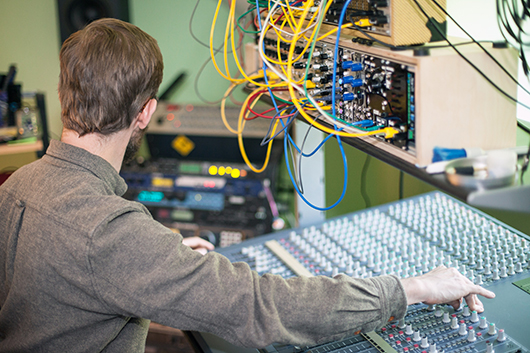
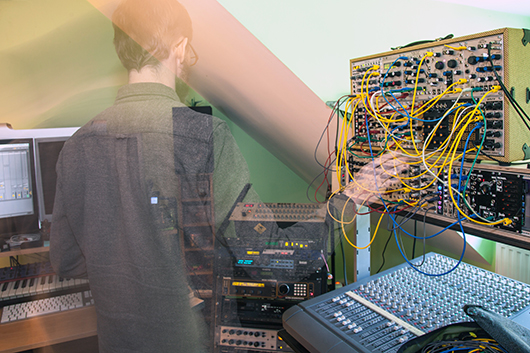
When it comes to techno, Anthony Child commands a level of respect that few artists can match. Since moving to Birmingham in the late ’80s, he’s released records as Surgeon via esteemed labels like Downwards, Tresor, and Blueprint, though he most recently issued his first solo record in over three years through Belgian imprint Token. This, coupled with the announcement of a six-part reissue series compiling some of his early material from old DAT tapes, got us thinking about the time in between and how Child has managed to keep his studio an exciting place throughout a 20-year career. Having recently been experimenting with a new modular set-up, the UK producer was more than happy to share some of the ups and downs he’s experienced along the way, and during the course of our conversation, he also touched upon the art of live performance and the importance of taking on new challenges.
XLR8R: A good place to start, since you’ve recently announced the SRX series, is at the beginning. What was your studio like around that time? Anthony Child: When I first started making music, it was purely with hardware because I didn’t have a computer at the time. I basically used whatever equipment I could get my hands on, so it was very basic. And quite frustrating at times as well, because the equipment was not really very good. But looking back now, I look at it in a very different way and I realize the good things about that, in the way that it forced me to be inventive and creative in the way that I used those machines. And it’s a story that repeats many times about people starting off with bad gear, or using it in a way it wasn’t really intended because they didn’t have a choice. So that’s very much the way that I started making music—having to force something out of bad machines, if that makes any sense.
There’s a great quote from you about how when you first began releasing music, the engineer actually had to leave the room while your record was being cut because no one understood electronic music. Where were you looking for advice at the time then, in regards to what you needed for your studio? Well, I actually moved to Birmingham in 1989 to study sound engineering at a technical college, and that was really good because I got to use a lot of studio gear that I never would have been able to touch because it was so expensive. You know, the mixing desks and the 16-track tape recorders and outboard gear and stuff like that, plus a few friends pulling any keyboards or drum machines or mixing desks together to create a very basic kind of studio and just creating in that really. And that was kind of the first period of making music, and that’s when the first music came out on Downwards and Soma.
So many people are referencing that early Downwards style as a source of inspiration at the moment. How do you keep the process enjoyable for yourself after so many years? How do you keep a sound interesting for yourself? I’ve experimented with different approaches over these 20 years, but when I kind of strip it back to the most fundamental idea, the most important thing is to make very, very honest music. That’s the most important thing—I don’t want the music to pretend to be something it isn’t. I don’t want to con people. I feel like putting music out there as purely and honestly as I can is the best thing I can do. It’s the best gift that I can give to people who listen to it, and buy it, and dance to it, or whatever. Whether they like it or not is completely up to them and it’s got nothing to do with me, but if I put it out there and it’s as honest as I can be, then that’s the best thing I can do, really, and everything just kind of builds from that. So for me, that’s like stripping it back to its essence. And it’s got nothing to do with its style, if it’s heavy or light or melodic or atonal, it’s just about very honest and pure expression.
Talking about honest and pure expression, how do you manage to make that work? I think that every technical approach to making music has its advantages and disadvantages, and it also depends on when that technique comes along in your creative life. So different things work better at different times. For quite a long time, I felt quite stuck with making music in the software realm. So if I actually kind of rewind a bit to make sense of that—I was talking about making music with this borrowed, very basic equipment, and this is going back 20 years ago. Then I signed a deal with Tresor and I actually got some advance money that allowed me to buy my own gear. That really changed things, because I got to choose what I made the music with. And that worked out well—I bought a computer eventually and started working with Logic Audio and Ableton, so my production gradually headed further into the software realm. And at times that was very liberating, because the ideas I had I was able to translate more effectively, and it was really liberating, initially. But staying in that realm for a long time, I began to realize that restrictions were actually a good thing and forced you to find creative solutions. I was really looking for a way of getting myself back on track.
So when you were immersing yourself in software, did you keep hold of your equipment? I haven’t got rid of any of my equipment. Not all of it still works, and sometimes a power pack might blow up and it’s completely impossible to replace, and DAT players get jammed, but I’ve kept everything. So more recently, I’ve been dragging a lot of that gear out again and having a lot of fun with it.
And you’ve been in this space for how long? It’s in the same place it’s been for about 10 years now.
Was it straight after reaching this point of frustration with software that you introduced the modular? It was just seeing more people playing with that stuff, and initially I wasn’t really… I encountered modular synthesis quite a long time ago, but I wasn’t really that interested in it because it seemed like you had to spend thousands of pounds to make a very basic kind of ‘clip-clop’ sound, and that didn’t really appeal to me.
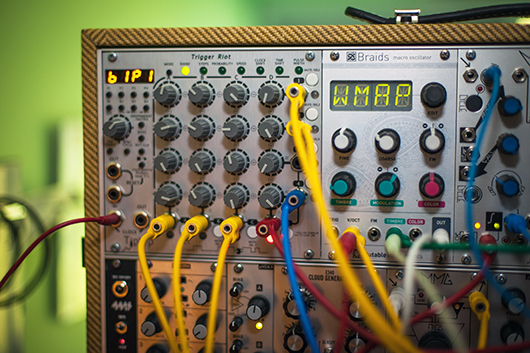
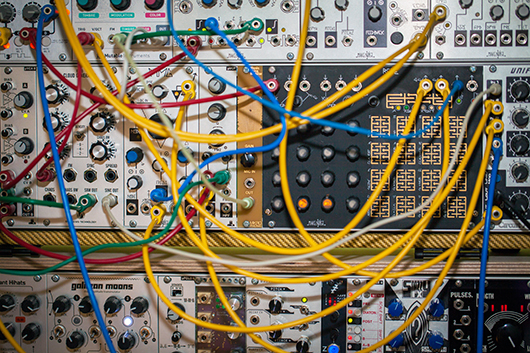
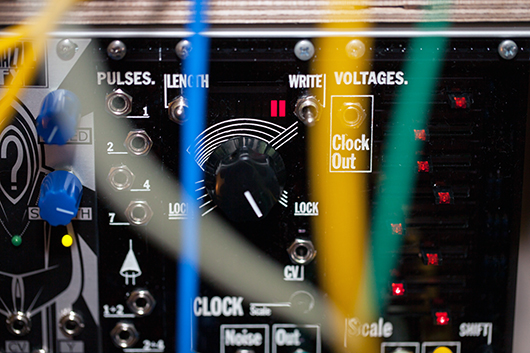
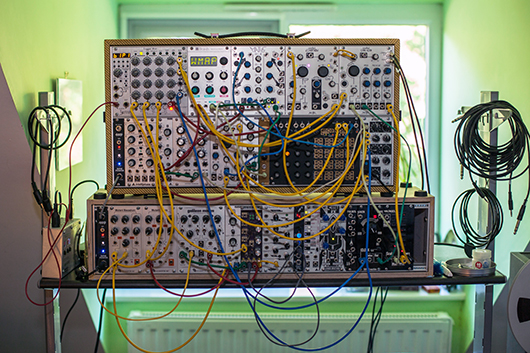
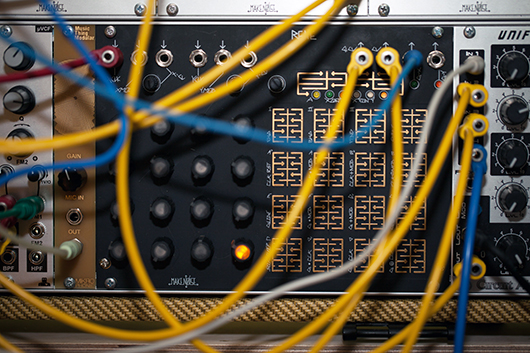
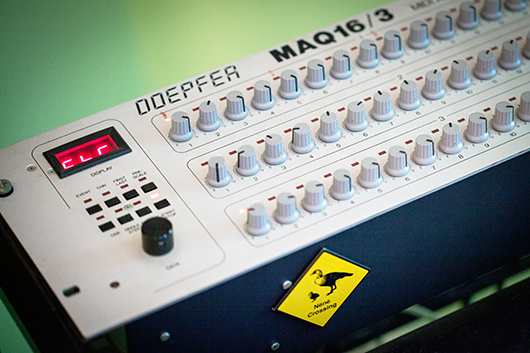
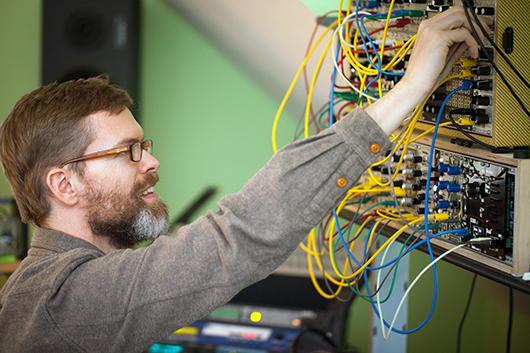
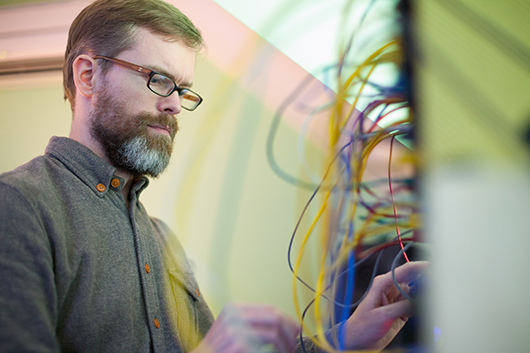
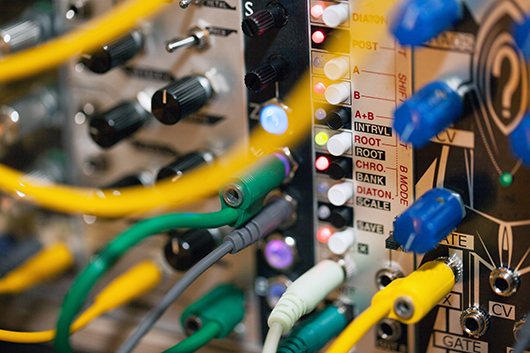
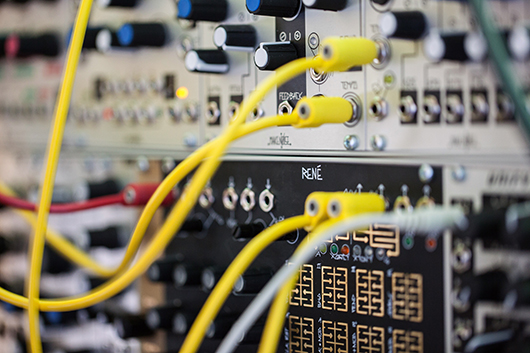
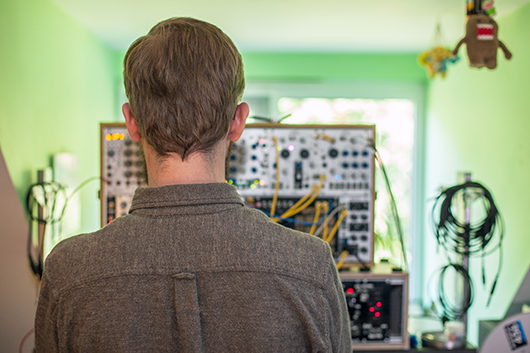
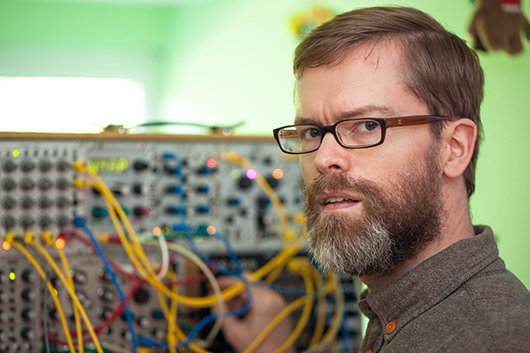
But [now ,] it’s really connecting with a younger generation of producers and [I enjoyed] seeing how much fun Jamie [Roberts (a.k.a. Blawan)] was having, because he and I do gigs together and I was confounded at his box of wires. But it just looked like a whole lot of fun, and that’s kind of what I was looking for, I think. Fun and play are very important aspects in music to me, so I just started playing around with getting into it—loads of Make Noise and Intellijel modules, Basimilus Iteritas and Zularic Repetitor from Noise Engineering, a bizarre random sequencer called the Turing Machine—and it’s just been really good fun, and quite a different character in the studio. It balances out really well with the computer and the old gear. It’s a real wild animal.
Blawan has talked about how he records big chunks of audio and then goes back and edits it afterwards. Are you working in the same manner? Are you using sampling techniques alongside it? Yeah, sometimes. A set-up that has been working really, really well is to basically take different outputs from the modular, so from each sound-producing module and effects and whatever. Take separate outputs from those and go to the mixing desk and then take the direct out from the mixing desk into the MOTU sound card, and basically use Ableton as a multi-track recorder. So I can record the jam, but I’m recording each separate aspect of it. And that way, I can mix it again or I can take separate parts of it, stuff like that. I found that a really good way of recording stuff with the modular, and I can keep it as it is or I can pull it apart.
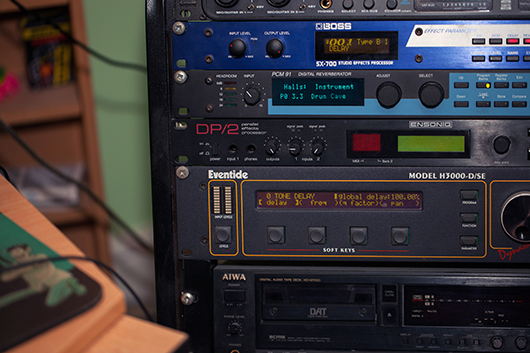
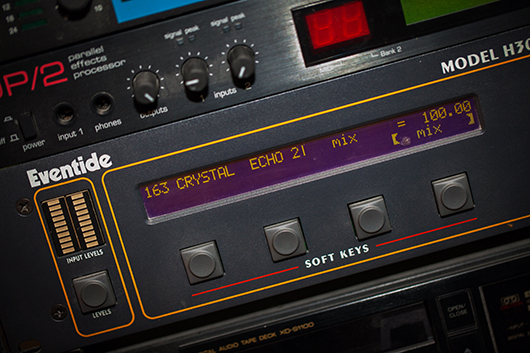
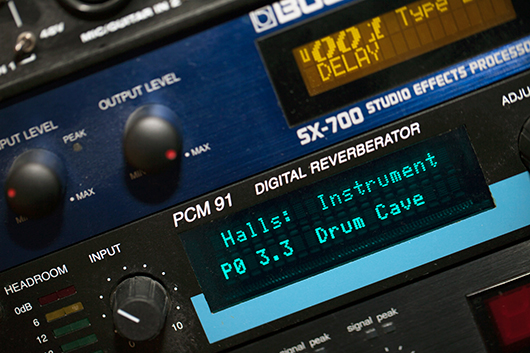
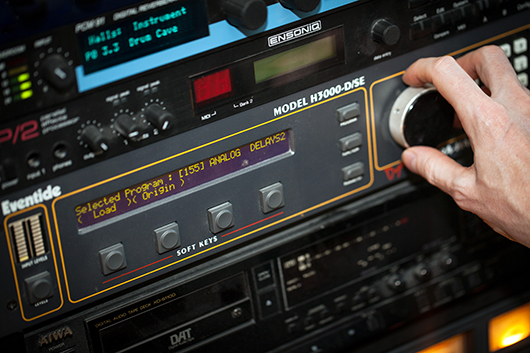
And what outboard equipment would you use to process those individual stems? The outboard gear I’m using when I mix the separate recordings from the modular is mainly a Lexicon PCM91, a Boss SX-700, an Eventide H3000 D/SE, an LA Audio Classic Compressor II, and a Focusrite Platinum Compounder.
Ableton is still an important part of your studio. How much of a creative tool is it, as well as a recording device? Well, for a very long time it has been the key thing in the studio, really, and I have done a lot of music purely inside Ableton and working with a lot of audio, but not using a huge amount of other software and hardware. Quite often, I find it good to bring the separate outputs from Ableton through the MOTU into the mixing desk, to mix it again, and it does give it a different kind of quality rather than just keeping it all mixed and rendered in the software. I have done a lot of projects purely with Ableton, but during the 20 years that I’ve been releasing techno, I’ve really found it very important to not get too comfortable with the method and the set-up that I use, and I’ve found that many times where, if the method gets too comfortable, if it doesn’t really challenge me or push me, it’s time to change it.
In the same interview with Blawan, he was talking about how he was using Ableton and then felt like he’d mastered it, somewhat, and it was time for a change. Do you feel like with your modular set-up at the moment then, taking it on the road with you, you’re challenging yourself? It’s quite unpredictable. Yeah. Similar to what you mentioned Jamie had said, I felt much more [like it was time for a change] in the performance side of things. I still call it DJing; I was using Ableton and it was working really well, and I was able to have very effective and precise control over the way the music worked, and the effect it had on the audience. And [I was able] to really control, very precisely, the energy of a DJ set. But it was starting to get too comfortable, and not really so challenging, so combining a modular set-up with that, it’s such a different character, sonically and—it’s like throwing a wild animal into the equation. It just works so well, because it sounds so different from Ableton. And the sounds don’t get in the way of each other, because it sounds so different. And when you play it over a soundsystem combined with Ableton, it sounds so fantastic, and they really fill in each other’s gaps with their strengths and weaknesses.
I’ve been doing that since late June I think. I just took it along for one gig, just to try it out, and I knew straight away there’s no way I’m going to go back to just playing with Ableton, because it’s just so much fun. It’s effectively improvising live over the tops of the tracks that I’m DJing. It’s really, really good fun, and the reaction from the people has been really good. I’ve noticed that even when they can’t see the modular, they react very strongly because the sound from the modular is so direct. They can really sense that it’s something that’s being created right there in that moment. And it creates something that’s very, very different from playing back a recording, whether that’s with Ableton or with vinyl or whatever format. I think it’s a really different effect that it has—it’s very powerful and really, really exciting.
This sort of hybrid—I mean, you still say it’s a DJ set, but it’s sort of evolved now, having all of these improvisational passages. Would you ever consider doing a completely improvised live set? Well, that’s basically what Jamie and I are doing with Trade now. We’ve been doing Trade gigs for a year now. I think we’ve done six, maybe seven. And technically, the set-up we use, it’s changed a lot. Currently it’s both of us just purely with modular, so we’re not using any computers or sampling. It’s very raw and very direct. Nothing is prepared because you can’t prepare anything, really, except maybe a patch that you’ve made. It’s really exciting because of that, but it’s totally like hanging on to a cliff with your fingertips. It seems to work and it’s very exciting and very raw, but I think it works because there are two of us, and it allows you to fill in for each other and have a bit of a breather. Doing a pure modular [myself]—maybe one day, but it’s a bit nerve wracking alone. I think it’s very different if you start to add stuff like drum machines into the equation.
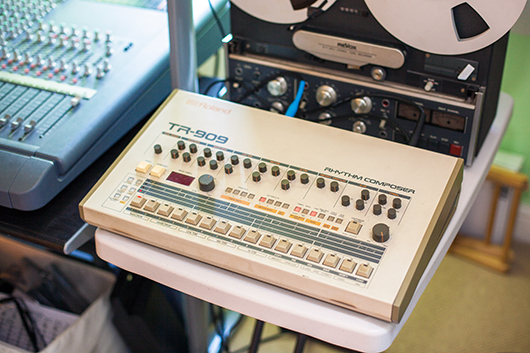
You’ve got a 909 in your studio. Have you ever brought that out with you? I haven’t done it yet. I’ve got some ideas about something that I would present as a live set that would involve modular and some other bits of hardware, and other parts using Ableton, but that’s just something I’m working on at the moment. I haven’t quite settled on exactly what the set-up is. I’m certainly not abandoning Ableton, it’s just serving a slightly different role in the equation. When I first started using a computer, I was using Logic Audio, and it was so much about menus—and I really hate menus, diving through menus to find things. I started using a very early version of Ableton; it was version 2, or something, and as the program grew and got more complex, I was still using it, so I saw it grow very gradually and I’m very comfortable with it. I still feel that’s my digital audio work station of choice, but it’s serving a slightly different function in my studio now.
With you utilizing this live set-up in the studio, and focusing less on structuring a track, is the end goal still to make records, or are you just concentrating on having fun with the creative process? All the different factors shift around in their significance and importance, and right now play and fun has really come back again. Because sitting in your studio in front of your computer monitor is not a fun state to be in at all. I’ve always said that I don’t want to release something if I don’t feel I have something to say. And an important thing to me is not having a release schedule that I hold myself to. And a lot of the time, I feel really satisfied musically from the DJ performances.
And you’re not in a rush to head to the studio to recreate them, or embellish recordings? I enjoy the transient nature of DJ performances, and having a recording is such a tiny part of the whole equation of what could make that night really special. Back to the beginning of when we were talking, it’s very hard to sum up 20 years, because my ideas have changed a lot and have been all over the place during that time, and I’ve explored different approaches and ideas.
It’s funny how many people come back with a similar story about how when they were first starting out, they were incredibly limited, and then they got into the digital age and realized that those limitations were actually what was most inspiring to them, and so their approach has almost gone full circle. I can definitely see that that’s kind of a common story. And I feel I’m in much more of a liberated situation at the moment, and not so stuck really. And that’s definitely a good feeling in terms of the music and performance.
Is it this liberation that’s lead to your recent ambient sets? Yeah, maybe. The ambient sets, they’re really connected to and expressing something that’s very, very personal to me because that type of music—when you’re talking about people like Coil, and those types of bands—that electronic music, I still love that. But it’s the music that I originally followed, way before I was ever aware of techno, or before techno even existed I guess, because I’ve been following music like that since the mid ’80s. So it’s a much deeper and more personal type of music for me. And of course I recognize that I can’t turn up at a big rave in Amsterdam and play that type of stuff, because it’s not really going to work. But there have been situations, like at Freerotation and Labyrinth, where the situation has been right for that kind of music and people have asked me to do that.
So it’s actually been something you wanted to do for a while, but you never really had the platform to do it. Yeah, it’s always been a real personal interest for me because I listen to and follow that kind of music, but there’s not often a performance situation that’s appropriate. I guess it also depends on how currently popular that style of music is as well.
Talking of new challenges and inspirations, what’s next for you? Is there anything you’re currently looking to obtain for the studio? I think with my current situation in the studio and with performing, I’ve really only just begun a very new chapter, in terms of bringing back hardware into the equation, getting into the modular thing—that’s a whole world on its own. So right now, it’s very inspiring, exciting, and fun. But I’m always trying to keep perspective and to not just get lost down this rabbit hole… It’s this kind of wormhole that you could fall down, and you could just sit there and wiggle away, and never ever record anything or make music because you just get lost in this modular world. So again, it’s having perspective and the discipline to say, “All right, I’m going to give myself a task and go through with it,” instead of getting lost.
Currently on the last leg of his brief North American tour, Gerd Janson has delivered the latest guest mix for Tim Sweeney’s weekly Beats in Space radio show. Unlike his recent XLR8R podcast—which found Janson confidently operating under a less-is-more ethos—the German DJ touches on a total of 15 selections (and some “EMERGENCY WIND NOISES!!!!”) across his 100-minute set, with tracks from the likes of Leon Vynehall, Joy Orbison, Fort Romeau, and Janson’s own Tuff City Kids project (a collaboration with Phillip Lauer) finding their way into the mix.
Janson’s full Beats in Space session can be streamed below, where it’s tracklist has also been included; the set is also available to download here.
1. Sad City – Polymath (Fort Romeau Edit) – Phonica Records 2. Jungle – The Heat (Joy Orbison Reduction) – XL 3. LoSoul – Behind Closed Doors (Theo Parrish Remix) – Elevate 4. Shadowfax – Shadowdance – Windham Hill 5. Lovebirds – Can’t Get Along – Winding Road 6. Roy Comanchero – The Delete Of Society – Running Back (RB051) 7. Oddworx – On It – Session Recordings < < EMERGENCY WIND NOISES!!!! > > 8. Bufiman – The Chase – Versatile 9. Tuff City Kids – Parallel Forest 1 – Internajonal 10. Traumprinz – I Love Ya – Traumprinz 11. The Working Elite – Freedom – Terre Des Pommes 12. Candi Staton – When You Wake Up Tomorrow – Warner 13. Lauer – Hands & Feet – Beats In Space Records 14. AKSK – Breaking – Unreleased 15. Leon Vynehall – Midnight On Rainbow Road (BAB 5) – TBC