As cities go, Barcelona is more beloved than most. With its sunny seaside location, stunning architecture, and reputation for late-night revelry, there is no shortage of reasons to fall in love with the place. For music lovers, Barcelona can be an especially rewarding destination, most notably in the late spring and early summer when Primavera Sound and Sónar—two of Europe’s largest and most well-respected festivals—each lure massive crowds from across the continent. During Sónar week, the city often feels like a legitimate hotspot for electronic music, as the festival draws more than 100,000 people and a myriad of unofficial “Off-Sónar” events fill Barcelona’s clubs with stacked line-ups and enthusiastic crowds. However, once the festival season comes to a close, a lot of that energy seems to melt away. Those outside of Barcelona may love to sing the city’s praises, but that passion often fails to extend to the music being turned out by the artists who actually live there. Acts like John Talabot, Delorean, and El Guincho have secured international acclaim in recent years, but there exists a much larger network of quality artists, DJs, and labels whose work generally flies beneath the radar.
Nevertheless, when beginning an examination of this network, John Talabot (a.k.a. Oriol Riverola) is certainly a good place to start. Following the release of his stellar debut album, ƒIN, in early 2012, he’s rapidly become Barcelona’s most widely celebrated electronic artist, an ascent that was further solidified in recent months by the release of his installment of the storied DJ-Kicks mix series. (By most accounts, it was 2013’s best mix album.) Talabot’s rise has been quick, but his journey goes back a lot longer than most people realize. A Barcelona native, he first delved into the city’s club scene as a teenager during the late ’90s. “My first impression was like, ‘What is this music? Who makes this music? Where do they sell this music?’ I was really impressed by the music in itself,” he says. “I was going up to the DJ booth and saying, ‘Hey! What is this track? Where can I get this?’ And people were like, ‘Fuck off! Shut up! You are here all fucking night near me asking everything.’ But it was because I was so impressed that I wanted to know everything about it.”

These days, Talabot’s music blurs the lines between house, techno, disco, and pop, but back then, his tastes went even further afield. “You could go to a club and one night there was DJ Assault playing and then there was a drum & bass night, and then there was a Rephlex (the label of Aphex Twin) night, and then there was a night of just Italo disco played by I-f and other people from Clone and Bunker,” he says. “People would just go to the club and listen to the music and decide if they wanted it or not, but they didn’t have the information to judge by the line-up.” Although this sort of musical diversity was more common in pre-internet-era clubbing everywhere, it’s something that has lingered in Barcelona to this day. Even now, there’s no real “Barcelona sound,” and many of the city’s producers seem to take more inspiration from what’s happening elsewhere in the world than from anything their hometown peers are up to.
“I think it’s a really good time for Barcelona, but in another way, I think there’s no super cohesive scene,” says Franc Sayol (a.k.a. Mistakes Are OK), a veteran DJ who’s heavily involved in the running of Talabot’s Hivern Discs label. (The two also co-host a weekly radio show, El Ritmo Infinito, on Spain’s Radio 3.) “It’s like everybody is doing his own thing and we don’t mix a lot. I would say it’s a good time, but also I think that there’s a long walk to go, to have a powerful thing to give to the world. A lot of people, a lot of music that comes from Barcelona, I feel like is still very dependent on things from the outside.” Riverola echoes the sentiment, saying, “I think that a scene comes up from a generation, and I think that we haven’t had a generation that builds something together in Barcelona. But that’s not bad. Everybody respects each other, everybody tries to help; they don’t work together, but they respect each other, and they support each other too.”
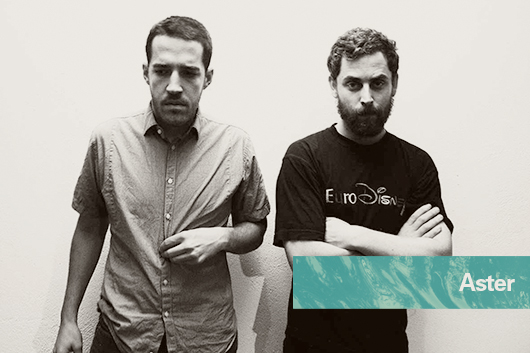
Hivern Discs has certainly done its part to help put Barcelona on the map. Much of the label’s early output was devoted to work from local producers, and several of its key artists are based in the city. Sayol previously released an EP for Hivern under the name Stainboy, and a Mistakes Are OK album is expected in 2014. The label is also home to Aster, the Barcelona-birthed duo of JMII (a.k.a. Jami Bassols, who currently resides in Berlin) and Pettre (a.k.a. Pedro Rufi). The pair’s melodic, slow-motion take on classic house sounds slots in nicely with the Hivern catalog, and undoubtedly has roots in the producers’ own clubbing experiences. “When we were kids, we always had international guest DJs in the city,” says Bassols. “But there weren’t too many people doing things like making music or having labels. And now, I think that really is growing, that kind of thing.”

Downliners Sekt is another Barcelona outfit with ties to Hivern—the duo reworked Mistakes Are OK as part of a 2012 remix EP—and the pair echoes the notion that some of the scene’s previous struggles to get noticed were systemic. They explain, “In the UK, they are really good at selling you scenes, where basically it’s one artist that does a great album or something new, so they put a new tag on it, and then everybody who lives in the same area is part of that… In Barcelona, there is no industry, nothing, so there is nobody who has really gone like, ‘Okay, we have this, we’re going to promote this.'” Downliners Sekt first came together in the early ’00s, so its members have seen and changed a lot over the years. The group’s current form—a two-piece with one member in Barcelona and another in Paris—has settled upon an enticing, albeit hard-to-pin-down musical direction, one which celebrates dark, bass-mined sonics, occasionally references leftfield electronic outfits like Mount Kimbie or the Brainfeeder collective, and also dips its toes into what sounds like deep, dubby house and techno. Parisian label InFiné issued the pair’s most recent EPs, Trim/Tab and Balt Shakt, and will be releasing a long-awaited LP from the duo sometime this year.
“The last years have been quite good,” says Downliners Sekt. “It’s because of the Internet, basically. It’s because finally it doesn’t matter anymore if you live in one place or another place… some people from Barcelona have gone totally worldwide—people like John Talabot or El Guincho or Delorean. People like that, they are from Barcelona, they live in Barcelona, but they’ve gone worldwide, and I think it’s really helping artists from here.” Still, Downliners Sekt does acknowledge that being from Barcelona has some benefits, at least in terms of perception. “It started in the ’92 Olympic Games or something like that. All of a sudden, Barcelona was put on the map and became this cool [thing]. Everywhere you go, if you say you are from Spain, [the response is] like, ‘Okay,’ but if you say you are from Barcelona, it’s like, ‘Wow!'” They continue, “There is no cohesion with [a particular] sound, but [living here] somehow helps, because outside of Barcelona, they perceive Barcelona as something really cool. Sónar and Primavera Sound are helping a lot with that.”

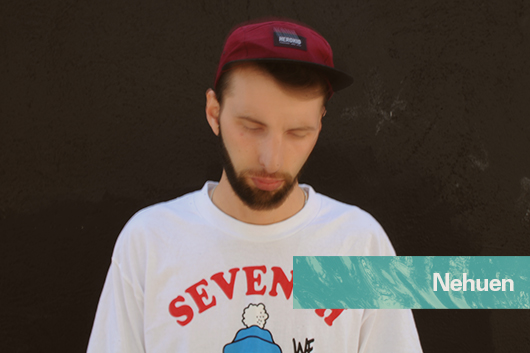
This perception also helps explains why many of the city’s more exciting producers aren’t necessarily from Barcelona, or even Spain. For instance, one label that’s been garnering attention over the past year or so is Classicworks, an imprint headed up by Cardopusher (a.k.a. Luis Garban) and Nehuen (a.k.a. Nehuen Mac Allister). Hailing from Venezuela and Argentina, respectively, the two producers both came to Barcelona in search of a better scene than what they had back home. Over the years, they’ve dabbled in various genres, but the duo founded Classicworks in 2012 and carved out a musical niche combining acid house, electro, footwork, and various forms of bass music. In many ways, the label’s sound is more in line with what’s presently happening in the UK and even the US than Barcelona, but Cardopusher and Nehuen nonetheless feel comfortable in their adopted home. “They kind of consider us from here—at least the people we speak to,” says Garban. “I think we are all in the same position, trying to do what we all want to do, trying to enjoy it. Because if you don’t, this network is never gonna grow up.”
(Photo by Ezequiel Bloise)
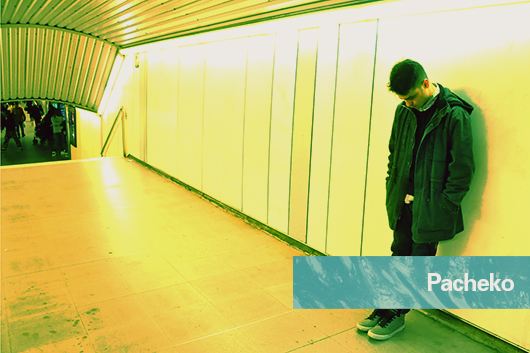
Pacheko (a.k.a. Francisco Mejia) is another Venezuelan transplant, a friend of Cardopusher who also came to Barcelona in search of a more vibrant music scene. Though he’s best known for his affiliation with the hard-to-define “tropical bass” world, specifically Venezuela’s changa tuki sound, his time in Barcelona has been rewarding, but challenging. “It’s not that you’re coming here and the next day you’re going to be like, headlining Sónar,” he says. “Job-wise, it’s not the ideal city; for instance, Berlin has more job opportunities and the rent there is cheaper, but then you have the weather and the language thing, and so each place has its good things and its challenges. In Barcelona, the balance for me was really cool, and I love the beach and I love the ocean. It’s kind of halfway between the Caribbean and Europe.” Mejia’s new surroundings have also brought him into contact with all sorts of new styles, sounds, and artists; in the process, he’s found himself increasingly drawn toward house and techno, and has even come up with a new moniker, Phran, to explore that inclination.
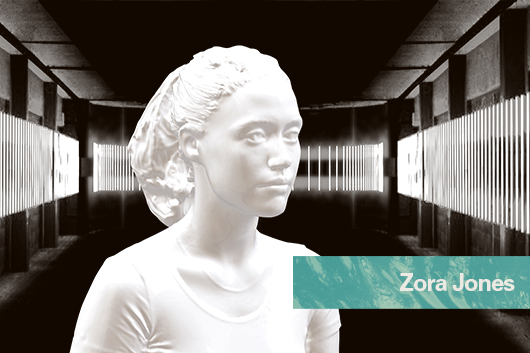
This freedom to operate is something a lot of artists find attractive about Barcelona. “The lack of a scene here gives me time to focus on what I want to do,” says Sinjin Hawke. Previously a resident of Montreal, he relocated to Barcelona two years ago to be with his girlfriend (and fellow DJ/producer) Zora Jones, herself a native of Austria. “I moved here [five or six years ago] because I really liked Spain, and Barcelona in general, because I really liked the people,” says Jones. “I didn’t ever have a connection with Austria, really, so I just came here on a vacation once and decided to move here.” It’s a simple enough story, but the couple has settled in and made a home in Barcelona (at least until Jones finishes school later this year). Admittedly, their shared taste for Southern hip-hop, Jersey club, and various hybrid forms of bass music doesn’t translate to many gigs in their adopted hometown—”In the last two years, I’ve DJed twice in Barcelona,” says Jones—but the internet keeps them connected to the larger music world and they both travel frequently to play shows in Europe and North America. Hawke in particular has seen his profile rise in the aftermath of his move across the Atlantic; he was a participant at last year’s Red Bull Music Academy and is finding himself increasingly in demand as a producer (often for hip-hop MCs) and remixer.
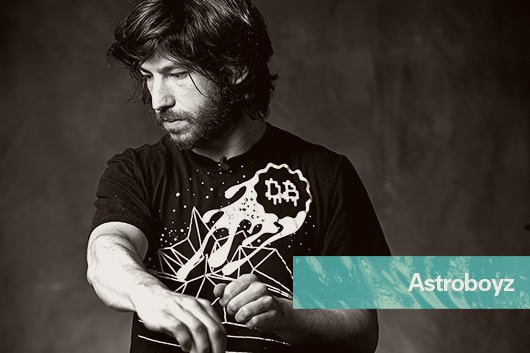
Another RBMA participant last year was Barcelona’s Astroboyz (a.k.a. Alex Silva). Like many of the city’s residents, Silva isn’t a native, though he is Spanish; after growing up in A Coruña (one of Galicia’s principal cities in the country’s northwest corner), he spent several years in Madrid before moving to Barcelona about five years ago. Over the course of his career, he’s released music on a variety of labels, but his most recent effort, Pianobatacazoo, was issued via the vinyl-only, Barcelona-based Struments imprint, which has also released a 12″ from Aster. Silva is happy to be in his current hometown, but he’s not so sure that the city has significantly affected his music. “The influence for me is that I have to pay a big rent every month,” he says with a laugh. “This stuff makes me be quick, you know? This responsibility makes me work harder.” Putting jokes aside, he elaborates, “I don’t want to say [the local scene] is shit, because I think Barcelona is more advanced than the rest of Spain in music.” He continues, “In Barcelona, I think there is not a proper scene, or maybe it’s starting now, because there are a lot of very good musicians, but the clubs, in my opinion, don’t support the local bands or local artists, and are always looking for money.”
Granted, a shortage of proper venues is a common complaint in electronic music scenes across the globe, but the problem seems to be particularly acute in Barcelona, especially given the city’s wealth of talent. In terms of a club circuit, Barcelona does have its bright spots (the reliable Nitsa [a .k.a. Apolo], and the more intimate Moog), a multi-room superclub (Razzmatazz), an out-of-the-way joint with potential (BeCool), and a handful of less desirable (and more overtly commercial) venues, but most artists seem rather unsatisfied with the situation. “The problem here is that we lack venues that are not very big, like small venues but with a good soundsystem, which is necessary to throw an electronic party,” says Sayol. “You have the traditional clubs or you have these really small bars with shitty soundsystems where it’s impossible to throw a party.” In these circumstances, many scenes would turn to underground or non-traditional venues, but Barcelona’s geography and concentrated layout usually takes that option off the table. As Riverola explains, “We have a really huge problem in Barcelona with the law, and the law says that if you do a party, and there is just one neighbor that you’re bothering, they’re gonna shut down your party… Barcelona is a small city—you will always bother someone.” Spain’s protracted economic difficulties aren’t helping matters either. “The club nights and the ‘scene’ are in the promoters’ hands—promoters that have been there for a long time,” says Riverola. “And when you are running a business, what you don’t want is to take risks. You want safe things, and you [especially] want safe things when there is a crisis.”

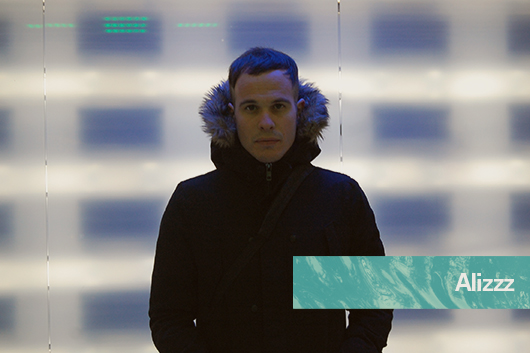
Spain’s ongoing economic crisis often dominates the conversation in Barcelona, as it’s seemingly affected just about every aspect of daily life, including the local music scene. Nevertheless, as the crisis has dragged on, one class of clubgoing customer has proven to be particularly recession-proof: the tourists. It’s no secret that Barcelona is one of Europe’s biggest tourist destinations, and a sizable portion of these visitors come to town looking to party. And though these people may be willing to hit the club in large numbers, they’re not exactly discerning in terms of music, which leads to less adventurous (and less local) programming on the part of the clubs. Over time, this has resulted in a real disconnect between the Barcelona club scene and the electronic artists who actually live in the city. “The club scene and the producer scene is completely separate,” says Hawke. “It’s very tourist-oriented—everything is for the tourists and the club nights are all about the tourists,” adds Mejia. Alizzz (a.k.a. Cristian Quirante), a bass-minded producer whose synth-heavy, R&B- and hip-hop-indebted music often draws comparisons to Rustie, agrees. Having spent most of his life in and around Barcelona, he knows the local scene well, and finds the club situation disappointing. “I think that the venues, the club scene, is not at the same level as the level of producers and people making music—that’s a pity. We are making really nice music, but we don’t have the places to perform.”
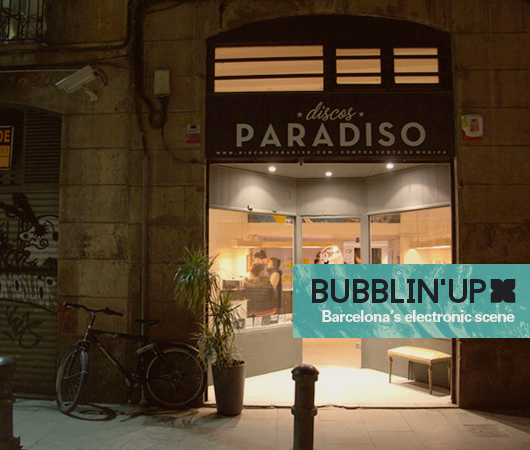
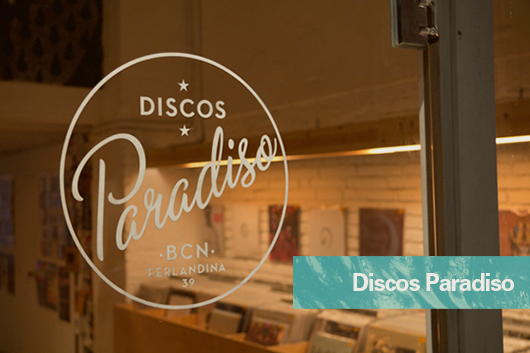
Without places to play and spaces to throw quality parties, a lot of networking that might normally happen sometimes goes by the wayside in Barcelona. However, there is one place that virtually everyone mentions as a true hub of the city’s electronic music scene: Discos Paradiso. A record shop in the formerly grungy, but now rapidly gentrifying El Raval neighborhood, the store was opened in 2010 by Gerardo López and Arnau Farrés, two guys who most people thought were taking a pretty big risk. “We thought that maybe—not that Barcelona needed this—but maybe there was a space for another record shop, or another kind of record shop,” says López. “We tried it. Things were very bad in that moment, all the people were saying that this was a crazy idea, but we have been open for three years and I can more or less pay my bills right now.”
Like their music-making peers, the Discos Paradiso crew has also taken notice of Barcelona’s lacking club scene. “All the festivals are full,” says López, “and during the year, most of the little good parties are [empty]. And this is not really right.” In light of this, Discos Paradiso’s owners sought to create a place that was not just a record store, but also “a shop where people can come and meet.” López explains, “That’s the basic difference between a shop and a mail-order webstore or whatever. We tried to be a point where people could connect.” By all accounts, these efforts have paid off. “It’s a church,” says Mejia. “You always see somebody there that you know and can have a cigarette or a drink with. You can drink some beers in the store, you can play in the store whenever you want, you can bring a bag of records and be like, ‘Hey, can I play?’ And they’ll be like, ‘Yeah, sure.’ So it’s always a really nice place to hang out.” Not surprisingly, the Discos Paradiso founders are also DJs themselves, and their monthly night at Moog is rapidly becoming one of the Barcelona’s best parties (and meeting places) for genuine electronic music heads.
(Photo via Pelousse)
Meanwhile, the number of intriguing electronic artists in Barcelona continues to grow. Clip! and Guillamino are both former RBMA participants who are experimenting with assorted strains of house, techno, and bass music. Marc Piñol is widely recognized as one of the city’s best DJs and recently reworked The xx’s “Fiction” as part of an official remix EP issued by Hivern Discs. David_M is another one of Barcelona’s top DJs; deeply connected with the UK music scene, his radio show on Sub FM is essential listening for anyone interested in the latest permutations of the so-called “hardcore continuum.” Then there’s beGun, a relative newcomer whose chillwave/synthgaze creations have started making waves, both at home and with internet-savvy listeners in other parts of the world. The Monkey Bar crew has built a following with its quality house and techno parties, and has also started up a label devoted to its love of deep dance sounds. Even the Primavera Sound camp has jumped into the label game, as its El Segell imprint champions a variety of indie and electronic acts.
With all of this activity, it’s no wonder that the local press has taken notice, and is actively pushing the scene as best it can. Playground is one of Spain’s largest music websites, and regularly covers electronic music. (Sayol is actually employed as a Playground editor.) Other enthusiastic sites include Concepto Radio and Clubbingspain, both of which also provide Spanish-language coverage of electronic music and often focus on the Barcelona scene. “The press supports a lot,” says Mac Allister. “I think there is more press support than the crowd/dancefloor support.” That said, the live music situation isn’t all bad. While there seems to be no real solution on the horizon for Barcelona’s lack of venues (or the existing venues’ occasionally bland programming tendencies), a couple of smaller festivals do offer a glimmer of hope for music fans seeking quality over sheer quantity. The Mira festival, most of which takes place in a refurbished industrial space outside the city center, recently completed its third edition with a line-up that included Panda Bear, Mu-ziq, The Haxan Cloak, Tiger & Woods, and several other electronic acts of note. In March, Montreal’s famed MUTEK festival will be celebrating the fifth anniversary of its activities in Barcelona. While past years have been relatively small in scale, the 2014 festivities will purportedly be much more elaborate; the announced line-up to date includes Kode9, Marcel Dettmann, Andy Stott, Nils Frahm, Laurel Halo, and several others.
Looking ahead, there’s little question that Barcelona’s electronic music scene at the very least appears to be moving in a promising direction. It may not be perfect, and it may not have coalesced around a singular sound or movement, but there’s unquestionably plenty of talent on the ground already. For relative newcomers like Mejia, Barcelona is a place that’s brimming with possibility. “People here complain and people here definitely have reasons to complain,” he says, “but for me, it’s all been really a blessing. It’s still a place where you can do what you love.” Quirante agrees, as he actually returned to the city two years ago after spending some time in Berlin, a place widely recognized as the pinnacle of electronic music culture. “Berlin was a nice city to live in,” he says. “The music was nice, the vibes were nice, I had good friends there. But everything was moving too fast, and I was making friends really fast, but those friends were leaving Berlin just as fast.” Having spent most of his adult life in Barcelona, Sayol certainly understands this sentiment and appreciates the city’s relaxed, low-key nature, but he also feels that Barcelona’s artists have some serious work to do. “We producers in general have to take a step forward and not rely on what we hear outside,” he says. “[We need to] try to be more personal and try to break some rules.” Riverola agrees, adding, “I think that in Barcelona there is something to build yet. So we can stay here and try to build it here… I prefer to stay here in my city and try to develop here in my job and try to help people here to develop themselves and their idea of a label or whatever, rather than just going away and developing [somewhere else]. I don’t know, maybe I am a bit Catalan in that.”