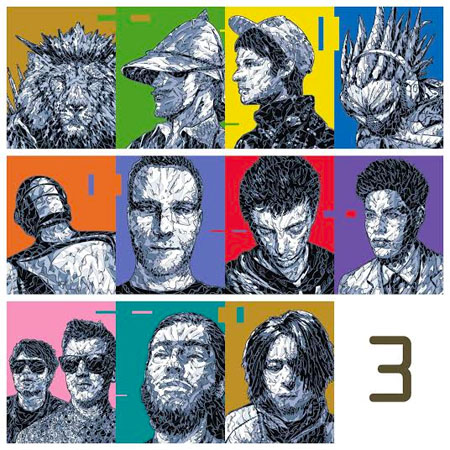
Based in Canada, the King Deluxe imprint has spent the last few years serving as a dependable hotbed for an international roster of genre-blurring producers. The label has decided to start 2014 by offering a free compilation, Year Three, which counts contributions from Julien Mier, Aleph, Metome, and others to its tracklist, alongside this rework of Alphabets Heaven from West Norwood Cassette Library affiliate Kamikaze Space Program. Living up to his namesake, the UK producer makes his remix all about, well, space. Despite its assemblage of galactic FX and textures, Kamikaze Space Program’s production is left wide open—allowing a few crisp rhythms and a dusty kick to remain in the foreground while trickling melodies, gliding pads, and tuned percussion sneak in from the sides. The rest of King Deluxe’s Year Three comp can be freely downloaded here.
While French company Arturia is maybe best known for its Analog Classic VSTs (faithful recreations of vintage synthesizers that are often heralded as sounding like near clones of their original versions), it nonetheless turned heads when it jumped into the world of analog instruments with the small-but-substantial MiniBrute and the even more compact MicroBrute. But the brand has not forsaken those who prefer the flexibility and ease of use that virtual instruments bring, having recently unveiled its KeyLab series. Arturia’s feature-packed MIDI controllers come bundled with the Analog Lab software—which includes 5,000 sounds from its various instrument emulations—and offer 25-, 49-, and 61-key versions of the product. It’s an expanded take on the smaller, more portable Minilab, and a new contender in a crowded field of MIDI controllers seeking to break down the barriers between software sound design and tactile control.
How It Looks
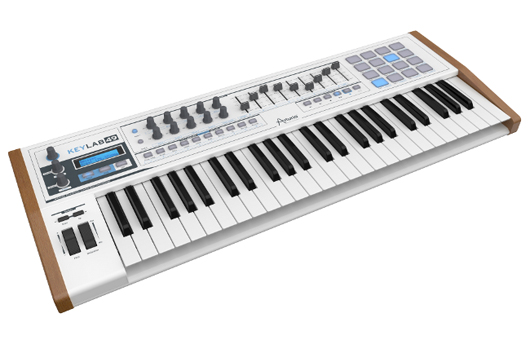
Unboxing the KeyLab 49 (the model we used for this review) immediately hints at Arturia’s goals—the controller is fairly heavy, solidly built, and elegantly designed. The real wood sides add a warm touch that most plastic keyboards can’t compete with, while the buttons, sliders, and knobs all feel substantial and sturdy. The same can be said for the keys themselves, which boast velocity sensitivity, aftertouch, and the right combination of weight and quick response. The 32-digit LCD screen is bright and easy to read from all angles, while the 16 pads on the side are perfectly suitable for MPC-style finger drumming, and can be easily programmed to play chords.
How It Works
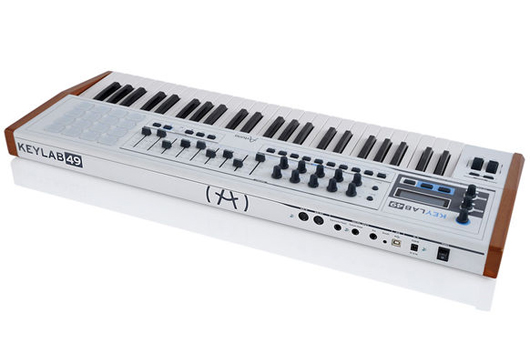
The KeyLab 49 can be used simply as a standalone controller for any DAW, and in this context, it excels. The array of controls on its surface—one modulation wheel, one pitch bend wheel, two banks of 10 encoders, nine faders, one volume knob, and 10 assignable switches—give users enough options to map an assortment of sound-editing functions, and setting up custom MIDI maps is expedited by Arturia’s MIDI Control Center, a handy piece of included software that allows users to quickly edit and save their parameters.
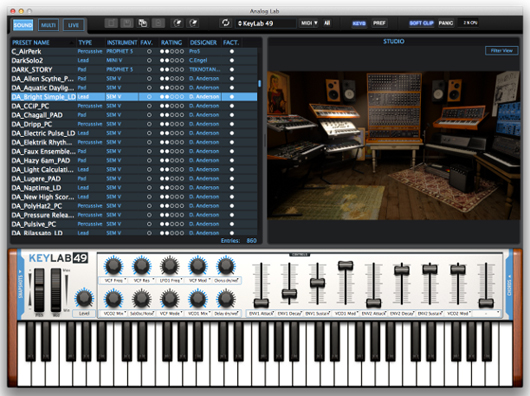
However, most users are likely to use the KeyLab with its bundled Analog Lab software, which can run as a standalone program for live use or as a plugin with any DAW. The included presets—which are categorized by genre, instrument, sound, or designer—can be used in either single mode or multi-mode, an option which layers multiple sounds together and allows the user to split the keyboard accordingly. The only catch is that each preset has a limited number of parameters available to edit, unless the user has already purchased that particular Analog Classic synth emulation. While this was initially frustrating, Arturia has done a nice job of selecting the most important parameters for each patch, ultimately helping save time and make choosing and customizing sounds a more streamlined process.
Analog Lab
How It Sounds
There is a reason that Arturia is one of the most heralded designers of software synths, and proof for that praise is readily available in the exceptional sounds that come bundled with the KeyLab. Spanning such synth emulations as the Roland Jupiter 8, Sequential Circuits Prophet 5, Oberheim SEM, and Moog’s MiniMoog, the 5,000 included sounds exhibit a depth and richness that make it very easy to forget they’re being digitally generated and not running through a slew of vintage electronics. Many of the presets sound ready-to-go without adjusting any of the potential parameter controls, which is not something that can be said for all software synths. A minor quibble is that a number of the included effects are fairly generic with minimal controls. Most users will likely run the Analog Lab through their own VSTs and DAW effects, thus making the included delays and compressors somewhat superfluous—not to mention time consuming to individually turn off.
The Bottom Line
Arturia has produced a sturdy, easy-to-use controller for its KeyLab series, one that will meet the needs of many users straight out of the box. Its substantial weight and highly playable keyboard, along with a bevy of tactile controls, makes it feel like a real instrument and immediately inspire confidence. When coupled with the diverse range of Analog Lab presets, the KeyLab is a great introduction into the land of VST instruments. However, those with experience programming real synthesizers might be inclined to purchase the full Analog Classic emulations; getting just a taste of each instrument without being able to tweak every parameter can be a bit unsatisfying. This limitation becomes a much more contentious point when considering the KeyLab’s hefty price tags (from $299 up to $499), as there are quite a few capable MIDI controllers with similar feature sets that sell for much less. Committed users of Arturia’s pristine Analog Classic instruments will find a lot to love in the KeyLab controllers, but producers with no such allegiance would be wise to take a second look and decide whether or not they want to commit to a relatively costly controller.
On Los Angeles-based artist Adam Forkner’s forthcoming THRU.U LP—a self-released record out on February 11, and the first White Rainbow LP to see a vinyl release since 2009’s New Clouds—he continues a pursuit of dreamlike beat collages and wonky electro-funk, often underpinned with his own spectral vocals. Featured here, lead cut “Batman Palace” bursts open in a flutter of hi-hats, confectionary synth layers, and a lilting, euphoric refrain which Forkner uses to ground the rhythmic havoc around him. The tracklist and artwork for THRU.U can be found after the jump.
1. Batman Palace 2. Cuban Egg 3. Killswitch 4. Don’t Wait 5. Dans On 6. Be the Dancer, Be the Dreamer 7. Touchdown 8. Plane 2 Sea 9. Only 4 Us 10. Terminator Failed 11. Screen Blind
Looking to make lots of money? Want to be a big shot in the music industry? Well, you should probably look elsewhere. But if you’re passionate about music and want to write about it, XLR8R is looking for editorial interns to work in its New York office, starting immediately. Please check out the requirements below, then send an email with “XLR8R NY Intern Application” in the subject line, along with your cover letter, resume, and 3-4 writing samples/clips attached, to [email protected].
NY Editorial Intern Requirements
– have a working knowledge of Word, Excel, and Google Docs, and be internet-, social networking-, and email-savvy – be familiar with XLR8R and its history, and have a solid knowledge of the artists and labels we cover (ie. be extremely familiar with the differences between house and techno, good and bad dubstep, IDM and EDM, etc.) – be able to get down to business with minimal hand-holding – be a serious writer with published (or at least publishable) clips – have a working knowledge of other media outlets that cover similar topics – be well organized – be an articulate written and oral communicator – be able to handle doing occasionally monotonous tasks – have a good attitude – have a critical approach to listening to music – have a basic familiarity with HTML and design tools like Photoshop
This internship is unpaid and requires a commitment of two five-hour days per week for four to six months. Candidates must be able to come to work in XLR8R‘s Manhattan office.
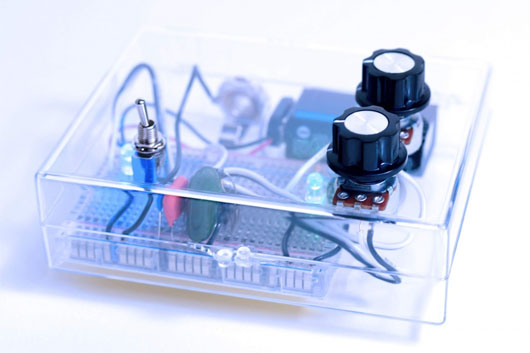
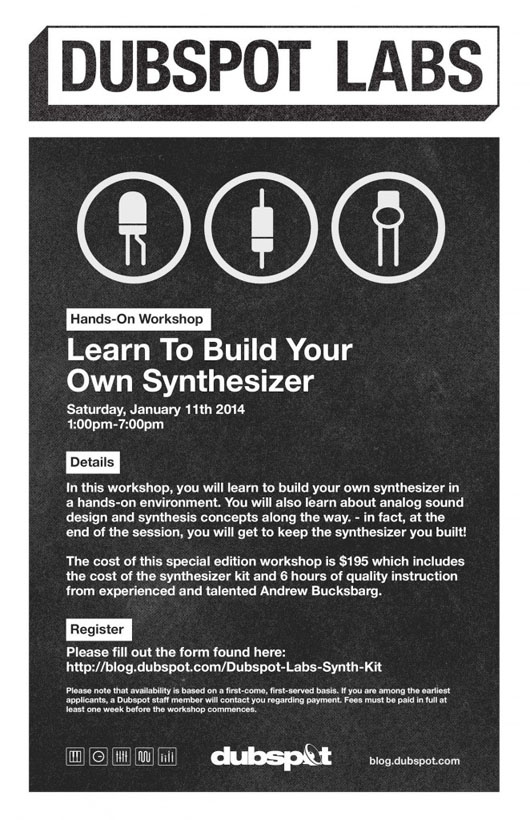
New York-based production school Dubspot (which recently revealed it would be opening a Los Angeles location in 2014) has announced Dubspot Labs, a new, ongoing series of special events and workshops scheduled to begin this weekend with a seminar on DIY synth building. Taking place this Saturday at Dubspot’s NYC headquarters, the six-hour workshop will give hands-on instruction on the basics of building synthesizers, and participants will leave with their own synth at the end of the day (something like the one pictured above). The class size is limited to just 20 students, and Dubspot is currently accepting participants on a first come, first serve basis. Enrollment in the one-day workshop is $195, which also includes the raw materials necessary to complete the course. More information can be found on the flier below; the full details are available here.
Portuguese outfit Photonz has been playing Chicago footwork purveyors DJ Rashad‘s and DJ Spinn‘s (pictured above) Shangaan Shake collaboration with South African artists Tshetsha Boys in its DJ sets for a while, coming to the conclusion that the track would mix well at the wrong speed, especially when paired with the duo’s own brand of gritty techno. For the “Photonz 33 1/3 Refix,” the blistering original cut is slowed down by a handful of rpms, and then augmented with TR-505 drum rhythms, Minibrute analog synthlines, and some light processing. The results offer a slurred, redlining edit that retains DJ Rashad & DJ Spinn’s skittish energy.
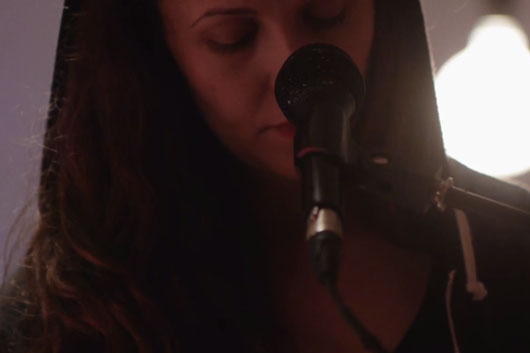
With Ontario native Jessy Lanza‘s breakout year just behind her and a short North American tour just ahead of her, the Hyperdub artist has turned in a new live session for Yours Truly. Performing in a dimly lit Montreal basement, the Canadian singer/producer (who we recently deemed one of the best new artists of 2013) utilizes a laptop and a Juno synth to accompany her silky vocals for a spellbinding live rendition of “Strange Emotion”—a standout cut from her debut LP, Pull My Hair Back. Lanza’s intimate performance for Yours Truly can be watched in full below.
XLR8R Couldn't find the embed function for type: "vimeo" and source: "<iframe src="//player.vimeo.com/video/82791431?title=0&byline=0&portrait=0&color=ffffff" width="530" height="298" frameborder="0" webkitallowfullscreen="" mozallowfullscreen="" allowfullscreen=""></iframe>".
Prolific experimentalist Jeff Witscher (a.k.a. Rene Hell) has kept a relatively low profile since September’s Vanilla Call Option LP—released via PAN, one of our favorite labels of 2013—but today Witscher has unleashed a brand-new mix online. Witscher says of his podcast for Resident Advisor, “I was just selecting pieces that were obviously very opposite as wholes, but consisted of smaller sounds that out of context could easily intertwine with completely different compositions.” Featuring noise and ambient work from the likes of Lee Gamble, Arthur Russell, Florian Hecker, Wolfgang Voigt, and William Basinski, the recording finds stark contrast between organic tones and their digital facsimiles. The full Rene Hell mix can be downloaded here, where a quick Q&A with the artist can also be found.
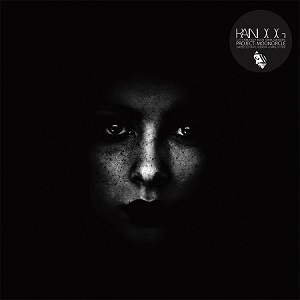
London producer Rain Dog (a.k.a. Samuel Evans) has spent the last few years carving a path of intimate and forward-thinking electronic music, eventually joining the Project: Mooncircle label’s growing roster. Ahead of his forthcoming Two Words LP, Evans has shared the beat-driven “Regolith,” an ambient-informed production which boasts a jangling piano amongst off-kilter claps and scattered vocal samples. The track is inclement and emotional, and finds its climax with a flurry of piano timbres and a vacantly drifting pad. Rain Dog’s Two Words album will be released on January 14, but until then, its tracklist and artwork can be found after the jump.
01. Felicity (feat. Bigson) 02. Cloven 03. Broken 04. Like a Lame Man Stepping 05. Regolith 06. Nerves Like New Thread 07. Nexus (feat. Robot Koch) 08. Once (feat. Tomika) 09. Fool’s Game 10. Watch Over (feat. Sam Rogers) 11. The World Is My Shotgun 12. Whistle And I’ll Come To You
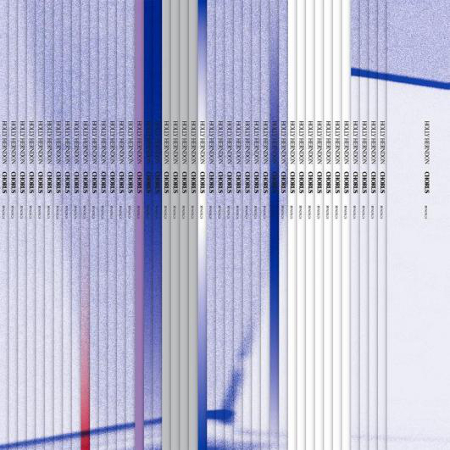
Returning to standout Brooklyn label RVNG Intl. (one of our favorite labels of 2013) for the first time since her 2012 debut Movement, San Francisco-based artist Holly Herndon has announced the Chorus 12″, both the artist’s and label’s first release of 2014. “Channeling YouTube, Skype, and other audio sources,” the title track furthers Herndon’s vocal explorations, this time harnessing samples from the Internet as well. On the flip, “Solo Voice” showcases a single track that “takes a rhythmic, polyphonic vocal effect customized by Herndon and spreads it across a spectrum of song to sputter for an unsettling minimalist accomplishment.” The official release for Chorus is set for January 20. (via Juno Plus)