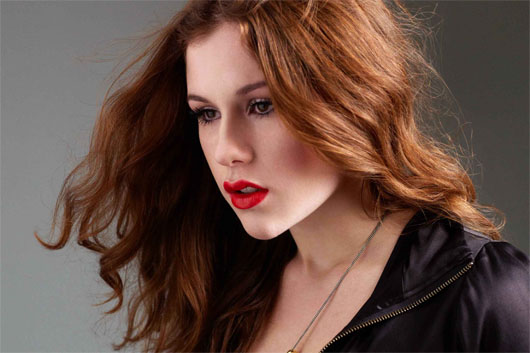
Before UK songstress Katy B drops a new single via Rinse next week, the chart-ascending vocalist shares “I Like You,” a dark club-pop hybrid produced by George FitzGerald. Built around one of the producer’s trademark deep, clean basslines and flecked with techno-minded percussion, the song balances Katy B’s pop aspirations with more underground sensibilities. The resulting concoction can be streamed using the player below, and a comprehensive discussion with George FitzGerald—as well as Duke Dumont, Bondax, and Hyperdub’s Jessy Lanza—about the portential rewards and pitfalls of navigating chart sucess as a club-music producer can be read in today’s Pop Goes the Dancefloor feature.
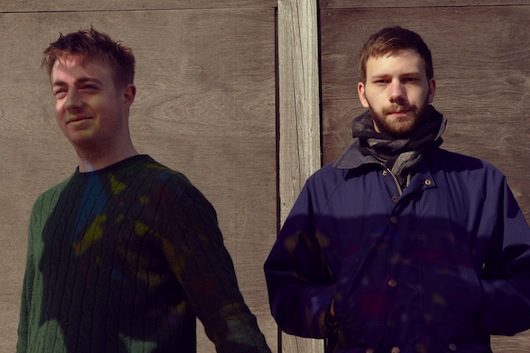
Tomorrow sees London duo Mount Kimbie release a Cold Spring Fault Less Youth companion EP via Warp, the three-song CSFLY Remixes, but just before then, the group has shared its last remix from the release, Pampa label boss DJ Koze‘s take on “Made to Stray.” The German producer stretches the original production into a slow-burning house rework, relegating the pads and odd textures to a more subtle space in the mix. At about the five-minute mark, the vocal refrain drops in as scatterbrained synth loops accelerate and skitter across the beat. A stream of DJ Koze’s full remix can be found below.
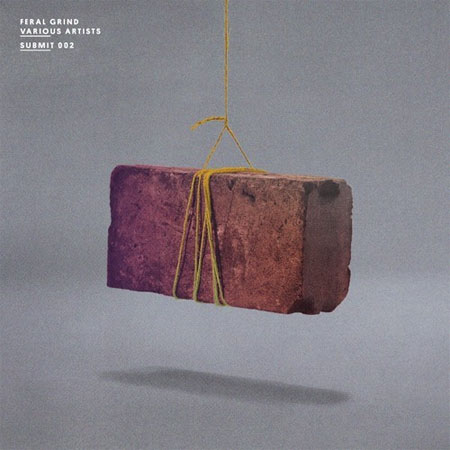
In the course of 2013, Ali Wells (a.k.a. Perc) has lanuched two new labels in addition to his established Perc Trax imprint, the club-minded Perc Trax Ltd. and the more experimental Submit label. The latter of those two outposts will issue its Feral Grind compilation—a collection focused on artists operating “at the intersection of techno, drone, and DIY electronics”—in late November. Featuring a handful of more established acts like Pete Swanson, Burial Hex, and Bleaching Agent alongside a considerable group of rising noisemakers, Feral Grind is a comp co-curated by Wells and noted music journalist Justin Farrar which strings together 12 tracks of hard-to-categorize electronics with an emphasis on Stateside producers. The collection will be available as a CD (with an extra track in the digital package), and will be preceded by a 12″ sampler with four cuts taken from the compilation. A preview stream of the full collection can be found below, along with the tracklist of the forthcoming 12″, before they both drop late next month. (via Resident Advisor)
Feral Grind 12″ Sampler A1 Pete Swanson – Pleasure Averse A2 Burial Hex – Final Love (Feral Love Dub) B1 Prostitutes – Braces On My Fangs B2 Profligate – Swarm
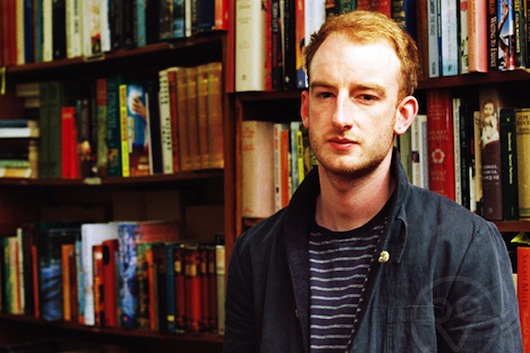
UK producer Kowton (a.k.a Joe Cowton) has been on a tear this year, serving up a healthy smattering of highly ambitious remixes and collaborations with fellow Bristol beatmeakers Pev and Julio Bashmore. For his next record, Cowton has readied a 12″ to drop via his own Pale Fire vinyl imprint. Both sides of “H-Street” b/w “Helsinki Sunrise” find the producer digging deeper into a minimal, gritty sound, making good use of overdriven kicks and spare arrangements that leave the rhythmic interactions in full view. Below, Kowton’s forthcoming record can be previewed ahead of its November 11 release date.
No-frills Australian techno duo Gardland has shown a proficiency with making the most out of a limited palette, and that same ethos is prevalent on the recenty released visual piece for “Nothing But Not Zero,” a track from the pair’s impending debut album Syndrome Syndrome (out tomorrow via RVNG). The tune finds Gardland balancing a stilted arpeggio and lonely, hollow-sounding synth melody over a straight ahead techno beat that subtly morphs as the track progresses. The accompanying visual is equally sparse, and uses extreme, wobbly close-ups of various landscapes—some recognizable, some foreign—to disorient the listener and heighten expectations for a sudden change that never comes.
Under his Lord Echo moniker, New Zealand producer and multi-instrumentalist Mike Fabulous has a knack for cramming together his disparate influences of jazz, boogie, and deep house by balancing uptempo trots with soaring melodic lines swathed in spongy reverb. “Digital Haircut” is the a-side from his latest single, a track which boasts bouncy beats and kaleidoscopic, nostalgia-tinged synths as it applys staccato trumpet stabs to its boogie-sourced groove. An ecstatic melody weaves its way around sampled guitar riffs and busy basslines before Lord Echo ends his track in emphatically abrupt strut and pose.
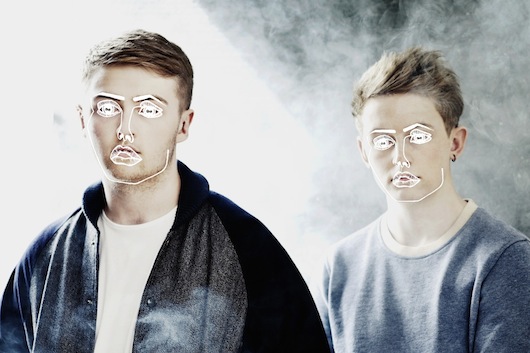
The English brothers of Disclosure, Guy and Howard Lawrence released their acclaimed debut LP, Settle, this past May, and today, the duo follows up its foray with a brand-new tune called “Apollo.” Leaning harder on a traditional house production, “Apollo” snaps with Disclosure’s typical intensity, this time focusing the female vocal line around the beat’s progression, rather than the other way around. With a set of outspoken synths filtered in a myriad of expressive styles, a cracking and composed rhythm, and the aforementioned vocal rushing by in a fit of delay and reverb effects, the Lawrence brothers have created a more practical club track to compliment the pop-slanted tunes of their debut. A full stream of “Apollo” can be found below.
Multi-monikered Hotflush label boss Paul Rose (a.k.a. Scuba) has shared details of his next release, a two-track single produced under his techno-centric SCB alias. “Rope” b/w “Technique” is described as offering “two deep, dark, and meticulously honed dancefloor productions,” both of which will arrive on November 11 via Hotflush. Rose’s new music will precede a compilation of selections from Scuba’s entire discography, called Update, a release which will feature 12 of the producer’s “most critically acclaimed tracks” lifted from each of his three albums and select singles. Update is scheduled to drop as a digital package on December 2.
For all its preaching about inclusivity, the dance-music community often likes to pride itself on appealing to certain sects while shunning others. Still, most years produce at least one ubiquitous hit, a track that balances hook and edge so deftly that it transcends style and audience; Tensnake’s “Coma Cat” and Storm Queen’s “Look Right Through” provide a couple of recent examples. Lately there has been a movement, particularly in UK chart pop, to replicate these tracks’ success on a mainstream level. This shift brings up a number of questions. Many of these chart successes began in nominally underground scenes. What have these artists changed in order to reach a new audience? And if they haven’t changed, what is unique about the current climate, in which a dance track can be a mainstream success? Meanwhile, less famous artists continue to play with populist aspects. What, other than record sales, separates them from the mainstream?
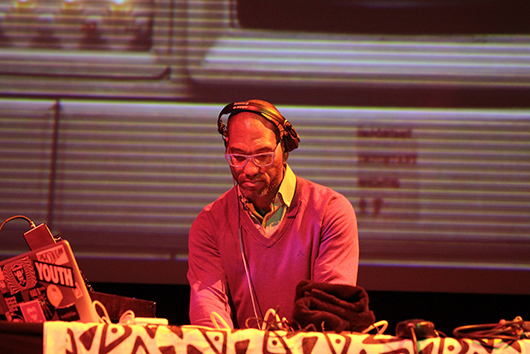
“My personal definition, and I don’t wish to impose this on anyone else, but it’s how I define pop music, is purely a song that has a vocal that is structured in a verse and chorus arrangement,” says British producer Duke Dumont (a.k.a. Adam Dyment). “If you consciously make a song that has a verse and a chorus, that’s a pop song.” After a string of nominally underground singles for the Turbo label, Dyment hit it big this year, making it to number one on the UK charts with “Need U (100%),” featuring the singer A*M*E. Granted, Dyment has been making music for years; his first single arrived in 2007, during a time when he was actively working within the now-maligned genre of “blog” or “fidget” house, chopping up pop vocals and inserting them into rousing grids of clicky drums. But doing “too many remixes” during this period eventually led him to start producing original material, largely in order to get DJ bookings. “Need U (100%)” was originally meant for his DJ tool series of EPs, For Club Play Only. But Dyment saw that “it had the potential to [reach] another level if [the song] got a good vocal on it. It would give it a much wider scope, a wider audience.”
Duke Dumont
Dyment didn’t set out to make a chart-topper with “Need U (100%),” but in its wake, does he feel pressure to recreate its success? Apparently not. “It was only a few years ago I couldn’t pay the bills, and was going to get another job and do my music on the weekends because I made so little money,” he remembers. “The real pressure is not being able to do what you really want to do, because you can’t afford to do it. Pressure for me now is obviously to keep the momentum going and keep on recording and—I mean, it’s pressure, but it’s not real pressure.” He’s a little reticent on how pop—by his definition—his new work will be, but the current speed of consumption seems a driving force: “People expect things at a quicker rate, and if it’s just you making music, maybe some audiences will get slightly impatient. The remedy to that is, everything you come out with, just make sure it’s really good. And then I think you can still sustain interest and have a career.”
Why was this particular track such a success, though? It’s clearly part of a popular wave of vocal house, or vocal house-esque tracks. Dyment feels that recently there has been a demographic shift. “When I first started DJing, it was an electro-house and techno environment. In 2007, 2008, clubs were 85% guys, without fail. At the moment, a lot of the clubs I play, it’s 50/50. Because there’s a lot of vocals in house music, I think girls can kind of warm to it a bit more.” The producer attests his favorite experiences DJing have been at “gay clubs, where the girls who are at the gay clubs know they’re 100% safe, and can just go and have a good time. The best experience as a DJ is when you look out at the dancefloor and people don’t give a shit how they look. They don’t care about anything else, they just want to dance and sweat and have a good time.”
It seems wishful to assume UK clubs have suddenly hit upon an egalitarian paradise, but surely something has changed. “The dubstep stuff got played out, and was just a bit too similar sounding and aggressive,” says Olly Wood, A&R at Black Butter Records, a diverse label that has found success in the currently house-friendly climate. “We were working on being an antidote to that, [releasing] stuff that was more girl-friendly, and it was just the right place at the right time—we managed to catch the mood. And now there are other labels that have a similar thing going on.” Thinking of pop house as a reaction to dubstep makes a bit more sense. Wood feels this is part of the UK charts’ natural pendulum. “Guitars will come back into it,” he predicts. “If you think about the last time that dance went into Britpop, it was like, there were bands with a dance aesthetic that were bridging it, people like Happy Mondays and Primal Scream.” If this is indeed the trajectory, his example of Black Butter’s centerpiece act Rudimental, a group with “live instrumentation… more like a band when they perform,” might then be ahead of the curve. “I reckon the dance stuff has got another year or two left in it,” he says.
Dyment and Wood have both been involved in releasing music for years, but the rise of the pop-club crossover has also been spearheaded by younger artists, among them the brothers Disclosure and the duo Bondax, both of which still have a teenage member. “All the kids that had a bit of an idea, have got the equipment to be able to just put that into something,” says George Townsend, who is half of Bondax, of the youth movement. “It’s so easy to make a professional-sounding track that you can create something interesting quite easily. There’s going to be even better and better producers coming through, younger and younger.” Bondax were too young to experience the shifts Dyment and Wood describe in the clubs, but they’re still wary about trends’ fleetingness. “In the UK right now, it’s very, very cool to like house music,” Townsend attests. “What I really hope doesn’t happen is that it falls in a similar way to dubstep, because too many people were just following fashions… you start closing that space for cool new music—which is really good right now, it must be emphasized. Like Chris Malinchak coming in at number two on the charts—that doesn’t make the track bad, that makes the charts really fucking good! This is the music we loved before it was popular, and now it’s popular because it’s good music.”
Bondax
Where Dyment worked to get his club track to a broader audience by adding a verse/chorus structure, the members of Bondax, perhaps because of their youth, sound much less calculating. “All we ever really wanted was to be big in the UK underground,” Townsend says. “To take influence from this music that we enjoy, which is seen as more underground music—because that’s what we’re into, that’s what we listened to before we were any success—and make happy versions of this kind of bass music. It was just purely a selfish thing—I guess we just have pop ears.” The duo isn’t actively fighting its popularity, but the guys are insistent that they somehow happened upon their success. “We always say to each other, as long as our intentions are right, if it becomes a big tune, then it doesn’t matter,” says Townsend’s companion, Adam Kaye. “We haven’t sold out. Even if it sounds more poppy, we [have to] like it in our heart. If it becomes a big tune then so be it, as long as you’re doing it for the right reasons, and you’re not doing it to make money or be a bigger act.”
It wouldn’t be surprising to find George FitzGerald‘s name in Bondax’s list of underground heroes. The London producer arrived in dubstep’s wake three years ago, releasing colorful, emotional takes on garage while balancing house- and techno-compatible arrangements with vocal hooks gleaned from popular R&B. If one was searching for a relatively underground precursor to the wave of house that’s currently sitting in the charts, one could make a very solid case for FitzGerald. The producer found popular success of his own this year with “I Can Tell (By The Way You Move),” released for Double Six, a subsidiary of major indie label Domino.
George FitzGerald
Where Bondax insists that the possibilities for pop are wide-open, FitzGerald maintains that his crossover track was a kind of once-in-a-career blowout, a “fuck off,” as he puts it. “For me, it’s very much like the end of a progression in my own music,” he says. “If you look at all the elements, there’s the deliberately old-school drums, and in the riffs and the sampled vocals. I got bored of using sampled vocals out of the R&B world, and elements I suppose I took from garage and vocal house. All of that was meant to be like, ‘I’m moving on from this. This is the last track I’m making like this.’ And in my head at least, it stands as this super over-the-top statement about finishing that off.” FitzGerald isn’t exactly sour about the tune’s popularity, but it’s clear it has exceeded his expectations, especially considering its place as an “endpoint” in his catalog. “I’m sure there’s a new market I’ve touched who want me to do another track like that, but it’s not going to happen,” he asserts. “I’m not saying I’m going to come and write something completely different afterwards—you’re going to be able to hear the progression.”
Regardless, FitzGerald did write “I Can Tell (By The Way You Move),” and it is a very popular track. How does the producer distinguish it from similarly big-room-ready tracks? “If things get too hooky, then people stop dancing—it becomes a concert rather than a dancefloor,” he says. “You have to bear that in mind. [For] that track, you could probably take all the same notes, and the same hookline, and produce it in more of a sterile, big-room tech-house style, so it would sound enormous on a soundsystem, and then it would sound kind of plastic and horrible. When I was doing the mixdown, my initial reaction was to make it as big-sounding and as pumping as possible. But actually that ruined the vibe of the track. In my head, it was meant to sound like some of the things from the ’90s: ravey, sort of acid house, like some of the stuff that made it into the charts in the ’90s. Actually, when you listen back [to music from that era] it has a really shit mixdown. It doesn’t sound as pumping as the stuff people make now. And that was actually the thing that kept the charm of the track.”
XLR8R Couldn't find the embed function for type: "vimeo" and source: "<iframe src="//player.vimeo.com/video/72142037" width="530" height="298" frameborder="0" webkitallowfullscreen="" mozallowfullscreen="" allowfullscreen=""></iframe>".
FitzGerald’s switch from club-oriented labels like Hotflush and Aus to Double Six isn’t exactly signing with a major label. But it gives the producer a unique home from which to release new forms, whether pop or experimental. He is insistent that “I Can Tell (By The Way You Move)” is merely a happenstance diversion in his discography, and not indicative of his relationship with the label. “It’s nice to work with a label where there’s more breadth,” he says. “It’s quite easy to get tunnel vision on the labels that I’ve been on, and that’s kind of what I want to get out of. Not broaden out in terms of going mainstream, but in terms of going into a world where—the people on Domino are equally underground, but they’re in a different world, they exist in parallel. It’s opened me up to loads of different stuff already, and it’s only been two or three months working with them. But already I’m thinking very differently about my music. My upcoming releases are not going to go anywhere near the charts.”
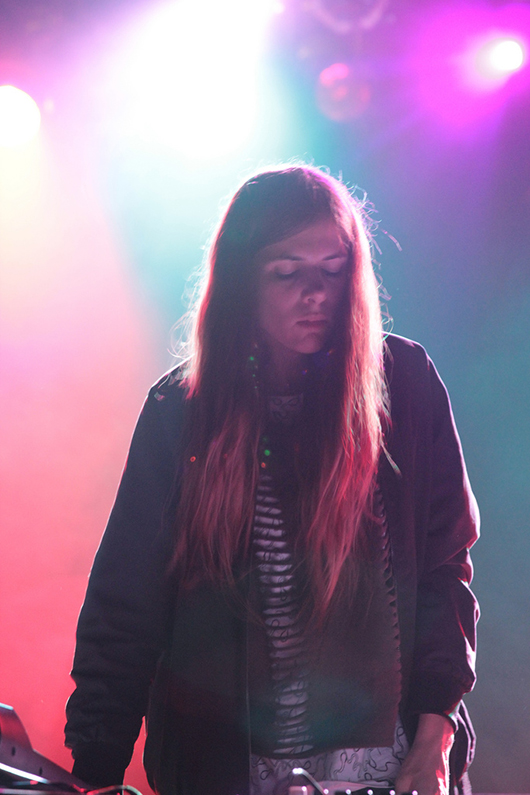
Jessy Lanza is signed to the similarly exploratory Hyperdub label, and has been featured in an article in The Guardian about “post-Cassie, post-Timbaland R&B.” Pull My Hair Back, the debut album she produced with Jeremy Greenspan of Junior Boys, has no chart-topping hits. “I was really flattered to be included with those people,” Lanza says of the article, “but I don’t even think Cassie was that important to me. I don’t see myself as being a neo-R&B singer.” Her wispy vocal presence is caked in delay, and as a result, the record’s intelligible bars are constantly dissolving into glossolalic fragments. This itself isn’t enough to ward off the mainstream; fellow Canadian artist Grimes has experienced a great deal of success experimenting with similar vocal treatments.
Jessy Lanza
As much as Pull My Hair Back is a pop album—and certainly by Dyment’s definition it is—it is a slightly crooked one, with its share of rough edges. “Some of the weird pockets come from the fact that Jeremy and I were passing files back and forth to one another, and he has a really nice studio and I have a pretty shitty studio,” Lanza remembers. “We both like to sit in the chair, and it’s hard for one of us to watch. We spent time together in the studio at some points, but a lot of the work would get done separately. Things would get layered on top of one another, so it has this kind of collage effect to it.” As a result, its hooks are buried, or sneak stealthily around its contours. While not a thousand miles from other dancefloor-meets-R&B fusions, its internal slink is perhaps too coy to really reach a mass audience. Lanza sees herself as more of a producer and songwriter, anyway. “I don’t have a crazy Katy Perry kind of voice, you know what I mean? I just don’t. When I’m doing vocals, I don’t think, ‘This is going to be the best fuckin’ vocal take,’ cause I can’t sing like that. I don’t have a strong voice. So I try to blend it into the mix in a way that’s interesting to people, because I’m not one of those powerhouse singers, and I don’t want to be. I think it’s more interesting to see how you can make it work in the context of the song while still keeping the structure.” Whether or not her songs are seen as having radio-ready hooks, Lanza seems fairly content with the public’s reception of her music. However, she is a little troubled by the assumption that the record was entirely produced by Greenspan. “People just have sexist opinions on production,” she says. “It’s just that old default of like, if there’s a girl and a guy making music, then the girl is the singer and the guy is the producer.” She admits that recording under her own name may have given people this impression, but the pair decided to forgo making up a duo moniker because, “Jeremy hates touring and has no desire to tour this record with me.” Even though Lanza is touring the record on her own, the lack of a big touring spectacle speaks to the project’s relatively humble ambitions.
In a similar sector of the North American dance music scene, though, more outsized trajectories are afoot. Olly Wood reckons Greenspan associate Morgan Geist is due for a UK chart-topper, as his 2010 single “Look Right Through,” written with Damon C. Scott as Storm Queen, was graced with an MK dub last year, and is now gaining popular traction. At the end of the day, it seems, chart success is still largely dependent upon how exuberant and outsized a song or performer is. Interestingly, almost everyone interviewed for this piece had either just released or was in the process of releasing an album. The album format typically lets dance producers that have been confined to 12″s experiment a bit more. At the same time, Disclosure’s Settle, the most prominent recent example of a pop-house LP, makes no excuses about being a simple compilation of singles. As we move into the future, one wonders how each of these artists will adapt to the format, and also how their respective fanbases, new or old, will accept it. It’s one thing to get into the charts, but it’s another entirely to sustain that level of popularity.
Last weekend, XLR8R headed down to Asheville, North Carolina for the first ever Mountain Oasis festival. Billed as an “electronic music summit,” the three-night affair was put together by the same promotional crew that was previously responsible for Moogfest. Given our general enjoyment of that event over the years—our review of Moogfest 2012 is here—we were optimistic about the prospects for this new event, even though its eclectic line-up presented a large number of acts that fell outside our usual range of interest. Still, we approached the event with open eyes and ears, and generally found ourselves having a pretty good time. Along the way, we also took note of some particularly memorable moments, which we’ve itemized in an effort to share a bit of our Mountain Oasis experience.
Jacques Greene (by Reggie Tidwell)
Asheville is a quality festival town.
In truth, the Mountain Oasis line-up looked like something hashed out between a college-radio music director and an attendance-minded booker. The artists that played the festival ranged from populist EDM (Bassnectar) to isolationist ambient (William Basinski), and from overly celebrated indie favorites (Neutral Milk Hotel) to 40-plus-year veterans that retain a distinctly cult appeal (Sparks). The line-up even touched upon ’90s alt-rock heroes (Nine Inch Nails) and and modern-day Pitchfork royalty (Animal Collective). From a stylistic perspective, it was all a bit jumbled, but as we mentioned before, the Mountain Oasis crew was previously responsible for booking Moogfest, and it seems that the all-over-the-map line-up is partly a symptom of the two organizations working out aesthetic custody issues.
Curatorial issues aside, Asheville is the kind of place that’s capable of sustaining more than one electronic-music festival. The city is a small, eminently walkable place, and among the five venues hosting Mountain Oasis events, the longest trek festivalgoers had to make was a 10-minute jaunt from a mid-size rock club called the Orange Peel to the ExploreAsheville.com Arena. In addition to the density of its venues, Asheville has a base of open-eared attendees from the local UNC, and it’s also accessible enough to draw fans in from places like South Carolina, Tennessee, and further afield—we spoke with someone who was visiting from Israel, and others from Minneapolis and Seattle who had come specifically to see Neutral Milk Hotel. Plus, with tourist attractions like the Biltmore Estate, the Thomas Wolfe House, a small museum dedicated to Black Mountain College, and a grip of excellent restaurants, there was plenty for visitors to do outside of partying.
King Britt (by Reggie Tidwell)
Still, despite the city’s general air of open-mindedness, several festival attendees told us that underground dance-music events remain rare in the area, although the region certainly has its outlets. Chapel Hill’s Nightlight club hosted Ital, $tinkworx, and Dynamo Dreesen the same night that Mountain Oasis started, and Carrboro’s All Day Records is one of the best mail-order distributors for dance music in the country. This base helps explain why the Mountain Oasis organizers felt comfortable putting together a sort of balancing act, one that featured both arena-sized names and more cerebral artists. It may have been a risky proposition, but it generally worked, allowing for a kind of cross-pollination between the EDM massive and more underground heads, all in a low-stakes environment with plenty of alternatives at every turn.
The primary downside of so much variety was an overabundance of choice. On average, at any given point during the festival—which ran from 7 p.m. to 2 a.m. on Friday and Saturday, and from 6 p.m. to 12:30 a.m. on Sunday—three or four events were occurring simultaneously. Still, Mountain Oasis’s organizers deserve credit for keeping the festival’s various threads as separate as they could. For example, juxtaposing Rustie’s trap-happy candy rave and Sparks’ arch cabaret was a savvy way of disappointing as few people as possible. At the same time, with so many options, it was difficult to curb our fear of missing out. As such, the weekend was filled with hasty snap judgments, a feeling of distraction, and crowd sizes that fluctuated wildly. The benefits of settling into a performance were clear when we could make the call to stay still, but just as often, the festival felt like a playlist on shuffle, with too many options to switch over to the next cut.
Laurel Halo (by Reggie Tidwell)
Laurel Halo might have confused the crowd, but we liked what she had to offer.
We’ve caught Laurel Halo at several festivals over the past year, and have usually been impressed with her ability to navigate between extended ambient passages, a ferocious hail of drum machines, and even her own mantra-like vocals. Halo has a reputation for continually evolving her live shows, and her Friday-evening set at the Orange Peel was destabilizing, even for the few people who seemed to know what to expect. The crowd reduced itself by two-thirds following Jacques Greene‘s pleasantly low-key opening set, which managed to make R&B and hip-hop-influenced house sound like slinky gray tech-house. Drawing upon her new Chance of Rain LP, Halo’s performance was vocal-less and even a bit formless, although it drew on a distinctly techno vocabulary. The oceanic masses of drum machine hits and the indistinct miasma of dissonant tones that made up her new live set reminded us of a substantially cleaned-up take on Chain Reaction-era Vladislav Delay. If there was a groove to settle into, it was several degrees removed from the immediate experience of the music, which hit the crowd’s organs as much as their ears, and yet the performance had a quicksilver quality, where its form was constant change. Understandably, she received the most ambivalent reaction from the crowd we witnessed during the whole festival. She started to veer off course somewhere around the midpoint of her set, with harsh tones straight out of a Morton Feldman piece failing to find common ground with confused drum hits, but she let things fall back together after 10 minutes of confusion. More than any other set at Mountain Oasis, Laurel Halo’s performance was a reminder that the means of electronic-music production can be used to question and undermine identity as much as they can be used to create a stable, predictable image.
Rustie (by Reggie Tidwell)
Rustie and Bassnectar shared some stylistic ground, but not too much.
Rustie‘s Glass Swords is still as good as it is tasteless; it’s saccharine done to perfection. There’s nothing subtle about that album’s diamond-eyed anthems, which sound like the kind of glossy, hyper-referential music that should be pumping in an anime warehouse rave. Rustie was slated to perform on Friday night at Mountain Oasis, and the promise of inescapable pleasure softened the blow of leaving Sparks‘ performance at the Diana Wortham Theatre only four songs into the veteran duo’s set. Rustie brought the Orange Peel closer to capacity than Laurel Halo had only hours before, but the venue was still large enough to leave plenty of room for maneuvering. The crowd also had a more diehard raver feel, and old-school standbys like furry boots and gloves with LEDs in the fingertips were in full effect for the first time (although it was only a taste of the no-holds-barred gurning that would accompany Bassnectar‘s arena set later in the evening). Rustie’s recent “Slasherr” b/w “Triadzz” EP found the artist being more overt about his trap leanings, but his live set was even more cutty, focusing on bumping low end and ratcheting hi-hats. It was too thick to resist moving to, but the highlights remained the odd moments when he’d drop a bit of “Surph” or “Slasherr,” which towered over their surroundings like prismatic pyramids. Once he wrapped up, we felt we’d be remiss not to swing by Bassnectar, both for contrast and continuity. The the ExploreAsheville.com Arena was extremely hype, although it was hard to make out the shape of the music, which was constantly exploding and collapsing like some sort of simmering, MSG-enhanced gruel of bass that kept the audience’s sternums vibrating at a resonant frequency. We walked away with no distinct impression, but did have a sort of gratitude about the more adventurous bookings that Bassnectar’s presence enabled.
Sparks (by Brock Caldwell)
Silver Apples and Sparks headlined a quality crop of electronic veterans.
When Laurel Halo’s set started to track a little wonky, we decided to poke our heads into the Silver Apples show at the nearby Asheville Music Hall. Originally a duo, Silver Apples now comprises singer and synthetist Simeon alone, following drummer Danny Taylor’s death in 2005. The show was more an act of intergenerational ambassadorship than an event in itself, and the anxious edge that makes the group’s recordings still sound so odd has been dulled, not unpleasantly, by age. Sibling duo Sparks, along with Alan Howarth and Gary Numan, were the other elder statesmen at the festival, but the pair came across as galvanized rather than diminshed by its long career; despite the brothers’ age, it seemed like they were still performing in their parents’ rec room strictly for their own amusement. Their tongue-in-cheek take on pop-music forms is not electronic music per se, despite their collaboration with Giorgio Moroder on No. 1 in Heaven, but there’s more than a little philosophical common ground between their constant irony and electronic music’s antagonism toward stable personas.
Ital (by Reggie Tidwell)
Actress, The Bug, and Ital brought the bass—and the heady electronics.
Ital warmed up the Orange Peel crowd on Saturday night, playing a set of warm and slightly cracked house rollers. Truthfully, we weren’t sure what to expect in terms of audience engagement, especially given the previous night’s Laurel Halo performance and Ital’s proclivity for live processing and tendency to get somewhat noisy at points. However, his set hewed closer to the sound of his recent 12″ for the storied Workshop label than the somewhat conceptual excursions filling out his two albums for Planet Mu, and the audience was intensely receptive, sending forth cries for even minor changes in direction.
But in terms of sheer damage, not even Bassnectar’s constant bass rattle could rival the nuclear assault that came from The Bug. The sliver of overlap between EDM’s pyrotechnics and The Bug’s bass-frequency science was more of the more fortuitous collisions at Mountain Oasis. On a visceral level, The Bug’s appeal was not lost on the crowd, even as it drew on a great deal of musical knowledge; his music is a melting pot of UK and Jamaican music descended from soundsystem culture, all infused with the grit of his earlier Techno Animal project with Justin Broadrick.
Actress was much harder to categorize. His live sets are never a sure bet, although it’s hard to tell the extent to which this is intentional. During his closing set on Saturday, he would occasionally lock into some sort of satisfying pattern, only to pull things back to a more protean, murky place. Judging from the excellence of his productions, it’s easy to assume that he’s simply on some other level and doesn’t care if we’re caught up, but another part of his live show does indeed seem intentionally sloppy and alienating, as if he’s uncomfortable with too much coherence. Still, Actress spent as much time being very good as he did being inscrutable, and was sometimes both at once, as when he closed his set with the tremendous “Raven,” only to take big chunks out of it with the crossfader. The set started out with bpms and track lengths comparable to his last release, the languid Silver Cloud EP, but the music offered little of the sonic clarity that lifted those tracks up above their torpor. Even as he transitioned into faster tempos and squelchy, crowd-baiting acid lines—almost hitting a Helena Hauff note—a compressed fog of low-mids sat stubbornly in the center of the mix. Ultimately, Actress ended up coming across as one of the highlights and one of the disappointments of the festival, taking listeners with him only to disappear behind a corner three blocks ahead.
Raime (by Reggie Tidwell)
Raime was intense.
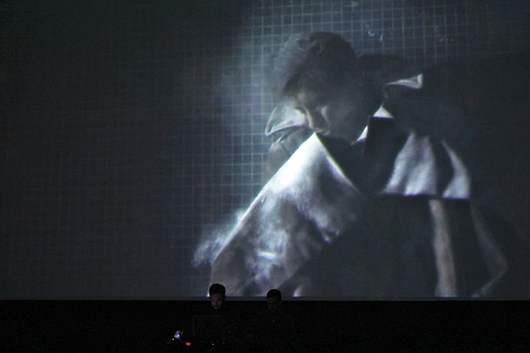
Raime’s Quarter Turns over a Living Line doesn’t scream out to be played at max volume—it’s autumnal, spare, and seemingly best served as a kind of atmospheric coloring. However, seeing the duo’s live set on Saturday at the Diana Wortham Theatre made us realize that the pair’s music works in a very different fashion than one might expect. Raime was preceded by the US debut of King Britt‘s Fhloston Paradigm project, which presented a cosmic arc of slowly evolving synth-and-drums improvisations, the music fleshed out with wordless, deep-space wails for maximum dramatic effect. It was a lot to follow, but Raime transformed the venue dramatically, dropping the audience into Hades with pitch-perfect videos that underlined the sustained, glacial intensity of the songs’ squealing samples. In one, a man in a chalky trenchcoat was writhing but hellishly incapable of pulling himself out of a nightmare; elsewhere, a man was pouring handfuls of construction dust over his back in some act of industrial penance. As striking as these images were, it was perhaps even more important that Raime pushed the bass to the forefront, so much so that the reluctant vibration of the theatre’s walls became an integral frequency. It was music of the long post-industrial nightmare, and something ideally suited to a seated experience. When we stood up after that onslaught, we felt as ghostly as the images that had populated the screen.
Mount Kimbie (by Reggie Tidwell)
Mount Kimbie capped a solid final night.
The last night of Mountain Oasis was its most song-oriented, as it featured sets from like-minded R&B fetishists Autre Ne Veut and How to Dress Well, along with a few UK acts on the cusp of the underground and something resembling broader acclaim: Jessie Ware, Disclosure, and Mount Kimbie.
Autre Ne Veut’s songs might be more obviously engaging than navel-gazing efforts of How to Dress Well, but their live sound at the Orange Peel was both murky and bombastic, which was a little strange considering that the only live elements were the singing itself and a somewhat superfluous, too-loud drum kit. Arthur Ashin laid into his songs with conviction, but also failed to hit his marks on the slo-mo strafe of “Ego Free Sex Free,” and it was difficult to tell whether his struggles merely stemmed from a miscalculated attempt to add some live juice to an Ableton performance or whether he was suffering from the same kind of monitor issues that Sparks and How to Dress Well openly complained about.
Bassnectar (by Scott Criss)
As the evening continued, Jessie Ware and How to Dress Well’s Tom Krell were responsible for some of the most entertaining stage banter of the entire festival, not that the competition was particularly stiff. Ware big-upped several couples at the Thomas Wolfe Auditorium for making out before doing a pocket cover of collaborator Julio Bashmore’s “Battle for Middle You.” Back at the Orange Peel, Krell dropped a couple aw-shucks gems. Prior to a new song called “Repeat Pleasure,” he said, “This song’s called ‘Repeat Pleasure’ and it’s about how desire will never be satisfied basically.” Things got a bit darker during his end-of-set ramble, as he shared, “I wanna have a baby at some point in my life, but I’m freaked out about them dying.” On the subject of his grandmother, who recently passed, he simply offered, “She was a bad bitch.” As for the music, his songs were technically not as overwrought as Autre Ne Veut’s, yet they somehow still came across as more overwrought that Autre Ne Veut’s, although assists from a pianist and cellist made the sound and intended affect much more legible and effective.
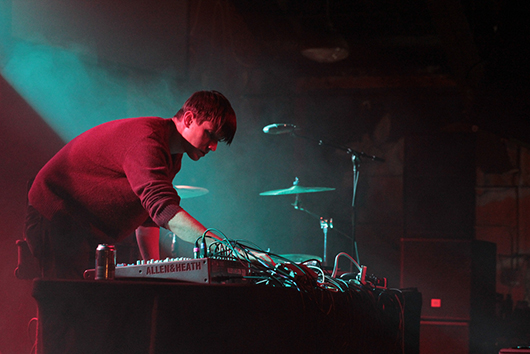
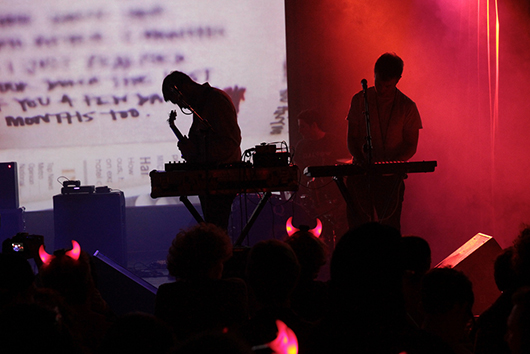
Before the night closed with the closest thing to an extended DJ set from The Orb—which presented two hours of slowly skanking, brightly colored, and movie-dialogue-festooned aquatic dub, packed in the thick syrup of Thomas Fehlmann and Alex Paterson’s childlike wonder—Mount Kimbie proved itself to be an unaccountably powerful live band. Projecting slides that appeared to be a kind of twentysomething Lomography parody of Godspeed You Black Emperor’s apocalyptic sandwich-board imagery—lovers’ pictures taken on vacation to New York, and cloudbanks with words like “PAIN” scrawled in red Sharpie on top—the duo drew primarily on its last album, Cold Spring Fault Less Youth, playing much of it live, including individual kicks. The singing could have been higher in the mix, but the imbalance served to underline the fact that, rather than retreating into the comfortable value system of songwriting, Mount Kimbie’s productions remain precise, and the group has found a way to go deeper into its own sound world while still leaving a few signposts up.
The Bug (by Reggie Tidwell)
When we weren’t rushing around, Mountain Oasis was quite fun.
Like any festival with such wide-ranging ambitions, Mountain Oasis’ strengths were intimately bound up with its shortcomings. Despite the best efforts of its programmers, we often found ourselves cutting out of a show less than a half hour after arriving, hoping not to miss part of another show that was happening a few blocks away. That said, when our aesthetic preferences and the program aligned, and an opportunity to settle down arose, the results were deeply involving on both the pop and experimental ends of the spectrum. And, however rushed we may have felt, things ran extremely smoothly, which was no easy task when one remembers that organizers were responsible for coordinating five venues over three days. Moreover, the venues themselves were solid and varied; each one was well suited to the acts they hosted, and the crowds were friendly and receptive, even to music that may have fallen outside their personal tastes. While the festival’s eclectic line-up was likely due as much to Mountain Oasis’ split from Moogfest (and a simple need to be economically viable) as it was any sort of innovative curatorial vision, it was still thrilling to see a huge undertaking such as this refuse to stay in any given lane. Granted, dance-music diehards didn’t find hours-long DJ sets and afterparties at Mountain Oasis—dance and electronic culture doesn’t exist on that scale in Asheville just yet—but it was hard to be disappointed when we were given the opportunity to see Sparks and Actress at the same festival.