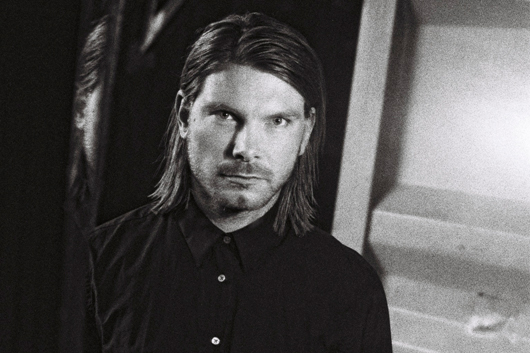
With his remix of Jamie Isaac‘s (pictured above) “I Will Be Cold Soon,” UK production whiz Hackman has now delivered three seperate remixes via our Downloads page in just the past four months (the other two can be found here and here, for those that missed them). Still, listening to his take on Isaac’s electro-acoustic-pseudo-R&B cut, it’s easy to hear why Hackman’s remixing services have been in such demand. Here, the UK tunesmith gently refits the lush track into a more dancefloor-oriented structure, leaving the essence of the original song largely intact while infusing it with a new percussive momentum and a characteristically enticing bassline.
It’s been a little while since Hamburg-based DJ/producer Tensnake (a.k.a. Marco Niemerski) dropped the limited-edition “58 BPM” 12″ via his own True Romance label, and the track has now finally seen a digital release, alongside the brand-new “See Right Through” single. To mark the occasion, a video has appeared to accompany Niemerski’s vocal-led “58 BPM.” The minimal clip uses abstract, spacey imagery that fits the tune’s slow-burning atmosphere, pairing the pulse of a distant light with some sultry close-up shots of various body parts. A video for “See Right Through” is said to be on the way next week, and is touted to be the first single from Tensnake’s as-yet-undetailed, forthcoming album.
We’re only a couple of weeks away from the release of Marcel Dettmann‘s sophomore LP, but the Berlin techno stalwart has only just shared the first leak from II‘s 12-song tracklist. “Seduction” is a sparse and moody production from the second half of the upcoming album, one which features warped bits of vocal work by Czech-born singer Emika. It might be somewhat slight on the kind of relentlessly churning grooves fans might expect from Dettmann, but makes for an interesting introduction to II all the same. Courtesy of Boiler Room, “Seduction” can be heard in its entirety below, before II drops on September 16 via Ostgut Ton.
Over the past three years, Atlanta-based producer Distal (real name Michael Rathbun) has proven to be a ceaselessly prolific producer, with a littany of quality releases under his belt for labels like Well Rounded, Grizzly, Seclusiasis, Fortified Audio, and his own Embassay imprint. Now, the seemingly tireless artist has announced plans to return to Pinch’s Tectonic imprint for a forthcoming EP. The Shadow Egg will present four new productions from Distal which continue to refit disparate dance music elements into powerful, bass-heavy hybrids. Furthermore, we’re told that the EP’s lead track will also be featured on Rathbun’s forthcoming sophomore full-length when it appears in January of 2014, though no further details have been shared at this point. In the meantime, the artwork and tracklist for The Shadow Egg EP (due on September 23) are included below, along with previews of two of its tracks.
A1 Ridge City A2 .25 Automatic B1 106 Degrees B2 Drone Circle
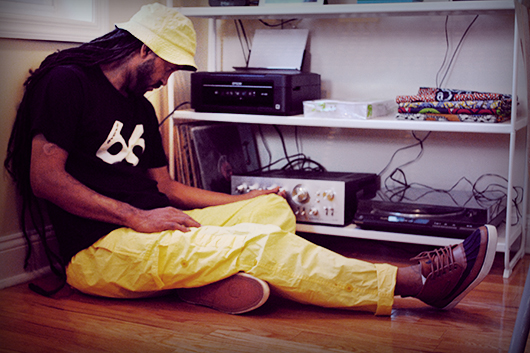
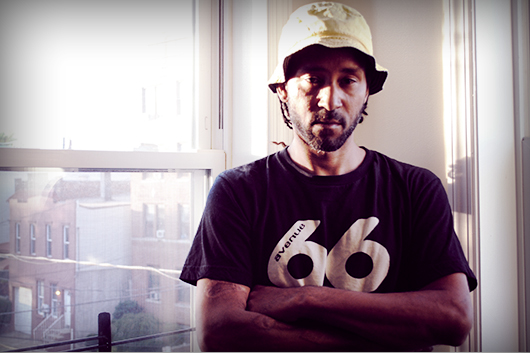
There’s something happening on the East Coast. A new generation of veteran house heads, folks who are old enough to have been clubgoers in the late ’80s and early ’90s, are dipping their toes into production with often startling results. In truth, this isn’t a new phenomenon—it’s an ongoing process that has already birthed a number of contemporary talents, including artists like DJ Qu, Fred P, and Levon Vincent. Now, we can add another name to that list: Joey Anderson, a New Jersey-based producer and DJ who’s found himself on the brink of success.
Anderson’s first public release came in 2008, when his track “Thee Analysis” appeared on the Exchange Place EP from DJ Qu’s Strength Music imprint. The song was deep house as recorded from beyond leftfield, a piece of loose, dub-techno-indebted, 5 a.m. dance music with a vocal that simply declared, “ad hoc and ad libbed.” That record’s message, a commitment to improvisation, has stayed with the producer over the years, guiding his work through and beyond Earth Calls, his breakout 2012 EP on Levon Vincent’s and Anthony Parasole’s Deconstruct label. But while “Thee Analysis” may have declared Anderson’s intentions, the truth is that artistic improvisation has always been a part of his character.
He grew up in Hoboken, New Jersey, a town that sits in shadow of Manhattan, just a short trip across the Hudson from New York City. As a young man, he was first drawn to music as a dancer, an activity that he would ultimately spend a large part of his life pursuing at a competitive level. “When I was 11 years old, [dancing] was a popular thing in the neighborhood,” he recalls. “We did it for bragging rights; everyone wanted to be a good dancer. But I got a little serious and my friends were so competitive, so we just kept practicing, getting better and better.” Running with his friend DJ Qu, he soon branched out from Jersey and hit New York’s club scene, honing his chops on the underground dancefloors of yesteryear. Of these he remembers the Sound Factory, and its hard-hitting DJ Junior Vasquez, as being particularly influential. “It was a spot known for [house dancing],” says Anderson. “It’s where all the dopest dancers were. You’d see dancers you’d see in music videos—popular hip-hop videos and [videos from] Crystal Waters. You’d get a chance to see them dancing in [house dancing] circles and that was the attraction for us. You’d be learning the newest and rawest stuff. You’d get a first-hand look at the most popular thing, the newest thing going on.”
It was on the dancefloors of New York’s historic institutions that Anderson cultivated his own style of movement, something that’s chronicled today on his YouTube channel, which features videos of Anderson doing graceful footwork and balletic spins that occasionally branch into more abstract forms of interpretive dance. He says of his style, “When I was coming up, it was about being fluid and mobile while being as tight on the beat as possible—flowing. The flow was important because it showed you understood the style and the dance language. Nowadays it’s about floorwork and tricks—breaking, you know? In my time, you had to do both, but you got more respect when you had more language on fluid moves—dance moves, not tricks.” In the ’90s, he remembers seeing the clubs being flooded with Japanese dancers interested in learning the rites of East Coast house dancing. This drove him to become better, but it also led him take up a part-time job as a dance instructor, where he forged a bond with the Japanese house-dancing community and eventually built connections that would see him travel to Japan multiple times to compete.
This background in dance informs his music, though not necessarily in an easily understood way. He says of the connection, “When I’m dancing, I’m trying [to make people think], ‘How did you create that?’ That’s what my students used to [ask] me. Being creative and being able to think on the spot is an integral part of competitive dancing. When I sit down and start working on songs, in my productions I try to look for a spot where [I can] build to a point where [you think], ‘Why did he think of that? Why did he put that in there?”
As an example, Anderson points to “Earth Calls,” a sparse, five-minute track that layers splotchy piano melodies and circular, monophonic synth leads above a skipping kick drum. Around the four-minute mark, the track is joined by jarring, dubbed-out stabs that sound like severely mangled guitar power chords. They appear out of the blue, but their inclusion doesn’t feel extraneous; somehow, they fit and manage to elevate the song to another level entirely, placing the listener (or dancer) in a disoriented state that’s altogether welcome. Moreover, Anderson executes the whole thing with style, which helps explain why the track became so highly anticipated when it first debuted as the opening cut on Levon Vincent’s stellar Fabric 63 mix. It later went on to become one of the standout tunes of 2012, a unique American dance record destined to soundtrack dim, red-lit basement parties for years to come.
When Earth Calls dropped, it changed things for Anderson. Or at least it did in the public’s opinion. “Well, in the eyes of the world [it changed things], yes,” he says. “That’s how they look at it, but a lot of people say, ‘We always knew Joey.’ To be featured on Deconstruct was more of an honor for me. To be asked by Levon meant more to me than the acclaim that the record got from the world. It’s a hot label, a very unique label. So I’m honored, and after that a lot of other labels have asked me [to do records for them] because of it.” Prior to Earth Calls‘ release, several of Anderson’s records had charted in the underground, including other stuff on Strength Music, a track on an Underground Quality sampler with Jus-Ed, and another on Fred P’s Soul People Music. He’d also started his own label, Inimeg, with a string of EPs that featured his original content alongside guest appearances by the likes of DJ Qu and Jus-Ed. The first of these, Organisms, was a heavy, four-track effort that envisioned a more brutalist direction, with abrasive sounds and raw acid augmenting his atmospheric dub tendencies and vocal explorations.
Today, Inimeg goes on, but Joey has increasingly found himself in demand as a producer and DJ around the world. In 2013, he’s already put out five records, the standout being the supremely psychedelic Above the Cherry Moon EP, which kicked off Absurd’s Avenue 66 sub-label. With so many records on the market, other producers might be tempted to take a breather, but Anderson has plenty more in the works, including an LP for Dekmantel in the fall and a soon-to-be-released 10″ for Synchrophone called Come Behind the Trees. It might seem scattershot, but Anderson says he “looks at it as one big long story.” With that in mind, it’ll be exciting to see what the next few chapters have in store.
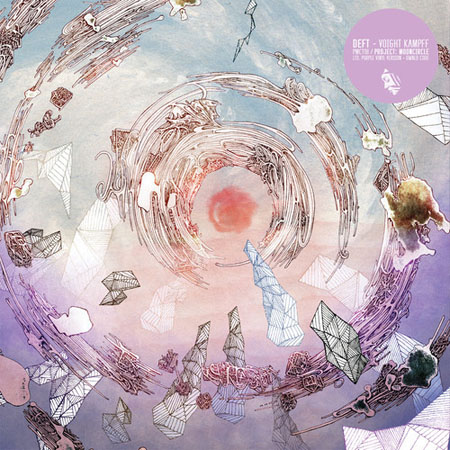
After unveiling the video for “Faded,” a track from Deft‘s forthcoming Voight Kampff EP, the Croydon-based producer has given us another cut from his forthcoming record. “Rising Sun” feels like an appropriate title for the single, with its loping 120 bpm groove and cascading pieces of clattering percussion. On top of these rhythms, Deft deploys an array of warm, side-chained pads which thicken the track’s foreground, while sun-kissed melodies and chopped samples float restlessly in the background. With both “Faded” and “Rising Sun” as early indications, the upcoming Voight Kampff EP seems likely to deliver dense textures and poignant moods when it officially drops on September 6 via the dependable Project: Mooncircle label.
2013 has been a big year for Letherette. Following the release of its eponymous first full-length and the album’s first single, the woozy “D&T,” the duo has now released its next 12″, After Dawn, which features remixes by Bibio and Barker & Baumecker, as well as a Jimmy Edgar remix of “Restless,” another track from Letherette.
By Letherette standards, “After Dawn” is a subtle production; whereas the duo’s usual club fare is often influenced by French filter house, “After Dawn”‘s slow, steady rhythms, swirling synths, and unobtrusive bass seem to draw inspiration from nu-disco. That’s not to say that “After Dawn” lacks club appeal or is a bad track; it’s well produced, enjoyable, and catchy. It does, however, somewhat suffer from an air of restraint, which is strange for an outfit like Letherette, whose best, most engaging efforts come from trying for bombastic or, alternatively, experimental sounds.
That said, the remixes here compensate where the original falls flat. Barker & Baumecker provide a particularly interesting take on “After Dawn”; what begins as a punchy house rhythm morphs into a bounding, energetic affair as it’s injected with the duo’s techno leanings. The melody is immersed in a thick coat of wonk, and the originally understated bass morphs into a deep, rumbling growl. Bibio’s rework stands out just as much; the Warp artist strips “After Dawn” of its disco underpinnings, then distills the beat down to a slow, sensual crawl. Syrupy G-funk synths, syncopated bass, and even the occasional guitar flourish are added into the mix, making this version of the track a more intimate affair.
With its chunky 4/4 rhythm, warped synth stabs, and airy female vocals, “Restless,” the record’s b-side, flirts with a house aesthetic. While it isn’t really groundbreaking, it’s engaging and fun, and Jimmy Edgar does a good job of giving the track his own personal touch without losing those vibes or straying far from the dancefloor. He takes a flashy, streetwise approach—especially in regards to percussion—by adding bits of Southern hip-hop skitters to the original’s upbeat house rhythm. The melody and vocals of “Restless” are similarly chopped up and reconstituted, with the synths being stretched, compressed, and warped even further through disjointed yet catchy melodies.
After Dawn may not be the best thing in Letherette’s discography, but that’s not a bad thing. Taken as a whole, it’s not as though either track strives to be anything more than fun or catchy, and both “After Dawn” and “Restless” succeed on those fronts. Even if that wasn’t the case, the ensemble cast of remixers does a good job of picking up the slack and keeping things fresh.
We’re happy to announce that XLR8R will once again be hosting a showcase at this year’s iteration of Decibel Festival in Seattle—an event which will include performances from recent Kanye West collaborator Evian Christ (pictured above), fellow Tri Angle affiliate and breakout Bristol producer Vessel, and up-and-coming house experimentalist Huerco S., whose debut LP will arrive next month via Software. Our showcase is set to go down at Chop Suey on Thursday, September 26, with advance tickets available here (those with a Decibel pass get free admission). More information can be found on Facebook, before Decibel kicks off on September 25.
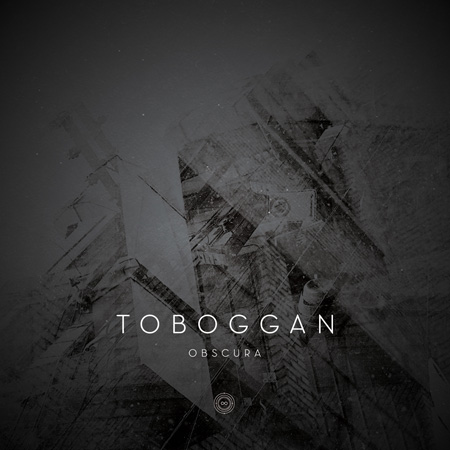
Montreal producer and previous Ryan Hemsworth collaborator Toboggan tends to work with the type of nocturnal, woozy sounds which recall the glory days of trip-hop. On “Baby Don’t Cry,” a track from his recently released Obscura EP for Infinite Machine, Toboggan marries jazzy, shuffled snare hits with swaths of white noise and a bluesy vocal sample that wouldn’t sound out of place coming from the corners of a Portishead record. Sampled synth chords weave through the production, leaving holes for intricate percussion patterns to sneak into “Baby Don’t Cry”‘s late-night gaze.
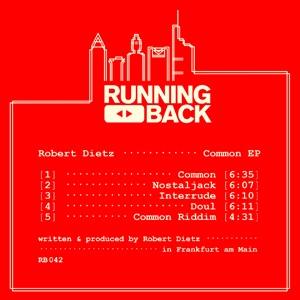
It’s easy to think of Gerd Janson’s Running Back as a label by DJs, for DJs. Janson releases the occasional smash hit, but the artists that make up the label’s backbone are low-key studious and efficient. B.D.I. Presents Compassion Crew, Raudive, and Disco Nihilist may not often be in the dance music tabloids, but they represent very pure and necessary production styles, making the tracks that paste mixes together. Count Frankfurt’s Robert Dietz among their ranks. Common is the producer’s second effort for the label, following 2009’s Forward Snipping, and if nothing else, it packs some mid-set punch.
The title track leans toward American garage with its brash drums and tubular bassline, and Dietz complements this framework with jangling piano, squealing organ, string pads, and coy synth flourishes. It’s hardly revolutionary, but the producer does a fine job of balancing its small, frantic parts. “Nostaljack” is marked by an infectious rolling tabla, and after letting this ride for awhile, Dietz adds rushes of rave stabs and choppy vocal shouts, which supply it with pretty much all the boisterous energy it needs. The thumping “Interrude” lays down a thudding foundation for a looping sample that, while obscured and not quite soaring, does lend some upward, uplifting motion. It’s maybe akin to a more polished Anthony “Shake” Shakir track. Before closing out with some bonus beats, “Doul” shows the producer in a different mode entirely; amid soupy, heady ambience, Dietz deploys halted drum patterns and recalls the astral spirit of early-’90s Warp in the process. Like its predecessors, it is a smartly considered composition, if somewhat more primed for home listening than the middle of a rambunctious party.