Thefft “There for Me” b/w “Contextual”

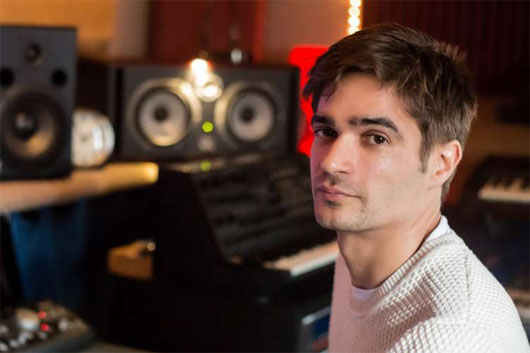
Following a two-year hiatus reportedly rooted in distribution problems and legal issues, Ramp’s dancefloor-minded sub-label PTN returns with this pair of tracks from jazz-inclined UK producer Jack Robertson (a.k.a Thefft). Roughly speaking, both tunes here pick up where last year’s excellent Distronet EP left off; they’re built from the same crisp techno synths and slinky garage rhythms that currently dominate the UK underground, but both are elevated beyond their relatively straightforward sound palette thanks to Robertson’s flair for unexpected rhythmic changes and subtly evolving song structures.

“There for Me” is fixed around a beat of shuffling hi-hats and crunchy, bit-crushed drum-machine hits. Hollow synth chords and a rounded, throbbing bassline place the track firmly in contemporary techno-tinged-dancefloor territory, while a heavy dose of reversed drum hits and heavily swung percussive lines keeps the whole thing moving along with plenty of energy. To his credit though, when it comes to structure, Robertson avoids the all-too-easy route of white-noise build-ups and predictable bass drops in favor of building tension via unexpected missed beats and wandering melodic lines that intermittently drop in and out of the composition.

B-side “Contextual” blends a stuttering house 4×4 with a melody built around thick, filtered synth chords that spring up on unexpected beats. Twitching hats and misplaced snares offset the upfront synth melodies, creating a glitchy take on peak-time dance music that comes across like a big-room house tune failing to launch. As with the a-side, it’s not too far removed from the prominent techno-informed sounds of Robertson’s UK house peers, but there is a satisfying level of depth and complexity to the tune. Both tracks here are straightforward enough to get a floor moving, but they’re still brimming with the sort of creative flourishes that will have techno connoisseurs nodding in appreciation. Hitting that sweet spot seems to be what Robertson does best.

Watch James Murphy and 2ManyDJs Discuss Their 50,000 Watt Soundsystem

DFA co-founder and former LCD Soundsystem frontman James Murphy recently teamed up with the Belgian crew 2ManyDJs and DFA engineer John Klett to build an enormous, 50,000 watt soundsystem which is solely compatible with vinyl. The rig, lovingly named Despacio, was recently given a three-night test run at the Manchester International Festival, where Murphy and 2ManyDJs played records together through their hi-fi system. Made up of eight 11-feet-tall speaker stacks and holding 48 high-powered McIntosh amplifiers (costing roughly $33,600 a pop), Despacio can impressively push about 100dB on the dancefloor, and is actually stored in its own specially designed room. More information about the ambitious speaker system can be found in The Vinyl Factory‘s interview with the crew of sound stylists and engineers, here, as well as the mini-documentary embedded below. (via FACT)

Saga “Bone”*Lost Codes*

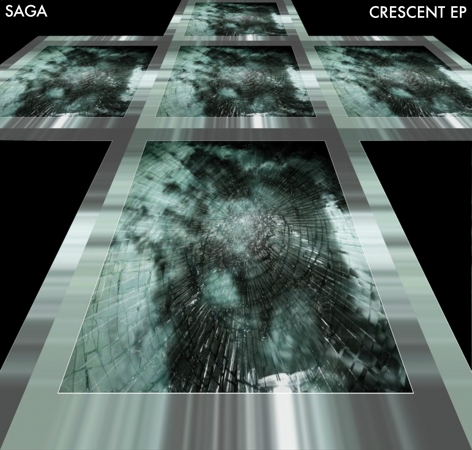
Saga is an Irish grime producer currently living in London, and he’s set to release his debut EP, Crescent, via fellow London producer Visionist‘s Lost Codes label, an outpost which has spent the last couple of years putting out forward-thinking bass music from the likes of Acre and SD Laika. From the aforementioned record (the details of which are virtually non-existent), “Bone” offers an experimental take on the classic grime template, with pummelling snares, aggressive claps, lurching dynamics, and wobbly synth tones working out the dark and fractured grooves.

Bone

Fatima Al Qadiri, Nguzunguzu, and J-Cush are Future Brown; Hear Their First Single Now

A few of New York’s, London’s, and LA’s most forward-thinking producers have come together on a collaborative project by the name of Future Brown—a seemingly rap-focused outfit comprising Fatima Al Qadiri, Nguzunguzu, and Lit City Trax founder J-Cush—which has just unveiled its first single. “Wanna Party” is a dystopian, trap-slanted party tune with a razor-sharp vocal turn from Chicago rapper Tink and additional production by ballroom house mainstay MikeQ, and according to Complex, is the first taste of Future Brown’s debut album. That record—which will feature more collaborations from the likes of Shawnna, Maluca, Ian Isiah and Teengirl Fantasy/Kingdom vocalist Kelela—is apparently still in the works, but “Wanna Party (feat. Tink)” can be streamed and downloaded now, below.

Jon Convex to Release New Single

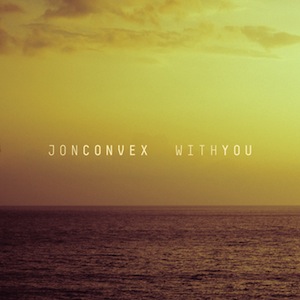
Jon Convex achieved recognition as Kid Drama and as half of innovative drum & bass duo Instra:mental before adopting his current alias, under which he has released a well-received string of techno- and electro-flavored records for labels such as 3024, Nonplus, and Hotflush. Now, the producer is inaugurating the digital-only branch of his Convex Industries label, aptly called Convex Digital, with a new two-track single. With You is said to see the veteran producer straying into more accessible territory, music which is said to be inspired by his experiences drinking cocktails on the beach in Hawaii and Australia. The single will be released on September 2, but before then, its artwork and tracklist can be found below.

1. With You
2. With You (Kid Drama Autonomic Remix)

Delsin Preps Second 12″ in Compilation Series

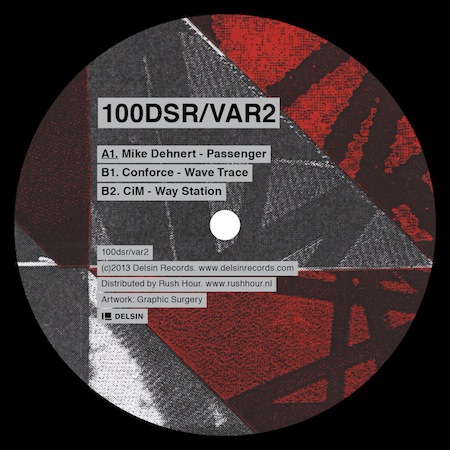
Dutch label Delsin has just revealed the next wave of artists set to appear on its upcoming second installment of a five-part series of celebratory 12″s. 100DSR/VAR2 will feature a track from Fachwerk label head and prolific producer Mike Dehnert on the a-side, paired with cuts on the flip from Netherlands-based DJ/producer (not to metion recent XLR8Rpodcast contributor) Conforce and veteran UK artist Simon Walley’s CiM project, which made its Delsin debut nearly 15 years ago. Before 100DSR/VAR2 drops at the end of August, previews of the record’s three tunes can be heard below, where its tracklist can also be found. (via Juno Plus)

A1 Mike Dehnert – Passage
B1 Conforce – Wave Trace
B2 CiM – Way Station

Me Succeeds “Seventeen (Iron Curtis Remix)”*Ki*

Longtime XLR8R readers might recognize the name Iron Curtis from our Bubblin’ Up feature with the Berlin producer a few years back, so it’s a nice surprise to see him pop up again since his podcast from last year, offering us his remix for Hamburg-based band Me Succeeds. The producer takes the group’s “Seventeen” track and gives it an intensity reminiscent of the excitement and hyper-active energy of early ’90s electronic music. Using drilling breakbeats, dreamy synth pads, and a funky bass tone that’s bursting with attitude, Iron Curtis transforms the song into a more detailed and cinematic take on the original version. Rongorongo Remixed, which compiles this track with remixes from 10 other producers, will be available via Ki on September 2.

Seventeen (Iron Curtis Remix)

Dinky “Blind”

As boring as minimal got over the course of the last decade, the good stuff still hasn’t lost its luster. The sounds of Dinky‘s last album, Anemik, were as wan and bloodless as those created by fellow Chilean Ricardo Villalobos, but Alejandra Iglesias’ talent manifested itself sneakily—she lashed those bits and bobs into a makeshift raft of percolating, spacious hits and scraps of her own voice. What could easily be a funkless marathon in another producer’s hands was full of organic surprises in Dinky’s, and that 2009 album stands with Margaret Dygas’ 2011 LP for Perlon as a severe-yet-seductive high point of the minimal movement. Dinky also hinted at her escape route from the moribund genre with the album’s last track, a cover of Mazzy Star’s “Fade into You.” Embracing her pop ambitions, Dinky’s latest album for the Visionquest label, Dimension D, shifted the focus away from the details. Her second remix package to follow the album’s release is “Blind,” which features two remixes each from Prins Thomas and Hreno and The Mole.

Hreno and The Mole’s “MHMD Remix” almost closes the loop between Dinky’s recent output and her earlier material, shrinking the original’s cabaret-esque contours into a wriggling disco loop that—in fine Mole style—clocks in at a minimally varied, exhaustingly undiminished 10 minutes. In contrast, Prins Thomas’ “Diskomiks” is careful to preserve Dinky’s phrasing and smatterings of hand percussion; still, this is disco of the cosmic variety, and its zero-gravity introduction only leads us into a stratosphere of silvery synths. The EP’s protagonists swap roles for the final remixes: Prins Thomas’ dub deigns to touch down on terra firma, locking into a groove that’s not too distinct from Hreno and The Mole’s; the latter’s “MHMD Ambient Yacht Mix” proceeds with the same delicacy and focus as the earlier “Diskomiks,” but misses the drama.

Check Out a New Four Tet-Produced Track from Omar Souleyman

Last month, it was announced that Syrian musician Omar Souleyman‘s forthcoming album, Wenu Wenu, was to feature production from Kieran Hebden (a.k.a. Four Tet). Now, the innovative artist has shared the first proper taste of his upcoming full-length in the form of its title track. “Wenu Wenu” is an infectious blend of the Shaabi street sound and the pulse of contemporary techno, and can be streamed in full before Wenu Wenu drops on October 22 via Ribbon, below.

This Week in Music Tech: In Moderat’s Studio, Jon Hopkins’ Found Sounds, MPC for iPhone, and More

While it might not have been the busiest week in the world of music tech, the bits that did find their way to the web surely were enough to keep us busy. This week, we check in with Moderat at the group’s Berlin studio to talk both producing and performing live, review Livid Instruments’ new Base controller, hear found sounds from Jon Hopkins, check out the iMPC for iPhone, and share an in-depth—and incredibly easy to comprehend—video which details the individual properties of analog and digital audio.

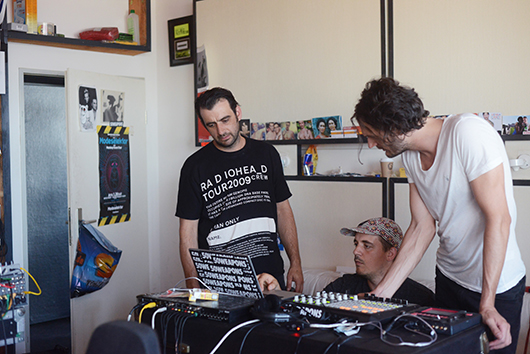
The week the band released its sophomore album, II, Moderat (a.k.a. the collaboration between Modeselektor and Apparat) invited us to its Berlin studio/rehearsal space to discuss the production methods behind its new record and how the group translates its songs on stage. Our full interview and drool-worthy collection of photos can be found in the latest From Studio to Stage feature, here.

Also on XLR8R this week, we took Livid Instruments‘ new Base controller for a test drive, deeming the unit from the boutique, Austin-based company “an expressive, finely crafted, flexible instrument that will play nicely with any software currently on the market.” The full review can be read here.

In a recent interview with Dummy, veteran UK producer Jon Hopkins shared a piece of found-sound audio used on his recent, XLR8R Pick’d Immunity LP in order to help illustrate how he incorporates real-world sounds and field recordings into his work. Hopkins’ piece of manipulated fireworks—which is used in the background of album track “Abandon Window”—can be heard below, while Dummy’s interview with the artist on the subject can be read here.

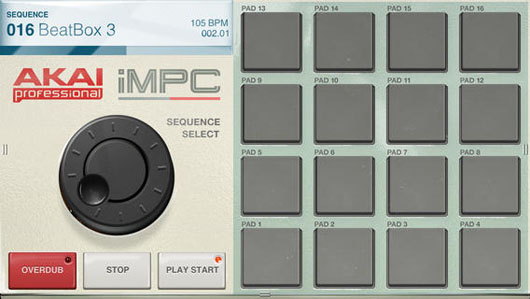
Though it has existed as an iPad app for a while now, Akai officially released an iPhone version of its iMPC app this week, featuring “1,200 samples, 50 editable programs, 80 editable sequences, and iconic MPC workflow.” Full details on the new app—which is currently available via iTunes for the reasonable price of $2.99—can be found here.

Lastly, for the true nerds out there, we’ve included this extremely informative video which explains the fundamental differences (and inherent similarities) between digital and analog audio, while also dispelling some myths about D/A and A/D conversion. Those seeking some concrete knowledge on the subject are encouraged to set aside 25 minutes to watch the video above. (via Create Digital Music)

Page 1619 of 3781
1 1,617 1,618 1,619 1,620 1,621 3,781