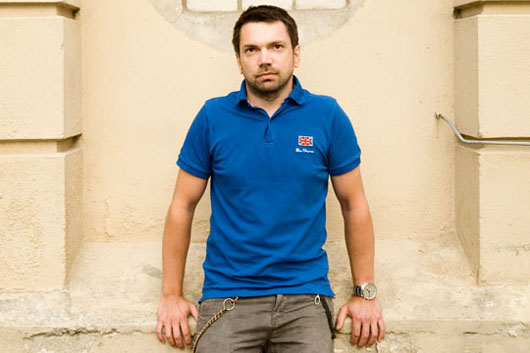
As part of its Slices series of artist video features and interviews, Electronic Beats has shared an extensive interview with prolific German techno stalwart Shed. The 11-plus-minute video finds the producer born Rene Pawlowitz driving around a few small German towns—including his hometown of Schwedt—and discussing his early days as a producer and DJ, the impetus behind his many monikers, and the evolution of his studio set-up (which is apparently now all software based). It all makes for an interesting and rather frank look at the work of Shed, a widely respected artist who still refuses to call himself an innovator or “techno visionary.”
We here at XLR8R are undoubtedly open minded when it comes to listening to new music, which is to say we always enjoy the chance to hear the wide array of unknown producers out in the world. In that vein, we have for you “Dawson” by newcomer Monoak. Though the Irish-born, London-based artist is undoubtedly a previously unseen face on the scene, this first taste of his work might lead you to think he’s been at it for some time. “Dawson” is a dark, uptempo number that showcases a mature, techno-influenced sound, and hints at what’s in store when Monoak’s debut release drops sometime in February.
While we all continue ruminating what Shaking the Habitual, the forthcoming fourth LP by enigmatic Swedish duo The Knife, might actually sound like, Karin Dreijer Andersson and Olof Dreijer have announced that they’ll soon take their dark synth-pop on a European tour this April and May. Seeing as how The Knife’s new album will be available on April 8 via Mute and its upcoming tour is called Shaking the Habitual Show, one could safely assume that this string of live dates will find the Dreijer siblings playing lots of material from their as-yet-unreleased album. You can check out exactly when and where they’ll be doing that below, and sign up to get the first crack at buying pre-sale tickets here. (via Pitchfork)
04-27 Hamburg, Germany – Docks 04-29 Milan, Italy – Magazzini Generali 04-30 Zurich, Switzerland – Komplex 457 05-01 Munich, Germany – Muffathalle 05-02 Cologne, Germany – E Werk 05-04 Paris, France – Cite De La Musique 05-05 Brussels, Belgium – Ancienne Belgique 05-06 Amsterdam, Holland 0 Paradiso 05-08 London, England – Roundhouse 05-11 Berlin, Germany – Columbiahalle 05-12 Copenhagen, Denmark – Vega 05-13 Copenhagen, Denmark – Vega 05-15 Oslo, Norway – Sentrum 05-16 Stockholm, Sweden – Hangaren Subtopia
Although XLR8R makes an effort to regularly cover numerous strains of electronic music from around the globe, occasionally we recognize the need to take a closer look at a specific scene or musical phenomenon. Welcome to… is a platform to dig deeper into the sounds emanating from a particular locale, even when that locale happens to be more virtual than geographical.
For all the discussion around the internet’s economic impact on music, its aesthetic impact remains harder to grasp. Simon Reynolds’ book Retromania diagnosed a lack of innovation across the board as musicians raid the archives, poaching sounds from other times and endlessly recombining them in variations on a basic “retrolicious” theme. But the past few years have witnessed the development of a more radically decentered aesthetic, one that rejects references to analog culture in favor of the hall-of-mirrors self-referentiality of the internet itself. These artists refer to the past, but through the flattening viewfinder of the web; there’s no longing to return to an earlier time or style because it’s all here, right now—all equally valid and equally LOLworthy. The space away from media-conveying screens that “IRL” once described has collapsed rapidly, to the point where—philosophically at least—there’s no lack, no difference between this and the real world.
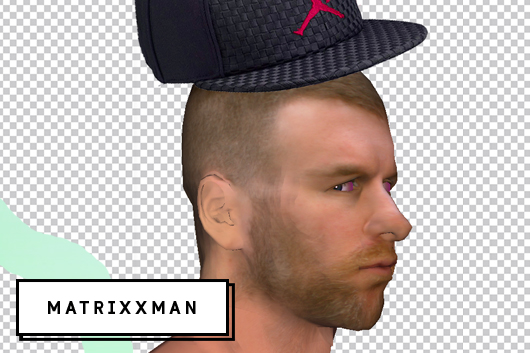
For many of these artists, the internet has gone from a mediating force—giving partial, finite access to the past or the present, but remaining fixated on another world out there, away from the screen—to a closed circuit actively opposed to linear time and hierarchical values. Despite what the design savvy we’re surrounded with on the web may be suggesting, we’re living in an achronological, carnivalesque present, both appalling in its smooth gaudiness and perfectly, reassuringly frictionless. “Some people think it’s willy-nilly,” Charles McCloud Duff (a.k.a. Matrixxman of LA/SF duo 5kinAndBone5) says about the aesthetic. “But there’s actually a carefully curated—for lack of a better word—theme of people trying to integrate with machines, trying to capture this weird, awkward discord.” McCloud makes music with his production partner Paavo Steinkamp, but handles the group’s vigorous online presence singlehandedly. It’s spread out over various platforms—existing most notably on Tumblr—but there’s still a sense of contiguous space: imagine the walls of a surly cyberpunk teen’s bedroom in Second Life, with hentai and corporate logos splashed on the walls. One gets the sense that it might be some kind of elaborate semantic booby trap. Oh, and about all the boobs: it’s knowingly puerile. If there’s nostalgia here, it’s for the internet as libidinal playground, before “content,” “curation,” and other editorial forces came into play—in other words, when the web still felt radically inhuman and isolating.
Photo by Alex Gitman
Physical Therapy (a.k.a. Daniel Fisher) isn’t as deeply enmeshed in this post-ironic visual culture. Nevertheless, his production work communicates a kindred sensibility, a shape-shifting approach to dance music that’s not tied to any particular lineage. It’s hard to get a bead on where the five tracks on Safety Net, his 2012 debut EP for Hippos in Tanks, were coming from. Drum & bass, house, rave, and numberless incidental influences weaved hyperactively throughout it all. “I’m a collagist. I’m a sample-based artist,” says Fisher. “I’m not good at programming drums or engineering kicks. Everything you’re hearing is the product of a lot of trial and error and a lot of cutting and pasting.” For the 24-year-old producer, the internet has only been a boon to getting started as a DJ and producer; indeed, his early DJ sets were comprised of lots of YouTube rips. That kind of quick-and-dirty research has allowed him to feel confident trying his hand at many different styles. “When I started being curious about house music, I just threw myself into it and downloaded everything I could, took in more and more, went from one tangent to another,” he explains. “That’s why my music’s always gone off in a thousand directions. I’m able to get many different things without having to go to a deep-house specialty store or mail order from a hardcore specialty store in Antwerp. I can spend three good months researching and building up my collection for zero dollars, and then be able to incorporate those sounds. And you don’t have to commit to one thing.”
Fisher’s digital-DIY approach is motivated by a punky sense of empowerment, and undoubtedly rubs some music fans the wrong way. One could argue that viewing genres as resources rather than ideas to be explored, challenged, and pushed forward contributes to the general sense of cultural stagnation—an abundance of options coupled with a lack of anything really new. Yet Fisher doesn’t see it that way. “There really isn’t a signature sound for artists like myself, 5kinandbone5, and the former LOL Boys,” he says. “[Every] track just comes from a mood. That’s really hard for people to hold onto, where it’s just a heady muddle of influences. Each Kingdom track sounds different, but you can hear it and know it’s the new Kingdom track. But I think people are growing to accept and want that multitasking ability. Every producer is going to need to produce at every bpm.” While this kind of talk all sounds decidedly future-oriented, Fisher isn’t without his own kind of nostalgia. Rather than longing for the seriousness and craft of hardware over the cost-efficient ease of software, he misses instead house music’s sense of humor, the intense-but-silly vibe of Green Velvet or even Armand van Helden—a golden age when technical details didn’t smother the potential for lightheartedness.
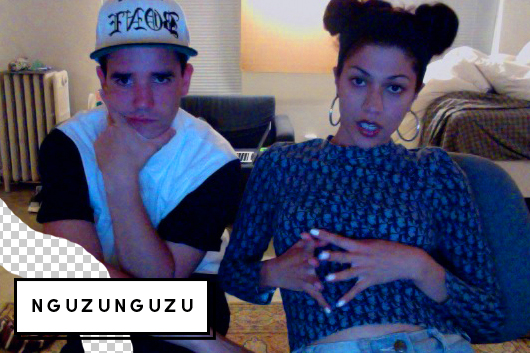
“I feel bad for writers,” says Asma Maroof, one half of LA’s Nguzunguzu. “It’s hard to talk about music.” Along with production/DJ partner Daniel Pineda, Maroof makes classily hybrid club music. The duo doesn’t quite belong to any one scene or tradition, which makes them an easy target for misunderstanding—Nguzunguzu has been lumped in with bass music, tropical/global bass, trap, seapunk, moombahton, and other internet-spawned genres, but Maroof and Pineda are too wily to be held to any single element of their sound. Perhaps more importantly, they aren’t particularly interested in correcting audiences’ perceptions. “We always mixed hip-hop and other kinds of dance music,” Pineda says, “Now it’s thought of like we’re doing this trap thing. But things change really fast and the trap thing will blow over and still stay around in its own way. New things and new headlines will come around.”
As with Physical Therapy, Nguzunguzu would sound very different were it not for the internet. “With Napster, iTunes, or whatever, you can access music that’s already out really quickly,” Maroof says. “But there’s also this whole database of music that isn’t released. When Myspace came out, people could put up music they made and you could message them like, ‘Yo, I love this track, send it to me.’ You could play demo tracks from kids that live in Iceland or whatever. That was really important in helping us find our sound. I wouldn’t say we wouldn’t be doing this without the internet, but I think [our music] wouldn’t sound like it does.” That said, artistry and originality are still key to what Nguzunguzu does. Pineda explains, “You hear something new, and it’s a whole new world, but if you want to produce something just like it [after] having heard one bit of it… I think that seems a little cheap. You’re probably not gonna make something better. If you go down the other path and find out more about it first, you can make something that stands on its own [and] fits into your own sensibility while being inspired by what you discovered.”
Brenmar (a.k.a. Bill Salas), covers similar terrain as Nguzunguzu—as his SoundCloud profile succinctly puts it, he makes “club music for the present.” What this means more practically is that he’s re-establishing a dialogue between dance music proper and hip-hop and R&B, with touches of 2-step’s and UK garage’s urban slinkiness. In truth, Brenmar’s sound is much more consistent than that of many of his internet-savvy peers, but he’s no less wary of straight-laced purism. “Nothing is created out of thin air,” he says, “especially if we’re talking electronic music or dance music particularly. It’s about how you combine it with respect to the source material and with respect to where you’re coming from. I’m not about to say you have no right to flip an Aaliyah sample if you didn’t listen to R&B ’til last year. That could be an easy callout, but it’s also like, ‘Why?’ If you let these little rules get in the way, you could miss out on some great beats… at the end of the day, if it’s dope, it’s dope.”
Salas is bringing up a subtle but obvious point that’s too easily overlooked in the internet’s cycles of quick fame and swift recrimination: the music has its own agenda, regardless of its perceived qualifications. He respects the importance of gatekeepers, people that care about the culture and have a sense of history, but also states, “Nowadays, more than ever, it doesn’t really mean shit. You’re not packing the venue because you use all-analog gear or because you really care about dance music. These purist ideals that we maintain are worthy of holding on to, but we might be in the minority.” There’s truth in what he says, which is why—at least in the lawless realm of the internet—there’s seemingly little value in artists marginalizing themselves by limiting their visibility or policing their engagements. And though it may be easy to criticize the producers with ASCII machine guns on their SoundCloud profiles doing it for for “lulz,” there are also artists homing in on their own obsessions, ultimately arriving at something which at least feels real.
Photo by Dom Smith
The concept of reality certainly comes into play in the music of Fatima Al Qadiri. Her latest EP, Desert Strike, takes its name from the Sega Genesis game subtitled Return to the Gulf. What makes it remarkable is that she grew up in Kuwait during the Gulf War and, like many of her Western peers, was addicted to videogames—an unusually literal example of escapism. “I think the reason so many children become addicted to videogames has to do with agency,” she says. “A lot of kids feel that they’re not participants in this world and its power structures very early on. Videogames allow them [a sense of] control and godlike agency not afforded by society.” Not surprisingly, the music Al Qadiri makes overtly references videogames’ sonic palette, but it’s miles away from cheap and cheerful chiptune, and gleams with an otherworldly precision that evades many of her peers. “The vast majority of electronic-music producers could put videogame soundtracks on their top 10 influences,” she says, stating a fact whose bluntness seems insightful. In recognizing these common cultural sources, she’s wary of defining an essentially amorphous “internet” genre, despite the fact that she serves as the music editor and a columnist for DIS Magazine, a webzine that’s done much to establish the so-called “Tumblr aesthetic.” Al Qadiri explains her hesitance by saying, “It has less to do with the artists embracing some internet aesthetic, and more to do with the reality of the internet invading every part of our lives. Our lives are turning into data management. There’s no way of weighing our present reality against a previous reality, of getting it all in the frame. The fact that we all come from the same generation says everything: it has more to do with the fact that we share the same influences from growing up.” Indeed, trying to pin down a shape-shifting aesthetic is a somewhat impossible task.
Yet even without a fixed definition of exactly what all of this music is, internet-fueled sounds have repeatedly run into trouble when it comes to issues of race and class. As much as the internet is part of a process of restructuring time, space, and cultural distinctions, the web still has a divergent tendency to both flatten and exaggerate our differences. The sounds of juke/footwork, trap, and ballroom/vogue house have all ascended to a place of greater prominence within the greater electronic spectrum in recent years, and though there’s a compelling strangeness to music that’s developed in America’s marginalized communities, these genres have also proven to be extremely exploitable by internet-ferried newcomers. Trap—a memeified name for tightly coiled Southern hip-hop of the Lex Luger variety, first imported into web-magazine news cycles by Salem and reaching a gruesome apotheosis last year with Purity Ring—in particular has seen the most intense metastasis since dubstep. As with footwork before it, a deluge of simplified takes on its signature sounds are issuing forth from YouTube and SoundCloud at a remarkable clip. And for every effort that innovates with these sounds while engaging them respectfully, there are a grip of swagger jackers trading in a form of the music that—either by design or simply due to ignorance—doesn’t confront the listener with the bleak disparities of American life in quite the same way, making for an oddly frictionless pantomime.
At the same time, it seems obvious that producers should be drawing connections between dance and hip-hop. After all, many producers are simply trying to connect the dots between hip-hop’s pop domination during their childhoods and the current fractal landscape of niche interests. “For me, rap music was such an important part of growing up, and I’m sure other people from my generation would echo that sentiment,” says RL Grime (a.k.a. Henry Steinway), the 21-year-old producer whose “Trap on Acid” coincided with the term’s explosion. “The rise of dance music from 2008 to the present sort of switched gears for a lot of people, including myself,” he continues. “I started going to shows and festivals primarily to see dance-music acts. I think now, the resurgence of rap within dance music was exactly what people wanted.” He admits having “super mixed feelings” about the word “trap,” recognizing its usefulness on the one hand while admitting that, for him, “all serious connotations [of the term] have been thrown out the window… it’s the artists that are trying something new that stand out to me.”
Ballroom or vogue house, on the other hand, seems tougher to put a finger on sonically. Most likely this is because the music is just one element in the rich, long tradition of competitive New York drag—itself no stranger to mainstream appropriation, most notably by Madonna. MikeQ (a.k.a. Michael Cox)—a prolific producer and busy DJ who’s one of the the most visible proponents of the ballroom/vogue sound—tries to explain what makes it unique: “[Songs like Masters at Work’s] ‘The Ha Dance,’ among others, are extensively remixed tracks we use here in ballroom, but you can’t just take these songs or sounds and think that what you are creating is ballroom when in reality it’s just a remix of that song.” He goes on, “I still cannot 100% pinpoint what it is about the sound of ballroom that makes it what it is. But there is a sound—you have to be able to vogue and walk runway to this music, and it can’t just be anything. Lately people are making what they think is vogue or vogue-inspired music, and it’s all wrong—it’s simply remixing the ‘Ha’ or adding some gay voice to a track [without] knowing what you are doing.” That said, MikeQ can name an impressive roll call of celebrities that have borrowed from voguing and ball culture, and has no problem with it. “It’s almost like paying homage or giving us our life,” he says, referring to Beyoncé, Missy Elliott, Rihanna, and many others who have borrowed from the dance, fashion, language, or other aspects of ball culture. The distinction, for him, seems to be between someone making a career on the back of an underground culture they may not understand versus established artists who are paying homage to a marginalized, outrageously creative scene.
The internet revels in its self-referentiality and frivolity, punctuating its endless reproduction of memes with bathos, an awareness of its own triteness that makes the entertainment value go down easier. Wallowing in GIFs is never far from worrying about that wallowing, as evidenced by whatever the most recent New York Times op-ed describing how its author learned to “unplug” happens to be. Still, having reached this volume of cultural production and consumption, it’s unlikely that we’ll take a step back and spare ourselves from premature jadedness. It goes without saying that shallowness and lack of a sense of history affects not just the music itself, but the whole culture and industry around it, criticism included. Nevertheless, this leaves today’s artists in a place where the only critically sure bet at this point is also a safe one: sticking to vinyl while keeping it in the wheelhouse of techno or house—acting, in other words, as if the internet hadn’t happened. With each passing year, that becomes a more daunting proposition, particularly for younger artists, many of whom lack that vestigial web 2.0 anxiety.
Yet this doesn’t mean that the integrity of electronic music is doomed; artistic methodologies may be evolving, but it’s not like the music world—and the artists themselves—aren’t thinking about the issues. When speaking to the various musicians for this piece, many of the problematic dynamics we asked them to comment upon didn’t seem quite as urgent or intractable when transplanted from the hothouse environment of Twitter and comments-section flame wars. Opportunistic music will of course always exist, and is bound to flourish when the costs of production, distribution, and promotion are close to zero. And when we barely have the time or attention span to really absorb the music we actually like, it’s even more tiresome to encounter lifeless music. But the only prospect more depressing than wading through the morass of sceney, less-than-half-baked, trend-hopping tunes is trying to articulate rules that would keep the dross from getting made in the first place or, at least, making its way into your field of vision. After all, the glut of bullshit hasn’t deterred audiences’ hunger for “new” content. From musicians to the editors and critics that put them on blast, everyone’s growing up in public. Appropriation and dilettantism are serious and dispiriting issues, and their persistence partly confirms our distance from the utopian, transhuman future many of these internet-oriented acts have conjured—a future we just might long for unironically.
Pioneer of ambient electronic music Jean Michel Jarre recently curated a selection of both old and new tunes from the catalogue of Lyon-based imprint InFiné to create InFiné by JMJ, a 14-track compilation released today. According to Jarre, his interest in the label lies in its ability to release a variety of boundary pushing sounds that somehow manage to share a common ground. “InFine? is in that league of labels displaying the kind of audacity only to be found in true artists,” said Jarre. “Like the musicians it represents, it has kept on demonstrating how important it is to have a common vision, a common ambition in order to initiate and finalize groundbreaking projects.” One of the tracks curated by Jarre is Rone‘s “Tasty City,” a compelling production from his debut album, Spanish Breakfast. Although it was originally released in 2009, the song remains a product of Rone’s inventive imagination, something far superior than a snapshot of what musical trends were popular at the time. And for many people who have never heard the track, it will sound entirely fresh, as Rone explores a variety of genres on “Tasty City”—ranging from tech-house to ambient—without ever settling on one.
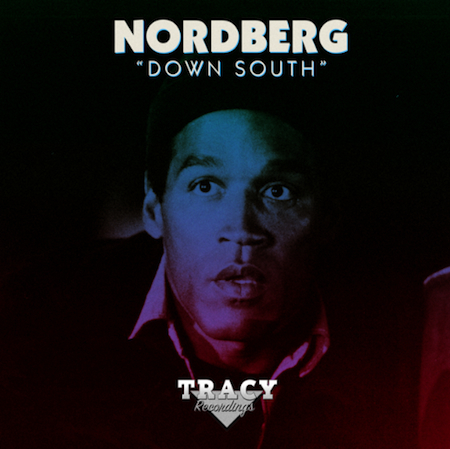
Barcelona record hub Tracy has just released its first record of 2013, courtesy of Top Billin head honcho Sir Nenis (a.k.a. Nordberg). With a handful of monikers (including Sharkslayer) and a consistently prolific label to run, it’s not surprising that the Nordberg’s release only features one original track. However, the four remixes featured on the record offer flavorfull renderings of “Down South,” including this one from Brooklyn artist Reilly Steel. The up-and-coming producer’s version of Nordberg’s single is a lighter take on the bass-heavy original, as it opens with soft, swelling pads and rises into a funky techno drop before finishing off with playful steel drums. You can check out the rest of the Down South EP after the jump.
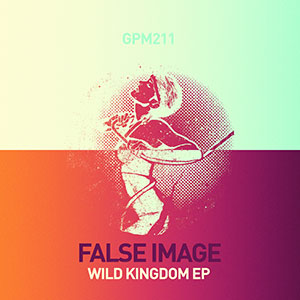
For most people, the initial attraction to False Image will stem from the identities of producers involved. The project is the creative offspring of veteran producers Noah Pred and Tom Clark, who struck up a collaborative partnership after Pred relocated to Berlin last year. The duo’s first official offering, the two-song Wild Kingdom EP, arrives this week, somewhat surprisingly via the Get Physical label. The record bears few traces of the imprint’s trademark electro-disco-house lineage—something that’s most likely a good thing for an outfit making its debut in 2013—but the music is undeniably functional, which isn’t surprising given the resumes of the artists involved.
“Ocelot” occupies the a-side, and it’s a slinky piece of tech-house, one that’s been coated with a high-gloss finish. The gleaming synths are the focus here, and False Image does a nice job weaving together various melodies over the course of the song’s eight-minute runtime. Over an ever-present filtered whirl, there are playful leads that occasionally warble and wobble, along with some acid-ish stabs that nicely complement the track’s bassline. The drums are more straightforward, little more than a basic four-on-the-floor skeleton with some scattered claps and popping snares, yet they serve their purpose and keep things moving. In truth, each element of the song certainly sounds good, but overall, the arrangement is a bit too linear, a fact that’s only magnified by the ultra-clean production aesthetic. As such, “Ocelot” can seem a little tracky and doesn’t really stand out as much as its creators might have wanted.
“Anteater” finds Pred and Clark delving deeper into the percussion side of things, assembling a snappy drum pattern and a more inventive rhythm. The track does have some slight nods to the stripped-down machine sounds of late-’80s/early-’90s acid house, but again, the song’s smooth polish eliminates much of the rawness that made those vintage tunes so exciting. “Anteater” doesn’t offer much in the way of melody, apart from the occasional synth cresting in the background, but its funky strut undoubtedly has a certain charm. Nevertheless, it’s still tracky, and could be easily overlooked by DJs in search of something a little more inventive or rough around the edges. There’s no question that False Image is the byproduct of two skilled producers, but the pair’s maiden voyage is less of a Wild Kingdom than a guided safari tour—there’s some nice scenery, but the safety of the excursion is never in doubt.
Made up of three rockers from London with a penchant for jacking beats, Factory Floor doesn’t waste time setting the stage. It’s not about delicate build-ups or atmospheric interludes with these guys. “Two Different Ways,” the trio’s first single for seminal indie-dance imprint DFA, was a sweat drenched, acid-meets-punk-funk workout, and “Fall Back” doesn’t deviate from that concept much—which is a good thing. Leading with a bass modulation that vibrates tighter than a rubber band stretched between New York and Manchester, it sets a relentless pace and demonstrates the group’s nuanced appreciation for both of those musical meccas.
Dominic Butler, Gabe Gurnsey, and Nik Colk Void may like to distance themselves from the references to Factory Records that the press plays up, but “Fall Back”‘s fusion of taut drumming and jacking Chicago machine manipulation makes for some strong parallels. It also puts them right at home with the rest of the DFA roster. The urgency, energy, and attitude “Fall Back” displays when it kicks into gear at the two-minute mark recalls some of the label’s defining moments, including songs like “House of Jealous Lovers,” “All My Friends,” and “Happy House.” Colk Void’s vocal styling exudes detachedness—she’s the cool girl in the room as she monotones, “did you feel like you were going to fall back?” It sounds as if she’s barely present when the steadily flogging beat and electronic tinkering build up around her. Before they engulf her entirely, she calls back, “although you feel like you were going to fall higher.” “Fall Back” is trance inducing, a particular brand of emotive machine music that comes from Factory Floor’s studied marriage of playing and programming. Evolving over a full eight minutes, Colk Void and company are caught in the thick of it, and once this track makes the dancefloor rounds, it’s likely they won’t be the only ones.
Throughout the week, a whole lot of material gets posted here on XLR8R. And while we know—and love—that some hardcore readers will eagerly pour over every single news story, interview, podcast, video, and MP3 download that appears on the site, we also realize that for most people, it’s impossible to see everything, which means that some quality XLR8R content is likely to get missed in the hustle and bustle of everyone’s daily lives. In the interest of making it easier for everyone to catch up, every Friday we present The Lowdown, a weekly wrap-up of the top 10 tidbits from our site.
1. This week’s XLR8R podcast came from rising UK producer South London Ordnance (pictured above), who followed up an impressive 2012 with this mix full of unreleased gems.
2. We kicked off Bubblin’ Up Week 2013 with an in-depth look at the current crop of underground sounds in Bristol, including artists such as Vessel, Kahn, Kowton, Artifact, Hodge, and others.
3. 19-year-old Leeds producer Dosage came out of nowhere and shared a new track, “Bring It Back,” which promptly lit up our Downloads section.
4. Berlin veteran Apparat announced the impending release of a new LP, Krieg und Frieden (Music for Theatre), an album based on the music he composed for Sebastian Hartmann’s theatre production of Tolstoy’s War and Peace.
5. Another Bubblin’ Up Week 2013 feature profiled four artists from the nebulous world of so-called “outsider house”: Delroy Edwards, Anthony Naples, Huerco S., and Roche.
6. Fresh off a Bubblin Up Week 2013feature of his own, Seattle’s Kid Simpl passed along a remix of The xx’s “Fiction” as a free download.
7. Posted just this morning, we wrapped Bubblin’ Up Week 2013 with a list of quick looks at 10 More Artists to Watch in the year ahead.
8. Moog teased the world with a video previewing a brand-new synth, which the company will be officially unveiling later this month at the NAMM convention.
9. Following a series of well-received EPs, Brainfeeder associate Lapalux announced that he will be releasing his debut full-length, Nostalchic, in March.
10. Production duo/technology experts Hermutt Lobby—who most recently helped develop the Beatsurfing iPad app—will soon drop a new EP of original material, Haters Gonna Hate, and shared one of its tracks, “Computer Club,” as a free download.
An expanded version of the The Lowdown is also available via a weekly email newsletter. Those interested in an even more in-depth round-up of XLR8R content, including a complete listing of all the free downloads we’ve offered in the past seven days, should sign up by entering their email address below.
After releasing the solid Dust March EP via Hessle Audio last year (and subsequntly landing in our list of the 40 best releases of 2012), UK producer Bandshell will soon return with his Caustic View EP for Mute imprint Liberation Technologies. We’ve already heard one of its gritty cuts, “Landfill,” but we now have the full details of the forthcoming record. Bandshell’s second EP will be released on February 11, and comprises four original productions that explore the reclusive artist’s taste for dark, heavy techno. You can check out the tracklist and, if you missed it, the video for “Landfill” below. (via Juno Plus)