Carsten Nicolai: Gridlocked

Carsten Nicolai is a co-founder of Raster-Noton Archiv Fur Ton und Nichtton (Raster-Noton Archive for Sound and Non-Sound), the imprint behind the Clear and 20’ to 2000 series. The former was an attempt to release music without anything but the music and the format it was carried on (packaged in clear casings with as little text as possible); the latter compiled a single 20-minute CD each month in the run up to the millennium. Nicolai is also a visual artist, whose sculptures, drawings, and conceptual installations have appeared around the world, including the Venice Biennale and Berlin’s Neue Nationalgalerie.

His new book, Grid Index, is a “visual dictionary on two dimensional grids and geometric tilings” that lifts inspiration from art, architecture, and scientific papers. Sometimes austere and often beautiful, the collection feels like an “arty” visual counterpart to the minimal electronic music he records under the Noto and alva.noto monikers. We talked with Nicolai about his lexicon of patterns and grid systems, which he describes as a functional tool, reference book, and practical resource.

XLR8R: What do you see as the function of Grid Index?

Carsten Nicolai:Grid Index was produced for myself, as an archive—a source book where I can just go and look when I’m searching for a specific grid for something like an architectural project or for design issues. I thought it should be published because it’s a massive work and a beautiful collection. It’s the first book, as far as I know, that tries to categorize and to make a visual example of grids. I see it as a kind of scientific publication. I hope designers, architects, and mathematicians can get some use out of it as well.

What are you saying or hoping to articulate with the book?

I hope it becomes a foundation. If you need a grid or if you want to know more about grids or make your own grids, you can use things out of this book.

Is Grid Index a design for living? Are such levels of order, regulation, or neatness deliberately reflected elsewhere in your life?

Um, maybe not. It’s really, for me, a tool rather than a design book. It’s maybe a bit confusing because Gestalten publishes many books on the edge of architecture and design and art. I like that it shares all these areas a little bit but it’s much more about being a source, like the tafelwerk we were given at school that had all the logarithm numbers before pocket calculators, all the basic formulas that you needed to calculate things. It’s a dream that everybody would want to have this book on their shelf and use it every day or every week or every month—that it becomes like a school book.

Grid Index is accompanied by a CD of the book’s grids and patterns. What do you hope people will do with these images?

I hope people use it. Copyright is quite flexible in that people can use it for personal use and people can create things. I hope that this CD gives many elements to play with, to start thinking about patterns in a different way, to start a discussion about ideas of patterns, and to be aware more of how we use patterns in our daily life.

You’ve previously worked as a gardener. In what way has this impacted your subsequent work?

I worked as a gardener and studied landscape design, and I think this has been very influential for me. Nature is still a huge, huge inspiration. When you look at Grid Index, you can see that many of these patterns are basically “inside of nature.” Many more complex patterns are in life organizations or inside the organization of lifeforms; they are part of the foundation of our life. Mathematics is basically a part of nature.

Grid Index is out this month via Gestalten.

Treasure Island Festival Dates Announced

Still a relative newcomer in the world of festivals, the Bay Area’s Treasure Island Music Festival is now planning for a third year of its two-day music extravaganza, with 2009 dates set for October 17 and 18. The event will, as it does every year, take place on that man-made island halfway between San Francisco and the East Bay.

Once again the Noise Pop crew takes the reins on this one, alongside Bay Area-based concert producers Another Planet Entertainment. Anyone attending last year will recall the ferris wheel smack in the middle of the two outdoor stages, performances from Hot Chip, Goldfrapp, Mike Realm, Foals, CSS, TV on the Radio, and Justice, and abnormally tasty, reasonably priced food for sale. Noise Pop is promising that this edition of the festival will be “the best yet,” so stay tuned for lineup and ticket information, which will be announced in early summer.

E-Dancer “World Of Deep (Original Mix)”

Detroit techno godfather Kevin Saunderson is set for a big summer, with the release of his History Elevate, a gigantic retrospective package made up of two CDs and 20 years’ worth of music by the man who operates under multiple musical guises, from his given name to Tronik House, The Reese Project, EssRay, and one of his more recent monikers, E-Dancer. Here’s a track from the latter project, and the deep-house vibes here prove Saunderson doesn’t always stick strictly to techno in his work.

History Elevate will be released June 9.

E-Dancer_World Of Deep (Original)

E-Dancer_World Of Deep (Original)

MC Zumbi Responds to Oakland Violence

News stations have been abuzz lately with the slayings of four Oakland, CA police officers at the end of March, but not everyone views the situation—or Oakland’s violent history in general—as a black-and-white, good guys-versus-bad guys scenario. Zion I’s MC Zumbi—an artist often known for his politically conscious lyrics—is digging a little deeper into the matter with a new track he created alongside Trackmasters producer ARE as The Burnerz, but there’s more to “Cops Hate Kidz” than its pointed name lets on.

Zumbi and ARE penned the track in response to the aforementioned slayings, but also as a rebuttal to the January murder of 22-year-old Oscar Grant, who was unarmed and shot execution-style at an Oakland public-transit station. “We feel that the tragedies that we are witnessing can be attributed to the long history of police brutality experienced in the black and brown communities,” explains Zumbi of the track, that, through its heated lyrics and ARE’s hard-hitting beats and rhythms, exposes the double-sided nature of the situation.

“It is our hope to fuel discussion about ways that the police can better ‘protect and serve’ the community, rather than abuse and exploit their power,” Zumbi continues. “As we move towards a ‘new America,’ it will be important that we learn to work together. The old models are falling before our eyes. This is our opportunity to engage change.”

He’ll likely share more of his message this spring, as Zion I is currently on a North American tour that runs until mid-May. In the meantime, you can hear “Cops Hate Kidz” right here:

Stream: “Cops Hate Kidz”

Dates:
04/01 Riverside, CA – University of California Riverside’s Belltower
04/02 Santa Barbara, CA – Velvet Jones
04/03 Santa Cruz, CA – University of California Santa Cruz
04/04 Sacramento, CA – Empire
04/05 Arcata, CA – Humboldt Brew
04/07 Eugene, OR – WOW Hall
04/08 Seattle, WA – Neumo’s
04/09 Portland, OR – Berbati’s Pan
04/11 Bellingham, WA – Nightlight Lounge
04/12 Whistler, BC – Garfinkel’s
04/13 Vancouver, BC – The Modern
04/17 Missoula, MT – The Badlander
04/18 Bozeman, MT – Zebra Lounge
04/20 Salt Lake City, UT – Urban Lounge
04/21 Colorado Springs, CO – Black Sheep
04/24 Minneapolis, MN – McNally College
04/25 Aspen, CO – Belly Up Tavern
04/28 Park City, UT – Star Bar
05/01 San Francisco, CA – Slim’s
05/07 Chicago, IL – Morseland
05/11 London, ON – Call the Office
05/12 Rochester, NY – Dubland Underground

zumbi

Black Dice REPO

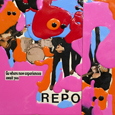
The typical trajectory of musical projects consists of gradual decline and increasing conservativeness of sound, with early works proving to be the best and most adventurous. Black Dice subvert this model. A decade into their existence, they continue to wring the most grotesquely warped sounds from their gear and sculpt them into a menagerie of beastly compositions. Repo, like most of Black Dice’s output since 2002’s Beaches & Canyons, is an unconventionally psychedelic record, one that seems to have emerged chromosome-damaged from a bizarre lab, created solely to score your most extreme hallucinogen trips. Although it’s relatively lighter in tone than past efforts, Repo still carries a pronounced unhinged quality. They haven’t ditched their demented, funhouse-mirror effects, but they have tilted them at more festive angles. Repo could be called a party record, albeit one that leaves deep trauma on your brain.

Mixtape: Lost Soundtracks by Ken Shipley

A lost soundtracks mixtape by reissue label Numero Group’s Ken Shipley .

1. Jon Brion “Theme,” from Eternal Sunshine of the Spotless Mind
I don’t even own the actual soundtrack, just a burned-down best-of I swiped from Numero co-founder Rob Sevier’s hard drive. Such a great song. Brion is my generation’s Henry Mancini.

2. Manos Hadjidakis “Taki,” from Never on Sunday
Flamenco guitars and accordion shredded over Eastern Euro-trash polka rhythms.

3. Miles Davis “Generique,” from Ascenseur Pour L’echafaud
I need to move this out of soundtracks and put it in with Miles proper. Possibly my favorite of his bop era material.

4. Henry Mancini “The Evil Theme,” from The Pink Panther Strikes Again
Steve Martin, eat your heart out. Too fucked-up and out of 4/4 for Beyoncé to ruin. Dig the plucked string section.

5. Duke Ellington and His Orchestra “Guitar Amour,” from Paris Blues
Liner notes provide no information as to who is actually playing the guitar here. I’m doubting Duke did, regardless.

6. Peter Sellers and The Hollies “After the Fox,” from After the Fox
Sellers’ interludes here are brilliant. Hollies: “Why not work?” Sellers (dismissively): “Work is hard.”

7. William Loose/Stu Phillips/Marvin Bling “Finders Keepers Song,” from Finders Keepers Lovers Weepers
The opening reminds me of Stormy’s “The Devastator,” but this cat calls himself “The Weeper.” Note to self: Ask Stormy about his inspiration for this song.

8. Manfred Hubler and Siegfried Schwab “The Lions and the Cucumber,” from Vampyros Lesbos
The fuzz guitar sounds like someone pounding on the amp’s reverb chamber. Having never seen the film, I’m having a hard time imagining anyone fucking to this without serious distraction.

9. Manfred Mann “My Little Red Book,” from What’s New Pussycat?
Love made it “famous” as a bad-boy song, but Manfred sounds downright sad here as he goes rock-crooner over Burt Bacharach’s plinky arrangement.

10. Hal Hartley “Run,” from Henry Fool.
Melodica huffs and single bass-drum kicks with a little keyboards. Simple. Beautiful. Everyone should own this soundtrack.

The Numero Group’s Local Customs: Downriver Revival is out now.

Atom™ Liedgut

German-Chilean shape-shifter Uwe Schmidt continues to be unpredictable and irreverent as ever on Liedgut. Last year, his Señor Coconut persona unleashed Latin dance covers of Daft Punk and Prince, and now he’s exploring noise and German Romanticism as Atom™. The tracks jump from glitchy scratches of electro-funk to sublime Kraftwerk homages (“Berge und Taler” recalls the glistening, Schubert-like synth chords of Kraftwerk’s “Europe Endless”). Not all of Schmidt’s experiments work, as he sometimes plays a synth like he’s still trying to figure out exactly how it works. Nevertheless, Liedgut still recalls the light humor of classic German electronic music and makes for good comic relief on a lazy afternoon.

Ras G “Shinelight”

L.A. beatmaker Ras G‘s latest release, Brotha from Anotha Planet, is aptly titled, given that the 13 tracks on this album—his first for Flying Lotus’ Brainfeeder imprint—maintain a vaguely trance-like, otherworldly aura as they transition in and out of one another. It’s as though he made the album while trapped inside a thick veil of smoke. Or maybe that’s just what happens when one makes instrumental hip-hop beneath the smog-drenched L.A. skyline.

Brotha from Anotha Planet is out now.

Photo By Art Vibez.

Ras G – Shinelight

Vinyl Albums Captured in New Photo Book

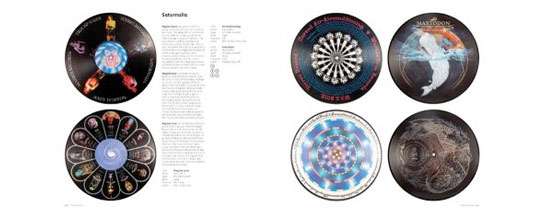
As the compact disc creeps closer to its slow and painful demise, another artifact from the past—vinyl—is still basking in all of its glory with a new, inclusive pictorial guide entitled Extraordinary Records. Presented in collaboration with Colors magazine, the book features a striking and colorful array of 400-plus images of vinyl albums (sans the covers) owned by collectors and Extraordinary Records contributors Alessandro Benedetti and Peter Bastine.

From countless designs and colors that include gold and clear records and splatter, marble, and beautiful picture discs dating back to the 1970s, this pair of record heads share an impressive 16,000 records between the two of them, while the book’s author, Italian producer and songwriter Giorgio Moroder, documents these recordings, including releases by The Beatles, Michael Jackson, Elvis Presley, Prince, and many more along the way. One page of the book showcases Pink Floyd’s Dark Side Of The Moon and Wish You Were Here on breathtaking picture discs, while another provides a stunning batch of odd-shaped novelties in the form of hearts and seashells. There’s even a slab of vinyl with a giant white whale in tow from sludge metal kingpins Mastodon. If you have an hour to do some skimming, Extraordinary Colors will definitely not disappoint.

Extraordinary Records is available through Taschen for $39.99.

Page 2736 of 3781
1 2,734 2,735 2,736 2,737 2,738 3,781