White Fang Release Album, Shreds U.S.

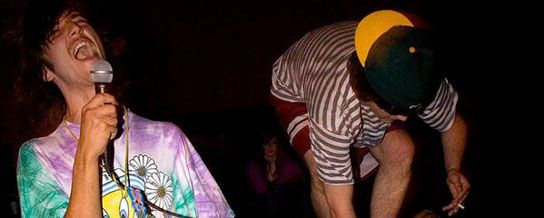
Pure Evil, the new record by Portland thrash-rockers White Fang, is now out on Marriage Records. The album tempers textbook rock moments with quirky brass accents, group sing-alongs and retro pop guitar lines.

To celebrate its release, the band has been shredding its way across the country this fall with glamorous, ghetto-tech Seattleites Mad Rad. Check out their gnar sound at one of the remaining tour stops.

Pure Evil Tracklisting
1. Breakfast
2. Tall Shadow
3. My Invisible Handz
4. Flashlight
5. All’s Cool
6. Grean Beanz
7. We’re Reborn
8. Feeling Infinite
9. Space Gemz
10. Gnar Shred
11. New Loudness

Dates:
11/17 New York, New York – The Knitting Factory
11/19 Jersey City, New Jersey – Grand Banks Cafe
11/20 Providence, Rhode Island – Mars G.A.S.*
11/22 Buffalo, New York – Broadway Joe’s
11/25 Madison, Wisconsin – Project Lodge
11/28 Denver, Colorado – Rhinoceropolis
12/1 Seattle, Washington – The Fun House
12/5 Portland, Oregon – The Artistery

*with Rainbro

Wilderness “Strand the Test of Time”

Wilderness‘ third full-length, (k)no(w)here, came about after the Baltimore-based, most unconventional band was asked to collaborate with renowned visual artist Charles Long at an exhibit the latter put on in the spring of this year. That said, the musical aspect of the project is quite the conceptual beast, and another one for experimental rock fans to add to the iPod. Check the stop-and-start guitars and vaguely doom-rock sounding vocals on this track for further proof.

(k)no(w)here
High Nero
Strand the Test of Time
(p)ablum
Silver Gene
Own Anything
Chinese Whisperers
Soft Cage

Wilderness – Strand the Test of Time

In The Studio: Jake One

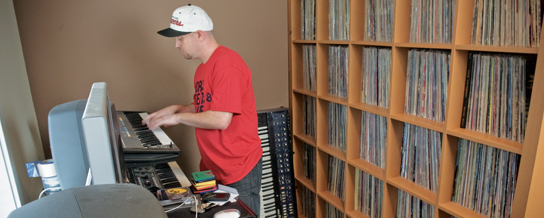
Seattle-based beatsmith Jake One defies classification in hip-hop. His discography this decade is as chart-topping as it is depth-plumbing, including work with E-40, MF Doom, and 50 Cent. And his production process is just as unpredictable–his beats can be entirely sample-based, all live, or a hybrid of the two techniques. No matter the process, Jake aims to bring his rugged underground sound to the widest possible audience. On his debut album, White Van Music, he calls in rhymes from indie stalwarts (Blueprint, Brother Ali) and Rap City-ready acts (Young Buck, Busta Rhymes) alike. XLR8R caught up with Jake to talk about how his album came together and his irregular approach to sampling.

XLR8R: On your album, you pair MCs that normally wouldn’t work together, like Plug One and Slug, or Brother Ali and Freeway. How did those collaborations happen?

Jake One: Instead of just having different songs by different artists, I wanted to put some people together that people wouldn’t expect but that I thought would actually work. The theme of the album is just trying to make quality hip-hop and not really worrying about singles, first-week sales, and all that bullshit. It basically tries to throw all that out the window and just make songs. [With] the song “The Truth,” when Freeway did his part, I just thought [Brother] Ali would sound good on it. I wanted to put him on the record anyway, so it just came together.

I’ve read that you don’t make beats with specific MCs in mind. What inspires the whole beat-making process for you?

A lot of time it’s just listening to records and getting into the vibe. I definitely get into a style for a certain period of time; for 10 or 15 beats, I’ll do something that’s similar. But a lot of times, it’s just listening to other music. When I was doing a lot of this album, I really was listening to a lot of the stuff I grew up on, a lot of early-’90s West Coast shit like NWA, Compton’s Most Wanted. There’s definitely some songs on the album where you hear that [influence]. But I just make the beats and they fall where they fall.

Those early-’90s West Coast beats were driven by keyboard and synth stuff, which you use a lot of. Has that always been the case?

I’m not really the greatest keyboard player. I always liked a lot of that music, but I’ve always been sample-based. So for some of these records, I start ’em with a sample and then have the musicians I work with like G Koop play around with what I do and add some additional stuff to make it more interesting. When I first started making beats I was trying to be Premier. Straight up, that’s who I wanted to be. And you could hear it.

I didn’t see the MPC on your gear list on your MySpace page. Did you ever mess with that?

I have an MPC–I had a couple of ’em–I just never got the feel for it. I could fundamentally [use it], but I couldn’t necessarily have the feel that I wanted to make the beat mine. For whatever reason, the first sampler I ever had was a Roland S-10 and it was a keyboard sampler so that’s just always how I’ve worked. I had an [E-Mu] Emax after that, which is another keyboard sampler, and then I got into the [Ensoniq] EPS. Now I’m on the [Ensoniq] ASR-10, which is what I’ve been using since ’97 or something.

Given the legal issues with sampling, are you leaning more towards writing your own loops?

I’m always gonna have some sampled elements in every beat I do, whether it’s drums or a string hit or something, just ’cause that’s the texture of sound I like. I’ve actually done a lot of beats without samples. I like people to not really even know what the hell I’m doing. I don’t even want it to be known whether I’m sampling or not; it shouldn’t be obvious. When I usually do the live stuff I put a lot of work into having the process be exactly the same as when I use samples. Like that record we did in New York, “Trap Door,” with my boy G Koop; he played a different part and chopped every single note up on the ASR like how I would with a sample. It’s the same exact process. So I pretty much get the same feel when I come back with it.

MP3: “Trap Door feat. MF DOOM”

Dr. Dooom Dr. Dooom 2

I’m the god of rap/The lord of music,” spits Dr. Dooom (a.k.a. Kool Keith) on “I Followed You,” from his latest medically minded excursion. But his rich career has buckled considerably in recent years, tarnishing past grandeur with Ultramagnetic MCs and solo projects Doctor Octagon and Sex Style. Dr. Dooom 2 is plagued with verses that are lazy, not funny, and amount to nonsense. “RIP Dr. Octagon” and “How Sexy?” are rehashes of his past personas, while the album’s best cut, “Surgery” (with Motion Man) is a mediocre collab (Keith even gets out-rapped!). KutMasta Kurt’s basic keyboard beats are stale, especially when unaccompanied by strong vocals, making the entire release offensively bad–and embarrassing.

Podcast 62: Scuba 10245 Dubstep Mix

Under his Scuba guise, DJ, producer, and Hotflush Recordings curator Paul Rose delivers this hour-long, exclusive mix that’s a comprehensive sampling of new dubstep sounds. Techno, electro, and atmospheric influences all collide with the genre in the form of tracks from Baby Ford, Sigha, Toasty, Untold, Martyn, and a few from Rose himself.

Rose, who relocated from his native London to Berlin in 2007, released his much-praised debut full-length, A Mutual Antipathy, earlier this year. His production work, like his tastes as a DJ, isn’t confined to straight dubstep, but rather looks to many different styles of music that could influence the genre. Catch him throwing his Berlin-based party SUB:STANCE on his off hours.

Dubstep 2008 with Scuba
01 Shackleton “The Rope Tightens (Badawi Remix)”
02 Scuba “From Within (Marcel Dettmann Remix)”
03 Mount Kimbie “Maybes”
04 Scuba “Bleach”
05 Sigha “Expressions”
06 Pangaea “Bear Witness”
07 STP “The Fall (T++ remix)”
08 Untold “Sweat”
09 Scuba “Tense”
10 Scuba “Ruptured (Surgeon Remix)”
11 Sigha “Bruised”
12 Baby Ford + Eon “Dead Eye”
13 F “The Untitled Dub”
14 Scuba “The Upside (Martyn’s Down Mix)”
15 Toasty “The Knowledge (Untold Remix)”
16 Mount Kimbie “William”

Subscribe to this podcast: iTunes or mp3 format. For help, click here.

Download MP3
Download M4A (iTunes enhanced)
Subscribe to Podcast (RSS)

Podcast_Mix_2008_11_13

San Serac, Copy Remix Faunts

The music of Faunts could easily be described as epic, cinematic, and entirely remixable. Thus, the Canadian five-piece outfit has handed its tunes over to friends who are up for the task of reworking them.

Said characters include Portland’s Copy, S.F.-based producer Boy in Static, one-man disco machine San Serac, and others, each remixing tracks from Faunts’ first two releases, High Expectations/Low Results and the more recent M4 EP. Faunts Remixed, all 14 tracks of it, will drop November 18 on Friendly Fire Recordings.

Also stay tuned for the group’s forthcoming full-length, Feel.Love.Thinking.Of, which is slated for a February 2009 release. For the moment, thee remixes should do.

Faunts Remixed:
01 “M4 (Part I)” (DVAS Macho Mix)
02 “Memories of Places We’ve Never Been” (T.H. White Remix)
03 “M4 (Part II)” (The Paronomasiac Remix)
04 “Place I’ve Found” (Mark Templeton Remix)
05 “23” (Cadence Weapon Dogcatcher Remix)
06 “Parler de la Pluie et du Beau Temps” (Copy Remix)
07 “Instantly Loved” (San Serac Instantly Dubbed Mix)
08 “Gone With The Day” (Graham Lessard Remix)
09 “Will You Tell Me Then” (Boy in Static Remix)
10 “Instantly Loved” (Set Transition Remix)
11 “Of Nature” (Brightest Feathers Remix)
12 “Memories of Places We’ve Never Been” (Domer Does Disco Remix)
13 “Parler de la Pluie et du Beau Temps” (Beaner’s Sleepy Mix)
14 “Gone With The Day” (Faunts Stars Are Out Remix)

Francois Virot “Not the One”

A former drummer for noise-pop trio Clara Clara, Francois Virot ventured off into solo territory recently and, upon the September release of his debut album, Yes or No, proved you can do a lot with a simple palate of guitar, vocals, and hand claps. And while his songs might be minimal in structure, they’re not lacking in the kind of quirky, spastic energy Virot needs to set himself apart from the dozens of other artists attempting to twist folk inside out these days. In what feels like a playful take on the whole genre, Virot delivers everything from melancholy ballads to spastic numbers in which he would appear to be treating the guitar as more of a percussion instrument than one merely made for strumming. As seen with this track.

Francois Virot – Not The One

Muxtape Founder Chats MP3s

Muxtape was shut down by the industry back in August, but that hasn’t deterred site founder Justin Oulette’s enthusiasm for music, the web, and the evolution of the two. Besides the lengthy post he left on the Muxtape site in September, he’s also featured on WePC TV’s first episode of “I Want My MP3,” a new series in which show hosts sit down with creative brains to discuss music and technology. Peep the clip below to hear Oulette’s take on music, technology, and the difference between the mixtapes we made in middle school and those we now create online (generally when we’re supposed to be working).

Various Artists Kalk Seeds: Karaoke Kalk Compilation #2

This Berlin-based label has never been afraid to take risks, releasing micro-minimal and electro-pop gems since the late 1990s by artists like Senking and Ekkehard Ehler’s März. On its second comp, 17 wide-ranging tracks defy immediate classification. What to make of The 23s’ “The Longest Moment (Still Lasting),” Toog’s “L’esprit de L’inventeur,” or Wechsel Garland’s “Tiny Stars” except to say that they’re all lovely, quirky pop tunes that grab and don’t let go? Leichtmetall’s “Im Paradies” sounds like sugary, 21st century chanson, Donna Regina’s “Vague” is slow, dark, and swampy, and Pluramon’s shoegazy “Turn In” gives the overworked sub-genre a booming backbeat and exciting new life. Not everything works here, but when it does it’s real damn good.

Totally Faded: Chris Coady

For the next four weeks, XLR8R will chat with four indie engineers who invite us into their studios to discuss production philosophies, gear, and how to set your music free. Next, we chat with producer/engineer Chris Coady, who has worked with Yeah Yeah Yeahs, TV on the Radio, !!!, Telepathe, and Blonde Redhead at his East Village studio, DNA.

What’s the centerpiece of your studio?

A vintage SSL G Series mixing board which has been restored. It makes everything that goes through it sound like a hit song.

What pieces of gear do you most often return to?

I’m most comfortable using Neve 1066 preamps, 1176 compressors, and SSL mixing boards. I use Pro Tools for editing and Yamaha NS-10 speakers for monitoring, though I desperately want to find something better.

What element of production do you usually spend the most time on?

I like to take my time on every step if it’s an option. During basic tracking I like to get everything set up and record for a day while changing slight details. During mixing, I like to take at least one day per song, if not two. Some people think you can over-think a mix, but I have yet to find one that didn’t benefit from taking extra time.

What are the most important elements to have in check before a record gets mastered?

First, I make sure that everyone in the band is totally happy with the mixing. Then I listen on different speakers at home and in the studio to make sure the vocals and bass are at the right levels. If something sounds off and there’s time available, I recall the mix and change it. A lot of times the original mix with flaws is favored over the perfected recall mix.

When a band comes into your studio, what do you typically wish they had more prepared?

I would like bands to be more prepared to take risks and try new things. Being in the studio gives a band an opportunity to set a new standard and to make sounds that have not been heard on any album before.

What are some strange things you’ve tried in the studio that ended up having great results?

One of my favorite things to do is not to record ambience tracks on instruments and instead use digital washes of sound to fill out the space where that ambience would naturally be. This way, you don’t hear a guitar player playing a guitar in a recording studio in New York City–instead, you hear a sound which sounds nothing like something you would hear in real life. It sounds more like the music is coming directly from their imagination. It still comes as a shock when I suggest it to a band rather than the traditional method of putting a hundred ambience mics around the room to make the recording sound very “real.”

What was your experience of working on TV on the Radio records, considering there is a producer (David Sitek) in the band?

When working with TVOTR, I take on the engineer role and take care of the recording and technical side, while Dave handles all of the creative and musical responsibilities in the studio. The coolest thing about Dave as a producer is how he interacts with the bands. It’s really magical. It’s almost like turning a studio into a dream world and when you enter, you leave everything behind at the door. He gets some really amazing recordings that way, and if I’ve learned anything from him, it’s to treat the studio and the bands in a way where they feel more empowered in the studio recording than anywhere else.

Do you think that’s a personality thing, or are there specific ways of creating that atmosphere?

I think it’s a matter of attitude about the situation. You can sit in a room filled with expensive equipment and feel one way, or you can kind of make the whole studio transparent so when people play and record the studio ceases to exist in the music. I think those are the best recordings: ones where it doesn’t sound like a bunch of people sitting around in a room with no windows waiting all day and then picking up a guitar and punching in their part.

What’s an album that you always turn to for its production quality?

Some of my favorite albums for the sake of production are Fleetwood Mac’s Tusk, Kate Bush’s The Dreaming, and Wu-Tang Clan’s Wu-Tang Forever. The Dreaming has so much imagination in the production that you hear new things every time you hear each song, no matter how many times you have heard it. Also, Kate Bush comes from a theatre background, so for every vocal on the album she assumes a new character–sometimes childlike, sometimes scary monsters. It gives the whole thing this other dimension. Later, in an interview, she would admit that the album was the sound of her losing her mind. Fleetwood Mac’s Tusk is the sound of people drunk on success but not nearly out of ideas. Lindsaey Buckingham’s songs are riddled with engineering errors but it simply adds to the feel. Listening to this album makes me think that they used more varispeed effects on Tusk than The Beatles used on Sgt. Pepper’s. Wu-Tang Forever has some of the most amazing vocal performances, as well as some of Wu-Tang’s best use of sampling.

What are the most common mistakes home producers make?

A lot of home recorded demo stuff sounds pretty good–there are some noisy tracks or some bad mic-ing but the feel is usually great. I think it’s pretty amazing that any kid can record at home using their computer and make a masterpiece if they have it in them. Making an album is something that doesn’t necessarily require money–more so just the will to do it. Grizzly Bear’s Yellow House is an example of people going into a house (a yellow one) with a computer and some mics and making a masterpiece.

I guess I feel like home recordings often don’t knock that hard…

Well, the mix is probably the issue, When you take the tracks into a proper mix room and sit with some really nice speakers positioned properly you can really dial in a hard mix. When you’re at home on headphones in a tiny Manhattan apartment it may be hard to really hear everything. Things like Ariel Pink always sound better when they are mixed and recorded at home, though I’d be interested to hear what he would do with an unlimited budget in a proper recording studio.

Last Week: Efrim Menuck

Page 2811 of 3781
1 2,809 2,810 2,811 2,812 2,813 3,781