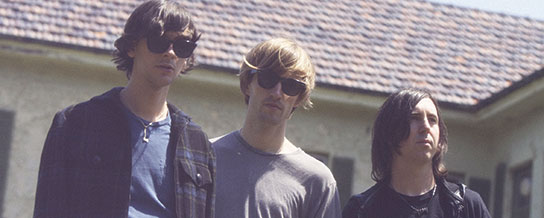
It felt absolutely, resolutely endless. Gothic grey streaks and storm clouds splayed for miles across the Bristol, U.K. skyline, comprising the daily view from Portishead’s perch at the top of band member Adrian Utley’s stately, two century-old Georgian house. Camped out in the top two floors of studio space, the band was entrenched in an interminable stretch of music-making, broken occasionally by talking, fiddling with vintage instruments, and drinking tea.
Progress was slow, and the trio was frustrated. They pined for ideas and concepts, abstracts which often felt as tangible as white sand slipping through bony fingers. The self-imposed pressure was evident. When the group first approached Island Records about making another album–their first new material in nearly a decade–in early 2007, they had seven finished tracks. A year later, they were back down to six.
The band struggled to find a new sound–one that didn’t just revisit the dark trip-hop blueprint that made them famous–while grappling with unease at the state of the modern world and its wars.
“I feel like Rowdy Roddy Piper in They Live,” says band member Geoff Barrow of his sense of disconnection from society. “I feel that if I put glasses on, I would be surrounded by a bunch of aliens.”
Uneasy Listening
The making of Third, the band’s third real full-length, may sound like the musical equivalent of Sartre’s claustrophobic play No Exit. Frustration was nine-tenths of the album, confirms Barrow. But isn’t that, in some way, the perfect set of conditions for a band whose music has always sounded a bit tortured and uneasy? Portishead emerged in the mid-’90s with their own soundtrack of gritty beats and dark, smoky, painstakingly sculpted atmospheres–they sounded as enigmatic, somber, and damned as the double agents from the spy movies they occasionally sampled. The trio was a perfect union of an unlikely grouping of musicians: Geoff Barrow, a young hip-hop head and denizen of Bristol’s bustling recording studios; Adrian
Utley, a jazz guitarist who had once toured with Big John Patton; and Beth Gibbons, then and forever a mysterious, 21st-century torch singer, blessed with a voice and inflection that sounds beautifully cursed.
Utley and Barrow met in a recording studio in 1993–Utley was in session with a jazz band, and Barrow, in an adjacent room, was trying to sample his breaks through the walls. As the two started working together, it was clear they possessed a different chemistry and sound than their peers. Utley remembers fellow Bristolian Mushroom, a founding member of Massive Attack, coming into the studio where they were recording. “He said, ‘What are you doing? What the fuck? You’re playing that music?’ He had no idea you could do that. He came from just records and sampling.”
The trio added vocalist Gibbons and set forth their own gothic take on trip-hop with 1994’s Dummy and 1997’s Portishead (and again with a 1998 live album, featuring strings from the New York Philharmonic). The pressure to create a new chapter of this wildly influential trilogy made the new record a stressful journey. Nonetheless, Third finds the group reinventing themselves without repudiating their past. It’s an exquisite record of motorik rhythms, dread-inducing beats, and oscillating, off-key electronics–all without samples.
“I wanted it to sound like some weird live recordings from the Amazon,” says Barrow. “I wanted it to sound like it struggled.”
Unsolved Mysteries
On his blog, Geoff Barrow wrote that making this album was like watching Lost. Like that post-modern mobius strip of a television show, Third has roots in Sydney. In early 2001, Utley and Barrow entered a small recording studio in Australia, intent on making Portishead tracks. Both arrived from radically different places, having taken their own routes since the band burned out after its last tour in 1998. Utley dove into soundtrack work, scoring The Sound of Claudia Schiffer, a Nicolas Roeg documentary. Barrow got a tattoo, his name in a graffiti font on his arm. It signaled an end and a beginning–after getting divorced and feeling tired of making music, he decamped to Australia and helped found the Invada record label.
“I couldn’t find anything I was into,” Barrow explains. “I couldn’t find anything to say musically. I felt like I was on autopilot.”
Utley joined Barrow Down Under and worked for a month, putting together about six or seven tracks, which Utley describes as being “quite soundtracky.” But it wasn’t quite clicking. Barrow said it was more about feeling they had to do it, not that they wanted to do it. They scrapped all the tracks–none appear on the new album–but a seed had been planted.
A short while later, Utley found himself back in the English countryside, holed up in a cottage in Dartmoor with Gibbons. The wind was howling, it was pissing rain, and a milk churn near the door kept banging into the wall, but this pastoral moodiness suited Gibbons, who grew up on a farm, just fine. Utley had disassembled all his studio gear and carted it here to help Gibbons record her own material. She needed to say some things she couldn’t say in the context of Portishead, he recalls, and the process inspired her. Recorded shortly after the Australian session, the material would become part of Out of Season, Gibbons’ collaboration with Rustin Man.
To this day, Utley and Barrow don’t intrude on Gibbons’ vocals, an intensely private world, nor would they want to. Though she is an intriguing frontwoman–lyrically abstract, notoriously media-shy, often seeming anguished as she draws out her tortured notes–Barrow says she’s really rather straightforward. “Beth doesn’t seem mysterious by any means. She’s brilliantly able to communicate on so many levels. She is such an interesting person, a brutally honest person who throws up massive questions.”
Musically, Gibbons also prefers to push the envelope. “The madder stuff you give her, the better,” explains Barrow. “She responds to noise and echoes and weird places. People think, ‘Hey, I can give her real mad [electronic or hip-hop] beats.’ Well, no, you fucking couldn’t.”
On Edge
Barrow and Utley certainly oblige Beth’s penchant for weird beats on Third. The band immerses itself in noise, drone, and free jazz, and influences from Om and Sunn O))) to early electronic acts like Silver Apples. “[Listening to that music] kind of blew the cobwebs out,” recalls Barrow.
Third finds the band traveling down the same dark road, but with an expanded sonic palette and faster tempos–and tracks that are bit more noisy, aggressive, and purposely out of tune. The album-opening “Silence” commences with an enigmatic snippet of Portuguese dialogue provided by their friend Claudio, then steps into a sonic jungle. A squiggly, leaden beat is at the fore, but the periphery quietly teems with electronic echoes, unseen birds and beats calling from the darkness. And that’s just the first 45 seconds–somber strings, Gibbons’ plaintive vocals (“Did you know what I lost…. Did you know what I wanted?”), and sublime guitars follow. “Machine Gun,” a punishing march of electronic drums, alternately pummels with sound and elevates with warm, gauzy synths. The choppy melodies on “Plastic” sound like loose rotor blades. “The Rip”’s folksy guitar lines morph into pulsating melodies, while the tense, upbeat “We Carry On” manages to be booming and frenetic and hypnotic at the same time.
The approach to making this album was more communal and less static, employing much more instrumentation–Barrow played drums and keys, Gibbons contributed some guitar, and Utley strums a ukulele on “Deep Water,” inspired by the Steve Martin film The Jerk. This time around, the group creates real imperfections and oscillations instead of restructuring pockmarked samples. “I’ve got nothing against creative sampling,” offers Barrow. “But I feel weird about sampling nowadays, like people should have moved on and started writing their own shit by now.”
Barrow, who is dyslexic, doesn’t have a real visual sense to his production–he sees studio time as a chance to “turn his eyes off.” “When I do interviews, I hear the word ‘perfectionist’ a lot,” says Barrow. “And to me, it seems just the opposite. You’re struggling to get something that sounds good, or kind of good, or even okay. Fuck perfection, I just want to get it in tune, or out of tune.”
There is something more that Barrow is searching for, though–he’s always striving for a sound that has presence and space. “The edge is the most important thing,” he states. “For me, that’s the otherworldly thing, the unknown quantity, the glue. When you sample something, the glue already exists, because it was probably recorded in some great orchestral room. It’s that mystery.”
Odd Fellows
Last December, Portishead premiered their new tracks at All Tomorrow’s Parties’ Nightmare Before Christmas festival, which they curated. The three of them were much closer, artistically and geographically, than they’ve ever been, and there was a palpable sense of looseness and relief on stage. Parts of Third were finally exposed, and it seemed that all the exhausting conversations, painfully long nights, and musical soul-searching had been worth it, if not essential to the process of being Portishead.
“We’re an odd band,” states Utley. “There’s such an oddness to us. But that doesn’t worry me.”