Chris Duncan: Punk Rocker to DIY Mystic
“I have fallen into everything I have ever done,” states 34-year-old Chris Duncan, who moved to the West Coast on a whim some years ago from his native New Jersey. Landing in Oakland, via a stint on the Tahoe slopes, this punk rock die-hard proceeded to get mystical, creating an organic body of work where wood putty, paint, lines of pencil and string, and pink tape converge into cosmic transmissions that suggest clues to the mysteries of the universe.
Though pieces have titles like “The Mess We’ve Made and the Year It Took to Clean Up” and “The Great Unraveling-American History,” they’re the only thing clear about this abstract art, which takes into account Joseph Albers’ color theory and places emphasis on laying bare the art-making process (via exposed threads, ghost lines, and the like).
On the flip side, Duncan does quite a few things that are very concrete. Since 2002, he has been producing the ’zine Hot & Cold with Griffin McPartland. Each issue features contributions from 20 artists and is limited to 150 copies; the ninth installment will be released on May 9 at a group show at San Francisco’s Luggage Store Gallery. He’s also the editor of My First Time: A Collection of First Punk Show Stories, which was released by AK Press last August.
We caught up with Duncan at home in Oakland and engaged in a heady conversation about Daniel Higgs, string, and sacred geometry.
XLR8R: What artist’s work was a revelation to you when you first discovered it?
Chris Duncan: I feel completely inspired and awestruck by Robert Irwin and Daniel Higgs. They both embody the growth, fearlessness, and maturation that I strive to have. Robert Irwin was an action painter who completely walked away from his studio practice to pursue installation art, which focused on color, light, and space. That was the early ’70s. He threw caution to the wind and never looked back.
When I was 17 I walked into a record store in Maryland called Vinyl Ink and was immediately drawn to a stack of LPs by a band called Lungfish. The record was called Necklace of Heads and it had this really simple, beautiful black-and-white picture of a man on it. He looked like he was in a trance. He was reaching out. That record came home with me and blew my mind. I had never heard anything like it. The man on the cover was Daniel Higgs, the singer. That was 1991. Over the years I have seen his art shows; I’ve watched him read poetry, play music, play the Jew’s harp, and just be. It’s 2008 and his music and art have taken such strange and honest turns. He is a man who is connected to everything around him–he has honed in on all of it. I find his creations and way of living to be beautiful.
Then there’s the Dada movement. All of it. All of them. They shook it up, and have left shock waves that will last forever. That’s amazing.
What are some installation ideas that you’ve discarded along the way to arrive at where you’re at now?
As my work was changing from things that had figurative elements in them to abstraction, I had a lot of ideas in regards to combining the two things. I made sewn paper houses and thought it would be rad to make a whole city. Mostly, I was afraid to let go and needed a push. That came in the form of Brion Nuda Rosch and the Mimi Barr Gallery. Brion put me in a group show there and basically let me go nuts. I did, without any birds, all string, and pink tape. It felt right and I am still building off that installation: investigating string, light, shadow, optical trip-outs. It’s fun.
What is the most common media you work in?
I tend to work on paper or wood panel. Working on paper allows me to expand on some ideas by offering up the ability to sew. I use watercolor, markers, graphite… a lot different things. All my surfaces have a coat of wood putty on them. The wood putty has a fresco feel and can be sanded down to be perfectly smooth. It’s a great surface to work on.
Then there’s string. The string installations came from my boredom with my sewing machine. I really enjoyed the use of thread, but wanted to expand and interact with spaces, rather than paper. Conceptually it made the most sense as well. I was making relatively permanent work about transience and ephemerality. It started to make me feel weird. So I called bullshit on myself and started investigating actual temporary work that was about that moment. It’s there and then it’s gone. Like all of us. Like everything.
What is one thing you would like to make but can’t because of monetary limitations?
I have an interest in threes. I have an interest in simplification and reduction and contemplation. That being said, I enjoy the three most common shapes that can be found in almost everything: the square (or cube), the triangle (or tetrahedron), and the circle (or sphere). I would like to create a cube that you can walk into that has a smaller cube in it. The doorway to the cube would be the same size as the smaller cube. That room would be totally white. There would be a doorway in the shape of a circle leading to anther room. That room would have a neon-pink-taped floor and a large sphere (referencing the earth) hanging in the center of the room. The last doorway would be a triangle. That room would be pitch black with a white string pyramid in it. The base of the pyramid would have a mirror on it, and [would be] lit so that there would be triangles reflected throughout the room. The sphere and the cube would have dots all over them. Form, energy, matter; mind, spirit, body; the beginning, the middle, the end; birth, life, death. Process. Three. This would be giant and [would] cost a lot of money.
Can you talk about your use of color?
I generally work off of primary colors. I mix them into other weird colors when it becomes necessary. When I make the dot paintings, I feel that it is important to have as many colors as possible or, at the very least, to have a lot of colors touching a lot of other colors to create strange color relationships. The clustered dots are forms or bursts of energy. I don’t know that I choose a color palette as much as it chooses me. I am very influenced by Josef Albers and his color experiments. I just put out the vinyl version of the Pale Hoarse record on my new label called The Time Between the Beginning and the End. The concept for the covers is inspired by Albers. I made 104 of them. They are silk-screened and sewn and hand-numbered. The drawing is the same and the ink used is the same, but there are five different paper colors. The ink reacted differently to each paper; for example, the pink ink on yellow paper made the ink look orange, but the pink ink on blue paper made it look purple.
There is quite a lot of geometry in your work: triangles, shapes formed by strings and lines… What is your relationship to geometry?
I went to the Louvre when I was 23 and it blew my mind, in particular the Egyptian sarcophagi. Some of them had these really rudimentary color wheels on them that represented the cyclicality of life. I took to that and started making color wheels. (Funny how at school I hated those assignments.) Anyhow, the geometry built from there. It turned into fractals, points of contact and connection, studies of form, etcetera… so definitely more mystic, though I believe there is a connection between mysticism and mathematics, and I also believe humans have an innate geometric sensibility. I am horrible at math, by the way.
What is the best lesson you learned from punk rock?
Don’t talk shit. Though I cant say I’ve learned that completely.
Various Ten Years, Who Cares?
When Sonar Kollektiv first opened its doors in the late ’90s, acid jazz was already fading into something more commercial. And while the “eclectic lounge” sound happily embraced genre-splicing, clubgoers and critics alike questioned how the afterhours music scene might evolve. Today, just try to tell label chiefs Jazzanova that these chilled-out vibes have seen their day. After 10 years of floating their mercurial jazz/hip-hop/house fusions onto mixes and dancefloors, their Sonar Kollektiv imprint continues to push the ever-blooming sound that it helped establish as the electronic music staple it is today.
Many labels claim to explore versatility, but Sonar has embraced its cross-genre directive with a voracious appetite for both stylistic and compositional fusion, resulting in a dizzying array of unexpected sonic blends. Ten Years, Who Cares? delivers a satisfying sampling of the label’s better finds; it’s a great starter for those still unfamiliar with Jazzanova’s stable and highlights why DJs continue to look to Sonar for new finds. The first CD culls together Sonar singles, mostly of the downtempo, soul-drenched-vocal variety. More than anything, the Sonar Kollektiv sound is a lush one: rhythms abound, rich in instrumentation and shimmering with dense layers. The most memorable pieces bind these sumptuous passages with percussive structures, like Soulphiction’s “Used,” where Suzana Rozkosny’s breathy croons morph rugged, macho beats into something eloquent and sultry. Forss’ “Using Splashes” could be the gem of this collection, showcasing the effortless pastiche for which SK is renowned: Dreamy atmospherics, hip-hop swipes, and grimy funk smolder together seamlessly, as beats tug and pull at each other, shuffling to fit within a tricky breakbeat puzzle.
Ten Years’ second CD, a mixed set, better demonstrates the palpable, we-just-really-love-music exuberance of Jazzanova’s sound, a vibe that the group’s fans will recognize from their peerless sophomore album In Between (certainly one of the most sophisticated albums ever produced in the amorphous “lounge” category). Like In Between, it’s hard to find a bad tune on this dancefloor-directed disc: A soaring, yearning remix of the Jazzas’ track “That Night” opens the mix, while Sequel’s “I’ve Been Waiting” flexes wavy, psychedelic notes into a gentle reverb of melody and funk, only to dissolve into a throaty, deep-house vocal growl. Techno also makes an appearance: Moonstarr’s elegant “Detroit” lives up to its moody namesake by dropping angular tones onto ethereal melodies, creating a simple, pulsing cadence that’s nothing short of electrifying. Segueing into Swedish duo Arken’s supple, acid-tinged track, “Arken 10,” the Jazzanova compilers display their expert mixing ears, rubbing coarse techno textures into a smooth, ambient-house vibe.
After all this time, it’s easy to forget why people started talking about acid jazz in the first place, but Ten Years reminds us how seductive this sound can be. Maybe the voodoo lies in the music’s ability to instantly conjure images of cool: Elegant, chill vibes emanate from these pieces, going down as easily as that icy cocktail in your hand. Ten Years is a vibrant document of lounge morphing into its next phase–and a testament to how genre categories, even a decade ago, are rendered meaningless to the knowing ear.
Soundpool “The Divides Of March”
The New York-based outfit Soundpool plays a dreamy sort of synth-pop, drawing from modern shoegazers like M83 and Broadcast, along with the earlier, influential records of Cocteau Twins and Lush. The watery, swirling tunes feature Kim Field’s fragile vocals floating on top of saturated guitars and programmed keyboards. Dichotomies & Dreamland, their second album (following 2006’s On High), is a pleasantly psychedelic trip of beat-driven pop songs and shimmering, instrumental interludes.
Why? Alopecia

For artists as self-immolating as Oakland hip-hop/future-pop purveyors Why?, titling an album Alopecia (an unpleasant form of hair loss) is no huge surprise. Why? main man Yoni Wolf’s deft lyricism often finds its focus in the granular details of everyday life, reveling in the mundane but often parlaying it into transcendent beauty. Maintaining his new focus on sung songs, started on Why?’s last record, Elephant Eyelash, Wolf’s reedy voice evokes everyone from The Mountain Goats’ John Darnielle to They Might Be Giants’ John Linnell but manages to always deliver the songs with unsentimental emotion. Alopecia finds Why? refining and clarifying the scope of its music to mostly excellent ends.
Clinic “Free Not Free”
I love it! The mood of the intro is completely misleading. The bass is way out of tune. The singer’s intonation is really unique; he’s always just a little sharp, whereas the bass player is entirely flat. These guys have a very sensitive taste for tuning–pleasing and not immediately graspable.
Tall Firs Too Old to Die Young

Like their Ecstatic Peace boss Thurston Moore, Tall Firs have a gift for slanted guitar atmospheres and laid-back vocals that feature as much slang as soliloquy. And like Moore’s Sonic Youth, the structure of Tall Firs’ anthems, like “So Messed Up” and “Blue in the Dark,” feature extended periods of guitar exposition mashed between their beginnings and ends. But Firs reach down closer to Neil Young’s roots than Glenn Branca’s on homespun yarns like “Lookout” and the finale, “Secrets and Lies.” But that’s just the back story: If you’re a chilled-jam fan that likes a freak-out here and there, Tall Firs’ second record will tickle your inner lava lamp.
Lyrics Born “I Like It, I Love It”

Bay Area resident, rapper, and self-professed Shoe HoLyrics Born headed over to Epitaph for his fourth solo album, Everywhere at Once, which was recently released in conjunction with his own Quannum Projects. As its title suggests, the album finds the man born Tom Shimura, dabbling in everything from hip-hop to eletroclash, further cultivating his image as an observant, conversational wordsmith whose lyrics are as humorous as they are conscious. This album is also Shimura’s first studio release to feature members of his live band, and also sees contributions from producers Jake One and Trakademicks.
Autechre Quaristice
Light and dark, desolation and grace–Autechre’s see-saw tilts steadfastly into its ninth LP manifestation. Quaristice convulses between minimalist mechanics and grim, subconscious melody more sporadically than ever before. The reverse tide of “WNSN” and low-frequency polar creep of “Notwo” lubricates the hyper-electro cadence of tracks like “chenc9” and “bnc Castl,” accentuating the disintegrated nature of the album. Whereas early works like Amber and LP5 explored the fusion of fluid and mechanical textures in a cybernetic form, Quaristice seems to break that formula down and explore the components in a more vacuum-like environment. However, hybrid organisms that do emerge, like the humming, titanic “Tankakern,” move with a dark and deliberate gait, bound for many a rewind.
Ghostland Observatory: Indie-Dance
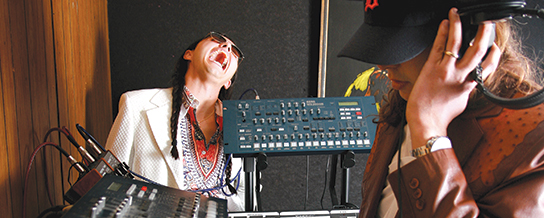
Despite its reputation as a hotbed of live music, Austin, Texas still loves its daily dose of mid-’90s dance crack–at least according to Ghostland Observatory frontman Aaron Behrens. “Everybody loves Jammin’ 105.9!” he crows, citing his favorite local radio station and most recent source of artistic inspiration. “C+C Music Factory, Marky Mark… ’90s, like, sweat dance. It’s the shit! If you listen to the 20-minute block, you’ll hear some Bobby Brown.” His bandmate, drummer/knob-twiddler/keyboard wizard Thomas Turner, prefers slightly more obscure material: “I’ve been listening to this oldies station a lot: Gerry Rafferty, a lot of old jams. I listen to what my son likes–he’s two. He’s listening to Kraftwerk pretty hard right now.”
Ghostland Observatory formed nearly four years ago when Turner and Behrens met each other as members of Waking Helix, a more rock-oriented band. Discovering a mutual attraction to the world of synthesizers and samplers, the two split off and Turner, formerly a rave organizer, founded Trashy Moped Records to promote and release Ghostland’s records. Their debut, delete.delete.i.eat.meat, hit the streets in 2005. Behrens and Turner are currently holed up in their Austin rehearsal space, preparing for a spring tour to support their third record, Robotique Majestique, also on Trashy Moped.
Ghostland’s repertoire has always defied easy genre classification, with songs jumping from funk to rock to electro-disco, and RobotiqueMajestique is no exception. Even Turner seems hesitant to categorize his work. “We just make music that we like. We try to stay different–we never really tried to figure out what genre it is, we just do what we do,” he offers, his shrug on the other end of the line almost audible.
After Robotique’s psychedelic, grandiose “Opening Credits,” the album dives into a series of driving dance numbers, anchored by funky synth hooks, disco-inspired keyboard machinations, occasional IDM clicks and snaps (possibly a nod to Turner’s rave-happy past), and references to Daft Punk and Behrens’ beloved C + C Music Factory. The wave of dance numbers meets an abrupt end with “HFM,” a lo-fi dance-punk shout-fest that would easily find a place among stacks of Atari Teenage Riot and Add N to (X) records. The only common element, it seems, is Behren’s distinctive wail, which veers from Axl Rose-style falsetto to manly power-rock grunt.
Sonically, Robotique packs an exponentially stronger punch than the group’s previous work, a development indicative of their musical growth as well as a new focus on production techniques. “The first record was done in a duplex,” Turner recalls. “The second was done in an office space, and the third record was done in a barn. We definitely spent more time on production. We’ve been doing low-budget for such a long time, this was the fist time we got a proper mastering job.” It’s a big step up from Turner’s beer-truck-driving gig and Behrens’ mailroom job, but the band remains grounded. “We are civilians!” declares Turner.“Not full-time rock stars.”