M83 “Graveyard Girl”

Anthony Gozales has once again proven himself one of the masters of 21st-century shoegaze with his fifth studio album under the M83 moniker. Saturdays = Youth, to be released shortly on Mute, finds the French producer enhancing the vocals, guitars, and percussion with his trademark dreamy synth notes, and structurally, songs on this album feel more coherent than on any other of Gonzales’ releases. “Graveyard Girl” is the album’s first single. Photo by Anouck Bertin.

Graveyard Girl

PlayStation Home: An Immaterial World

In 1982, Tron posited the wild idea of humans zapping their psyches into a digital realm, which allowed them to roam inside a virtual world, ride around on sweet motorcycles, and “de-rez” (read: kill) each other with DayGlo frisbees. A bit ahead of its time, this romantic, Atari 2600-inspired dream’s lasting appeal only really tickled the fancy of a relatively small cult of sci-fi fans and proverbial basement-dwelling computer hackers.

Fast-forward to today and massive multi-player online (MMO) titles like World of Warcraft (10 million registered accounts) and Second Life (20 million registered accounts) have thrust this once fantastical idea of personalized characters running roughshod over digital environments not only into the lives of hardcore gamers, but also those of soccer moms, priests, and CEOs.

Despite few MMO games appearing on consoles, the wide appeal–and more importantly, money–that these virtual communities garner is not lost on console manufacturers, least of all Sony–this spring the electronics giant prepares PlayStation Home for the PlayStation 3. Combining stylistic elements of successful online works like The Sims and Second Life with those of community-based websites like MySpace or Facebook (with a dash of Xbox Live), PlayStation Home has managed to create its own online vibe like nothing else on home consoles to date.

A free download, Home allows PS3 owners the opportunity to create their own “space” in a 3-D utopia that’s buzzing with all manner of consumer-based activity. After creating your own customizable avatar, users can begin exploring and interacting with the world around them. You can voice- or text-chat with other users, get low in the local dance club, hustle fools at an ersatz pool hall, watch movie trailers in a virtual theater, visit a trophy room that trumpets the in-game achievements of Home users, or simply soak in the idyllic vistas that surround you and your new friends.

One notable feature of Home is that it allows users to continually personalize their own little (or big, depending on how things go for you) online residence with any number of items, such as art or furniture that can be bought or otherwise obtained within the world; Sony will eventually provide users the tools to create their own items (which can then be sold for real money using an auction system). Once in your apartment, other users can pay you a visit and trade media–from music to images to game data–with you, should you choose to do so.

As the service is free to users, advertising will, for better or worse, be a part of Home, with Sony encouraging retailers to create their own areas within the world as well as enabling them to stream dynamic ads targeted to particular users based on their gaming habits. While this may seem suspect on the surface, it allows for potentially interesting promotional events such as contests, sponsored concerts, or first-look video premiers exclusively for Home users.

With most of the major movie studios, retailers, and even Netflix committing to Sony’s proprietary Blu-ray format (the PS3 is still the cheapest Blu-ray player on the market), the advent of Home, which will constantly be augmented and tweaked, could finally launch the PS3 closer to the level of virtual awesomeness Tron predicted 26 years ago–without the “de-rezzing,” of course.

Best of the Rest
Three other virtual places to put your feet up–amongst other things.

Vles
For those not content with actually living, visiting, or puking within the confines of New York’s real Lower East Side, MTV and VICEMagazine bring would-be hipsters a chance to try before they buy–or more likely rent–with Virtual Lower East Side. With representations of many (not all) seedy LES establishments, you too can be a part of NYC’s best-kept secret! Oh wait…

Habitat
Okay, this one doesn’t actually exist anymore, but it’s worth a mention as it is widely considered to be the first online game, and the one whose technology spurred the entire movement. Developed by LucasFilm (now LucasArts) in 1986 for the Commodore 64, Habitatallowed users to barter for materials, and even murder for them, which prompted the community to create their own laws before shutting down in 1988.

Red Light Center
Modeled after Amsterdam’s Red Light District, Red Light Center encourages you to “live your fantasy” (or “bang,” as it’s also known) in a bevy of nightclubs, hotels, and bars. With over 700,000 users currently, all RLC avatars are anatomically correct and can smoke weed. What else do you need to know?


ii Landlakes

With its largely improvised debut Landlakes, Melbourne duo ii (or eye, eye) gracefully balances on a tight rope that splits genres. Alex Nosek and Jon Tjhia create abstract instrumental pop by layering the synthetic beat of Boards of Canada with Grizzly Bear’s dreamlike depth. The album is purely organic, and brings some tangible energy to an often-stagnant indie rock genre. “We Ate Everything” begins with a cluster of drum beats and drones, and quickly sorts itself out with the smooth and airy “Oho,” only to come crashing down with the surf rock-esque “Clamshell.” With Landlakes, ii begins the countdown to 2008’s year’s-best lists.

Man Man “Top Drawer” from Rabbit Habits

The chorus is strangely pretty to me, made up of one big chord–even though it sounds like the guy’s saying something about hot dogs. It’s a lurching half-tempo kind of song, with carefully layered electric pianos, guitars, and marimbas. I like all the syncopation, which sounds really good on headphones. And then there’s a really nice kind of instrumental section (like Xhol Caravan or Soft Machine or something), which I think makes the chorus prettier each time you hear it. This music takes its time to build and make its statement.

No Kids Announce Tour Dates

The three permanent members of No Kids are set to venture out of Vancouver today, for a brief U.S./Canadian tour that will keep them busy for most of April. The group, whose Come into Our House album was released earlier this year on Tomlab, will travel with Brooklyn’s Dirty Projectors for the majority of these dates, though a show with Blitzen Trapper is scheduled for the beginning of the month, as well as a couple solo shows. For more on Nick Krgovich and Co’s music, songwriting process, and distaste for offensive band names, click here.

Dates
03/31 Montreal, QC: La Sala Rossa*
04/01 Toronto, ON: Sneaky Dee’s*
04/03 Chicago, IL: Subterranean*
04/04 Cleveland, OH: The Grog Shop^
04/05 Princeton, NJ: Terrace F. Club*
04/07 Washington, DC: Black Cat*
04/09 Brooklyn, NY: Music Hall of Williamsburg*
04/11 San Francisco, CA: The Independent*
04/12 Los Angeles, CA: The Echo*
04/16 Portland, OR: Holocene*
04/17 Seattle, WA: Chop Suey*

* w/ Dirty Projectors
^ w/ Blitzen Trapper

The Acorn “Crooked Legs”

Influenced by Honduran folk music of the 1950s, as well as by West Indian rhythms, Glory Hope Mountain, the sophomore release from Canadian indie rockers The Acorn, finds the band digging deeper than ever–lyrically and musically. Theme-wise, the album is an homage to frontman Rolf Klausener’s mother, tracing her unstable beginnings in Honduras to a life-changing relocation to Montreal. The storyline is accompanied by an intricate musical arrangement of strings and percussion.

Crooked Legs

Loading… God of War Review

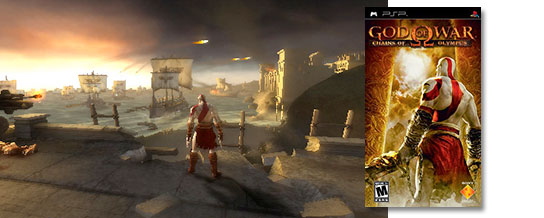
God of War: Chains of Olympus
Sony Computer Entertainment
PSP
$39.99

In the few short months that 2008 has been alive, the PSP has seen an impressive jump in quality titles, from the fine RPG adventure of Final Fantasy VII: Crisis Core to the arcade-action of Wipeout: Pulse. But perhaps the best example of the PSP’s ever-increasing potential is the recent release of God of War: Chains of Olympus.

In case you have never played a God of War game, the story follows a mighty Greek warrior with a dark past (Okay, he was tricked into murdering his wife and child–mad dark, son!) as he battles against various gods and monsters to relieve himself of the nightmare of his continued existence. Fun!

The basic gameplay is similar to that of other PS2 games in the series, in that you attack your enemies with blades at the end of chains attached to your arms, which you then use to attack from a distance with numerous combo-styles. Other weapons can later be discovered, such as a powerful gauntlet that decreases your reach but greatly increases your attack power, or magical items, such as the spirit of a fire demon or an enchanted mask that can become big difference makers. All items can also be upgraded to increase their potency as you collect orbs throughout the course of the game.

Visually, Chains of Olympus is hands down the best looking game on the portable system yet, and rivals its PS2 counterparts at nearly every instance. If it weren’t for the small screen you are forced to play on, you wouldn’t know the difference between Chains and the other games in the series. Colors are vibrant, animation is silky smooth, and the attention to detail is astounding.

The style of gameplay that fans have come to love is mostly intact here, and is hampered only by the PSP’s design. But Chains makes the best of things and absent buttons or attacks aren’t terribly missed once you get going.

As a prequel to the original game, we get to learn a bit more how Kratos became a slave to the Gods of Olympus and about his love for his family, which comes even more into play during a certain moment in the game that, while we won’t spoil anything, may have you saying “Oh…no. Please…don’t make me do this…” It’s kind of heart-wrenching.

If we had any complaints, they would be that the story does tend to be a tad jumpy and overall, it all seemed a little too short for our liking. But that’s just because the thing is just so damn good and we wanted more.

If there was ever a game that was a testament to what the once barely-breathing PSP is truly capable of, God of War: Chains of Olympus is it. We are excited to see what else this little machine will do next.

Major Steinski Career Retrospective Announced

Before there was Coldcut, Cut Chemist, Z-Trip, Kid Koala, Soulwax, or Girl Talk, there was one artist who pushed he boundaries of cut-and-paste urban music, a style that was a precursor to turntablism and mash-ups. New York’s Steve Stein, also know as Steinski, began releasing his influential collage hip-hop 12” singles in 1982-83, and is now the subject of a major double-CD career retrospective, What Does It All Mean?: 1983-2006, which drops May 26 on Illegal Art. The set includes a 20-page booklet with liner notes by Hua Hsu (The Wire, New York Times, Village Voice) and Steinski himself.

Steinski, along with partner Double Dee (Douglas DiFranco), co-produced the series of records known as “The Lessons,” “The Payoff Mix” (MP3), “Lesson 2 (The James Brown Mix)”, and “Lesson 3 (The History Of Hip-hop)” for Tommy Boy Records in the early 1980s. These analog tape cut-and-paste collages, still widely bootlegged (and wildly illegal), are generally acknowledged as three of the most influential works in the world of hip-hop and dance music production.

Steinski’s 1986 single, “The Motorcade Sped On,” was a collage of John F. Kennedy assassination news reports, and became a staple among the pre-rave music Wax Trax industrial-dance crowd in the late ’80s and early ’90s. More recently, Steinski was tapped by Stones Throw records to mix the 12” collage “Ain’t No Thing” for their release of The Third Unheard: Connecticut Hip Hop 1979-1983 compilation.

Steinski retains a cult following and is widely considered to be a major contributor to New York’s ’80s hip-hop and urban music revolution, which also includes the likes of Afrika Bambaataa, Mantronix, Grandmaster Flash, The Bomb Squad, and others.

What Does It All Mean?: 1983-2006 Tracklisting
CD 1 (Retrospective)
1. The Payoff Mix (MP3)
2. Lesson 2 (James Brown Mix)
3. Lesson 3 (History of Hip Hop)
4. Jazz
5. Voice Mail (Sugar Hill Suite)
6. The Motorcade Sped On
7. It’s Up To You (Television Mix)
8. I’m Wild About That Thing
9. The Big Man Laughs
10. Vox Apostolica
11. Is We Going Under?
12. Ain’t No Thing
13. Everything’s Disappeared
14. Number Three On Flight Eleven

CD 2 (Nothing To Fear)
1. Tonight From NY Intro
2. Swingset
3. Opening Credits
4. Greatest Man Alive
5. The Id
6. Let’s Get It On
7. Hit The Disco
8. Lolita
9. Hot Spot
10. It’s A Funky Thing Pt. 1
11. Bboy Breakdown
12. B-beat Classic
13. Funk Construction
14. Them That’s Not
15. Swan Lake
16. Here We Come
17. Product Of The Environment
18. By Any Means Necessary
19. The Art Of Getting Jumped
20. I Like It Like That
21. Solid Air
22. Country Grammar
23. Let’s Get It On (Reprise)
24. Muscles
25. Easin’ In
26. It’s Time To Testify
27. The Acid Test
28. Silent Partner

Page 2967 of 3781
1 2,965 2,966 2,967 2,968 2,969 3,781