Much ink has been spilled over the way that hip-hop artists are increasingly becoming defined by their entourages. Less discussed is the fact that techno is going the same route. (For proof, reference any photograph of the DJ booth when Richie Hawtin is holding court.) The proliferation of discount airlines and the growing notion of a “clubbing season”–marked by the opening and closing parties of Ibiza’s biggest institutions–are turning DJ entourages stateless and nimble, as quick as a flash mob and as ubiquitous as a 4/4 kick.
Matthew Dear may seem an unlikely person to possess such a posse. Since his 12″ debut in 1999, the quiet Ann Arbor, MI-based producer has been a staple of the Ghostly International label roster, his loopy, minimal tracks synonymous with underground–some might even say “indie”–techno. But the breakaway success of his 2003 single “Dog Days” and his increasingly on-the-mark productions and remixes as Audion–among whose many triumphs is the 2006 techno anthem “Mouth to Mouth”–have put him on a parallel trajectory with techno’s recent worldwide resurgence. Now he’s got four appearances in Ibiza this summer and a pending residency at one of L.A.’s biggest clubs. He’s touring the world nonstop, and wherever he touches down, a crowd of people does too.
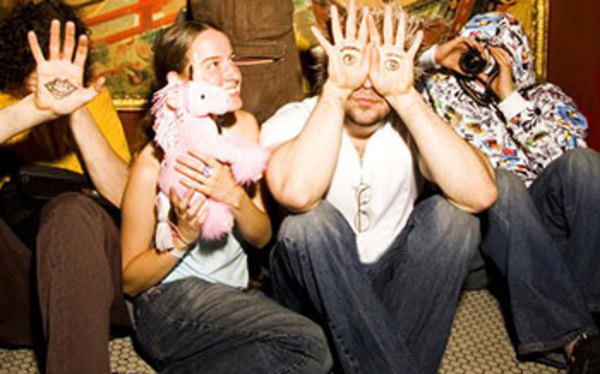
Every time I’ve crossed Dear’s path in the last couple of years–Mexico City, Barcelona, Portland, San Francisco–he’s been surrounded by an impromptu assemblage of people who have arrived for the sole purpose of spinning in his orbit. Over a recent weekend in San Francisco, a handful of old friends from L.A. have flown up on a moment’s notice just to have dinner and hit the club before flying home the next morning. At a recent gig in the Midwest, he used his Blackberry to coax two buddies into buying plane tickets, right there at the venue; they followed him to Miami for the following night’s party. A friend of mine from Mexico City tells me that a dozen people have contacted her for travel advice; they’re all coming down to celebrate Dear’s birthday at a villa in the countryside. All good DJs specialize in the art of moving butts; Dear specializes in moving them across multiple time zones.
Sing Your Life
In close company, Dear doesn’t come off as a superstar, or even necessarily the center of attention, but there’s no doubt he is. And he stands to become even better known with the release of his ambitious new album, Asa Breed–the first recording under his birth name since 2004’s Backstroke EP. With its confessional lyrics, warm timbres, and Eno-like overtones, Dear’s idiosyncratic take on electronic pop could easily cross him over to large-scale popularity among indie-rock crowds. This prospect looks even more likely given Dear’s live-performance aspirations: When Asa Breed (Ghostly) goes on the road, Dear will take to the mic, ceding the rhythm section to John Gaviglio and Mark Maynard of the band Cannons.
Dear tried singing and playing live alongside a collaborator once before, for the Backstroke tour. “I was just having fun,” says Dear. “At that point in my life I just wanted to play shit and I wanted to try something new, so I didn’t think too much about it.” Reviews were mixed, and Dear acknowledges the criticism: “I’d say 50% of the shows were awesome, and 50% were people getting used to it.” This time out, Dear has already spent a week in New York rehearsing with his bandmates, and with much of the album’s material written to include more electric and acoustic instrumentation, he seems much more confident about assuming center stage.
Mouthing Off
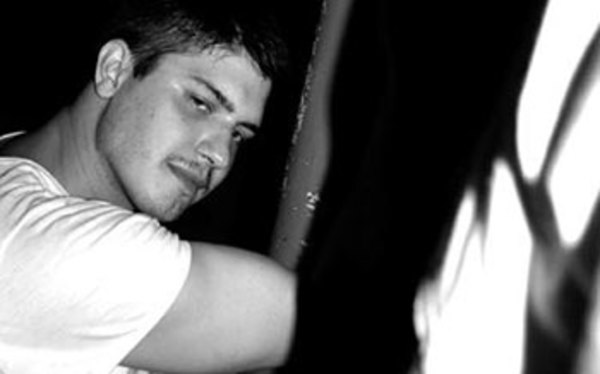
The very model of tall, dark, and handsome, Dear is unfailingly polite, but he can seem distant, even standoffish, around those who don’t know him. Among friends, his shyness melts away, and he’s not afraid to goof on your outfit or your romantic misadventures, or even to mock-boast about his own success. “‘Mouth to Mouth’ secured my fuckin’ fate, man,” he says at a boisterous dinner one night. “After ‘Mouth to Mouth,’ I could make acoustic folk ukulele music if I wanted to, and if people said anything to me’ could just be like”–he adopts an ironically cocky expression–”Hey! ‘Mouth to Mouth!'”
Like many introverts, Dear tries on extroversion–especially when the liquor flows freely–but he has the sense to back away when the bluffing misfires. Over sushi in San Francisco, a friend-of-a-friend sitting at the crowded table doesn’t understand why Dear and I are hunched over my tape recorder. “I’m being interviewed,” he shouts, grinning and spilling sake. “It’s my interview! Shut the fuck up!” Soon after, the kid slinks off. Later, in the club, a girl approaches Dear to tell him that back at the sushi restaurant he’d hurt her boyfriend’s feelings. In a flash, Dear is at the guy’s side to apologize for the joke gone bad. A week later, recounting the episode, he still seems clearly pained.
Dear readily owns up to being shy, and there’s a song called “Shy” on Asa Breed. It’s ambiguous and, like most of the record, more than a little brooding: “I’ve got some reasons to be kept inside/Don’t go outside just to stay alive.” Whatever he’s keeping inside, Dear has to go outside a lot these days. He has spoken openly about the way that partying becomes a crutch when you’re moving from city to city, stranger to stranger. You get the sense that in drawing people around him, he’s building a barrier against the fakeness and enforced loneliness of the star DJ’s career.
That’s not to say Dear’s lifestyle has a monastic bent. On another recent swing through San Francisco, the after-show gathering at a friend’s house lasted well into broad daylight; Dear woke up on a couch hours after his plane had left. No wonder that when I first heard Asa Breed‘s “Give Me More,” which includes the cryptic lyric “I awake in the middle of days/After dreaming about plays/I’ll never make in my life,” I misheard the rhyme as “planes.” He screws up his face when I tell him this.
“I’m not that literal,” he says, a little huffily.
Well Bred
When it comes to lyrics, Dear is actually the opposite of literal: he’s vague, evasive, downright obfuscatory. “Let people Google it themselves,” he says when I ask him where the title Asa Breed comes from. “That’s what makes it fun. It’s not smart. It’s not hidden.” (For the lazy, it’s the name of a minor character in Kurt Vonnegut’s sci-fi novel Cat’s Cradle.)
If Dear’s evasiveness is surprising, it’s because Asa Breed sounds like the work of an artist putting himself on the line–baring his soul, even. A pop record, it’s far more indebted to song structure than any of Dear’s previous work: Where Audion tracks routinely push the 10-minute mark, the average length of an Asa Breed cut is a radio-friendly three minutes. The 4/4 chug of house and techno is still the rhythmic foundation of his music, but synthesizers and drum machines make room for electric and acoustic guitars, high-necked basslines, and live drums and tambourines. On the surprise cut “Elementary Lover,” labelmates Mobius Band contribute Afro-pop-inflected licks to an easy shuffle that recalls Tony Allen.
More than anything, though, it’s Dear’s voice that makes Asa Breed seem so personal. Every one of the album’s 13 tracks features his multi-tracked vocals–baritone, alto, and falsetto fluttering in uneasy harmony. And the lyrics, more often than not, are dark, shifty, and plagued with doubt.
“There have been times when I slipped and fell,” he sings on “Fleece on Brain,” the album’s uneasy opening cut. On the grinding but somehow sprightly “Don and Sherri,” he intones, “I’ve been sending you signals/But my signals have never been seen/I’ve been writing you letters/But those letters never leave me.” “Pom Pom,” which sounds like a bizarre fusion of Kompakt, Yaz, and The Beach Boys, might even be more telling: “I’ve got to figure out love/It’s such a tricky thing/Can include diamond rings.” When I ask Dear, who is married, what his wife thinks of the lyric, he only laughs.
“You know what? She hasn’t said anything. The good thing is that all my other songs are so abstract’ can just say that one is too.”
“I channel people,” he continues. “I channel characters. It might not be about me, but it’s about an experience. It’s almost like a story, but very abstract and open-ended.” Sometimes the story itself hardly matters–the words and phrases, from their connotations to their purely phonetic properties, function like the loops in techno. On the ominous “Will Gravity Win Tonight?” confessional lead vocals are offset by tightly trimmed oohs and ahs that, on closer inspection, reveal themselves to be a sort of mantra: “More work to be done.”
“That’s the prime example of what I learned in techno and applied to organic music,” says Dear. “I wanted to loop vocals and use them more like a rhythm. The voice doesn’t have to mean anything. I want it to mean something different to everybody that hears it.”
The album’s emotional core, “Deserter” (also its first single), underscores the ambiguity at the heart of the record. Over a keening, electric-guitar-led melody, Dear conjures Ian Curtis and The Psychedelic Furs as he drones:
What was that
You found deserted
Lost and alone
The world around you
Is gone perverted
Don’t be afraid
This is what you’ve been saving for
Everything that you’ve done
Nothing seems to be what it’s worth
On the page, the lyrics might not look like much–a little adolescent, a little clumsy–but rising up from the mix, they reach out and draw you in. And the chorus might as well be a lifeline to doubters everywhere:
I ain’t really all that I been
looking for
It really doesn’t matter but I
try to do more
Just keep on searching,
don’t be uncertain
Your life will only be just
what you want it for
The words jumped out at me as I took a sullen neighborhood walk, brooding over a depression that had plagued me for months. Turning self-doubt into a kind of security blanket, it gave me a peace I hadn’t felt in weeks.
“I wrote that song three years ago,” says Dear. “I wrote that song before I ever toured the world! It goes, ‘Been around the world, seen my share…’ I wrote ‘Deserter’ knowing what I would do.” No wonder it sounds so reassuring: It’s like a message from the future, a consolation that everything really is going to be ok.
Dear in the Headlights
Matthew Dear resists putting too much stock in connecting his confessions–or perhaps, his characters’ confessions–to himself. Just as he sings in three-part self-harmony and counts Audion, False, and Jabberjaw among his various aliases, there are many Matthew Dears. There’s the Matthew Dear who mouths off to a stranger and apologizes later. There’s the Matthew Dear who looks almost scarily confident behind the DJ mixer, the very picture of poise with a matte silver chain dangling from his neck. There’s the Matthew Dear who treats his father to a fly-fishing trip in the Gulf of Mexico. (Dear credits his father, a commercial fisherman and home-taping amateur musician, with instilling in him the knowledge that “you didn’t have to have a label, you didn’t have to make records–you could just record your own music and play it for yourself, and it didn’t mean anything else; it wasn’t about being a ‘recording artist.'”) And then there’s the Matthew Dear who surrounds himself with cronies and cohorts and co-conspirators, staving off the loneliness of the road.
At a party at this year’s Winter Music Conference, Dear played the main room; unfortunately, the venue was too big, the crowd too small, and all but a few head-nodders migrated to the side room where Miss Kittin was playing. Dear soldiered on, playing a mind-bending set of minimal techno. I was standing at the bar, the music still playing, when I noticed someone next to me: it was Dear, on leave from deck duty. “Can you guys come up and hang out with me?” he asked, gesturing to the empty booth. “I’m bored.”
Aud Man Out
Matthew Dear’s mind-meltingest dancefloor tracks.
Audion “Mouth to Mouth”
Ghostly’s sub-label Spectral’s highest selling record to date, “Mouth to Mouth” began making the rounds shortly before last year’s DEMF; when Richie Hawtin used it to close his festival set, it cemented its reputation as one of the tracks of 2006. “It’s not a track, it’s a moment,” says Dear. “It’s 12 minutes of bliss.”
Audion “I Gave You Away”
Less dramatic than “Mouth to Mouth,” this recent compilation cut might actually be the better track. The reverb on the drums feels simultaneously close and faraway, queasy synths chafe against strict time-keeping, and handclaps slam shut like rat traps–the whole thing’s at once claustrophobic and horizon-wide.
Hot Chip “No Fit State (Audion Remix)”
Preserving nothing of the original but the dirge-like title phrase, this oily carousel of a remix is druggy, disorienting, and not a little frightening–and that’s before the alien-death-ray organs come down like a bolt from the blue.
Black Strobe “I’m a Man (Audion’s Donation Mix)”
The lyrics are part lounge singer, part rock ‘n’ roll, and while they might raise eyebrows the first time you hear them, they soon make themselves at home. This is one of Dear’s sexiest tracks, and the churning, Carl Craig-styled synths in the background make for a delirious peak-time tease.