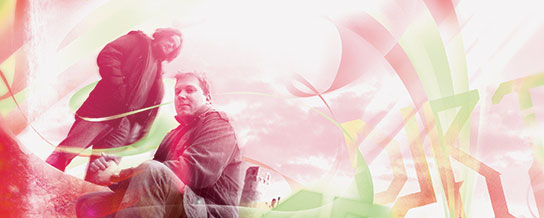
Seba and Paradox: Break for Love

Drum & bass pioneers Sebastian Ahrenberg (Seba) and Dev Pandya (Paradox) have always followed their hearts, rather than fickle trends in the scene–conformity is not a word in their vocabulary.

British producer Paradox began carving his own niche in breakbeat as early as 1991, when he released his first track as Mixrace (with DJ Trax), the 180-bpm “Too Bad For Ya.” Never happy with the simple boom-clack boom-clack two-step beat that currently defines most drum & bass, he has since found thousands of ingenious ways to slice, dice, and reconstruct the funkiest of breaks, hitting his stride in the mid-’90s with a slew of releases on the legendary Reinforced imprint. Pandya currently runs four of his own record labels (Outsider, Esoteric, Paradox Music, Arctic), championing a style of drum & bass he calls “drumfunk,” which is heavily influenced by ’70s funk breaks.

Stockholm, Sweden’s Seba has parallel interests, but a very different background. He made his name with a string of rich, soaring grooves for LTJ Bukem’s Good Looking Records in the late ’90s before founding his own imprint, Secret Operations, in 1999. After a string of house excursions under the alias Sunday Brunch, he resurrected the label with a series of smashing releases that can be heard on Beats Me, a mixed CD of his work with Paradox that was released in April. After a DJ gig in San Francisco’ sat down with these close friends and found out how they make it all happen.

XLR8R: How did you guys end up working together?

Seba: The first time we met was at Ministry of Sound [at] the launch party for [LTJ Bukem’s mixed CD] Logical Progression. We were just bigging up each other. It was funny because we knew that we were on the same tip when it came to music.

Paradox: We were reading interviews about each other in the press, so Seba could see what I like and I could see what Seba likes–we were basically into the same music.

Since you live in different countries, do you exchange tracks by mail or using AIM?

Seba: We don’t work over the Internet, since we believe it’s important to be present when changes are made. If you hear something new in a track, you might instantly get a new idea that you could work on. We fly over to each other’s studios; so far that’s involved about 10 flights. Since Dev is using OctaMED on a Commodore Amiga and I am using Cubase on PC, we decided to work on my set-up. I guess it’s easier to learn Cubase than it is to understand a tracker program. This means that I engineer the tracks, and we arrange [them] together. Dev usually carries samples with him and sometimes we import breaks that he previously programmed in his studio.

Many of your collaborations feature the soulful vocals of Robert Manos. Who is this mystery man?

Seba: Robert Manos is a guy who lives in New York. I know a house producer that used to live in New York named Alexi Delano. He calls up and says this guy Robert Manos is coming to Sweden because he has a son who lives there. At that time I was working with Swedish house producer Jesper Dahlbäck making house music and some D&B. We took out a D&B track we were working on and said to Robert, ‘Would you be able to sing on this?’ He started to do this Studio One reggae thing. We said, ‘There’s not one element of reggae in this song,’ and Robert said, ‘Well I thought it was jungle.’ I said, ‘No you have to listen to this track.’ He asked ‘What do you want me to do?’ I said, ‘Think Marvin Gaye,’ and he just started singing and it took off from there.

There’s been an increase in popularity of the breakier style of D. Is this something you knew would happen and how do you feel about being at the forefront?

Paradox: Everything goes in cycles. In 2000, when there wasn’t much classic breakbeat D&B, it was a bit disheartening when the two-step copycats took over the scene.

Seba: That’s when I started making house music.

Paradox: Just before Seba and I started working together, I thought that things could change. Another reason why Seba and I got together is because I couldn’t fight the battle on my own. I’ve been doing it for so long. I needed someone who had their own identity just like me to help push forward. It’s mainly due to our profiles that we’ve pushed this breakbeat sound forward. It’s fair to say that we are the most well-known breakbeat producers on that side of the scene. We’ve got a responsibility.

What’s the idea behind your new Beats Me CD?

Seba: We decided to do a showcase CD of what our labels (Secret Operations and Paradox Music) are about. We’ve reached out to the vinyl buyers, but there are a lot of people that don’t buy vinyl and come to our show asking where they can buy this music. Plus, vinyl sales in general have been down.

But aren’t artists who make anthems still doing well off of vinyl sales?

Paradox: I know friends that are selling so many units and making a lot of money out of it, but the music is absolutely diabolical–just hardcore cheese–and we can’t make that. If we closed our eyes, we could do it in half an hour, but we have souls and I can’t bring myself down to that level and make crap music.

Seba: I don’t think we can make that music, though I know what you’re saying. I don’t think the people making that music think it’s good. It’s just another track to make 1,000 people jump up and down so they can get paid and buy new polished rims for their Beemer.

QQ: Jamaican Boy Wonder

“The people have spoken. QQ, come back to the stage.”

It’s 4 a.m. in Kingston and Flexx, host of Passa Passa’s third anniversary dance and part of dancehall group T.O.K., is calling QQ back to the stage for the third time. The four-foot-tall child prodigy bounds on and launches straight into a sweet rendition of “Poverty.” The song, his first single, held the number-one spot in Jamaica for four weeks in 2005 and stole the record from Dennis Brown who, at 13, had previously been the youngest artist to achieve a number one.

Working the crowd like a veteran, the 12-year-old’s microphone-shaped medallion glistens as he pours his soul into roots and culture lyrics addressing the problems of Jamaica’s poor. Ghetto kids rush the stage–this is their artist. Lighters shoot into the air and a teenager lets off a fire torch. Between verses, QQ urges, “Listen my people,” and a hypnotized crowd of downtown rudies, dancehall queens, Rastas, and uptown revellers do exactly that.

As he exits, the crowd calls his name. “Please,” he says, stopping them. “There’s some big artist back stage a’wait to come on.”

The next day–while the majority of the Passa Passa revellers are still sleeping–QQ is sitting in class for a full 8 a.m.-to-3 p.m, school day. He tells me when he first hit the big time his friends would say, “Bwoy, you can’t talk to him now he’s the big man.” To which he’d reply, “No, man, our friendship never changes–the only thing that change is that I now do music.”

This maturity is prevalent throughout his songs, saving him from Kris-Kross-esque gimmickry. On tracks like “My God Is Real,” “Mrs. Babylon,” “Betta Mus Come,” and “Never Know the Use of Her,” he articulates socially and spiritually deep ideas with a wit and understanding that seems inborn rather than coached. I ask his father if he has always expressed himself with a depth beyond his years. “He’s been a powerful youth from the day he was born,” he says. “Sometime I have to remember him still a child.”

Born Kareem Dawkins, QQ got his first taste of performing in the school choir whilst living in London. Although he excelled in academic subjects, from a toddler music was his passion; at age nine, he asked his father if he could join him in Jamaica to build a musical career. Now living in Marvely in Kingston–an area neither uptown nor downtown–QQ says he spends his days “at school, playing with friends, writing lyrics, praising the Almighty, and recording tracks with producers Kalibud and Bobby Digital,” two of the best roots producers in the world.

When asked what his goals are in life, he looks at me earnestly. “[My goal] is to help people unite and love each other,” he says. And this is possible through music? “Music has powers,” he says. “Music can make you do things, and make you don’t do things. Music can change life.”

Warn Defever & NOMO In The Studio

Warn Defever, the man behind dream-rock-cum-experimental-blues project His Name Is Alive, has been manipulating all manner of sounds from what he calls “an ethical and moral perspective” for over 15 years. His early records, self-recorded projects that bear names like Livonia (after his suburban Detroit hometown) and Mouth by Mouth, helped to define the gauzy, ethereal sound of British indie label 4AD. But Defever has made so many unique twists and turns in his career (with an electro stint as Control Panel and solo work in the style of John Fahey’s Americana) that it’s near impossible to pin him to a single “sound.” Following HNIA’s exquisite Detrola, Defever has also taken on the task of recording new demos with the remaining Stooges. Here, he walks us through his studio and the production of Ann Arbor-based Afrobeat octet Nomo‘s New Tones.

XLR8R: The NOMO record was produced all over the Detroit, right?

Warn Defever: Yeah, it’s a pretty put-together record. We started at United Sound. It’s a historic studio. It had the deadest rooms you’ve ever seen and everything you did in there sounded good. We ended up having to bring a lot of our own stuff in, so it was almost like a field recording at that point. And when we started this, we were already recording all the NOMO shows… Sometimes when you’ve got a nine- or 10-piece band, and everyone’s doing solos, you don’t always get the right vibe. So, by recording the live shows, I thought we could mix and match, and take a solo from a live part and have it be a little less of a document of an event that really happened.

Is it difficult to record a brass band? Any tips?

The thing about any jazz or funk band, or any sort of improvised music, is you should have a room that sounds good. You shouldn’t try to do it in your basement. The way I record, I don’t have a technical background. I engineer from a moral and ethical perspective–that’s my motto. It’s about trying to figure out what’s right. Recording is a series of choices, and I always try to be on the side of good.

How does that ethos apply to your early His Name Is Alive days, when you were recording in your house?

At that point, HNIA is at the opposite end of the spectrum from NOMO. It’s me by myself, and I’m recording the most private, personal music that I could do. So, in that respect, if you’re a solo artist and you’re writing songs by yourself, and it’s personal music, don’t go to a studio. Don’t pay a stranger $50 an hour to mess up your songs.

So how does your Brown Rice studio stack up against your basement in Livonia?

It’s the best of both worlds. It’s my private space. I’ve opened it just so I can be recording in a bigger room. Plus I kinda needed to get out of the house a little bit [laughs]. Having worked primarily at home for 15 years, I started having a growing aversion to recording and I found myself seeking out new locations to do field recordings. I went to Japan and did a really nice recording at a 500-year-old Buddhist temple and I did some recordings in the Everglades…

What kind of setup did you use?

Sometimes a portable DAT. Sometimes a portable Pro Tools rig. Sometimes just a MiniDisc recorder.

What does the portable Pro Tools rig consist of?

I use the Digidesign 002 rack mount [unit] running through a Mac laptop. Is that a technical question? C’mon, I work from a moral and ethical perspective [laughs].

What did you first start recording on?

His Name Is Alive covered every base. The first album was done on a [Tascam-type] cassette four-track, which grew to an eight-track reel-to-reel to 24 tracks of ADAT. I’ve been using Pro Tools now for almost 13 years. I can edit faster than anyone else [laughs].

What are the most important pieces of gear in your studio?

Well, the Electro Harmonix Micro Synth. Everything goes through that at some point or another. Any kind of bass drum or bass, and any time there’s a guitar or synthesizer.

Anything else?

An Altec 436C–a tube preamp. During the NOMO process, one thing that I noticed is that they’re all really good players, and sometimes I wanted to bring it down a notch; I thought it was too good… We had to process it and give it just a little bit more character, where you can hear the struggle between what the person’s playing and their ability to record it. A lot of times [I’ll use] an old tube preamp, just to take the edge off.

Black Dice: Blood & Guts

Can you see the music? From Bjorn Copeland’s collage, drawings, and sculpture to Aaron Warren’s video art, the members of Black Dice have always had their fingers in other media. Small surprise, then, that the group’s latest release, Gore (Picturebox Inc.; softcover, $29.95), comes in ink and paper. The book gathers nearly 130 pages of psychedelic collage spliced with the photographs of Jason Frank Rothenberg, a friend of Bjorn (and his bandmate and brother Eric Copeland) since their early teens. Like Black Dice’s music, Gore mixes the ecstatic with the disturbing; its bright pages suggest the sublime aspects of the imagination and nature but return to material corruption via scrawls and jumbled images, empty candy wrappers, and unflattering snippets of body parts. Eric helped us connect the eye and the ear from the road on the band’s European tour.

XLR8R: How did the idea to make a book come about?

Eric Copeland: We had been thinking of doing a longer book for a long time; [San Diego hardcore label] Three One G put out a handmade short book [of ours] with a single a few years back. I guess we just wanted to work on something a little different, a bigger project of some sort, try something new. But Bjorn and Jason started to talk seriously about it between them and the whole thing sort of snowballed.

How did you go about making Gore?

Because we were collaborating with Jason, it took a long time to figure out how that relationship would work. In the end, we worked together physically on a lot of the pages and often we worked separately with each other’s work, and some of it is just singular work that fit with the project as a whole. A lot of the work is collage with straight photos as well, but, again, just figuring out how to work visually together seemed to [become the focus of] the project. It took almost a year for everything to be out of our hands.

How did the visual collaboration compare to the way you make music?

[We had] lots of similar ideas and methods of working, at least [around] the time of [2005’s] Broken Ear Record (DFA/Astralwerks). We all felt comfortable enough and [that we had] a lot of support to try anything we wanted. [It was] like we had shed some role and could try a variety of new working methods and projects. Bjorn, Aaron, and I have a pretty long-standing working and musical relationship, but the whole process visually felt somewhat surprising at times, getting to see everyone shift their strengths to something wholly different.

Did you split up the work, with some of you doing collage and others doing digital stuff, or did you all have a hand in everything?

For the most part it was cut and paste. There was a lot of laying out on the computer and some work was digital only. It was pretty much however someone had to work, [depending on] location, money, time, skills. And for us, sometimes the strength in something is a direct result of how it was made–somewhat incorrectly or improperly at times.

How visual is your music-making process?

Sometimes the sounds find a visual language that is often playful and personal. Sometimes we do have to draw what a song will look like or find each other through visual rather than sound terminology. And I think that our ideas of songs are sometimes privately visual as well.

There are some notes in pencil and pen in the book. Is any of that material stuff you’ve used to compose music?

A lot of it is, one or two found things, some notes or working lists…

Have you considered other mediums? Video, for example?

We tried to include a flexi-disc as part of the book but couldn’t find a manufacturer. I think we will definitely work in other mediums, and I know that video is one that we have talked about often, though maybe down the way a bit.

What would you say if someone decided to use a page of Gore as a musical score?

Do it.

Gore Vital: Inside the Making of the Book with Jason Frank Rothenberg.

Photographer Jason Frank Rothenberg has known Black Dice’s Eric and Bjorn Copeland since high school, but that didn’t prepare him for the surprises that ensued when they got to work on Gore.

“Working together was a new kind of relationship,” says Rothenberg. “[The band has] a really developed aesthetic, and they’re uncompromising in their artistic practice. I’d been around it–taking photos while they made their last few records–but that’s different than being in it. I didn’t realize just how serious these guys are about their art, but it makes sense when you look at their body of work.”

Of course, the process wasn’t all furrowed brows and glue-stained palms. “Those dudes are so funny, so it was a lot of fun,” recalls Rothenberg. “And there were a lot of synchronous happenings, [such as] the way the photo on [page 69] works formally with the collage on 68. Also, the photo on pages 100-101 as well as page 78… They’re sort of standard documentary images from our time together in Australia (when they were making Broken Ear Record), but they’re so flat, they almost look collaged. On top of that, in a very literal way, both images represent collage (scissors, magazine), so it was nice to see the context give them new life.”

Rothenberg says the toughest part of Gore was juggling everyone’s disparate schedules and locales, and paring the material down to the final 128 pages. “There were moments where our aesthetic sensibilities conflicted,” he offers. “It could be hard to swallow editing things out, but in the end it made the book more interesting. In the end, it’s kind of about where our aesthetics overlapped and even more so, [how] they evolved.”


Dirt Crew: Rave Results

Pablo Picasso once said, “Good artists borrow. Great artists steal.” That’s true, but few artists–even in the age of sampling–are ballsy enough to admit their “genius” actually came from someone else.

Not so with Dirt Crew. Germany’s two-man house team borrows liberally from the old school, and they’ll straight-up tell you so. “Dirt Crew [records] always [have] some disco samples or samples of old techno and house records from the ’80s,” says 34-year-old Crew member Peter Gijselaers (also known to Trapez fans as Break 3000). “We then try to mix those sounds with the current minimal techno or minimal house sound. The difference [between us and other electro-house producers] is that we try to keep things on the house side, and always put some of that older Chicago feeling in it.”

On The First Chapter–a digital collection of 11 of Dirt Crew’s previously vinyl-only singles–nfluences from Cerrone to 808 State to DJ Pierre come through loud and clear. The robotic one-two punch “Rok Da House” and dark, sweaty workouts “What You Want” and “Give Me House” wouldn’t be out of place next to classic Trax Records acid jams. And Gijselaers’ favorite track, the duo’s remix of Sasse’s “Soul Sounds,” features spooky hollow synth washes and piano vamps that will give anyone over the age of 30 profound flashbacks of warehouse parties and drugs.

Of course, Dirt Crew records don’t sound entirely old–they have a crisp, sharp quality that could only come from today’s digital production. Gijselaers and 30-year-old partner Felix Eder (a.k.a. James Flavour) work entirely on Macs running Logic, sending tracks back and forth via the internet from their respective homes in Cologne and Berlin. “We don’t use any hardware,” explains Gijselaers. “I think if you sample from old records and combine the old analog sounds with the new digital production, you get the best of both worlds.” Plus, having too much gear can be distracting. “I found it easier to produce since I sold all my hardware and bought my computer,” he says. “Some of the best tracks are made on simple machines.”

When Dirt Crew Recordings kicked off in 2003, making new New Beat and acid trax wasn’t quite as common as it is today. Where can an act that made their name with retro flavors go from here? Gijselaers says he’s drawing inspiration from producers who combine different genres; he drops names like Ame, Cologne’s Daso (who records for My Best Friend), and Solid Groove man Switch (“He takes breakbeat garage and mixes it with electro-house and techno. This is very exciting!”).

And if all else fails, Gijselaers will just build a time machine back to the disco days. “I would love to go back to 1976 or ’77,” he muses. “I think this was an extraordinary time for freedom–of music, sexuality, drugs. I think the world looked a bit better than now.”

CX Kidtronik: The Crack Game

Hip-hop might be all about the crack game these days, but CX Kidtronik has an entirely different sort of crack driving him. Spurred by the recent low-rise jeans craze, the Brooklyn beatmaker’s debut LP, Krak Attack (Sound-Ink), is an homage to female ass cleavage, punctuated by cover art that features a collage of ample-assed women doing their best plumber impersonations.

“The pictures were taken by the winners of my ‘Krak Attack Booty-Krakmonster Kandid Photo Kontest’ on Craigslist,” CX explains. “They had to be 100% real candid shots of chicks on the streets, subways, or wherever. One poor photographer suffered a Flintstone bump because the lady heard him laugh [while he was taking her picture]–and then she hit dude in the head with a gallon of orange juice.”

Sonically, Krak Attack mimics a smash to the head. A distinctly punk aesthetic (CX is also a member of punk-rap fusionists Deuce Gangsta, with Krak Attack contributor EKG) informs the mohawked former-Airborn Audio DJ’s bugged-out, crunked-up electro hip-hop, which is generally distilled into manic, one- and two-minute joints. While the hour-long, 32-song album features some familiar voices–Zion of Zion I, MC/graf legend Rammellzee (who apparently launched rockets from the shoulders of one of his Gothic Futurist get-ups to the beat while recording “Tricky Dick,” a routine that dates back to the Bambaataa/Flash days), Antipop Consortium’s High Priest–it’s filled out by a cast of largely unknown but talented MCs like Rockola, Moses, Ricky Ray, and DET.

“I (directed) the rappers to rap about krak, and then everybody just went off and did their own thing–not rapping about krak,” CX says, explaining the relationship between the MCs’ lyrical output and his own thematic vision. “(Everyone) is talking about selling crack, or they shit is crack, so it makes sense in a retarded way. I even tried to bring ladies in the studio. I asked them to stand with their backs to the rappers, and told them their shoelaces were untied. Eventually I had to put skits on the album, so it would make sense to the slower-moving humans.”

While he’s been holding down Brooklyn for the last decade, CX spent the early ’90s in Atlanta where he and Morehouse College classmate Saul Williams formed K.I.N., a group whose spacey vibe and mosh-pit-instigating shows caught the attention of Andre 3000 and Lil’ Jon long before Dre donned wigs or Jon got crunk. Reunited with his former partner after nearly 15 years, CX recently served as the one-man band and DJ during Williams’ opening slot on the last Nine Inch Nails tour. While on the road, CX and Trent Reznor teamed up to produce a large chunk of the material on Williams’ forthcoming album.

“Trent was cool as shit to work with and mad open to all ideas,” he says. As for his own wild ideas, CX explains, “I am from the world of Zerf in the 5th Quadrant. We have similar vowel sounds, but our women have bigger krak attack problems.”

Yuki Chikudate and Neil Halstead

Yuki Chikudate, frontwoman for New York atmospheric rock combo Asobi Seksu, was just a piano-playing teen in Southern California when British singer-guitarist Neil Halstead released his first record with shoegaze heroes Slowdive in 1991. But after a few extracurricular lessons in Sonic Youth and Stereolab, Chikudate traded in classical for a decidedly noisier approach to music. Halstead, now the frontman for country-tinged Mojave3, has quieted down significantly. With Mojave 3’s latest, Puzzles Like You (4AD), Halstead (along with Slowdive grads Rachel Goswell and Ian McCutcheon, as well as Alan Forrester and Simon Rowe), rediscovers ’60s AM-radio gold. But despite the differences between Puzzles Like You and Asobi Seksu’s Citrus (Friendly Fire), Chikudate and Halstead still share a love for subdued vocals and bright, screaming guitars. Here we tighten the gap between their respective homes in New York and Cornwall, England with a telephone chat about atmospherics, arguments, and unexpected studio guests.

Yuki Chikudate: I was reading Rachel’s [Goswell, vocalist for Mojave 3 and formerly Slowdive] blog and how she’s having health issues with her hearing. Were you guys ever concerned with hearing loss back then?

Neil Halstead: No, we never really thought about it at all, to be honest. And I’m not sure that the problem Rachel has is caused by that. But I know that Kevin Shields from My Bloody Valentine suffers from tinnitus and stuff, and I think that’s probably related to the volume they played at.

Yuki: Do you guys wear earplugs onstage?

Neil: No, no.

Yuki: Really? [laughs] You have no problems hearing at this point in your life?

Neil: I don’t think so. People have more problems hearing me because I talk very quietly… I suppose, sort of stupidly, we didn’t really think about it, probably because volume was something that really was a part of the experience for us.

Yuki: I’ve always felt that what made [Slowdive’s] sound interesting was the blurring of all the instruments and the ghost tones and reverb, and I’ve always been curious about how you were able to balance that live.

Neil: The sound sort of came together live, really, with Slowdive. I remember when Christian [Savill] first joined the band, he kind of changed things because he had this crazy guitar sound. And from the very first rehearsal, everything just kind of gelled… I don’t know what effect he was using, but it just sounded crazy–and it worked with what we were doing.

Yuki: Did you and Rachel have any problems hearing vocals onstage?

Neil: Yeah, we always had problems like that. We just sort of lived with it, and I think that the reason the vocals are always so quiet on the records is because we were used to the way it would be onstage–you’d never really hear a lot of the vocals [laughs].

Yuki: We have the same problem. People always complain and say ‘We can’t hear the vocals.’ Did you hear that a lot [playing] live?

Neil: Well, we definitely hid behind the guitars and stuff, vocals-wise… [But] it was more about the noise of the whole band, and the guitars were almost more important than what was happening lyrically.

Yuki: I feel like we have to explain that to people, because they don’t seem to understand that that’s the point–not to hear every single note and word that I sing.

Neil: Everyone’s kind of trained to pick the vocals out, because that’s how records sound, you know? In the ’60s, it was always just the drums and the vocals that would be loud. That’s the way people hear music.

Yuki: Our guitarist read somewhere that you guys used solid-state amps. Was that to distinguish your sound from conventional rock guitar, and let the liquidy reverb become the focal point of the sound?

Neil: I’m not really sure how that happened. When we got our first advance, we just went out and bought a whole bunch of stuff, but up to that point we just had these little amps that we just turned up as loud as we could. I think Christian used Marshalls and I use Rolands a lot of the time, just because they seem to be able to deal with all the frequencies a lot better than other amps. I’ve never been too techy about stuff like that. It’s kind of like, what you do is always dictated by your limitations, you know?

Yuki: Do you feel like there’s a shoegaze revival with acts like Serena-Maneesh, M83, and Ulrich Schnauss? Do you know any of these bands?

Neil: I’m not really aware of whether there is or isn’t a shoegaze revival, but I’ve noticed that people want to talk about it more now… It’s kind of interesting because there was this whole bunch of bands that were around even before us, like Spacemen 3 and Loop and Bark Psychosis. I used to love them, and it’s kind of weird because it’s almost like no one talks about them now. I hope that those records are sort of rediscovered and people see them the way I kind of see them, [as] records that are doing something different and interesting.

Yuki: What morphed Slowdive into Mojave 3?

Neil: The last Slowdive record was very abstract; everything I’d been listening to was abstract, like Stockhausen and Neu! and all this weird kind of techno. [The record] wasn’t very melodic; there wasn’t any lyrical content to it. [Eventually we] just kind of OD’ed on that and rediscovered people like Leonard Cohen and Dylan and Hank Williams–just stuff that spoke to you really directly, music that had this kind of raw emotion. With Slowdive, we’d almost kind of reached a point where it was so abstract that it was hard to find emotion in it. So [Mojave 3 was a result of] just wanting to rediscover naivety in music.

Yuki: You guys are all old friends in Mojave 3. It must be great to work with people who you have a deep personal relationship with.

Neil: I’ve known Rachel since I was 12 years old or something. In fact, we used to go to the same primary school but I didn’t know her until I was a bit older. It’s kind of nice because we’ve all grown together, and I guess with Mojave we’ve been going for like 10 years now.

Yuki: Do you guys ever argue?

Neil: Yeah, obviously you do, but I think it’s like anything–if you wanna get past it, you get past it, and if you don’t, then you don’t. But I think we’ve always kind of wanted to get past any arguments we’ve had. At one point, me and Rachel went out together. I think we were going out for two years, at the start of Slowdive, and that was really difficult when we split up. Actually, keeping the band together was really tough, but I guess you sort of figure [out], well, whether it’s something you wanna do, whether it’s important, you know?

Yuki: I heard that you initially tried to record Puzzles Like You in your own studio but that you had a bit of a mouse problem or something [laughs]?

Neil: We recorded the whole record in the studio, but there was a point where we were completely overrun with mice. It’s in an old airfield and there’s a lot of farm buildings there. We’ve always had a mouse problem but, for some reason, last summer it was just insane. There would literally be mice sitting on top of the speakers. The farmer was telling us we should poison them and we didn’t really want to do that, so in the end we kind of got these humane trap things. They’re probably infesting somewhere else now; we just released them down the road… On some of the really quiet vocal takes you could hear the mice squeaking in the background.

Yuki: So, you guys and mice are on the album. That’s pretty awesome.

Neil: There’s a dog on there as well. On one track, if you listen closely, you can hear barking.

Yuki: The studio we recorded in had a not-so-cute problem. We had a bedbug outbreak in the building. The whole time we were just so panicked and freaked-out…

Neil: Yeah, well, that’s rock and roll.

Page 3344 of 3781
1 3,342 3,343 3,344 3,345 3,346 3,781