
MCs Vise Versa and Chief Nek grew up in Colorado Springs, a town known more for Rev. James Dobson‘s Focus on the Family organization than for hip-hop. After blowing up the Springs, they moved to LA and recorded this solid debut; on the introspective single “Everyday” they document this transition, with help from fellow Springs native/LA transplant Stro the 89th Key (The Procussions). Standout tracks here include the soulful “Sweet Music” and the banging hard “In Deux Time,” both of which announce the duo as an estimable presence in the City of Angels.
Aeox Null #12
AeoX always steps into strange territory with sounds never heard before; this one is like Frank Zappa with a gay twist. They tore the roof off of Panorama Bar in Berlin (and my mind!) with their live PA. Hanno Hinkelbein and his guitar-swinging monster mate Alexej are worth checking out if you‘re bored with minimal techno from Germany-and you like punk. I sure do!
Skream Skreamizm Vol. 1
This boy is on fire, and with Tempa behind him, get ready for the Skreamizm series; lots warm low-end but with the coldest heights. “Rottan” is like the wacked-out cartoon Monkey Dust, but for your ears. The bass here just never dies.
Dizzee Rascal Wasteman
On the Rascal‘s third LP, we can expect a maximum of ladylove. His taster, “Wasteman” (produced by Footsie of Newham Generals), is a big tune. It‘s Dizzee himself who takes the track to big heights, showing why he is the number one MC around.
Harald Sack Ziegler Punkt
One half of child‘s-play-pop purveyors Sack & Blumm, as well as a frequent Mouse On Mars collaborator, German tape scene pillar Harald Sack Ziegler‘s scatterbrained solo sound seems to hail from a toy workshop where punk, ska, electronic, and folk music compete for equal time on the hi-fi. Punkt, a 22-track album comprising the illustrious Cologne-based musician‘s previously vinyl/cassette-only work, is a frothy collection of wonkalicious woodwinds, slapstick samples, funk snippets, crashing drums, and steely guitars all stamped with Ziegler‘s distinctively oscillating vocals. A frantic romp indeed, Ziegler succeeds by imbuing every nook and cranny of his sound with a quirky, ear-perking catchiness.
Rhymefest Dynomite (Going Postal)
I was hooked from the first horns; then the cymbals come crashing in like a Mack truck. This song is just epic, lyrically and musically. I would suggest listening to it loud as hell right before you tell your boss to stick his TPS reports up his ass. “If King were alive this is how he would sound: ‘You a soft-ass nigga, you a mark, you a gump/Fuckin‘ lame, you a coward/You a punk, you a chuuuump!‘” Agreed.
Baby Dayliner Whodunit
Baby Dayliner‘s got that classic delivery that is going to carry this song to the top of a lot of best-of-2006 lists. “Whodunit” has all the ingredients for a dancefloor staple. The disco-soul-inspired rhythm drives the song, and Dayliner‘s just got that way of making you want to sing along with him-at the top of your lungs. I‘m not leaving home without this song.
Pigeon John Brand New Day
There are a handful of songs that you can drop at a party-or at home with your friends or in your car-that will turn a bad situation good and a good situation great. This is one of those songs. It starts out with drums set at a tempo normally reserved for indie rock bands, which only intensifies the energy that John brings. Then the guitar riff kicks in and you‘re officially uplifted. Pigeon John‘s going to find himself making a lot of new and excited fans with this track.
Judith Juilerat: Sinister Lullabies
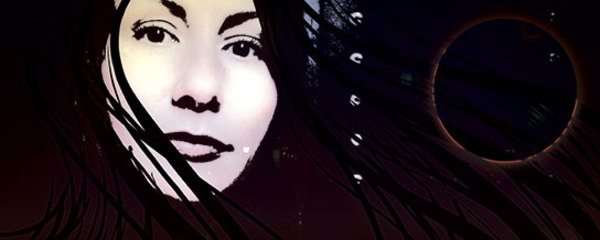
The harshly beautiful music of Judith Juillerat speaks pointedly of rain-damp alleyways in Berlin or Cologne, so it’s a shock to find out that she operates light years away from Germany’s techno epicenters. Juillerat hails from Besançon, a sleepy French town with no music community to speak of–it’s home to nothing much, actually, besides some nice foliage and the aged walls of the town citadel. And as a 36-year-old, full-time mother–entering the studio only after her two kids are asleep–Juillerat is both a latecomer and an anomaly in the electronic music game.
Juillerat also boasts a surprisingly wholesome bio for one whose music is so dark. “I like listening to uneasy music,” she explains. “It’s good sometimes to be face to face with fear. It allows us to start from scratch. But, of course, I avoid listening to too much terrifying music with my children–they will have plenty of time to hear it later!”
It’s telling that Juillerat’s first album, Soliloquy, unfurls like a collection of sinister lullabies. Employing a limited arsenal of hardware (“software is too indirect”), she crafts techno love letters pulsating with mechanized cricket drones, the echoes of distant bells, and her own smoky voice. Tracks are by turns soothing and discomfiting, like “mes nuits sont plus belles que vos jours,” which begins with a music box chime and Juillerat’s bedtime humming, but disintegrates into an eerie loop of the Pledge of Allegiance.
By Soliloquy’s release, Juillerat had already been making music in her living room for 12 years, first “borrowing” her then-boyfriend’s gear, then improvising on her own, inspired by albums like Laurie Anderson’s Bright Red/Tightrope. But she’d never made anything public before 2004, when–on one fateful Friday–a friend told her about a UNICEF-sponsored contest to remix Björk’s “Army of Me.” The contest ended that Monday, and an energized Juillerat worked through the weekend to produce the seething revision–renamed “a(r)mour” on Soliloquy–that would ultimately win out over 600 contestants.
The same year, Juillerat began talking to the Berlin-based Shitkatapult label. “Their eclecticism attracted me,” she recalls. “So one day I just sent a demo. Three months later I was in touch with [label boss T. Raumschmiere], who said he loved ‘haphazardly’ and would like to make a version for his album.” (The track, featuring Juillerat’s muted monotone, appeared as “3 Minutes Happiness” on his 2005 Blitzkrieg Pop.) When Juillerat announced that she had a completed album ready–redone heavily with vocals after her work on “Army of Me”–Shitkatapult jumped to release it.
As Juillerat preps for her first-ever live performances in support of the album, Soliloquy appears as a personal testament to the road long traveled. “I picked the title to evoke my solitary musical work, because that was so important for me,” she says. “It’s the first time I’ve worked alone. I can’t help asking myself a lot of questions all the time. I wanted to make something intimate, which could make the listener ask some questions, too.”
Magic Pony’s Favorite Things

In 2002, Kristin Weckworth and Steve Cober started their own fantasyland called Magic Pony. The storefront/art gallery–located on Queen Street in Toronto, Canada–stocks the cutest things on the planet, from Yoshitomo Nara sticker sets to Pete Fowler’s Monsterism rings to Marcel Dzama’s Sad Ghost salt ‘n’ pepper shakers. Magic Pony also hosts monthly shows, introducing the newest work from the likes of Kozyndan, Nathan Jurevicius, and Dalek. We caught the globetrotting Pony duo on their way home from Toy Con in New York, and they told us what’s floating their boat.
1. Derrick Hodgson‘s My Mania
My Mania is the first comprehensive collection of Derrick Hodgson’s artwork. It unearths this Canadian artist’s creative process from sketch to screen and gives insight on how he combines aspects of cartoon, graffiti, and contemporary design to create a prolific world of characters. Get ready to go mogo with the poppers, peepers, floaters, sprouts, yetis, and ghouls that float and multiply from every corner of these pages. Apey stuff.
2. Creatures Off My Back by Geoff McFetridge
Geoff McFetridge’s design work constantly surprises and delights us. McFetridge’s newest creations are four colorful figures–each is a little human, but with something else going on inside. From the Solitary Arts set to the gentle Sasquatch Coins, these figures sum up a little piece of human existence in a way only McFetridge can. A total essential for any fan of good design.
3. The Malfi Trio by Friends With You
Friends With You is two wizards from Miami that keep conjuring up the weirdest creatures ever to be seen by human eyes. Now, their Malfi Trio is here to bring magic and mystery to the world. Super Malfi’s spots are supposed to have magic powers, Smiling Malfi is a trick master, and Regular Malfi will bring you wealth…or trouble! Who doesn’t need a pleather plush doll to add some excitement to everyday life?
