
James Murphy: Cracked LCD
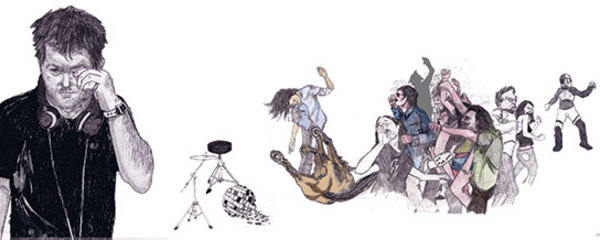
Since ditching punk rock in favor of dance music about five years ago, James Murphy’s done his damnedest to help indie kids get reacquainted with their backsides. In addition to comprising the American half of New York’s lauded production group-cum-label DFA (with Brit Tim Goldsworthy), he’s also the brains behind the celebrated LCD Soundsystem, whose vinyl singles “Yeah” and “Beat Connection” have enjoyed residencies on many a dancefloor. When it came to LCD’s long-awaited self-titled debut, Murphy’s always had something specific in mind. Below, he details the method behind the madness of eight tracks from LCD’s debut.
“Daft Punk Is Playing At My House”
“When I was in punk rock bands, houses were my favorite places to play. If you went from one town to another, like Chicago to Seattle, that’d be a huge drive, so you’d play in people’s houses along the way to get across. You probably wouldn’t make any money but they’d be amazing shows, and you might make something selling shirts or CDs or whatever because a lot of these towns didn’t have good record stores. As a grown married man, I’m not looking to haul ass around in a van and sleep on people’s floors again any time soon, but that was something beautiful and I really cherished that time.”
“Then I realized that a lot of people in dance music totally missed [house shows], and I got this notion that if I was ever going to throw another house party, it would’ve been great to save money for years and years and hire Daft Punk. We’d do it through their main agent and not let them know what kind of show it was and then put them in a basement with, like, 60 kids! I wanted to have a video where we actually did that and make a live DVD, but they’re in the middle of making their record so it became too cumbersome and impossible.”
“Too Much Love”
“This is disco and Bowie and [Can’s] Damo Suzuki. I like building loops, not necessarily for making songs, but just in general. I like programming without a grid and just making things that feel nice. I like using odd things to generate notes, whether they’re drum patterns or basslines, rather than using synths.
“The vocals are by far and away the most painful thing to do, they drive me totally insane. I throw everybody out and I get really angry. I always write vocals in the studio the day that I record them–it’s kind of a rule. It has to start from zero and go to recorded finished vocal by the end of the day or else I’m a disaster. I don’t like vocals that sit around; I think they get stale and lose their meaning.
“All the harmonies on this record were sung separately, meaning I don’t listen to the other ones when I sing them. I’ll play a loop, sing the lowest part, then I’ll sing the part above that, then the next part, but I’m not monitoring them. I like a lot of Eastern singing where there’s no vibrato and the microtonal stuff is a lot more square; depending on the chord, the oscillation won’t always be harmonic and so pretty. They’re more unsettling that way, so I use the track as a reference instead of the vocals. When you listen to another singer and you sing along, even if it’s just yourself recorded, you start making these adjustments that I find really gross and singer-y.”
“Tribulations”
“This was another song that was a total challenge. It was written in about 40 minutes. I was trying to work with someone and I was like ‘Okay, just write a pop song.’ They said, ‘It’s not that easy’ and I’m like ‘No, it actually is.’ So I made it as a challenge on my desktop on Reason. I was just trying to show my friend how to arrange, so I brought the loop downstairs and said ‘Play it, I’ll tell you when to turn things on and off, and I’ll hook up a guitar and sing.’ I never intended for it to be an LCD song, so I gave it away on disc to friends for shits and giggles and it started getting played a lot by people and getting shared online. So we started playing it live and I started really liking it and it became more of our song.”
“Movement”
“That was written in the shower, specifically for a show. I just really wanted a song that was a strict and silly electro song that could be done identically as a rock song, so it’s basically the song twice. It was supposed to stop there but I had fun layering ridiculous solos over it in the studio–we ended up going with the most retarded one. That was only after we were done doing all these grandiose, really disgusting, ‘American Woman,’ triple-tracked solos.”
“I was getting kind of bored of all the [music press’s] gabber-gabber about the new rock. ‘The new rock is back!’ And I’m listening to most of the bands and thinking rock is tired. I’m a huge rock fan, but wearing an MC5 shirt is not being in the MC5. For me, rock is not an outfit or a pose. I just thought ‘If I’m gonna complain about rock, I should make some.’”
“Never As Tired As When I’m Waking Up”
“For about two and a half years I didn’t have a home, so I lived in the studio. We were working on The Rapture record, and I would stay up at night and play the piano in the elevator, ‘cause that’s where the piano is. You could ride the elevator down to the basement and get lots of echo because it’s open-topped or you could ride it up top and it’s not that echo-y. I just wrote this song for myself at night; I write songs all the time and don’t release them. We had recorded a song called ‘Open Up Your Heart’ for the Rapture LP and we worked really hard on the drum sound, bass sound, and vocal sound, and I was really excited about the way they sounded. So after they left at midnight, I made this song. After, I realized there was this big descending line that sounded like ‘Dear Prudence’: I thought it was funny and did a George Harrison guitar solo and then did a Paul McCartney bit–it was like putting a big X through something that you’ve drawn. I had it on CD for friends, like, ‘Here, this is what I made yesterday,’ and Tim was kind of insistent; he said it was cowardly not to put it out. I realized it would be a good challenge to see if I could make an album that it fits on, so that became another challenge, especially to see if it could go with ‘Movement.’ And I kind of like the way they go together.”
“On Repeat”
“This was purposely pulled back; it doesn’t explode like most of the things I wind up doing for dancefloors. I’ve been listening to a lot of stuff that I really love that doesn’t go so hard, like a lot of disco, I don’t like when I go out and buy a dance record and put the song on, listen to the beginning and think ‘This is pretty cool’ then put the needle at the end of the record and it’s still the fucking same thing! You’ve just been turning shit on and off for seven minutes! What the fuck have you been doing?! Just go do something, grab an instrument, make it change. That’s why I love something like Vitalic’s ‘Le Rock’ or [Josh Wink’s] ‘Higher State Of Consciousness’ where you feel someone’s intent, even their mistakes, you hear it.”
“Disco Infiltrator”
“That’s one of the oldest songs. It was written long before ‘Losing My Edge.’ The beat is totally inspired by BS2000, by working with Adam [‘Adrock’ Horovitz from The Beastie Boys] and seeing how much fun he has. It only has one note, it’s just switching octaves [and] the whole bassline never changes a note. I wanted to see if I could make a song where you could do that to do the bassline and no one would really pick up on it. It’s fun; it’s a game.”
“I don’t use Eno’s Oblique Strategies. I’ve looked at them before. They’re built for a more optimistic rock world, which is not the world I inhabit. I inhabit a far more pessimistic rock world and for that, I just talk to Tim, who used to run Mo’Wax and hates everything…and I hate everything, but we love music a lot so we sit there and find a little sliver that we don’t loathe, and move forward on that.”
“Great Release”
“I was obsessed with making a last song. I wanted to make something that kind of erased the record. I like songs that erase the record and make it acceptable to start the CD over again at the beginning; where you kind of forget how everything went and you feel a little refreshed.”
The Perceptionists: Triple Play
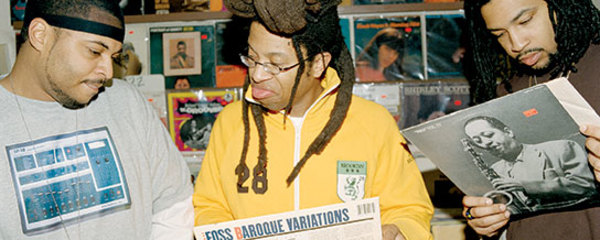
The vibe in Boston is so good at the moment,” The Perceptionists’ Mr. Lif says of his hometown. “It’s an ill time to be here–the region is just synonymous with excellence right now.”
Lif isn’t talking about the attention the city’s historically ignored hip-hop scene has been receiving lately–he’s referring to the success of the Boston Red Sox and New England Patriots, whose recent championships have helped redefine a city often preoccupied with the failure of its sports franchises.
The MC, born Jeffrey Haynes, might be best known as the dreadlocked, pro-black arm of the Definitive Jux camp, or as Boston’s most politically conscious MC, but–like his Perceptionists cohorts Akrobatik (Jared Bridgeman) and DJ Fakts-One (Jason Goler)–he’s a bit of a jock at heart, too. All three played high-school football; Lif, who also played nine years of organized hockey, was even recruited to play lacrosse by Colgate University.
So it’s fitting that, despite the politically-charged anthems (like the Bush-baiting single “Memorial Day”) on the trio’s upcoming Definitive Jux LP, Black Dialogue, the group is making inroads to more mainstream audiences with “The Razor,” a mixtape-and-internet-only ode to the Patriots that’s gotten play at home games and even brought team owner Bob Kraft to a Perceptionists show in Cambridge.
In fact, it’s their possession of Patriots tickets for the following day that’s got Akrobatik spending New Year’s night 2005 at Lif’s pad, a basement apartment underneath his parents’ house in suburban Dedham. “I predicted the Red Sox in Game 7 on stage at CMJ in New York and got booed,” Ak recalls with a laugh while checking Lif’s Ensoniq EPS for a beat Lif’s just produced for the group. “And what happened?”
While athletic victory might be the source of Boston area brotherhood, the same can’t be said for the city’s hip-hop scene–despite what you may have heard. “Hip-hop in Boston is actually divided and busted up,” explains Akrobatik. “There is a whole side that most people don’t know about: talented artists that are having a hard time being heard,” he adds, citing unsung street MCs like Dre Robinson and Smoke Bulga. “People say Boston is Akrobatik, Lif, Esoteric, Krumbsnatcha, and Edo. G and ignore the whole side of Boston that doesn’t have the fanbase rooted in the college scene. Unlike a lot of other major cities, Boston doesn’t have a [tight-]knit black community,” says Ak. “It is very small and in some ways neglected.”
Despite their billing as a Boston “supergroup” of sorts, the members of The Perceptionists–all of whom have been collaborating together since the days of Fakts’ WERS radio show in the late ‘90s–say their emergence as a unit has nothing to do with repping the wider picture of their hometown. “I plan to move out in the next year or so,” Akrobatik says matter-of-factly. “It doesn’t have anything to do with rap music–I have just been here my whole life. I am not trying to ‘blow up,’ I am just trying to make music with my people and hopefully our work ethic will provide us with some reward for that.”
Nonetheless, there is a perception around the city that, like its sports franchises, Boston’s hip-hop scene is finally thriving–that it’s no longer the place Guru had to abandon for Brooklyn in order to make it as an MC. This past November, Boston hip-hop father figure Edo. G released arguably the best album of his 15-year-career in My Own Worst Enemy, a 10-song back-to-basics LP produced primarily by Pete Rock. Just two months earlier, Insight, an up-and-coming MC/producer from the same Roxbury neighborhood as Edo, released The Blast Radius (on local institution Brick Records) to almost uniformly positive reviews. MC/DJ/producer Edan, a transplant from Maryland who scored a leftfield hit in 2002 with the old-school revisionist LP, Primitive Plus, recently completed its even more distinctive follow-up, Beauty and the Beat.And director Scott Limanek’s Boston Beats and Rhymes, a documentary on the city’s hip-hop circuit featuring the aforementioned MCs, began screening around the city last summer.
All of which sets the stage for Black Dialogue, perhaps the most anticipated Boston hip-hop record in recent memory.
“It was always a plan that after we got our solo albums done we’d do an album, even before the name came along,” says Fakts, whose Long Range LPis still awaiting release by Coup D’Etat Records. (I Phantom, Lif’s first official LP after nearly half a dozen EPs and a live record, appeared on Def Jux in 2002; Akrobatik’s Balance arrived via Coup D’Etat in 2003).
Produced by a four-man committee of Fakts-One, El-P, Willie Evans, Jr., and 19-year-old prodigy Cyrus Tha Great (who rocks a Joy Division sample into the album’s standout track, “What Have We Got To Lose?”), Black Dialogue is the sort of chaotic-yet-cohesive debut you might expect from a trio of friends who’ve been waiting nearly 10 years to make an album together.
The record is alternately serious (“What Have We Got To Lose?” calls for revolt against the current US government) and playful (Digital Underground’s Humpty Hump stops by “Career Finders” to help the crew run an employment service to get ignorance-promoting thugs out of rap). It doesn’t stray from expected themes, but it isn’t predictable either. Aware that the album’s audience will likely be predominantly white, Akrobatik says the album’s title and content represent an effort to reconnect with an urban, black audience.
“We’re making music for the people we want to affect, regardless of the fact that most of them won’t get to hear it,” he says. “What if they get to hear it 10 years from now? What if something happens that makes it so that millions are hearing our music? Then this is the stuff we want to be saying.”
Tigersushi: Forging Links with the Future
If electroclash represented the needless, and often desperate, repetition of nearly everything we loathed about the plastic ‘80s, another group of artists and labels–who we’ll call by no clever name, thank you very much–took influence from the synthetic decade’s more experimental inclinations. Enter Tigersushi, stage left.
Not content to devise new styles and/or formulas to co-opt, the Parisian label (and its accompanying website) has found itself playing tastemaker to the tastemakers of the dance underground, offering a sort of guide service for those interested in things fresh–whether old or new, electro, punk, or, um, country. Under the able-bodied tutelage of label owners (and consummate Frenchmen) Charles Hagelsteen and Joakim Bouaziz, our collective musical past, present, and future entwine like so many spiraling strands of newly formed DNA. While the releases are revealing new and telling links between unlikely and obvious sources, they’re also inspiring dancing–albeit, dancing for the intellectually inclined.
Tigersushi started in 2001, after Messieurs Hagelsteen and Bouaziz bonded at university over a late-blooming obsession with electronic music. “We were a bit late getting into it and at first it was over Mo’ Wax and the French Touch stuff,” Hagelsteen confesses somewhat sheepishly. The first incarnation of Tigersushi, formed on the crest of the dot-com wave, was a website made by music obsessives for music obsessives, or at least those with aspirations thereof.
“To me,” explains Hagelsteen, “the label and the website are evidence of connections [Joakim and I] had dreamt of between all music genres, times, and eras–a sort of infinite circle. All music is basically interlinked, if not culturally and objectively, at least subjectively through your hearing sensations.
Creating a fantasy universe where Krautrock rubs shoulders with electro and dub clashes with punk, soundtrack music, and Detroit techno, the site–which features brilliant compartments such as a genre map, an “Unsung Heroes” section and a list of essential “Good Old Stuff”–is a wet dream for those with the desire to dig for rare jams. It’s also a helpful resource to learn where today’s underground stars have borrowed more than a little inspiration.
With the site up and running, the label proper introduced itself to the world in 2002 by way of the near-legendary More GDM 12” series, named after the late ‘70s underground hit “No GDM (Great Dark Man)” by Gina X, punk-disco’s own Marlene Dietrich. The series pairs rare underground classics with new music from a related (or sometimes not) artist. The debut release coupled ambient Krautrockers and Brian Eno collaborators Cluster with the talents of Detroit techno progressive John Tejada. This was followed by the aforementioned Gina X classic packaged with New York Italo-funk couturiers Metro Area; still other installments featured Material with Maurice Fulton and Freddie Mas with ESG. On the idea of pairing old and new, Bouaziz becomes animated. “We like the idea of confronting artists from different backgrounds. It really brings music back to life. It says, ‘Hey, I’m not coming from nowhere, I have roots.’ Or ‘When was this produced?’ You know, discovering music (should be) exciting.” Hagelsteen agrees. “We just react to the music unearthed. It’s that ‘Fuck, this is good!’ cold turkey feeling of ‘I gotta have it!’ I get [when a] friend exposes me to good music. It’s like a heroin seizure, sort of.”
This crate-digging approach has placed Tigersushi in an esteemed class of labels–among them Acute, DFA, Environ, Troubleman Unlimited, and Gomma–who get as excited finding a rare post-punk schoolyard jam or Italo-disco track as Madlib and Timbaland must get when stumbling upon that sought-after jazz or Bollywood record.
Subscribing to the pragmatic “if it ain’t broke, don’t fix it” school of thought, the label has continued with this approach for their Kill The DJ mix albums and their So Young But So Cold: Underground French Music 1977-1983 collection. The mix CDs, from the likes of Black Strobe, Ivan Smagghe, and Optimo, leave no hot jam untouched, making the idea of genre-dictated mix-albums appear all the more insular and a hell of a lot less fun. On these audio representations of the kind of sets played at Parisian club Pulp, Loose Joints merges with Akufen, Luciano with Basic Channel, Blondie with Ricardo Villalobos. So Young, meanwhile, dusts off the obscure avant-electro of Nini Raviolette, Mathematiques Modernes, Charles De Goal and others, revealing that France’s tradition of arty pop doesn’t end with Serge Gainsbourg and Brigitte Fontaine.
“We never think in terms of genre,” asserts Bouaziz, who also records as Joakim, K.I.M., and Poni Hoax. Surprisingly, then, Bouaziz reveals he “hates acid house, electro, and also disco, rock between 1975 and 1976, be-bop, death metal, funk before 1966, male soul singers, the second wave of Detroit techno, and a lot of other things.” But he and Hagelsteen can see the bigger picture, he says. “We love music as a whole. And when we sign a new artist, it’s only because we’ve been moved by his music or impressed by a potential. We recently signed a Chilean tropical garage band, a French rock band coming from a free jazz background, a young crazy girl from IRCAM (Institute of Advanced Musical Research), an IDM duo, and a French folk singer.”
If Hagelsteen and Bouaziz hope to make, as they say, “music for the small majority” (to borrow an idea from Moodymann), they’ve succeeded with aplomb. And with a reissue compilation of the brilliant Belgian label Disques Du Crepuscule (responsible for releasing Arthur Russell, Young Marble Giants, 23 Skidoo, and Cabaret Voltaire) and French new wavers The Hypothetical Prophets to come, we can only wait with bated breath. “The philosophy of Tigersushi,” Bouaziz concludes, “is basically to do the good instead of the bad, or at least something close to that.” A subjective idea, certainly, but Tigersushi has earned our trust.
Tigersushi’s five essential tracks, picked by Charles Hagelsteen.
1. Gina X “No More G.D.M”
(from the No More GDM Vol. 2 12”)
The essential compilation-defining track. This is the voice I will eventually get when I’m done smoking Gitanes.
2. Bernard SZajner “Welcome To Deathrow”
(from So Young But So Cold)
Every time I hear this piano chord, I think of Robert Palmer’s “Every Kind of People” and fancy drinking a Heineken.
3. Panico “Transpiralo”
(from the forthcoming Panico CD)
Well, I sweat all the time and am in dodgy situations all the time as well, so this is my number.
4. Digital Tongue “No Way You Can Sleep”
(from How To Kill the DJ (Part One))
This is the perfect electro hit. The Krikor remix is spot on and I like the Matt Johnson (from The The) vibe.
5. Big Ned “Final Steps” (Oscarr)
(from How To Kill The DJ (Part Two))
“You were weak when you should have been strong/You were laughing when you should have been talking/Unable to use the powers that lurk with us all.” Well, this one sounds just like me.
Move (Remix)
Hood Stays Afloat

“Hood is like a ship always tempted to push how far it can safely venture; at times it felt like it was sinking, but the water’s frozen around it and stopped the boat,” laughs Chris Adams of Leeds-based psyche mâché artists Hood, as he metaphorically describes his group’s dynamic. “We started as a speedboat two years ago [following 2001’s critically successful Cold House], then went round the various harbors and took on water; but we’ve been in for repairs and are seaworthy again.”
Together for 14 years, Hood’s latest cargo is Outside Closer. Adams, his brother Richard, and collaborator Stephen Royle form Hood’s nucleus, while a host of revolving crewmembers have contributed across nine albums and 17 singles.
Hood’s last full-length, Cold House, was duskadelic, glistening glitch featuring micromanaged pastoral minutiae and stippled hip-hop from Doseone and Why? of cLOUDDEAD. On Outside Closer–the more instrumentally sumptuous follow-up–there are still masticated melodies and an underlying lo-fi twitter but no outside collective’s resources, which proves fortuitous. The band was forced to chart new seas, taking all production onto their own shoulders; they recorded and premixed at home before utilizing a friend’s studio for mastering and additional instrumentation. While thus entrenched, Hood faced a consuming and sometimes compromising process.
“We didn’t want [to go into] full-on philharmonic orchestra territory, but we wanted more real instruments, atmospheric things,” recalls Adams. “We didn’t have the resources to realize all our ambitions so, over time, we made judgment calls. What happened is we really wanted to make something poppy and brash. But slowly you realize you don’t personally listen to in-your-face records all the way through. And yet we didn’t want an album that was stripped back. So we met the ideas halfway.” The resulting mood and mode of the recordings befits the record’s disconnected title, and the vocal-laden music is Hood’s most approachable yet–though it’s still far from immediate.
“Though we’re widely considered melancholy, I don’t see our music as inherently sad,” observes Adams. “There’s a longing, but I think it’s inherently hopeful, offered as an eddy from horrid bustle. It’s about acknowledging the little disappointments while not dwelling on them or being despondent. With both our production reach and creative outlook, there’s that push to see what’s round the corner. It’s a total learning curve, basically.”
Mitsu the Beats: Transnational Soul
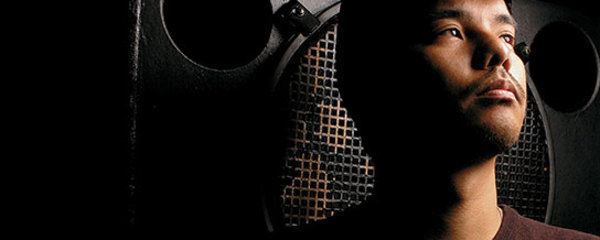
Twenty-eight-year-old DJ and producer Mitsu the Beats hails from Japan’s wilder northern climes (Sendai in the Miyagi prefecture)–think snow monkeys and hot springs, not bullet trains and the world’s largest city. Nonetheless, his ruthlessly smooth hip-hop is as metropolitan as it gets. Balancing an ear for hooks reminiscent of ‘93 with the boundless, borderless skills of Japanese MCs and occasional forays into broken beat, Mitsu is fast becoming a global talent.
Growing up on his father’s Japanese soul music and what he called “standard jazz,” Mitsu found hip-hop as a youngster through a Japanese TV program. “It always featured a dance battle with new jack swing-type music–artists like Heavy D,” he recalls. Mitsu was hooked, eventually becoming a battle DJ and teaming up with 2002’s DMC world champion DJ Kentaro. His horizons expanded even further when he met Taro Kesen of Jazzy Sport Production, who at the time was licensing tracks for the British label Laws of Motion. Mitsu developed a taste for the broken beats of West London and it was some of those DJs and producers, plus tastemakers like Michael Reinboth (Compost) and Patrick Forge (Kiss FM), who in turn began to champion Mitsu’s production.
Mitsu says that he follows the basic formula for making hip-hop (“Listening to records, sampling and adding dope beats to samples”), yet his New Awakening LP (Planet Groove) is anything but formulaic. From the shimmering guitar that rests beneath Rich Medina’s rap on “Do Right” to the restless rim shots and bass synth that push forward “Fly Away” with Lady Alma, it’s clear that Mitsu has a special talent for adapting his production to the differing strengths of vocalists. Mitsu’s collaboration with Dwele, “Right Here,” features delicate-but-earthy singing from the Detroit soul vocalist and an unforgettable sax sample over gritty hip-hop beats ‘n’ bass–it’s guaranteed to fill floors, though it’s been two years since it started its rounds on CD-R. And watch out when his Japanese cohorts (like Hunger from Mitsu’s hip-hop group G.A.G.L.E.) get on the mic, because their whip-crack, hard-edged consonants are the perfect compliment to Mitsu’s extra-crispy beats.
As the forthcoming Planet Groove album of remixes, a planned G.A.G.L.E. full-length, and new 12”s for Jazzy Sport will show, DJ Mitsu’s Sendai style can hold its own against anything from L.A. or London. Despite all this, Mitsu maintains a healthy perspective, adding modestly, “Me? I’m just a hip-hop producer.”
Boyskout: Danceable Melancholy

When Leslie Satterfield started Boyskout in 2001 she had something to prove. After working on a quiet, moody solo project (Cat Power’s What Would the Community Think was a major influence) she was determined to show people that her sound could be, well, tougher. Three years later, the band’s debut LP, School of Etiquette, put the exclamation point at the end of Satterfield’s declaration.
Boyskout’s brand of dreamy, danceable melancholia is a whirr of guitars and dark synth keys led by Satterfield’s breathy vocals; her voice is equal parts plaintive and spry, mirroring the irresistible push/pull of personal relationships laid out in her lyrics. Some listeners have labeled it another copycat of The Cure or Suicide, but Boyskout sets itself apart from the recent rash of hybrid new/no wave bands with strong musicianship and a complete lack of pretension that comes with a genuine love of music. Take Satterfield’s current source of excitement–the band’s new keyboard, which comes equipped with the eerie Wurlitzer sound she loves. “I really feel drawn to kind of a haunting sound,” Satterfield says. “That would be the thing that is at the center of every single song that I write. It’s just what I think is beautiful.”
After a brief but successful stint in New York City, a couple of years worth of line-up changes, and a national tour, Satterfield is back home in San Francisco with the steady crew of Zola Goodrich on keys and guitar, Piper Lewine on bass, and various rotating members on drums. Boyskout’s new songs sound even stronger (if not as tough) and buzz with a lush, melodic wall of noise from Satterfield’s guitar, evidence of her strengthened style and long-time appreciation of tripped-out troubadour Syd Barrett. “I think it’s just a really natural thing to come back to having the songs be a little more chill,” she says. “Maybe I’m putting more of myself into the songs this time–just more of who I really am.”
In the meantime, the band is steadily honing tracks for its follow-up LP and looking forward to playing this month’s SXSW. “People always tell me the more I show of myself the better it is anyway,” Satterfield says. So far, so good.
U.K. Garage Girls
For years, So Solid’s Lisa Maffia and Ms. Dynamite were the lone female faces on the MC-driven side of UK garage, with Maffia dropping sparse cockney wordplay and Dynamite raining fire with breakneck patois. In their wake comes an army of girls who can spit syntax faster than a Tokyo bullet train, and whose alternative flow and lyrical content is shaking up the testosterone-fuelled scene. Making their name on the hostile rave and pirate radio circuit, these girls are executing seamless transitions from MC to artist–something many of the male spitters (barring exceptions like Dizzee Rascal, Wiley, and Taz) have been struggling to do for years. Meet Stush, Shystie, Gemma Fox, Fury, and Lady Sovereign–female mic controllers who are ripping up the script.
Stush
How did you get into MCing? I’m a cross between a Jamaican DJ and a cockney MC. I write songs though, not just 16 bars. I started as a singjay on the reggae circuit in 2001 but I got more love on the garage scene. I did 150 PAs.
Breakthrough tune: “Dollar Sign” in 2002, produced by Sticky
What makes a good MC? Clever lyrics using metaphors. Talking about a subject or making a joke but putting it in a different way.
Do you clash? No, but I have a book of warring lyrics ready. Everyone does. Only 10% of MCs really freestyle, everyone else just draws from clashing lyrics they’ve put aside.
Have you ever been pressured to sing? My label signed me as a DJ so they never pressured me to sing.
What’s the difference between an MC and an artist? MCs have lyrics but artists have lyrics, charisma, and stage characters. You’ve got to have character to progress from MC to artist. I have this high-pitched squeak I use to entertain the crowd. People are surprised when I come on with the same fire as the boys. They’re thinking, “What’s she gonna do, lift up her skirt?” Then I give it to them. As an artist on stage, it’s every man for themselves.
Shystie
How did you get into MCing? I hung out with boys who were into MCing. They encouraged me to try it and once I did I was bitten by the bug.
Breakthrough tune: A reply to Dizzee Rascal’s “I Luv U.” Back then there were no girls on the scene, so people were feeling the alternative take. As a girl you can’t come with alright lyrics; you have to smash it to get respect.
What makes a good MC? Confidence and originality.
Do you clash? Not really, but I can. I just done a series of 02 parties where people text words to my phone and I had to spit lyrics using them. People sent crazy things. That was harder than a clash.
Were you ever pressured to sing? Some labels I went to before I signed my deal wanted to push me that way. I come from the grime scene so to sing would make no sense. No one will pressure me to be something I ain’t. That’s why I took a year to choose a label.
What’s the difference between an MC and an artist? An MC can spit live over beats and hype up crowds at raves. I’m still an MC but I’m also an artist. I have an image, a sound, a style. I’m a whole package–that’s what you need to be an artist, tight flow isn’t enough.
Gemma Fox
How did you get into MCing? I was writing songs from age 14 but I found it easier to get on the mic in clubs and spit as an MC.
Breakthrough tune: “So Messy,” remixed by Paleface in 2002.
What makes a good MC? Hype, energy, fresh style, and party vibes. Your delivery is different when you MC rather than rap–you spit with more aggression and you’ve got to be able to freestyle for hours.
Do you clash? Only if it’s a girls versus boys event. You make light-hearted comments about the opposite sex but it’s about having a laugh rather than an all-out battle. When there’s a lot of MCs on stage it can be hard getting the mic–people can try and sabotage your opportunity.
Have you ever been pressured to sing? I am a singer. I started out MCing as that was easier to get into. Singing is my stronger point and it’s what I’m concentrating on now.
What’s the difference between an MC and an artist? Artists do PAs of their songs and MCs have to hype a rave for hours on end. Artists have personality and give you lyrics that are different rather than the standard A, B, C. Being an MC is the ultimate artist training.
Fury
How did you get into MCing? My brother was a DJ so I started spitting on his set up at home. I did competitions at raves like Young Man Standing and eventually they billed me on the flyer. East Connection brought me into their crew so I rolled with them for a while doing sessions on De Ja Vu, [a London pirate station that pioneered the grime sound], but now I’m solo.
Breakthrough tune: “Merk Dem,” an underground release.
What makes a good MC? Talent, personality, and persistence. As a girl it’s hard to get accepted. Girls don’t MC, they cook–you get me? So you have to bring something strong to the table that’s as good as, or better than, the best male spitters. When I was starting out and no one knew me I had to grab the mic out the boys’ hands. Soon as you have a rep, everyone’s on you.
Do you clash? I did last year with Cutie, Godfather’s sister. I don’t like it. It ain’t positive and it don’t make you any money. Two people that have never met flinging insults at each other…it’s stupid.
Have you ever been pressured to sing? No, but I’ve not dealt with the major labels yet so maybe that’s to come. I’m staying away from them right now as in the early stages of your career they can be damaging.
What’s the difference between an MC and an artist? Artists can’t just hype up a rave, you have to be able to do stage shows and some MCs shake when it comes to that.
Lady Sovereign
How did you get into MCing? I started writing when I was 15. I’d do live call-ins on pirates and spit down the phone. I started doing PAs and people were surprised to see a tiny white girl spitting how I spit. It took me a long time to find this voice but once I had it I knew it would blow.
Breakthrough tune: “The Battle” in 2003. It was a clash between boys and girls.
What makes a good MC? Personality. I’m cheeky and no one really comes like that. You got to have original lyrics and be able to freestyle over any kind of beat, especially if you’re clashing. The DJ could drop anything so you’ve got to be prepared, but you can’t use pre-written lyrics against someone you’ve never met.
Do you clash? No, but I know there’s people out there that want to clash me and I’m ready for them.
Have you ever been pressured to sing? That’s not my talent. I’ve told everyone I can’t sing.
What’s the difference between an MC and an artist? Nothing really, except one is more developed. I’m an MC but I’m also an artist.
Mr. Scruff in the Studio
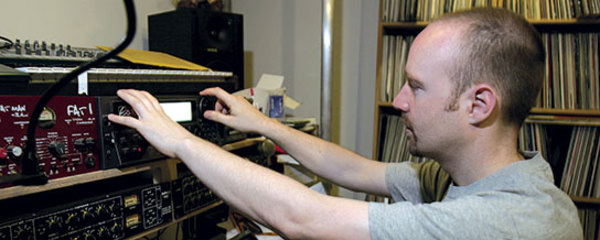
Compared to the standard dark breaks and moody electronic music we’re used to, Andy Carthy’s deft work behind the 1200s and painstakingly composed beats sound downright happy. On such humorously titled albums as Trouser Jazz, the artist known as Mr. Scruff pens odes to dancing and sausages. Amidst the rigors of touring, he’s been working on a slew of remixes and preparing for a sequel to 2004’s DJ mix Keep it Solid Steel. After a whirlwind week of DJ gigs ringing in the New Year, Scruff finally got a chance to relax, sip a cup of tea, and sit down for a chat about what makes his studio tick.
XLR8R: What are the most indispensable pieces of equipment in your studio?
Andy Carthy: A tea kettle, an [Akai] MPC 60, and the E-mu 6400 sampler. I have a very small studio, and along with that I use the [E-mu] SP-1200. They’re both very old pieces of equipment from about 1987. They’re both mono. The quality of the sampling on the SP and the MPC is quite low, so any sample you put in there comes out the other end with the sound of that machine. The MPC has a bit more memory, it’s a bit more versatile, and the SP is very brutal, very gritty, and it has a great rock solid feel, even though when you analyze it the groove is actually quite wobbly. [The limited sampling rates] help me create a style rather than wallowing around in a laptop that’s got unlimited everything and 2,000 plug-ins and every keyboard ever made. I prefer to acquaint myself with two or three bits of equipment that are quite limiting, and just push those and that limit.
Do you have keyboards in your setup?
Well, I only have one keyboard. It’s a Korg MS 2000, not the original ‘70s one but a repro. With my keyboard sounds especially, I will resample stuff and then quite heavily process it in the sampler, or just resample lines that I played live, just to give it a similar feel to the sampled record. Or just to grime it, [I’ll] put it through old compressors or EQs, just to give it that warmth, that feel of the music from the ‘60s and ‘70s, that grainy sound quality. It gives it a coat, a slight ambiguity that’s difficult to explain but easy to hear.
And you wire your studio differently for each track?
The reason for the different wiring has to do with different machines being in control. If I’m using two or three samplers, then one will be sending the MIDI and handling the sequencing and the others will be following it, depending on whether the main groove is created in the Mac, the MPC, or the SP.
How do you get started making a track?
I don’t tend to have a theme or anything when I work on my albums, I just write music and a theme or mood reveals itself. Remixes are quite nice because you already have some definite material to work with and some restrictions, and I generally only remix stuff I already like. I just approach each piece of music individually and try and find out what it’s telling me. It’s like a conversation between you and the piece of music you’re writing, and it’s definitely not a one-sided conversation. Every instrument in a record has a voice–whether it’s drums, bass, vocals, keys, horns, or random effects, it’s all part of a song. As long as something has the requisite amount of light, shade, and contrast then you will find it engaging, the same way you mix ingredients and put a bit of seasoning in your food.