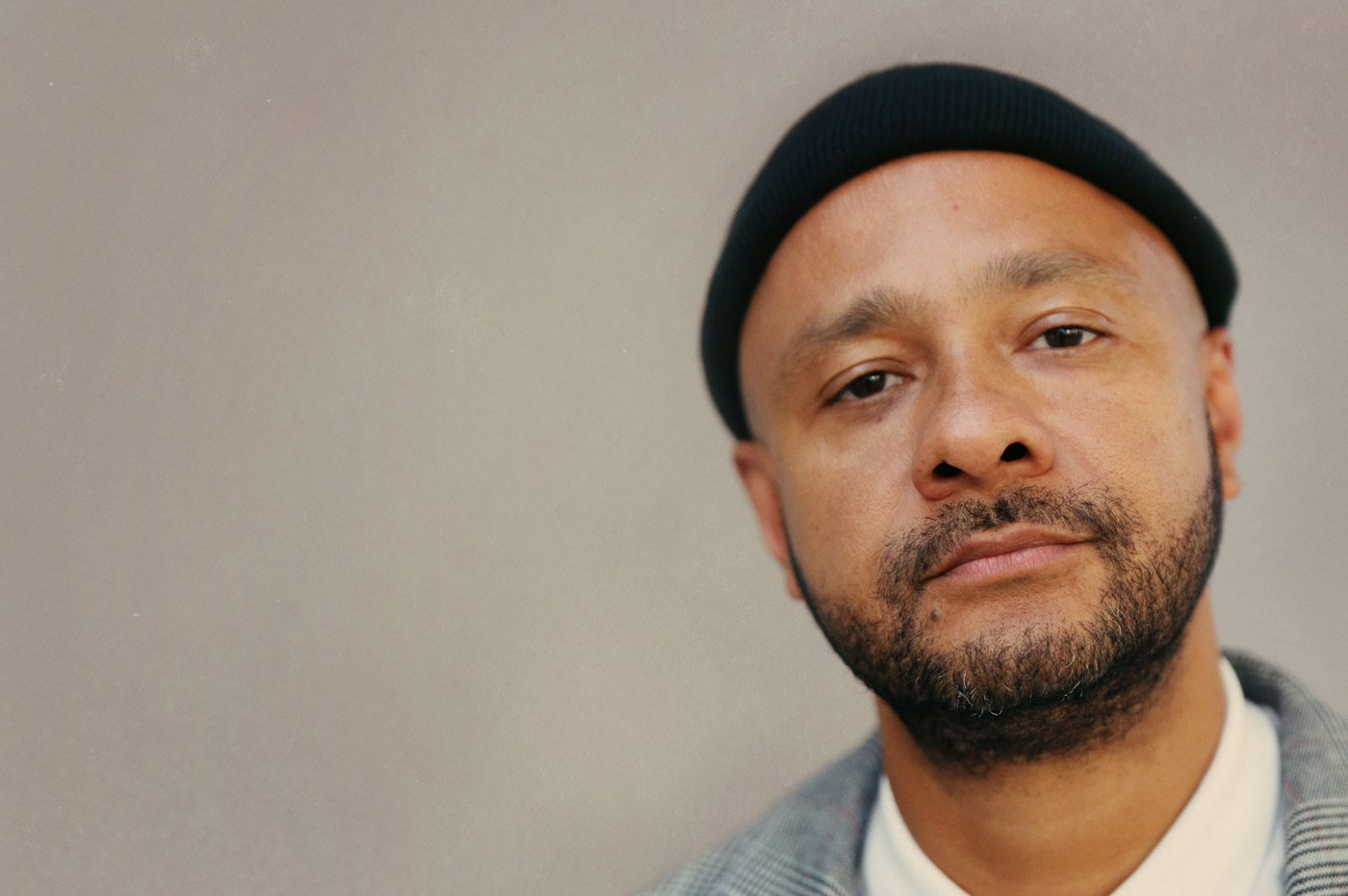
For today’s XLR8R download, Shash Records has offered up a remix by Swedish producer Yellowfriend (a.k.a. Ylwfrnd). For the rework, Yellowfriend turns his hand to Abby Lee Tee‘s “Efeu,” a cut from his 2015 album, By Accident, twisting it into a deep and morphing nine-minute groover.
The remix arrives as a somewhat preview of Yellowfriend’s forthcoming album on Shash and following a recent tape release on Dinzu Artefacts by Abby Lee Tee—you can purchase the tape here.
Yellowfriend’s remix of “Efeu” can be grabbed below via WeTransfer.
Yoshinori Hayashi, a Tokyo-based artist, has been flying under the radar for some years now. He creates a peculiar form of organized chaos by abstracting simple elements, travelling between acid-jazz, big beat, house music, African rhythms, and celestial moods.
This latest EP, a three-track release, follows releases on Going Good, JINN Records, and Gravity Graffiti. It’s described as “the type of record that you could drop the needle on at any given groove and still experience something new, even having heard the track 50 times.”
Rawsome Recordings will tomorrow present a full-length album in the shape of Nelson’s Underground Business.
We’re told that the German producer puts forth a collection of some of his best work to date with 10 tracks of bumping house music, covering ranges from peak hour grooves to the deeper, darker vibes in “Make Me Feel”—which is available for download below.
Tracklisting:
01. Aether 02. Homies Steppin 03. Brooklyn Thing 04. JaxxDax 05. Flava 06. Make Me Feel 07. Quick Fix 08. Other Side Of Town 09. Do It Right (Retrospektive) 10. Underground Business
On January 8, Milan-native Thomas Feriero (a.k.a. Avatism, CW/A, and House ov Leaves) will drop his sophomore release as Maenad Veyl on Rotterdam label Pinkman.
The EP, titled Somehow, Somewhere They Have Heard This Before, follows on from the Maenad Veyl debut on Oliver Ho’s Death & Leisure imprint with six tracks filled with abrasive atmospheres, intoxicating drum programming, gloomy synth lines, and foreboding tension. From the slow burning gallop of the opening track to the tense and searing synth lines of the closing cut, the EP charts a haunting path influenced by industrial, techno, metal, and drone.
Somehow, Somewhere They Have Heard This Before will be available digitally and on cassette—the tapes are professionally dubbed and limited to 70 editions—next week and can be pre-ordered here. Ahead of the release, you can stream the opening cut via the player below.
Iconic Warp mainstay George “DJ E.A.S.E.” Evelyn (a.k.a Nightmares on Wax) is up next in our Ask The Experts series.
Evelyn, who originates from Leeds, England, formed the N.O.W project in 1988 alongside John Halnon and Kevin “Boywonder” Harper. Having seen Halnon remove himself from the project, Harper and Evelyn when on to release their first album, 1991’s A Word of Science: The First and Final Chapter, via Warp Records. The 11-track release followed “Aftermath,” an iconic British chart hit, and was lauded for its blend of hip-hop, soul, and funk. Harper then left the collaboration.
Under Evelyn’s guidance, Nightmares on Wax has gone on to become one of the most iconic names on Warp’s roster—releasing some of the finest downtempo, trip-hop material of the last few decades. Smokers Delight landed in 1995, thrusting him into the limelight and establishing N.O.W’s work on the other side of the Atlantic. It was followed by 1999’s Carboot Soul, which saw Evelyn incorporate more live musicians, and there have since been various EPs and four more LPs—the last of which landed in 2013 in the shape of Feelin’ Good. As one person comments on Discogs: “He’s delivering one masterpiece after another.”
Up next is Shape the Future, NOW’s long-anticipated return—an eighth full-length. The marriage of soul, hip-hop, dub, and timeless club sounds that N.O.W. has been perfecting for years is said to find its “most fluid” form on this latest release. We’re told to expect a “masterpiece of contemporary and classic genre-blending that solidifies Nightmares On Wax’ place as an inspirational electronic music figurehead.” The LP includes the shamanistic vocals of recent single “Back To Nature,” and in particular the arresting voices of Mozez alongside Kanye West collaborator Allan Kingdom, as featured on the brand new cut “Citizen Kane.”
Whatever it may be, all questions should be sent to asktheexperts@xlr8r.com with “Nightmares On Wax” as the subject line. We’ll pass them along to George who will then select his favourites, and soon we’ll publish his answers.
We last heard from LA-based party and record label The Black Lodge back in August of last year with a feature of Frequencia’s “Fall Traxx,” a cut from The Black Lodge’s first official release, Spirits Of The Black Lodge Vol. 1, which encapsulated the crew’s sound with five tracks that touched on techno, house, punk, and industrial. Now, The Black Lodge is set to return with its second release, Spirits Of The Black Lodge Vol. 2.
The new VA gives a further glimpse into The Black Lodge with four raw and heady cuts from Gavin Guthrie’s TX – Connect alias, LA-based duo Belligerents—made up of producers One Child Policy and Black Lodge resident Simonowsky—Interdimensional Transmissions and Acid Camp affiliate Jasen Loveland, and Black Lodge label co-founder and resident Kosmik. As you can infer from the first release, the tracks on Vol. 2 hit hard with gritty, razor-sharp percussion and tense atmospheres—they’re tracks built for late-night, sweat-filled dancefloors.
In support of the release, which you can purchase and pre-order here, The Black Lodge has offered up Belligerents’ wall-shaking “Crack99” as today’s XLR8R download, available via WeTransfer below.
SmallPrint is an independent record label and worldwide collective founded in Brighton, UK, in 2015. The label is dedicated to pushing forward-thinking music and soulful/jazz-influenced, bass music. We recently offered up Seanote & Ill Chill‘s “Super Food” from the latest label compilation for free download.
Up next is a single release from missiles over moscow x Mt. Moon Collective. “Fragments” is a soulful/jazz-influenced, bassy cut, with smooth, soothing melodies.
Ahead of the single’s January 14 release, you can stream the entire cut in full below.
Rites of Fall is the alias of Bartek Kuszewski. The project aims to “dissolve boundaries between past and future musical traditions.” Having originated in experiments with placing religious and folk music elements in new contexts, the project has now evolved into its darker and heavier form.
The debut EP Truthsayer (2017) is narrative-driven and intended to be listened to more like a hypothetical movie soundtrack rather than a set of songs or dancefloor material. It was created in Subcarpathian and Warsaw and stretches between folk-infused atmospheres, modern, bass-heavy electronics, and improvisation.
Truthsayer was mastered by Rafael Anton Irisarri (Black Knoll Studio) and is available as limited cassette and digital.
In support of the release, you can download opener “‘Eden (Last Days)” in full via the WeTransfer button below.
Tracklisting
01. Eden (Last Days) 06:40 02. Corpus Resonanticum 06:20 03. Head of the Snake 05:25 04. Truthsayer 05:06
A regular in the Berlin house scene, Annegret Fiedler (a.k.a Perel) is about to make her international break with a debut LP to be released on DFA later this year. A soft-hearted and spiritual force, the producer-vocalist is returning to her electro roots, with a sound forged through her East German identity, with lashings of wave and krautrock influences.
Born and raised behind the Iron Curtain in the DDR (the Deutsche Demokratische Republik), Fiedler grew up in an era where culture and music were restricted to whatever the system governed. Having spent her childhood listening to her parent’s krautrock and wave collection, Fiedler is now slowly growing in stature, setting her own terms of her success, and becoming the first German to release on DFA. With the EP Die Dimension having been released last year—and an album due in 2018—Fiedler will bring with her a sound that isn’t too distant from the records she grew up on, dictating to the world a musical narrative that took her from East Germany to New York, and back again. “It still feels like a dream to me, as DFA was one of the labels I grew up with,” she confesses. With these exciting releases on the horizon, Daniel Cole travelled to Berlin to learn more.
Far from bubbling under, Fiedler—having lived in Berlin since 2010—has had several house releases over the past seven years. As an artist, she is someone who survived the Berlin scene, seemingly coming out stronger and brimming with confidence about her new direction. “Since I realized what my purpose was with my music, I had trust in the universe,” she states about her new found success.
I first find out about Perel’s forthcoming release on DFA when we meet up at a secret LCD Soundsystem gig at Berlin’s Funkhaus. With striking blond hair and tattooed wrists, Perel can come across as a steely Marlene Dietrich, if she had fronted an ’80s new-romantics era pop act while listening to hip-house records in her spare time. Later that night after the show, she managed to catch up with James Murphy, who tells her how much he’s looking forward to putting the record out. Somewhat overwhelming, it’s a huge step in the German producer’s career, one she’s managing with temperament and prudence, as she tells me in our candid conversation when we catch up a few weeks later. “I take care that I don’t say too much,” she says about her approach to interviews. “I’m cautious of what people will think about me.”
Behind the decks, the German producer is a bouncy, and infectious performer, one that is very giving to a dancefloor’s needs. Having caught one of her sets recently at Leipzig’s cult-spot Institut fuer Zukunft, it was interesting to see how young and engaged the crowd was, asking for track names, and getting into the flow. It was a mixture of modern house numbers, edits, and ’80s electronic (or at least ’80s electronic sounding jams, like Francisco’s “Beat Line,” and the contemporary disco take that is Marvin & Guy’s “Theme from Fire! Fire!” on Permanent Vacation). This intersection of old and new perfectly sums up Perel’s style. It’s also a style that is gaining recognition throughout Europe, having recently just played alongside DJ Harvey, and Carlos Souffront at Paris’ Concrete.
Originally from Saxony, tucked away in the south-eastern corner of Germany, Annegret “Perel” Fiedler grew up in quintessential, East German surroundings. She reminisces about her parents’ record collection—of which she confesses to having taken most of for herself—featuring ’80s krautrock, and classic East German music, including that of Reinhard Lakomy, a much beloved, children’s music writer. “Subconsciously, you take a lot of influence from your upbringing,” she states. “That’s why I decided to sing in German—something that is actually quite difficult.” Her East German connection goes far beyond her vocals. Just scanning through her Facebook page, and her forthcoming gigs are advertised using cutouts from old ’80s, German teenage magazines of kids with slick haircuts, and loose-fitting trousers, characterizing the former nightlife scene. It comes across initially as cliquey, but behind the lighthearted imagery is an artist connecting her modern-day self with her childhood roots.
Moving to the city of Halle to study around the turn of the century, Fiedler entered a new world that opened up her musical opportunities. “At that time in Halle—like other cities such as Berlin when the wall came down—was full of empty houses and so much space. You would have illegal parties everywhere,” she states. “You’d have all these art students and it was really cool.” Already making music and DJing, Fiedler started to front a chic, electro-pop act called Thiz iz a Dead Parrot—a band in sync with the late electro-clash rumblings of the time. With black hair and a deadpan demeanour, Thiz iz a Dead Parrot fully advocated the synth and krautrock influences that constituted Perel’s East-German upbringing. Ultimately a lot of fun, it began her career as a frontwoman, setting her up to be her own vocalist.
Looking to further her career, Perel moved to Berlin in 2010. DJing under the name Annek, she was playing a selection of rock n’roll, electro, and a lot of ’80s wave music. “My first DJ gigs in Berlin were at indie clubs, like Magnet,” she describes. “I was more into this indie-thing but then I slowly discovered the club scene.” With its infinite possibilities and 24-hour party culture, Berlin sucked her in hard, acting as a surrogate musical playground for Perel’s talents, “It was a huge feeling of freedom just discovering every kind of club. Cookies on Tuesday, Horst, Stadtbad—stuff like that.”
As Annek, she went on team up with local DJ Mathias Meyer to form Klub.Mono, a hybrid, live-DJ act, that brought together the worlds of electro, pop, and house. It was stylish, brash, and full of energy that earned the duo a residency at the city’s Wilde Renate club. “I always loved that ’80s stuff, the transition from disco to house,” she says about her style. In 2013, Fiedler took on the name Perel (taken from the Greek and Afrikaans meaning of her name) to make a break and distinction between the black haired, indie-wave kid of before, and to define the new, house-loving DJ in Berlin. “I loved listening to really straight house music,” she says about the period. “It was almost-something new to me.”
As Perel, she became an authentic selector and dominant act behind the decks. Gaining authenticity in Berlin is one of nightlife’s major credits, which is something she achieved. “My first [Perel] record came out in 2014, and it was a hip-house number.” Featuring MC Abba Lang and released on the German label O*RS, Body Talk was a single that categorized the jaunty, and earnestness about Perel’s sound. It was, to a certain degree, very much the sound of Wilde Renate.
Following this came records on Do Not Sleep (the classic-house sounding “Charles Manson“), various remixes, and a whole sleuth of touring, but she soon grew disillusioned with her career with house music, and started to question whether it was the right direction. “It didn’t feel comfortable to me. It wasn’t the right scene and it turned into something strange,” she confesses. “I didn’t know what kind of music I wanted to do. I loved house music, but I felt for some reason making music this way didn’t feel right.”
“I wasn’t even playing my own records when I was DJing and wasn’t happy with my career. I needed to get back to doing melodies.”
Highly integrated into the Berlin club scene, the pressure to remain and keep face was high. “I had just finished my studies and I cancelled all my job offers and focussed all my energy on making music.” Wanting to succeed and work as a full-time musician, she became conflicted with who she was and where she was going. “I wasn’t even playing my own records when I was DJing and wasn’t happy with my career. I needed to get back to doing melodies,” she states.
Ultimately, the strict nature of house music was not representative of her character, and a change was inevitable. “I always thought I needed to be a cool girl to survive the world of male DJs. I thought I had to do really rough house music. But this is bullshit because that’s not me. I stressed myself out a lot. It was stupid to focus on music without a job. Hustling without knowing what’s coming next.” Fiedler reflects upon this period with great candour, acknowledging that it was both necessary and hard, leading to something transformative. “I felt a lot of energy for something new. I had to ask myself why am I doing music. To be famous? No. In the end, I realised it was all about melodies.”
And then something did change, with bountiful melodies. In 2016, Amin was released on Mile End Records. Progressive and full of melody, pads, and strings, with a late-Innervisions charm, the record had less of a beat and far more flare. “It was like a new beginning,” she said about the record. “It was about switching off your brain and doing the music you really feel.” Among many other things, the record came about as a process of changing her approach to production; recording live, using an old Novation synth, taking her time and allowing mistakes to happen. The natural ebb and flow came through and the record’s harmonious sound happened naturally. From being in an insecure place to being at a point of confidence about the sounds she wanted to make, and the way she wanted to make them, Fiedler began to find her sound.
A spiritual person at heart, Fiedler believes that everything in her life is related. To her, it was no coincidence that with the release of Amin, the next steps in her musical journey started to fall into place. And as the universe began to speak, so did Tim Sweeney. A fan of the record, he invited Perel to play on Beats in Space while she was in New York over the Christmas period. Afterwards, while playing with Justin Strauss at The Lot Radio, Juan McClean swung by and liked what he was listening to—which happened to be unreleased Perel records. He asked her to send the music over, and in turn forwarded it to Jonathan Galkin at DFA Records. “I sent them all my tracks, and they suggested doing the album. I thought they were kidding me,” she describes. Having received a folder of unpublished, and largely unfinished works, Galkin listened through everything and decided what was going to constitute the record.
“Die Dimension” is the first song to be released from the LP. It’s a record that has the nu-disco vibe of early Lindstrom with a cold steely demeanour, the cool synth sounds of Saint Etienne, and the driving energy of Neu! “I love daring to have big melodies, and you can hear it on the single,” she declares. There’s also something epic about German vocals; a mysterious, dramatic poetry that befits the un-wavering, electronic tapestry. “I had to send DFA an explanation of what the song was about,” she says about the track. “It’s ultimately about the feeling that we’re all caught in a world where we’re just slaves—our world situation, trying to get rid of these social patterns, and false role models.” The song serves as a reflection of her insecurity, and search for identity in modern times—portraying her story from being an actor in the German house scene to looking for her real artistic self.
From her beginnings in an electro-band, through to surviving the Berlin house scene, Perel’s musical journey is one about reconnecting with herself and her environment—one that is open to vulnerability. “Berlin did something to me because I was partying hard the first four years and it was too much,” she confesses.” At the same time, her Berlin experience became a transformation. “It was a self-discovery, about who you are and what do you want to do with your music. Everything has a natural flow, from when I met Tim Sweeney, to my housemate and I spending Christmas in New York,” she states. “I started to pray to the universe, and become very grateful for everything that happens. I have contact with a spiritual dimension and it changed me in my heart, to see good in people and to get rid of negative energy.”
Having bridged the gap between her East German upbringing, and contemporary sounds as Perel, the future is still very much open. “I’m honest enough to say that I have contact with a spiritual dimension, and it changed me, in that I followed my heart,” she confesses. Connecting dimensions, Perel’s honest, heartfelt and melodic krautrock depicts a story about breaking down facades, being honest and going all the way. Currently working on her live show, in which she once again becomes the lead singer of her own band, Perel has come full circle and is one to watch whether it’s in this year, or the next.