Photos by: Juliana Bernstein / Get Tiny Photography

Photos by: Juliana Bernstein / Get Tiny Photography

Releasing music on the French imprint Fake Music, the budding and anonymous artist from the Sudan known as Edyth has been traversing his way through the world with a stunningly unique sound. Following the release of his debut EP, Bare I, Edyth sat down with Pigeons and Planes to explain that the whole project is “a narrative-backed, sci-fi influenced, and earth-inspired project that I’ve dreamt of exploring ever since I took up music producing.”
Following on from Bare I, Edyth is preparing to release his sophomore EP, Àgua Verde. To help celebrate this fact, Edyth has graciously offered up the EP’s title track as today’s XLR8R download. Psychedelic in nature, the track spins around with grace-like watercolors on glass (as the EP art suggests), while featuring a charming guitar riff, luxuriant vocal samples, and a knavish, rebelling drum arrangement.
You can download the track “Àgua Verde” below via WeTransfer.
Àgua Verde

Although they’ve maintained a very low profile to the masses, Adrien Doumenge and Lenny Mailleau (together known as Zendid) are well-known and widely respected names in microhouse circles. A quick search on YouTube will reveal a plethora of big-name artists playing out their productions—including Sonja Moonear, Cristi Cons, Margaret Dygas, Rhadoo and Raresh—and there are more exciting things to come on this front in the next year. Supported, in part, by this string of successful releases, the duo’s demand as DJs also continues to grow, with appearances scheduled at many of Europe’s leading venues over the course of the next 12 months. Today, the French DJ-production duo has shared a one hour segment from their recent performance at Checkpoint, Barcelona. The mix is available to download exclusively via the link below.

Having made it to the number three spot of our “Best New Artists of 2015” list, Luca Cara (a.k.a Spacetravel) continues on the path towards a bright future both in the studio and behind the decks. Originally picked up by Binh for his label Time Passages, his debut EP Galactic led him to his forthcoming sophomore release titled Time To Wake Up which is set to drop on Vera and Alexandra’s fresh Melliflow imprint this May.
Today, Spacetravel posted a picture of a promo press with his name on it, coming from the reputable Berlin imprint Perlon. Details regarding when and where we will be able to hear this new release remain scarce but we here at XLR8R will surely be keeping our eyes peeled.

Next Friday, Dave Harrington will release Become Alive, the debut album under his recently announced solo endeavor Dave Harrington Group, on Other People. Ahead of its release, he has shared the bonus track ”Social and Folk,” which follows the previously released album cuts, ”Become Alive” and ”White Heat,” both of which are also streamable below.

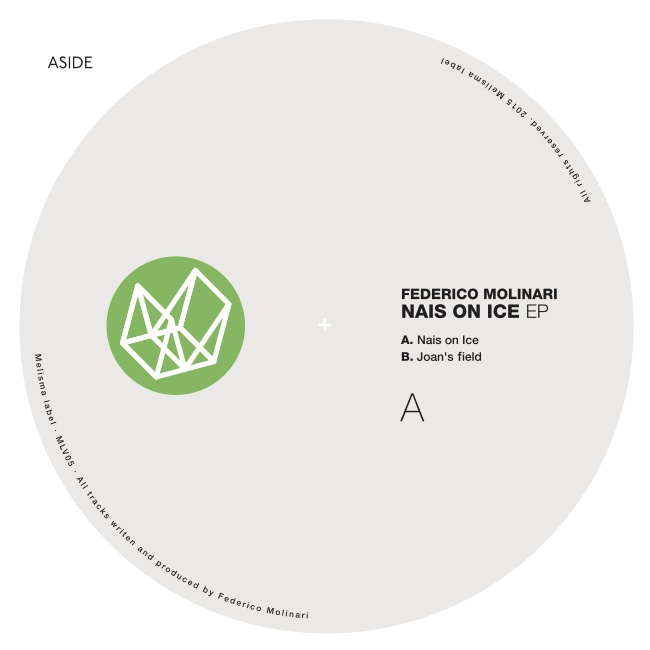
Swiss-Chilean imprint Melisma has revealed that its next EP will come from Argentinian producer Federico Molinari, due out April 20.
Molinari has been a staple in the minimal and tech house scene in Europe since his move from Argentina to Germany. He sits at the head of Oslo Records (alongside Nekes), an imprint through which he has put out a lot of his own material, as well as records by the likes of Johnny D, Mara Trax and NoiDoi.
For his next EP, Nais On Ice, he heads to Melisma, a label that has so far put out records by Dani Casarano, Felipe Valenzuela, Felipe Venegas, and Jkco Mosqueira. The two-tracker will also quickly be followed by an EP called Congo Toys on French label Apollonia in May.
Berlin-based fans of the label can look fowrard to a Melisma showcase at Hoppetosse on April 8. Following that, Nais On Ice is due out April 20, and can be pre-ordered at Redeye. Check out snippets from the EP below.

Craig Richards has shared details of his latest endeavor—a new 7” singles label called Tuppence, for which the first release comes from electro specialist Keith Tenniswood (a.k.a. Radioactive Man).
Richards (best known for his lengthy residency at Fabric London) is no stranger to running a label, having already put out several records via his other imprint, The Nothing Special. His latest project is Tuppence, an imprint that will specialise in 7” only, which promises releases from Convextion and Deadbeat in the near future.
The label’s debut outing comes courtesy of Radioactive Man—a British electro producer, who has released on the likes of Rotters Golf Club, Wang Trax and his own Control Tower over the course of the last. Go Ahead London fuses his typical electro rhythms with some indie dance elements, as well as taking things downtempo on the flip.
Go Ahead London can be pre-ordered at Above Board (where you can also find snippets of both tracks).

S Olbricht is the solo-mode moniker of the Hungarian artist Martin Mikolai, a producer known for both a love of hazy, fuzzy experimentalism and a propensity for unusual stepping-off points. (His cassette-only 2012 long-player, The Last Act Of Dorothy Stratten, released on his own Farbwechsel label, was an ode of sorts to the murdered Playboy Playmate.) His latest album, For Perfect Beings, released on Lobster Theremin, is a perhaps less obvious about its subject matter—but it’s an assured exercise in atmosphere, a confident release that sees Mikolai further refining his lo-fi four-to-the-floor musings.
Several of the album’s tracks revels in the same sludgy, hiss-heavy saturation that permeated his previous release for the label, 2014’s A Place Called Ballacid EP. But rather than fully defining For Perfect Beings, Mikolai here uses that aesthetic as a jumping-off point, with his various musings bubbling out of the primordial stew. Sometimes, that effervescence doesn’t carry his ideas far from the source—“Blambestrid,” for instance, trudges along on heavy legs, as in one of those dreams where you’re escaping danger but your feet refuse to cooperate, wading in concrete. An eerie synth line adds to the uneasy feeling, as does a rising squall of sound—but just when it’s about to become too much, that squall comes to the fore and reveals itself as something almost placid, giving comfort at the dream’s end.
It’s an effective juxtaposition—beauty arising out of the murk—and it’s a trick that Mikolai has perfected. “Rien” is the sound of a gorgeous record playing on an vintage Victrola—but it’s a record with a skip in the groove, and a Victrola with a heavy accumulation of dust on the needle; both versions of “Ovacrwded” (one marked “fast,” the other “slow”) boast what might be poignant melodies, if you could fully discern those melodies through the mire.
They’re all impressive pieces—that fast version “Ovacrwded,” with its wavering synths and distant chiming, is eerily spine-tingling—but Mikolai is perhaps at his best when he employs a lighter touch. Album opener “Asterid” commences with a steady kick, syncopated claves and a far-away squelch, before moody chords and a spare bassline take over; the track slowly evolves, with haunting coos and bleeps working their way in and out of the mix. The track never quite reaches a climax, and it’s all the better for it, as its trip itself is worth the ride. “Fadaisco,” with its repeating synth line, syncopated percussion and hypnotic feel, is perhaps the most overtly “housey” of the album’s cuts, though it’s a version of house imbued with a spectral edge; the sublime beat-free flutter of “Gesnaria” could have easily been stretched beyond its two-minute run time. It’s a gorgeous moment in an album brimming with them, full of shadowy depths and shimmering heights.

Ben Lukas Boysen is set to release a new LP on Erased Tapes.
Boysen is the son of opera singers Deirdre and Claus Boysen, and was brought up classically trained on piano and guitar from the age of just seven. His upbringing involved the works of Wagner, Bruckner and Bach, alongside contemporary artists and groups like Autechre, Godspeed!, Pink Floyd and the like.
Spells is his second album, a follow-up to his debut Gravity. An alternate version of song “Sleepers Beat Theme” from Spells was actually featured on Jon Hopkins’ Late Night Tales from 2015.
Spells LP is scheduled for June 10 release via Erased Tapes.

Unless you’ve been avoiding any kind of electronic music-related content for the past few years, you have noticed the rise in popularity of modular synthesis. Once the preserve of scientific institutions and extremely wealthy progressive rock musicians, the mind-boggling world of modular has steadily democratized to a point where any self-respecting hardware-focused producer has half an eye on their next fix of “Eurocrack.” There were indications that a tidal wave of interest in the arcane practice was on its way when Radiohead’s Jonny Greenwood took to wheeling out a floor-standing modular rig in order to perform the electronic elements of “Idioteque” on stage, while indie-baiting electro outfit Simian Mobile Disco kept a sizable portion of their own live setup modular in nature. These days it is common to see artists such as Surgeon, Carl Craig and Blawan bringing their modular rigs on stage, while scores more have adopted the practice for their own studio endeavors.
From an outside perspective, it can seem baffling as to what exactly a modular synthesizer is, and why they hold such appeal. If you were to take a typical studio set up of a drum machine, a synthesizer and some effects units, imagine pulling the component parts of those devices out so that each individual element is in front of you, ready to be manipulated and interconnected any which way you choose. Each of those elements is represented by a single module, allowing a musician to be the absolute architect of their perfect machine.
The history of modular reaches back to early Moog models in the mid ‘60s, as well as manufacturers such as Buchla, but the playing field changed drastically in the mid ‘90s when leading module makers Doepfer released the A-100 system. The size of rack used to house the combined modules became something of an industry standard (although not entirely universal), referred to as Eurorack, and adhered to by many other manufacturers. This enabled users to combine modules from all different kinds of designers and builders, vastly increasing the creative potential within the murky world of modular, while also opening the door for boutique brands to develop their own designs. The market has never been more buoyant, with leading shops in most major cities from London Modular through to SchneidersBuero in Berlin and Modularsquare in Paris.
By its very nature, a modular synthesizer is always unique to its builder. In order to shed some light on the creative potential within these complex, customised machines, we’ve asked Wales-based producer Steevio to give us a detailed tour through his own self-contained modular set up, using the above video of his live performance “Primes” as a reference point. Having been a musician for more than 40 years, and having made techno since the early ‘90s, he’s experienced more shades of musical creation than most, and in 2009 he made the leap to a purely modular set up for every step of his musical process.
The first evidence of this change in direction for the Sunderland-born artist came at the notorious Freerotation festival that he co-organises, where he would perform live improvised techno to the intimate crowd. As his experience and set up grew, he started the Modular Techno series on his Mindtours label, which is soon to reach its fourth and final volume. At this point in time, Steevio and his partner Suzybee are performing live on a global level, often billed on modular-focused showcases, his singular approach making him something of an accidental ambassador for the modular explosion.

The route to modular
For many years prior, Steevio’s set up was a more classic approach to the techno-focused studio. “I started out with a TR-909, an Akai sampler, a couple of TB-303s, an SH-101 and an Atari ST,” he explains of his set up in the ‘90s. “I bought the Nord Lead in ‘95, and a Sherman Filterbank, but I got sick of hearing the 303 so I stopped using it around ’99. Eventually I started gravitating towards using the Nord 3 for drum sounds.”
As his more traditional set up started to feel limited, Steevio looked to other hardware that would provide inspirational paths down which his music could travel. After struggling with an Alesis Andromeda for some years, he settled on the rackmount version of the Moog Voyager, which still resides in his set up today, but he still felt something was lacking.
“The whole point of it was to make an instrument that was pure improvisation, so you don’t think about the arrangement, you just do something when it feels right at that moment. I wanted the whole thing to be holistic, so every part of what’s going on is affecting every other part of what’s going on.”
“I was starting to lose my will to make music at one point, because I just felt like I’d done everything that I could with the equipment that I had,” he explains. “I’d always wanted to have a modular synthesizer, I just could never afford it. It was only when the modular Eurorack explosion happened in the mid 2000s that it was more worth going down that route because there were so many people starting to make different types of modules.”
Steevio decided he would need to create an instrument made out of modules that could generate his entire sound, without the need for any external hardware. The aforementioned Moog Voyager provides something of an exception, although through connections both in and out of the rest of the rig, it performs as a module like any other.
In preparing to enter into the modular swamp with both feet, Steevio spent many months planning out the shape his set up would take, what modules would be required, and how every element would connect and interact with each other.
“The whole point of it was to make an instrument that was pure improvisation,” he explains, “so you don’t think about the arrangement, you just do something when it feels right at that moment. I wanted the whole thing to be holistic, so every part of what’s going on is affecting every other part of what’s going on.”

The rig: an overview
As you’ll be able to ascertain from the video above, it would take too long to detail every single module in Steevio’s rig. Rather, it makes more sense to give a broad overview of the set up before we explore the key areas in greater detail. The top left of the set up contains what Steevio refers to as “the core” of his modular, a pair of eight-step sequencers that send out the rhythmical pulse that eventually triggers the sounds that you hear.
Of course, it’s nowhere near as simple as that, as the notes fired off from the sequencer pass through various quantizers before heading on any number of possible routes through the modular. Depending on Steevio’s intention, the notes can pass through switches and modules that can change or multiply these notes on their way to the oscillators, the root of all sound generation in the rig. Meanwhile, filters and envelopes are on hand to receive their own instructions, sculpting the tones coming from the oscillators depending on the purpose they will serve in the mix. We’ll explore the variable routing of the signals in more detail later, but for now let’s focus on where the sounds actually come from.
The flexibility Steevio described earlier as being key to his modular set up applies to the sonic qualities of his rig as well as the rhythmic, and the oscillator modules in his set up can be responsible for all kinds of different sounds depending on what feels right in the moment. Focusing on the percussion, it’s worth noting that he does have a Jomox ModBase 09 module dedicated to kick drum duties, and equally he has a specific hi-hat module that he runs through additional distortion, wave shaping and filtering in order to control the characteristics of what would otherwise be a basic, tinny 808-style hi-hat sound. Other than the explicit purpose of those units, all the other oscillators are simple wave generators as you would expect to find in an analog synthesizer. It is then through the application of envelopes, frequency modulation and filtering that they happen to end up as percussion sounds, or any other tone for that matter.
“You could have what sounds like a big deep tom-tom sound,” Steevio explains, “and you can turn that into a little high pitched whistly bird sound with a few tweaks of a few knobs, so it’s just constantly evolving through the set.”
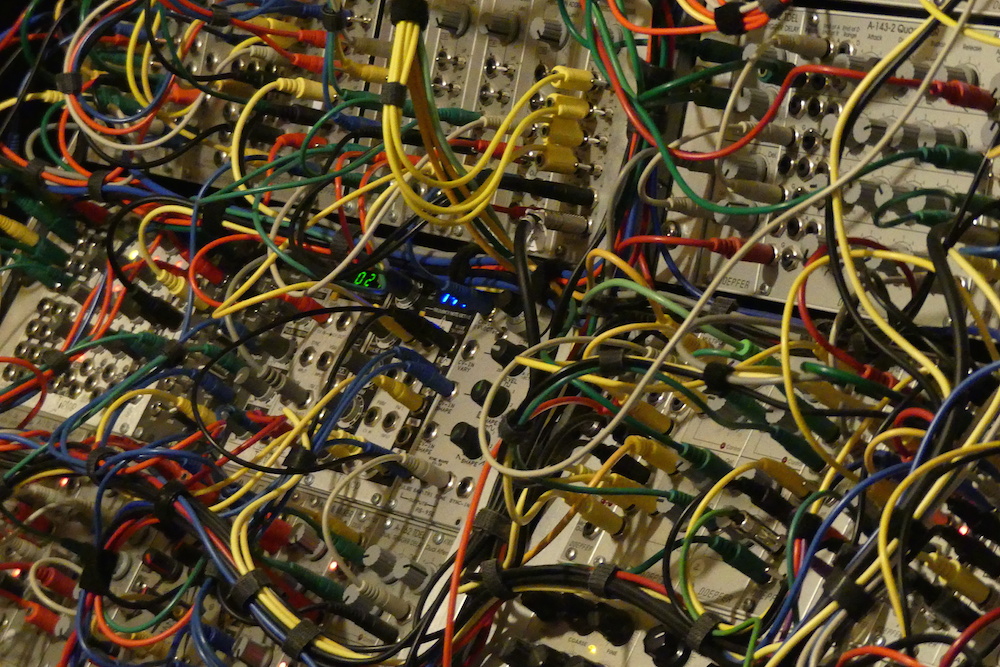
As well as the seven oscillators in within the Eurorack frame, there are also three within the Moog Voyager, which sits at the bottom of the set up. You might well notice in the video for “Primes” that Steevio reaches to this piece of hardware regularly, influencing those sweeping filter effects you can hear on some of the more melodic elements of the music.
“I’m still doing the same thing with the Moog as I’m doing with anything else on the modular,” he states, “but I do tend to go to it quite alot because you’ve got great big filter knobs and sustain knobs which are great for expression.”
Everything starts with a drone
When it comes to setting up for any live performance or studio jam, everything in Steevio’s sound begins with a drone made up of all the oscillators humming at once. Starting with a “fundamental” oscillator that will represent the lowest drone, later to perhaps become a kick drum or a bassline, Steevio will then tune each successive oscillator to a harmonic of that “fundamental.”
“By the time I’m finished I’ve got all the oscillators in the modular droning,” he says, “and I will adjust them to the point where it’s giving me an emotion, and that comes from things happening in my life that make feel a certain way.”
Once the right mood has been set, Steevio uses filters to shut everything down to silence, but still those oscillators are continuing to drone away underneath the rest of the rig. In essence, all the musical sounds that you hear in the actual performance are just snippets of that original drone being allowed to peek through in a particular way. While he isn’t sure that everyone approaches a modular performance in this way, the setting of the harmonics in the drone are an essential part of creating music that reflects Steevio’s emotions at the time.
“It’s all of the sound, all at once,” he says, “so if you can handle that, then you can handle little bits of it. There’s something fundamentally right about it.”
It’s worth noting that even if each oscillator is tuned to a starting frequency, that in no way sets its purpose for the rest of a session. Control voltages arrive from the sequencer and other parts of the rig to change the pitch throughout a performance.
“I might flick that oscillator up a couple of octaves and use it as a high pitched hi-hat sound,” Steevio explains, “or I might tune it down two octaves and make it into a bass note, or it might have a sequence going into it which creates a bass note on one note and then a high pitched percussion sound on the next.”
Generally speaking, Steevio keeps the majority of his oscillators at their fundamental tuning once the session has started, as adjusting tuning on the fly could run the risk of sending all the sounds out of harmony. However he will always keep a couple of oscillators freeform so they can be re-tuned if the direction of the jam calls for it.

Moving in sequence
With the oscillators set to drone, it’s up to the sequencers to create the rhythmical movement in the music. In Steevio’s set up, two eight-step sequencers sit in the top left hand corner of the frame working as the main sequencers for the whole rig. Another sequencer on the right hand side controls some other parameters such as the velocity of notes triggered on the Moog and the kick drum, while scattered throughout the rig are smaller sequencers to affect more detailed parts of the rhythmical process.
Although the eight-step format might lend itself to the tradition of grid-based timeline production, controllers on the sequencers allow Steevio to determine the length of the sequence, which direction the sequence moves in, and the ‘shape’ of his sequences with envelopes.
“I took out the concept of any form of arrangement right from the start. You literally turn knobs, press buttons, flick switches and something happens. You don’t even know where the bars are.”
“With an envelope connected to the controller you can use a shape to control a musical pattern,” Steevio points out. “I use two envelopes on each sequence, so the sequences are running in different directions and stopping and starting, and some of them are running in polyrhythmic steps so you get all sorts of cross rhythms happening.”
As if that wasn’t enough of a headspin, additional feedback from the rest of the modular can in turn affect the behaviour of the sequencers, all helping Steevio move away from loop-orientated sequencing. “I took out the concept of any form of arrangement right from the start,” he says. “You literally turn knobs, press buttons, flick switches and something happens. You don’t even know where the bars are.”
One aspect of sequencing Steevio wanted to maintain from his years spent working on a 909 was the swing. He readily admits that it has become part of his sound, although he also acknowledges that the three or four choices of shuffle on a 909 are somewhat limiting. By running the straight-ticking clocks of his sequencers into a splitter to create two streams and then delaying one of those streams, he can create as much or as little shuffle as he likes.
“It’s actually an analog shuffle,” he states. “You can put movement into the sequence any way you want. You might have more shuffle on the second note than you have on the fourth note, so you get a kind of wobble to the rhythm.”
Routes less travelled
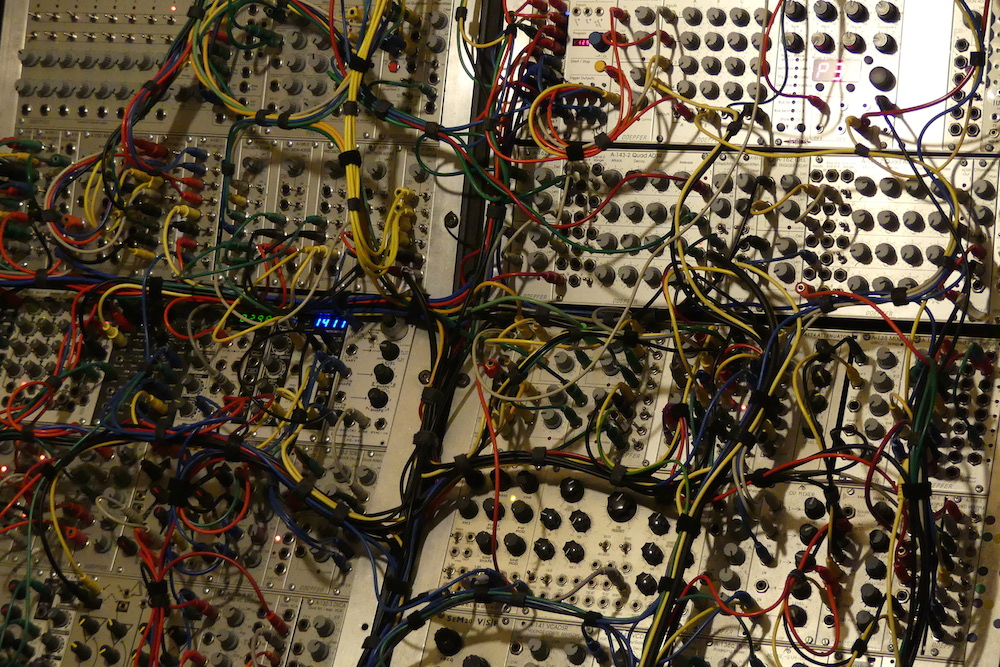
As if the immediate control over the sequences wasn’t complex enough, Steevio has developed his rig to be able to direct those sequences to different modules to alter their behaviour and form in a multitude of ways. The results can manifest as intricate melodic lines or twisting percussive patterns, or a mixture of different sounds intertwined, or yet more behavioural information feeding back into the system. Due to the improvisational nature of his work, he had to design a system that wouldn’t need re-patching in the heat of the moment, so all those wires you can see sprawling across the frame are fixed in permanently. Instead of having to move a patch cable in order to send a signal to a desired module, Steevio has installed banks of switches and additional sequencers that route sequences and audio anywhere he desires. Some of those switches may be automatic, others may be triggered by a separate part of the rig, but they all serve a shared purpose of keeping the music constantly moving and always interesting.
“You can do an hours set and never go over the same ground twice,” Steevio declares. “The routes are being swapped round and things are going off in tangents so it’s just really flexible. I designed it that way so that all I’ve got to do is flick a few switches and it’s a completely different thing happening.”
Getting mathematical
In the midst of these pathways through the rig are the modules that excite Steevio the most, where mathematical incidents affect either the voltage or the movement of that voltage on its way to becoming an audible sound. For example, the Maximum/Minimum Selector is a Doepfer module that combines up to four different wave-forms and gives you two outputs, one which mixes the maximum peaks of all the signals and one which mixes the minimum peaks of all the signals, generating completely new wave-form shapes in the process.
The Precision Adders (of which Steevio has five in his rig) can add or subtract voltages together. All the streams of control voltages coming from the original eight-step sequencers arrive at the Precision Adders, and their varying sequence patterns can either be added together or taken away from each other to create new voltages. If you consider that a voltage is equivalent to a musical note when it reaches an oscillator, in effect you could add together the D and the E note in your sequence to create an F # (where C is set as the base note).
“When I look at the modular I’m seeing all the mathematics that’s going on there, and in my minds eye I can see where the signals are going and what they’re gonna do. It’s only when it’s turned into sound that I become a creative person, so it’s like two halves of my brain working.”
“I can create almost any melody I want with those five precision adders and four separate streams of notes coming out of the sequencer,” Steevio says. “I’m actually creating the tunes with the Precision Adders effectively.”
If you needed more evidence that maths plays a big part in Steevio’s creative process, just look to the title of his demonstration track. “Primes” was so named because every mathematical decision in the process was based around prime numbers. Of the two main sequencers, the top one is set to seven steps and the bottom is set to five, while the intervals between all the melodic notes are prime numbers and all the oscillators were tuned to prime number harmonics.
“When I look at the modular I’m seeing all the mathematics that’s going on there,” he adds, “and in my minds eye I can see where the signals are going and what they’re gonna do. It’s only when it’s turned into sound that I become a creative person, so it’s like two halves of my brain working.”
Playing the system
With all the complicated mechanics affecting the movement of the sound, Steevio chooses his points of interaction with his system carefully. Many of the musical developments that occur throughout a session rely on the simplicity of the original patterns on those eight-step sequencers, often using just one-note variations on each of the four sequencers. Where the notes are then travelling through quantizers (to set the intervals between notes into a chromatic scale) as well as the adders and other modules, a simple adjustment to one knob on the sequencer and flicking some switches on the Precision Adders can result in a melody with no relationship to the previous one. “It’s what you’ve got to be able to do if you’re gonna jam along and keep changing what you’re doing as you go through a set,” Steevio insists.
In terms of bringing sounds in and out of the mix, Steevio shies away from using his outboard mixer as anything other than a landing point for all the sounds coming out of the modular, with all eleven channels set to the same level. Instead every sound ends up in one of nine filters as a last port of call before heading out to the mixing desk.
“I don’t like to use mixer faders because filters are much more pleasing to the ear,” Steevio insists. “Most of the things I’m tweaking on the modular while I’m playing are envelopes, which in turn will tweak a filter and voltage controlled amplifier. I’ve never used just a volume control, because it’s pretty obvious when you hear something coming in or going out.”
Overall, much of the complexity in the sound Steevio has crafted occurs as a result of the tailor-made system he has built. Rather than having to battle with the mechanics of operating each part, he can set the system off in a direction, read its mathematical behaviour, and then respond to the resulting sound to initiate the next step.
“It’s a constant feedback loop of what I’m hearing and working out what I’m gonna do next,” Steevio explains. “It’s intuitive really. All the thinking was done when I wired it up in the first place.”

The wider world of modules
To come full circle to the point made at the start, no two modular synthesizers are the same and Steevio’s approach represents one particular way in which the highly adaptable practice can be moulded to an artist’s specific needs. There are countless other possibilities out there, such as semi-modular systems like Roland’s System-1m that bridges the gap between computer-based production and the Eurorack world. Equally you can find experimental module designs in manufacturers such as Mutable Instruments that push the analog roots of the format into new, digitally-powered places.
“I think my set up’s a bit different to what quite a lot of other people are doing at the moment,” Steevio considers. “The newer modules that are coming out are a little bit more gadgety. I’m not adverse to buying the odd module that does some weird shit that someone’s come up with, but I prefer to go down the simple route I suppose.”
Quite whether anyone else agrees that Steevio has taken the simple route is up for debate, but there’s no denying he’s built a machine that he understands every inch of. There’s some solace to be taken in the fact that he confesses to be just as confused when he watches someone else performing on their own modular rig.