Grimes has announced that the follow-up album to 2012’s Visions will land in October. Taking to Twitter earlier today to share the news, the Canadian artist says the varied and as-of-yet-untitled LP uses a lot of real instrumentation and will be “surprise released all at once.” “I want fans to get it before press,” she continued, “and the tracks should be heard together.” Apart from disclosing that none of the new tracks resemble her latest singles “Go” and “REALiTi,” further details of the album are being kept under wraps for the time being. (via Pitchfork)
As with John Talabot, Redshape and Ten Walls before him, the identity of the anonymous producer Man Power has been electronic music’s favourite guessing game lately. Names such as Talabot, Michael Mayer and Tim Sweeney have been thrown around as possible crafters of the textured, genre-straddling house and techno of his recent EPs for Correspondant, Hivern, and most recently New York’s Throne of Blood. The producer in question hasn’t revealed his identity as yet, so it’s something of a surprise when I dial him up for what I assume will be a sound-only Skype call and am cheerily greeted by a man in his 30s in a blue denim shirt and wooly hat, his grinning face very much on camera and unobscured by shadow, mask, or gigantic ornamental feather.
His face (and his jovial Newcastle accent for that matter) is naggingly familiar. I mention this during a later exchange of messages and say I think I must have seen him play at some point. “Maybe,” he replies, before adding with a certain glee, “or maybe we’ve even met…” Though I (maddeningly) can’t place him exactly, I can put to bed any lingering Talabot/Mayer/Sweeney rumors, unless any of those guys has invested in prosthetics and accent lessons lately. When pressed, he says he’d prefer to wait until his self-titled album comes out (today, May 25, as it happens, so hopefully I’ll have been put out of my misery by the time you read this) before he absolutely confirms who he is, though he admits he has generally been a lot less guarded about it in recent weeks.
“[My anonymity] wasn’t intended as a gimmick, but I’d be full of shit if I pretended it hadn’t ended up helping me get noticed.”
“The guesswork is a lot more interesting than the truth I’m afraid,” he laughs. “Being anonymous started as a necessary evil, simply because before Man Power I did a project with two friends, which is still a going concern but has been on the back-burner lately. We had built up a network of bookers, and when I found myself in the position of wanting to do something solo I wanted to avoid it being lumped in with that project, because I thought that bookers would look at the situation and say, ‘we can book these three guys and pay three sets of expenses, or we can just book this one guy and it’ll be the same thing’. So I felt like I’d be stabbing the other guys in the back if I didn’t keep it a secret. Also that project is a lot more Balearic/disco-oriented whereas with Man Power I wanted to explore either odder or tougher sounds, so I decided to take who I was out of the equation and work with new labels and new bookers in a totally new place. It wasn’t intended as a gimmick, but I’d be full of shit if I pretended it hadn’t ended up helping me get noticed.”
The “new place” Man Power refers to is Berlin, where he has been based since late last year. It was “moronic” to move there in the grip of winter, he laughs ruefully. I say I think most of his music feels like a warm-weather thing, and he agrees. “I seem to play in a lot of really hot countries, so all winter I’d be coming back from Israel or L.A .or Mexico or wherever wearing a little jacket and just be weeping on the U-Bahn ride home.” He’s been DJing “for about 20 years,” and before his move to Berlin was based in his hometown of Newcastle in the north of England, where he and his two friends have enjoyed “as much success as we were looking for” with their group project.
So how did a member of a (self-described) “very niche” Balearic/disco project in the north of England end up casually flicking out his first two solo EPs on two of Europe’s most respected labels and building up a fearsome head of creative and critical steam from there? Simply by aiming high, it turns out. “Without wanting to say that I’m in a position to be doling out advice, if anyone asked me for one tip I’d say to them to start off at the top of what you want do and work back from there. I just really liked what Jennifer (Cardini) was doing with Correspondant and what Talabot was doing with Hivern, so I got in touch with them. They liked what I sent them, we got to know each other, and it all happened from there.”
Man Power talks in quite touching terms about Talabot and in particular about Cardini, label head of Correspondant, which put out his Kiloton EP this time last year and is now releasing his album. “Having Jennifer as a sounding board has been totally vital to the album coming out the way it has. She would constantly tell me to tighten this or that up, to not repeat myself and so forth, and there’s no way it would sound the way it does without that. I sort of hesitate to use the word ‘mentor’ but really it’s totally justified, I owe her a lot. She’s a great person who has a very selfless ambition to give exposure to the music that she really loves.”
The breadth of styles and consistency of quality in Man Power’s records to date are one of their most obvious and notable characteristics. He loosely defines the sounds he’s looked to create for Correspondant and Hivern as “a tougher, slower techno sound” with the former and “more spacey weirdo multi-influence stuff” with the latter, while his Throne of Blood EP hits on slightly darker textures. The album, meanwhile, is a work that expertly weaves together too many influences and inspirations to name, but that has an overall sunny glow and lightness of touch that should ensure his days of shivering on the U-bahn after gigs in hot countries are far from over.
“I grew up with my grandparents,” he explains, “but still saw my parents, so I had more than one set of influences. One set of grandparents would be listening to Bing Crosby, then the other set Nana Mouskouri and Ray Charles. My dad was into blues and Americana and my mum was into acid house, so it just kept my ear open a bit more I suppose. Even when I was going out all the time I was never a house kid or a techno kid; you’d be just as likely to find me in a rock club or a commercial club or whatever. I just loved music full-stop I suppose.”
Man Power’s description of the experience of making his album (“like doing a jigsaw puzzle, in the dark, but you have to cut the pieces yourself”) fits well with the image of a producer toiling to assimilate this lifelong cascade of influences, though the clarity and cohesiveness of the finished work suggests a knack for self-deprecation, extremely hard work, or both. The warm, propulsive house of “Forget To Remember,” “Tofu ist der Teufel”‘s charisma-soaked blend of trumpet and clicky, precision-aimed drums, and “TEN”‘s beautiful, sun-dappled guitars, are among the first-listen standouts. Really, though, Man Power is an “album” in the truest sense: a full-length that rewards repeated, concentrated immersion from beginning to end. Laurie Anderson, Steve Reich and Tangerine Dream are mentioned as particular influences, with Anderson’s 1982 debut LP Big Science clearly a particular inspiration for how “the same synthetic refrains come in and out throughout the record.”
Never shy to credit the input of others, Man Power is at pains to point up the influence of Suade, a fixture of the Newcastle music scene with ties to the Items & Things label. “He’s a genius,” he says bluntly. “He did mastering and some mixing on the album, and having his ear was so important. He also gave me access to outboard compressors and stuff like that from his studio, which added a really nice vintage feel to a lot of the tracks. He’s never been as well-known as he should be outside Newcastle, but apparently through this, Talabot and some other people have become aware of him and are going to work with him, so hopefully it’s been worth his while.”
Man Power’s plans for the rest of the year seem to outnumber the weeks left in it. From planned EPs for Voyeurrhythm and This Is Not An Animal and developing his own LBL imprint, to live shows alongside Rebolledo as Topaz Efimero, and planning a two-month stint in Mexico to record a second LP with a full-band setup, he looks very well-placed to make the most of the position he’s found himself in, not to mention thoroughly, refreshingly excited by it all. In the course of taking me through some of the torrent of ideas and plans in his head, he laughingly recounts an idea he and his friend Moscoman had recently to team up under the name Moscomanpower. I suggest that Matrixxmanpower might also be a decent idea, and his face lights up. “Wow…Matrixxman is probably my favourite producer of the last year,” he gasps, mental cogs spinning away immediately. “I think I might send him an email…”
Last month, a newly Berlin-based Blawan inaugurated his new label, TERNESC, with a sampling of some of his first solo material to see release since 2012. Now, UK-born producer Jamie Roberts (who also serves as one half of Karenn alongside Pariah) has revealed details of the second EP in the series. Set to arrive on June 16, Hanging Out the Birds offers four fresh modular techno cuts, though—as Resident Advisor points out—keen listeners may recognize the title track from Pearson Sound’s recent Beats in Space mix. EP clips are available to stream below.
Ten years ago, minimal techno sound resonated throughout Berlin; today, one of the most vibrant of the city’s techno formulations is one that’s heavily influenced by noise and dark industrial sounds, fronted not by one leading name but rather by a gradually evolving collective throughout the city. Instrumental within this collective are Shapednoise (a.k.a. Nino Pedone), Ascion [a .k.a “Pasquale Ascione”) and D. Carbone a.k.a. Honzo (a.k.a “Davide Carbone”), three Berlin-based producers who have played at events including Berlin Atonal, CTM Festival, and Contort. Together, Ascion and D. Carbone run 3TH, a small imprint that focuses on an experimental techno output, while together all three run Repitch, as well as Cosmo Rhythmatic, a small label that will soon release the collaborative album of Franck Vigroux and renowned Finnish minimalist producer, Mika Vainio. Following this announcement of that LP, XLR8R sat down with them to discuss the motivations and inspirations behind their labels. Let’s start with Repitch, the label you all started together in 2011. How did that come about? What was the the original idea? Ascion: It’s quite easy really. Davide [Carbone href=”http://www.mikavainio.com/”] and I were both producing music, both of us techno with a minimal approach. We are from the south of Italy but started living together when we moved north to study. When we were there, it became clear that we shared the same ideas both had a love for music, so we decided it was important that we had our own platform. It was actually the same time that we met Nino, we spoke with him about our idea. We began chatting online and it became clear that we had very similar tastes, so the label actually developed quite naturally. D. Carbone: In the beginning, Pasquale and I had been producing and releasing for a while. When we met Nino, we found distribution and it all just grew from there. Day by day, we also shaped the sound of the label; I think it became a mix of all of our individual sounds.
And what about the name? Ascion: It’s named after an old project of me and Davide which was entitled Pitcher, so Repitch sounded right because we wanted to make something new.
Nino, what were your inspirations for coming on board? Shapednoise: When I began speaking with Davide and Pasquale, I hadn’t actually started producing music. Pasquale and Davide told me all about the project and it sounded really interesting.
And did you have a specific vision that you wanted to achieve? You mentioned earlier that you wanted a platform to release both your music and that of other artists. Is there any more to it than that? Ascion: We didn’t really have a genre we wanted to target; it was just music that we enjoyed at the time—just uncompromising electronic music.
Shapednoise: We didn’t really have a vision at the start, but I feel that Repitch artists today have a specific kind of style that you can recognize almost immediately. We like to release the music of artists who produce slightly left-wing techno; we’re looking for techno that is a little bit more personal and complex in its style. I think that all the artists that have released on our label have done so because they have a style of techno that you can recognize easily. In short, it has become a vehicle for giving unique artist a platform to get their music out there. For me, it is too easy to produce just the regular techno or drum & bass or something, but doing something really personal and developing a unique style is just something a lot more interesting. This takes more time and this is what we want to promote and celebrate.
That raises the question of how you do your A&R—how do you try and find these artists? Ascion: Basically, there is a range of different ways we find this music. Sometimes it is via the Internet, other times it is via a friend of a friend or something like that. I think the growth of digital communication has facilitated A&R processes for the music we’re looking for, and we use this a lot. Nowadays there are so many more ways of finding music.
Do you proactively search for artists on SoundCloud? Ascion: Not that much. Gaja, for example, who released on Repitch, was a guy that we met here in Berlin, and we realized that he was a very good producer. We asked him to release on Repitch. It’s also important that we are friends with them; the A&R process is far more than just a professional relationship.
And do you get lots of demos? Ascion: We do, yes. We receive quite a lot of unsolicited demos from unrecognized producers, but it’s very rare that we release this on the label. D. Carbone: It normally happens that we ask artists to come and release on the label. We will hear them and recognize straight away that his sound is right for the label. We will then approach them to join Repitch. Shapednoise: That said, sometimes we do release artists who approach us via a demo. For example, we found Stave, who released on Repitch, via a demo. He wrote to us asking for a feedback about his music, and that’s how he ended up on Repitch. D. Carbone: Almost always, about 90 percent of the time, when one of us finds an artist, the other two will agree that he is right for Repitch. I can’t really remember a time that one of us found an artist and we didn’t all agree that he was right for the label. We know each other’s taste pretty well nowadays.
How did you learn to run a label? D. Carbone: By making mistakes! It’s completely trial and error, to be honest with you. Nobody has explained this to us, and we have learned by experience. Gradually you learn which are the best distribution companies for you and how to do the business side that’s required for a label to grow. Shapednoise: I think that once you begin running a label, you learn pretty fast. It becomes clear what’s working and what is not, and it just takes a bit of time to understand the process.
Do you keep the roster of artists intentionally quite small to ensure the quality of the output? Shapednoise: Yes. That’s very important. We analyze the roster very carefully to ensure we can offer the artists what they want. We will evaluate how far the artist has gone, what they’ve got coming under and then make decisions on how to tweak the roster.
Talk to me briefly about the Repitch showcase parties that you’ve started. What’s the idea behind these, and what’s the criteria for a party? D Carbone: The idea is to grow and celebrate the label. They’re always fun! We don’t have a specific club or venue because it’s not that important. As long as there is good music and a good energy, then the party will work.
Ascion: The label has grown enough now that sometimes we are getting requests from venues to hold these parties. We will then look at the venue and see if it is fit for a Repitch party. There isn’t a specific criteria but it is important that all three of us play in the event—this is the only way of establishing the sound of the night. In addition to this, we will normally have a guest from the Repitch roster to showcase what we have coming up. Shapednoise: The promoter must understand what we are looking to achieve, and we will always speak with them to make sure they can make it work. It was amazing because last year we played a party in Milan, and it was clear that people had come to see the label and us play, not just for the venue. It was a pretty cool feeling because it wasn’t just the hype of the club that sold the tickets; most of the people had come for us and promoter did a great work too so the energy really was incredible.
All three of you also started Cosmo Rhythmatic in 2014. Do you see this as a sub-label of Repitch or as a completely different entity? Ascion: I think it is a sister label. For us, it is on the same level as Repitch; it’s just a different label with different goals. Shapednoise: But it is clear that the two labels are connected to each other. It’s not like Repitch is the main label and Cosmo Rhythmatic is a lesser label. Whereas Repitch focuses on left-wing techno, we founded Cosmo Rhythmatic to focus on the more abstract and noisy side. D. Carbone: I also think that both the labels complete and compliment each other.
If Cosmo Rhythmatic was started to focus on more abstract techno, do you feel that Repitch has its own unique identity nowadays—and that you must protect it? D. Carbone: Yes, that’s exactly it. It’s a different type of music, and if we released Cosmo Rhythmatic music on Repitch, it would damage the integrity of the brand and confuse the fans of the label. It just becomes confusing. Shapednoise: The idea for Cosmo Rhythmatic arose because I became more and more interested in this abstract avant-garde noise, and I had just stopped my old label Violet Poison. Because of this, I needed a platform to release this noisy, abstract techno, so we just decided to go and do it.
You released the Franck Vigroux EP, Centaure, at the end of 2014, and you’ve followed this up with the new Mika Vainio collaborative album coming on Cosmo Rhythmatic. How did that come about? Shapednoise: I was in touch with Frank for a year, and we played a couple of shows together. I was really impressed by his work, so the main idea came about because we just wanted to work together. We all decided that Franck was a perfect for the label, and the Centaure EP expressed the more electronic side of his work. He usually composes music and lots other things, so this was a something new for him too. We went to lunch and we just felt inspired. The collaborative album came about because Frank was excited about the work we did with the EP, and he had already started speaking with Mika. We all met up and then we decided to release this on our label.
What makes this label unique in such a saturated market?
D. Carbone: I think it is too early to really understand this yet, and we must wait for another two or three releases. However, I the idea at the moment is to focus on completely original collaborations between different artists. The label is growing slowly, not just because we keep the roster of artists small, also because we are thinking a lot on what we are releasing. We’re focusing very much on completely unique on individual projects and collaborations. Shapednoise: Collaborations are certainly something we’re going to focus on. It’s like the Mika Vainio and Frank Vigroux album we have upcoming; this is one of the first ones—although there will be one before that.
Finally, lets quickly discuss 3TH. Is it just a vehicle to release your own material, Pasquale and Davide? D. Carbone: I could release my experimental work on Repitc,h but it doesn’t make sense to jeopardize the brand of the label. It’s simply because not all the tracks we produce will fit on Repitch and Cosmo Rhythmatic. When I am producing, I am not putting all of them on Repitch or Cosmo Rhytmatic. Ascion: If you listen to the 3TH catalog, it’s is quite eclectic. They are linked to each other but they are all different styles. It’s not like they are all the leftovers from Repitch or Cosmo Rhythmatic, it’s a completely different project that we started with Lucindo in 2013 that allows us to experiment. I also wanted to focus more on visuals, and Davide wanted another platform to explore other avenues, so it just made sense. It allows us to experiment with our techno sound. We make so much music that we needed another platform! Shapednoise: I think also that we all specialize in our own sound. Cosmo Rhythmatic came about because I moved onto obscure avant-garde noise and Davide and Pasquale went on to different forms of techno, so that’s why 3TH started.
How do you find the time to run a label? Do you all have different tasks? Shapednoise: We have definitely got different roles. I focus very much on the A&R for Cosmo Rhythmatic while Pasquale and Davide focus on Repitch, I feel. In the artistic side at least, we’ve all definitely split. Ascion: I’ve always take care of the graphic side of the labels – I create all the graphics, including the websites, logos and the t-shirts and so on. Davide then focuses on the technical stuff. D. Carbone: I don’t know how we find the time!
“When I Hear That Music,” the lead track on Ron Basejam’s new Tales From the Night EP, has a feel reminiscent of something that a generation of NYC clubbers might have danced to, circa 1982, at clubs like Paradise Garage. Its loping, skeletal rhythm, ghostly dub effects and swirls, and overall moody vibe are not so far off of the sound of songs like, say, “Walking on Sunshine” by Rockers Revenge or “Don’t Make Me Wait” from Larry Levan’s Peech Boys—which, of course, is a very good thing. Also good: The cut’s hypnotic, subtly relentless feel is reminiscent of what masters of nostalgic, funk-fueled repetition along the lines of Tiger & Woods and the Revenge strive to achieve in their best moments. But “When I Hear the Music” is far from a slavish copy of any of the above. Basejam—known to his pals as Jim Baron, and a member of U.K. boogie-house unit Crazy P (with Danielle Moore and Chris “Hot Toddy” Todd— is far too talented to borrow a few tricks and call it a day. The flourishes he tosses into the mix—a rhythmically propulsive synth, jazzy little piano riffs, horns, a minimal bit of bluesy six-string, some naggingly familiar vocal samples and more—make the song his own, and the end result is a gem of a tune.
And it’s not the only one to be had on the EP, released on the invaluable House of Disco website’s label. “Kag” is something of a slow-jam epic, with swirling keys giving way to wah-wah effects, sweet R&B vocal samples and a majestic downtempo groove, complete with a bit of slap-bass funkiness to complete the dream-soul feel. “We Know How to Work It” offers a more housed-up feel, though with its simple but effective chords, robo-disco throb and some filtered sass from Moore in the mix, its as close in feel to Janet Jackson circa 1990 as it is to anything else—and with its massive Jimmy Jam & Terry Lewis–style kick drum, syncopated guitar work and breathy vocals, “The Fire” also conjures up distant memories of those long-ago days. Finally, there’s a reprised version of “When I Hear That Music,” one that strips the song down to its component parts to devastating effect. Sure, Tales From the Night might be a bit backward-looking for some—but a touch of sentimentality for times gone by isn’t all that bad a thing now and then, is it?
Kicking off tomorrow, Detroit’s Movement Festival is regarded as one of the best festivals in the United States—and the world for that matter. Fittingly taking place in the birthplace of techno, Movement is one festival on the yearly calendar that you don’t want to miss. The festival itself is truly world class, with Detroit’s hometown heroes all featured heavily alongside out-of-town heavyweights, but the fun doesn’t stop there with the afterparties sometimes overshadowing the main event. To keep you informed, XLR8R will be uprooting the team from LA to station ourselves on the ground in Detroit, gathering content and reporting on the happenings as they ensue.
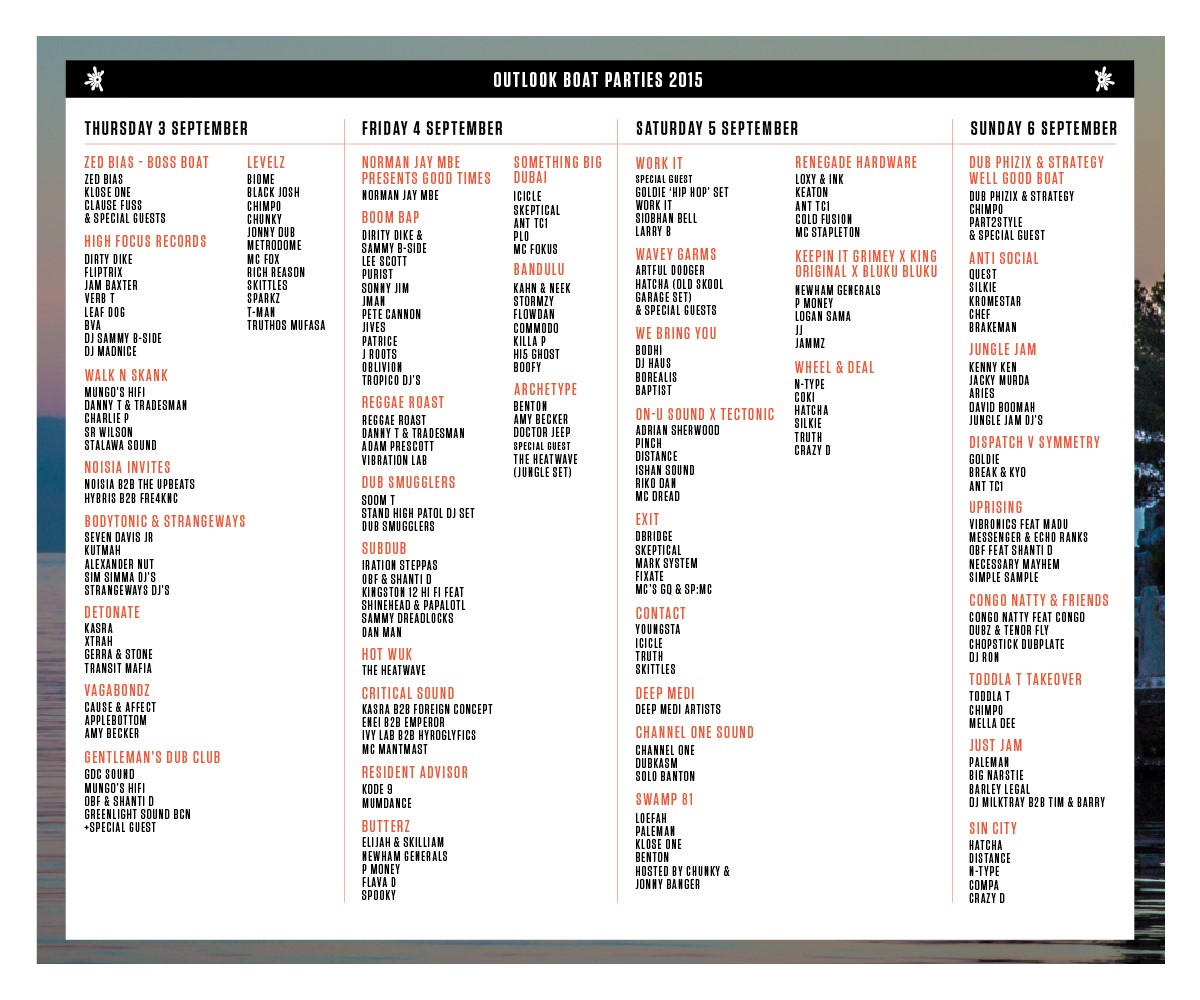
Celebrating its eighth year in September, Outlook Festival has announced its boat parties for 2015. Hosts will include Swamp 81, Just Jam, Renegade Hardware, High Focus, Channel One Sound, Reggae Roast and Norman Jay’s Good Times, with 12 parties per day setting sail across the beautiful Adriatic sea. A huge list of artists are set to perform with highlights including Goldie, Mala, Noisia, Toddla T, Zed Bias, Loefah, dBridge, and Adrian Sherwood.
Outlook is set to take place September 2-6, with the full schedule and complete lineup of boat parties below.
This year, San Francisco electronic music pioneers Gavin and Robbie Hardkiss (who along with the late, much-missed Scott, make up the faux-brothers Hardkiss clan) are celebrating the 20th anniversary of Hardkiss’ seminal album Delusions Of Grandeur. As part of the group’s PledgeMusic campaign—which offers The Hardkiss Vault ’91-’99, containing over 65 songs and over 7 hours music—Hardkiss will be releasing the album digitally for the first time ever on May 25, with the group also performing the album live for the first time ever at Public Works, San Fran on May 30. In support of the campaign, XLR8R has been offered a mini EP of sorts with three diverse tracks from The Hardkiss Vault ’91-’99:the driving acid-steeped “Stationary Tornado-Hawke,” the soaring, atmospheric “Daylight (Dreamerdreamsalone),” and “Champagne Beat Boogie (Vocal Mix),” a sun-soaked body mover. This is a perfect introduction to the pioneering act for those uninitiated and a nice digital surprise for the already converted. You can download all three tracks for free below, with much more available over at the PledgeMusic page.
Los Angeles on a Friday evening can provide such an amazing variation of discrete musical events to choose from, meaning that dance lovers looking for a late-night techno party don’t have to go very far to find one. This situation is due to the work of many L.A .promoters who are currently banding together to create new alliances, helping to curate events that satisfy even the most discerning of techno enthusiasts—and the techno community in L.A. is reaping the rewards. Spend a night on the dance floors of techno advocates such as Droid Behavior or Mount Analog, and you will quickly see how dedicated the dance music community in L.A . continues to be.
Mount Analog does a couple of things really well, and one of them is carefully craft forward-thinking label nights that mix performances and impressive DJ sets at their Nuit Noire series. Droid Behavior is no stranger to large-scale international techno productions as well, with legendary lineups joining them during their long-running event series, PRIME. Das Bunker also contributes to the techno landscape in L.A., and all three of these promoters teamed up to create a supergroup—this past Friday, May 15, at Lot 613, they presented an incredible evening featuring the L.A. film debut of Industrial Soundtrack To The Urban Decay, DJ sets by Raiz and Rev. John, a live performance by Youth Code, and a Jealous God label lineup featuring Broken English Club, Silent Servant, Terence Fixmer, and James Ruskin.
The night started out with a special “history of industrial” DJ set from Raiz, showcasing some of the seminal tracks that took industrial music out of the manufacturing plants and factories and onto the stage. This mix of the familiar and the historic was a great way to get attendees prepared for the screening of the film. Industrial Soundtrack To The Urban Decay is a documentary about the creation of the industrial-music scene, and speaks about the industrial and Dada art movements that surrounded and inspired a new wave of creativity. Directed by Amélie Ravalec and Travis Collins, and starring industrial music stalwarts such as Throbbing Gristle, Cabaret Voltaire, NON and Clock DVA, the film serves as a history lesson on how they created and nurtured the industrial-music revolution. By the time the credits were rolling, we were quickly welcomed by yet another transitional DJ set, this one by Das Bunker’s own Rev. John. Soon after that, the crowd moved back as a large standing metal rack of drum machines and keyboards was quickly wheeled to the front of the dance floor for performance by Youth Code.
Youth Code members Ryan William George and Sara Taylor put on an energetic live show that featured fast post-punk industrial beats, along with screaming vocals from both members. Ryan operated a three-tier hardware rack with a microphone cord wrapped around his neck, while Sara engaged the crowd, getting everyone to move closer while she screamed and climbed speaker stacks with aggressive bliss. After Youth Code finished up with their punishing set, it was time for the Jealous God label members to take over.
Jealous God is run by former Sandwell District members Karl O’Connor (a.k.a. Regis) and Juan Mendez (a.k.a. Silent Servant), along with Blueprint label boss James Ruskin. True to the night, Silent Servant presented a mix of genres and selections that showed his love for all things punk and industrial—Broken English Club, who also goes by his given name of Oliver Ho, then took us on a trip that included droning percussion with live vocals sprinkled over high hats and minimal loops that slow-boiled into drum crashes. While Ho swayed and snapped his one-word vocals, Terence Fixmer set up his hardware for a live performance. With a release coming out on Ostgut Ton on June 8th, and with a plethora of label releases under his belt that includse CLR, Prologue, and Electric Deluxe. Fixmer has built a reputation as a versatile producer and a master of blistering live sets. He built the energy up by adding layer upon layer of drums while slowly introducing new elements that brought the tempo up to a fever pitch, finally handing the controls off to the long awaited Los Angeles debut of James Ruskin.
The Blueprint label head has been producing music for over 15 years, and with releases on Tresor, Ostgut Ton, and Coda, Ruskin is the only person to share a release on Surgeon’s label, Dynamic Tension. Within a couple of tracks, Ruskin proceeded to put on a clinic, demonstrating how a Funktion-One sound system can make a crowd who stayed past 3 in the morning turn into a complete frenzy. Aggressive backspins, masterful mixing, and old school pitch shifting tricks were all applied with a renaissance touch reminiscent of Ben Sims with a gentler hand. At one point Ruskin moved from relentless techno into breaks layered over a 4/4 beat, then shifted the entire tempo into half time before closing the circle and bringing the tempo back to it’s original pace. James is never at the mercy of a track, and his mixing style suggests that he can make a song do whatever he wants, whenever he feels the time is ready.
While the venue could certainly scale down on the flashlight wandering security staff on the dance floor, the bartenders and the staff outside create an inviting place where a full scale music production and a film premier can come together and have a cohesive night. The crowd stuck around well past the end of the music to give the promoters and the artists their gratitude and well wishes. All of the promoters and artists involved really put on a special night for the techno community, and that is why those in that community continue to support them passionately.
American DJ and producer Eric Cloutier built his name off the back of his meticulously crafted DJ sets, holding residencies at some of the best clubs around the world including the highly regarded Bunker New York. Recently beginning to release his own music, Cloutier is amassing a back catalogue as in demand as his DJ sets.
His latest EP, Raxeira, arrived last week as a vinyl only release on Wolfskuil Limited. The three-tracker lands backed by a remix by Italian techno master Donato Dozzy, with the tracks on offer full of the deep and hypnotizing qualities you’d find in their sets. From the dubby and driving “Raxeira,” the EP rolls into more trippy territory with “Palimpsest,” a low-slung groover with endlessly echoing synth bleeps. On the flip side, Dozzy twists “Raxeira” into a peak-time steamroller, adding a rolling bassline, highly textured layers and scattered percussion.
Raxeira is available now via Wolfskuil Limited, with the full EP streaming exclusively via the player below.