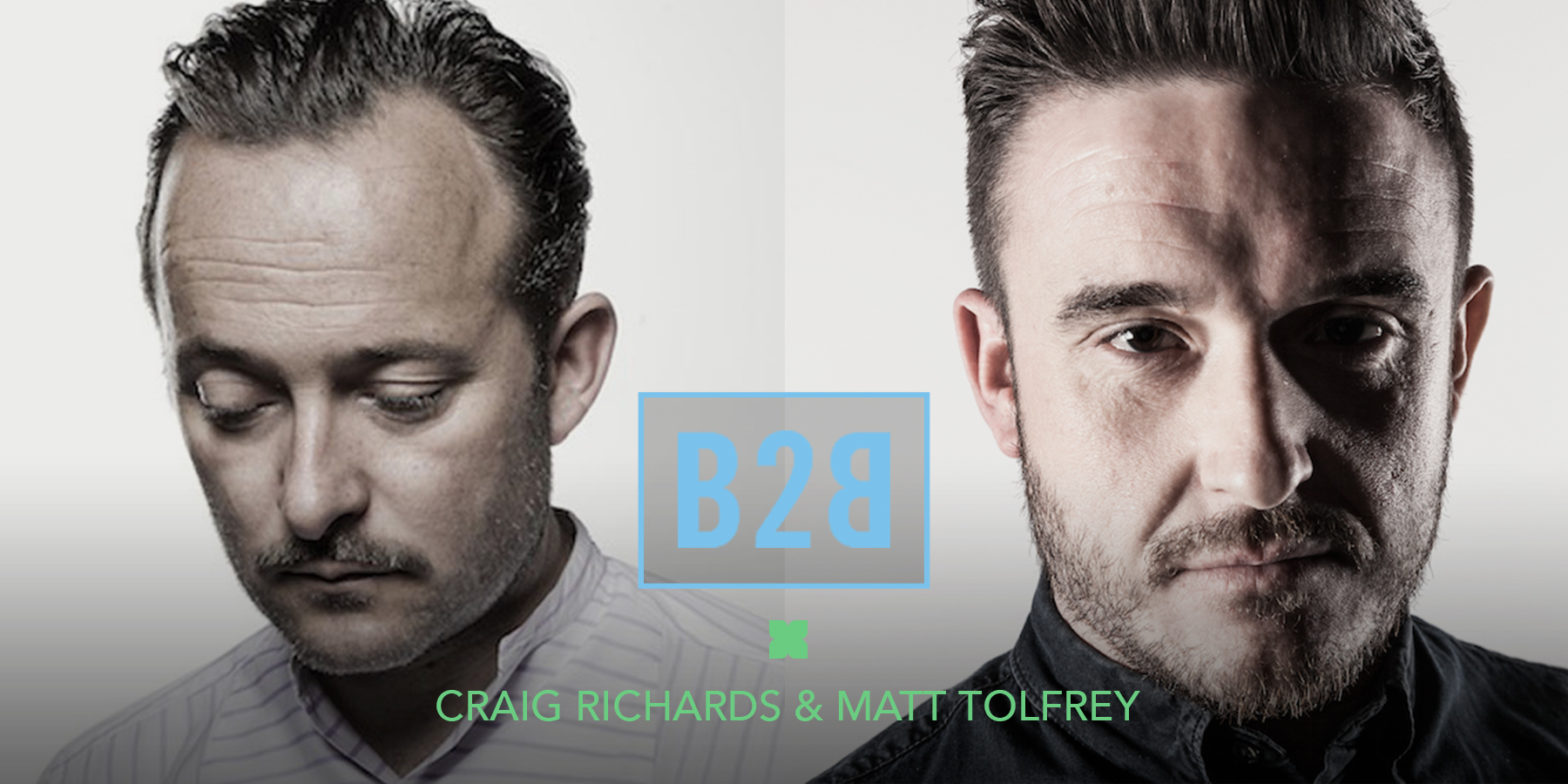
The U.K.’s Matt Tolfrey and Craig Richards are old pals, having met at the Bomb, the much-missed, seminal Nottingham house club, in the ’90s. The two have kept their professional and personal relationship going for years: Among other activities, Richards, the Saturday-night musical director at London’s Fabric, tapped Tolfrey, the man behind the Leftroom label, to become one of the beloved boite’s residents over a decade ago, and he remains a regular spinner at the nightspot today. After all this time, Tolfrey’s finally consummated that relationship (so to speak) via the club’s latest mix-CD release, Fabric 81—and now, Richards has quizzed Tolfrey in wide-ranging interview about the club, traveling, DJs versus entertainers, the pernicious influence of social media, and plenty more.
Craig Richards: The levels of enjoyment realized on a weekly basis in Fabric’s early years have left my memory somewhat blitzed. Large chunks of the good times appear to have been erased. Can you provide any early memories to add to the ones lost along the way?
Matt Tolfrey: My first time playing most probably stands out the most. I remember being in the Malmaison Hotel going through my records before the gig, and you rang me with some words of wisdom—I’ll never forget that. I remember the first time i heard you play Schatrax’s “Mispent Years,” the Freaks remix of Human League’s “Sound Of The Crowd,” and when you brought things right down one birthday and played Bushwacka’s “Herbal”: “Red, white and green, you know what i mean?” Ricardo playing the warm up set in Room One and finishing on “Easy Lee” was a mind blower, as well as your three-way tag with Ricardo and Zip two birthdays ago, when you kept running out onto the dancefloor once you’d finished a mix to have a dance. You also used to play this 10-inch drum record that worked the system so hard—never found out what that was.
On to the funny stories though: A certain German DJ getting a bit excited on his debut in room one and finishing his warm-up set fist-pumping at 132 bpm. You just let the record run out and started again at 124 bpm. And you playing reggae before a live act you were unsure about. What tops the pile though is us two walking to grab some cigarettes one birthday in full drag and high heels. We bumped into some old friends of yours you hadn’t seen for years and we casually sat outside the pub and had a few drinks with them in the sunshine. No one mentioned that anything was out of the ordinary, and off we went on our merry way afterwards!!! Very much a “did that just happen” moment.
Craig Richards: You’ve been a regular player at the club for years now. Do you feel at home when you play?
Matt Tolfrey: I often use the term “feeling at home at Fabric” as an expression of feeling comfortable while playing there. I don’t feel like I am restricted in anyway at the club, the booth in Room One is second to none, as is the sound system and staff—so I can’t really imagine it gets any better than that. On numerous occasions when playing at other clubs abroad I have felt pressure to play in a certain style, or tempo, but I have never felt that way at the club.
“I feel sorry for a lot of DJs now who are producers first—they’ve had a big record and have been thrust in front of a lot of people to DJ.
Craig Richards: As a DJ and as a human I try to respond to my surroundings and rarely have a plan. Are you a DJ who responds to his surroundings or one that has a plan?
Matt Tolfrey: On the odd occasion, I will plan what my first few records might be, but other than that I hope that I give the impression that I respond to my surroundings. I learned to DJ in a bar, to drunk people where the music was secondary, so it really gave me an insight into how to get people’s attention, and how not to get too excited. I have also played the warm-up slots for over half of my DJ career—often they are my favorite—so this really rubs off on you. I feel sorry for a lot of DJs now who are producers first—they’ve had a big record and have been thrust in front of a lot of people to DJ. Some, I find, are more entertainers than DJs—there’s a big difference.
Craig Richards: We met years ago at the legendary Bomb club in your home town, As an aspiring young DJ, you were always super-inspired by the music. Now that you are a hard-working professional do you still have the same love and enthusiasm?
Matt Tolfrey: I would say I do, but the turn of the digital age has made music a lot harder to keep up with. Going to your two or three favorite record shops once or twice a week was super-exciting and enable you to stay on top of things. Nowadays you can get sent 200 or 300 promos a week, and on top of going to record stores and finding dozens of labels and artists you’ve never heard of before, that can be a bit daunting. Good music still inspires me—it’s just a lot harder to find nowadays, and I think it is harder for young or new producers to get to you.
Craig Richards: What effect do you think the undeniable monster sound of EDM has had on the scene as a whole?
Matt Tolfrey: I think essentially EDM/commercial music and underground music are so far apart that in reality, you can’t really compare them. It would be like comparing an MP3 to vinyl. In terms of EDM as a whole though, I’m one who believes there are positives and negatives. Negatives being—as I mentioned before—that the EDM scene is full of entertainers, not DJs. They have full lighting shows that are all timed with the music, so they are pressing play on a mix-CD and merely dancing, and in some cases throwing cake at the crowd. It’s not intelligent music, it doesn’t make you think, and the people involved are merely in it for the monetary aspect, not the cultural aspect. Most of them are just trying to get into the pop charts. But all that being said, I have noticed a lot of these big festivals, especially in the U.S. that used to be fully EDM-led, will now have at least one tent of DJs playing less commercial music. If some young kids go to a festival to see Tiesto or David Guetta, but they end up spending most of their time in the “underground” tent, then this can only be a positive thing. I used to go to Birmingham clubbing when I was 18 years old to listen to Paul Oakenfold, but this then lead to Sasha and Digweed and Danny Tenaglia, then I moved to Nottingham where the Bomb took over my musical tastes. So if it can happen to me, it can happen to anyone.

Craig Richards: I have always had a problem with traveling—how do you find it?
Matt Tolfrey: I don’t travel as much as some of our friends, but it doesn’t bother me all that much. I grew up in the Middle East so I traveled a lot as a youngster. I can sleep on planes, and a lot of the places I play now, I have been playing at for years so I have a lot of friends in the cities I visit—but I just did a four-gig weekend from Thursday to Sunday, and I don’t know how some DJs do this every weekend. Seth told me on Wednesday that he’s been in his house in London four days since New Years Day—that would drive me crazy. I remember you telling me when Tyrant really kicked off, you and Lee got booked to play all over the world, but something just clicked somewhere when you were playing to a crowd that had no idea what was going on. Kind of like a “what am i doing here?” Saying that though, i wouldn’t like to travel so much if I got to play at the best club in the world every Saturday night. If Fabric hadn’t of happened, I guess you would of been forced to travel a bit more, which isn’t an ideal situation at all. I always wanted a family, and my goal was never to take over the world or be number one, so not traveling every weekend definitely suits me.
Everyone talks about there being a lot more vinyl sales now, but that is because there are thousands more record labels, not because the record labels individually are selling more.
Craig Richards: Describe the labor of love which is running an underground record label. How has it changed for Leftroom in the last years?
Matt Tolfrey: There’s obvious things like receiving more demos, music styles changing, artists coming in and out—but the hardest thing for me has been dealing with the label expanding. Leftroom was not started to make money, or hit the top of the charts—it was there for artists to express themselves and become part of an extended family. As the label grew and I became busier, I had to release some control to a label manager and to a distributor. I’m not a control freak as such, but when you’ve started something on your own and done everything yourself, it is natural to feel uneasy when others do it for you. I guess it’s like the first time a babysitter looks after your baby: You go out for dinner, but you’re not going to feel all that comfortable at first. The vinyl aspect of the label is the one that has changed the most. We would press 2000 copies as standard ten years ago, but nowadays we’re only pressing 300 copies. Everyone talks about there being a lot more vinyl sales now, but that is because there are thousands more record labels, not because the record labels individually are selling more.
Craig Richards: Of course, we all play music digitally, As long as the music is good, who cares what format it is delivered in? But personally, I prefer to buy and play records. For me there is nothing like it, especially when coupled with a rotary mixer. What are your thoughts?

Matt Tolfrey: Whenever I play in the U.K., I always take a bag of records with me as well as my USB sticks. I still haven’t quite got over the two record bags I lost while traveling to Tokyo three years ago, so I am always nervous about taking vinyl with me out of the country. When it comes to the rotaries, I understand the technology behind them and the feel, but I did not grow up with them. The first mixer I had was a Vestax PCM-08A, followed by a Pioneer DJM600, followed by an Allen & Heath Xone 62, which still sits in my studio. My style of mixing is a lot more suited to up faders, but I have taken on the Allen & Heath V6 in room one Fabric a few times. We just didn’t get along all that well.
Craig Richards: Despite the apparent importance of social media, I have little interest in it. How much do you engage with people liking you or not liking you? Is it necessary to be connected with other humans in this way to be successful?
Matt Tolfrey: I think if you grow up with social media it is always going to be a part of your life, be it personally or professionally. It does confuse me massively how lot of clubs, especially in the U.S.A., book DJs based on the amount of Facebook likes they have, and a lot of festivals around the world do their billing the same way. If said DJ has more likes that the other then said DJ, he will be higher on the bill. This just seems lazy to me, and will never push things forward. All social media, when involved with what you do for a living, is essentially self-promotion. I use social media a lot to let people know what music Leftroom is putting out and when, and I’ll use to show where I’m playing. But I’m not out gunning for “likes” on a daily basis with the newest gimmick. Ricardo put it perfectly in an interview he did recently, where he said “promotion is essentially a lack of talent or attraction.”
“It has been a huge ambition of mine for a very long time to be asked to be a part of the mix series. Seeing my name stamped on the metal tin really made it all sink in.”
Craig Richards: I am always slightly suspicious of people with great ambition. Professional success can be very difficult to quantify. How do you measure your progress? Are you ambitious?
Matt Tolfrey: When I was younger, I was more ambitious and in some ways eager, but that was more down to my age than my personality or how I measured myself. I base my success purely on the way i achieve my personal goals, and how proud I make the people closest to me. I’m very close to my family; they all watch what i am doing with watchful eyes. My mum has even been down to Fabric to see what it is all about, and my brother came down to see me play at my CD launch night. Recently though, getting the opportunity to mix Fabric 81 is the biggest thing that has happened in my career, and a huge tick in my goals. I’ve been playing at the club for eleven year now and raving at it for longer, so it has been a huge ambition of mine for a very long time to be asked to be a part of the mix series. Seeing my name stamped on the metal tin really made it all sink in.
Craig Richards: As electronic dance music becomes more and more of a swollen business, can the underground scene survive in its raw form? Does money ruin love?
Matt Tolfrey: The underground will live forever—it never goes anywhere, it just sits back in the shadows at some points. I think that as electronic dance music is so big now—the pop charts are even dominated with it—then it is harder for the underground to really be itself, and show it’s true identity. As the fad of pop music crossing over with dance music fades away, and the kids start buying guitars and amps again, then the underground will reappear out of the shadows. There’s just too much out there, and everything is getting oversaturated. Does money ruin love? Not initially, but it can ruin families, as well as happiness and your grasp of reality.