At the end of this week, Barcelona-based producer Tom Watt (a.k.a. Fitzroy North) will team up with Montreal’s Ancient Robot Records to release his latest EP, Cronopic, a five-tracker brilliantly showcasing his analog synth-funk sound. Watt recorded the EP mostly on the road between Barcelona, a farmhouse in the Pyrenees, and various Bordeaux campsites, applying his modern production techniques to his “distinct penchant for 1980s-inspired R&B, electro and boogie-funk jams.” Pulled from the EP is the soulful “Ampersand,” a synth-heavy electro cut full of beautiful textures and Watt’s 80’s inspired sounds. You can download “Ampersand” for free below, ahead of the May 18 release.
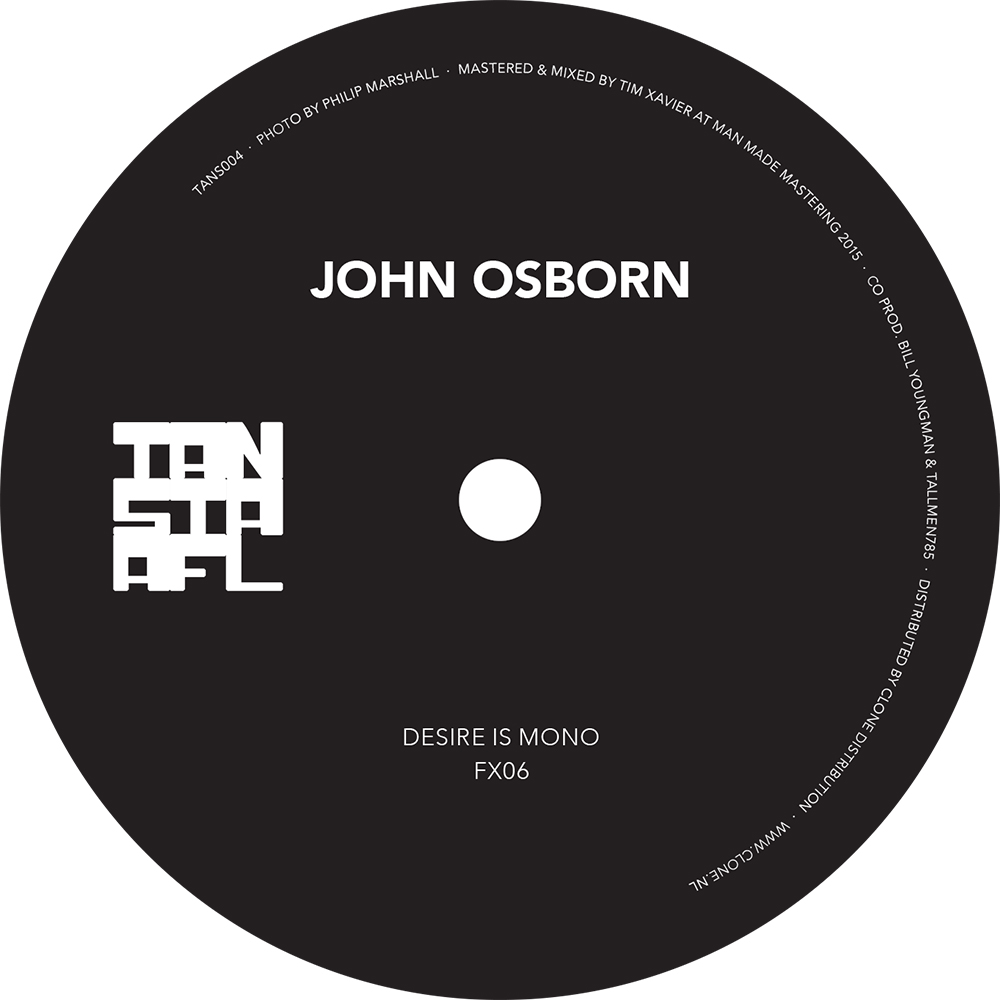
Berlin DJ and producer John Osborn built his name as a DJ first and foremost, with his Sub:stance and Panorama Bar sets achieving somewhat of a cult status among house and techno aficionados. Now with some highly regarded production credentials under his belt, as well as an upcoming headline DJ slot at Amsterdam’s FIBER Festival, the Berlin-based Londoner is really hitting his stride. Osborn once stated that he strives to create a sound that “lives in between house and techno,”and his second solo release, Desire Is Mono—just released on Tanstaafl, the Berlin/Bristol-based label Osborn runs with October and Eric Cloutier—is a true testament to that statement. Like Osborn himself, Tanstaafl manages to perfectly straddle the house and techno divide, releasing four brilliant hybrids since it was inaugurated by Osborn’s debut release, 2011’s Epoch4.
The new record’s title track follows in the lineage of Osborn’s previous releases, but this time sprinkled with a touch of rave nostalgia. The cut opens with an acid-tinged synth line that would feel right at home echoing through an abandoned warehouse, crawling up from the depths before a sledgehammer-like kick drum slams you in the chest. With every pound of the kick, the synth line twists and morphs, never letting up and providing the driving force behind the track. Osborn doesn’t try to overcrowd things—instead, he focuses on the movement of the tune’s strongest elements, with faint, submarine-like pads, loose claps, and skipping hats providing enough variety to ride the track out. On the flip side, “FX06” is pure analog funk: Built around a machine-driven rhythm and gurgling synths, it’s the perfect accompaniment to the bigger-room feel of the title tack. Desire Is Mono might be only Osborn’s second solo outing for Tanstaafl, but it further shows that he’s just as confident with producing body-moving house and techno tunes as he is playing them.
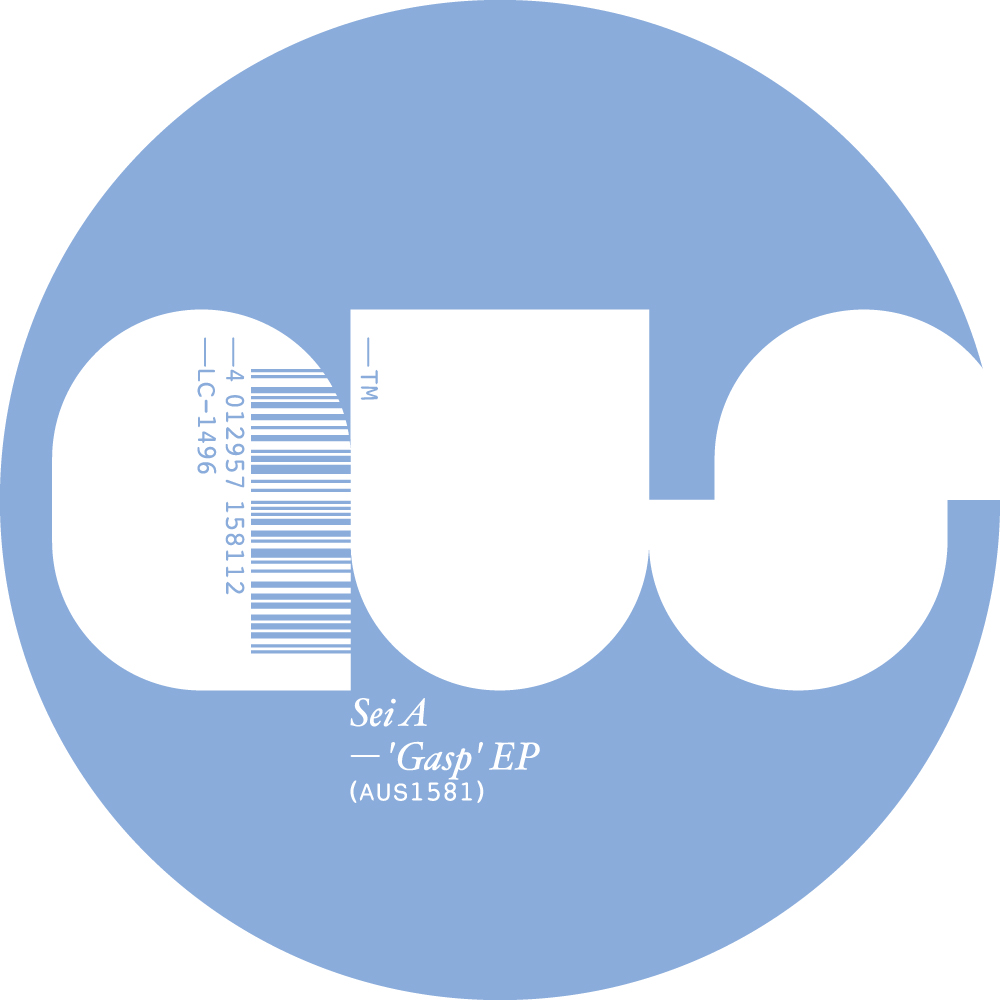
Following on from Bicep’s huge ‘Just’ EP, AUS Music has announced Gasp, the new EP from Sei A. Gasp will be the London-via-Glasgow producer’s first contribution to the label since his 2013 Wants EP and features three club-ready tracks with Sei A’s left of centre touch. Ethereal vocal samples butt up against sharp percussion, with dense textures and mournful chords filling things out. The EP will see release via AUS Music on June 15.
At the end of the month, Phonica White will release Mouth Shut, the new EP from NEVERSLEEP, the collaborative project from Moiré and Disguise—who previously worked together on Moiré’s brilliant debut LP, Shelter. The A side features a club-ready remix of the title cut by Moiré, combining his idiosyncratic vocal chops with hard-hitting percussion and dense atmospheres. On the flip, Disguise makes his first foray into sound, with the visual artist joining Moiré for an edit of “Party girls,” before also turning his hand to “Mouth Shut.”
In support of the release, NEVERSLEEP has launched a website—which you can check out at neversleep.co—featuring the tracks from the EP mixed together and a preorder link.
Taking influence from music, art and culture from across the globe, Roland Klinkenberg’s organic approach to the creative process is a superbly unique one. Over his 25-year musical journey, Klinkenberg has a production catalogue that translates to more than over one hundred releases.
His next release is Construct, a blissful 12-track LP which serves as a culmination of all the sounds that Roland Klinkenberg has explored over his highly-experimental and wonderfully innovative musical career to date.
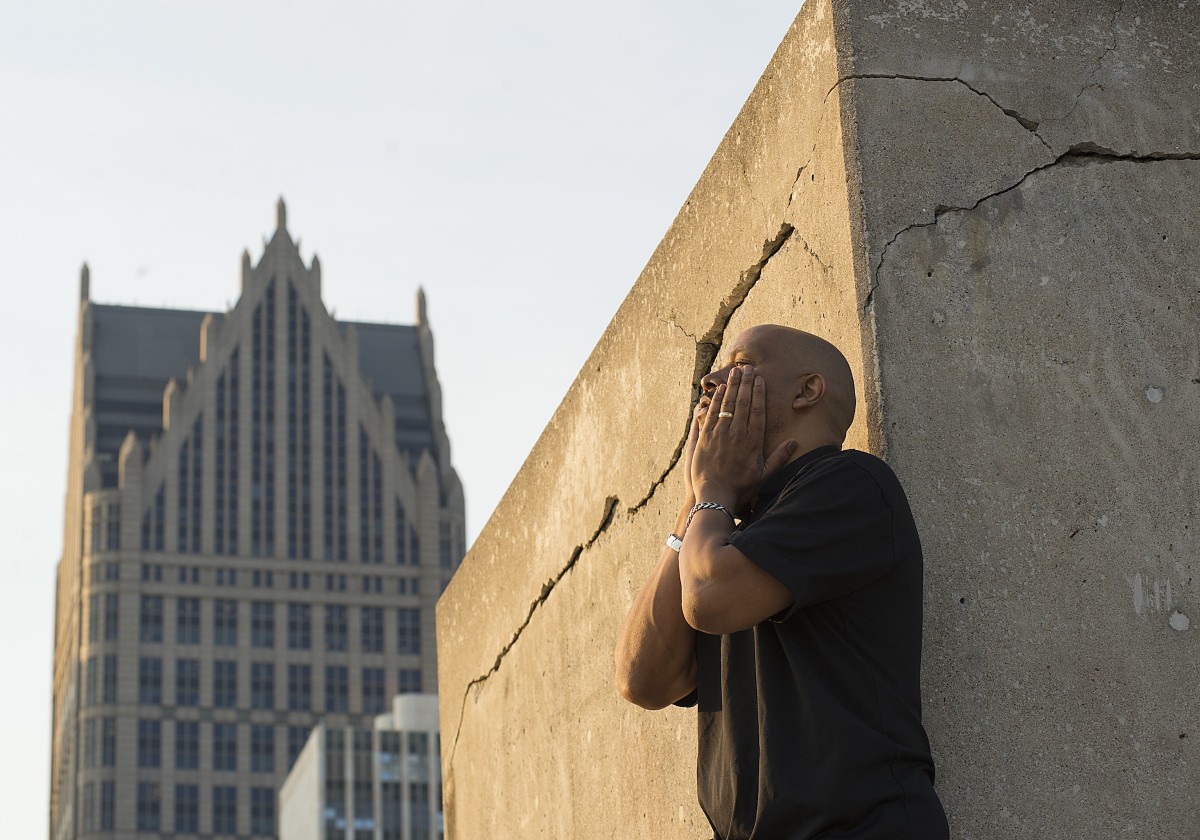
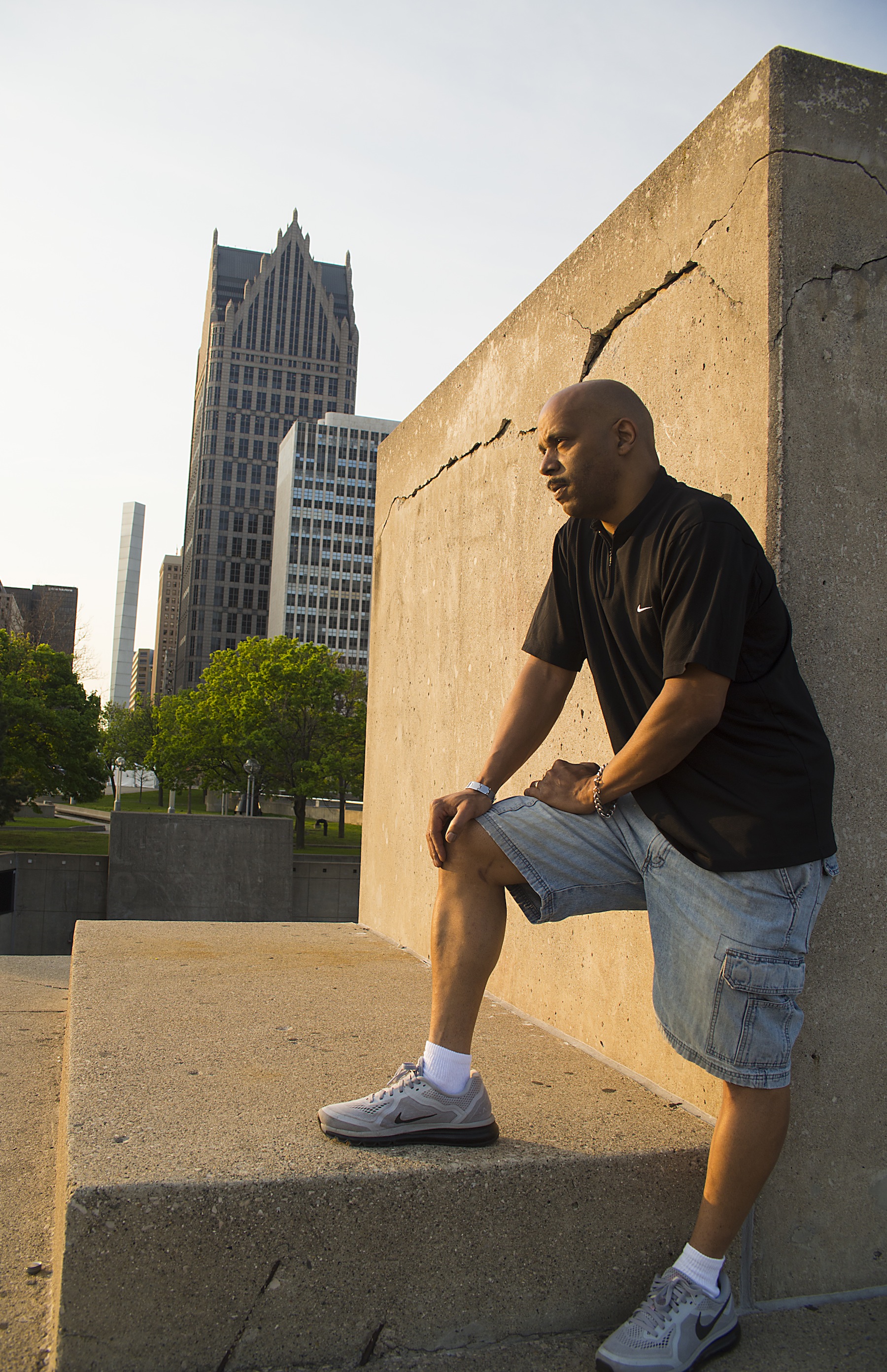
“Oh, you really trying to kick up some dirt,” Detroit’s Eddie Fowlkes says with a laugh. We’ve been talking for 20 minutes, and I’ve just inquired if it caused a rift between himself, Juan Atkins, Derrick May and Kevin Saunderson when the U.K. press decided to run with the “Belleville Three” branding. He’s right to point out that it’s the first mention of Belleville since we sat down. “It didn’t cause a rift for me because I knew where I stand. I mean, everybody knows,” he answers. How, then, did Fowlkes, who identifies as the domino that set Detroit techno into motion, get edged out of the equation—and essentially become a footnote in the very book he helped to write?
“I didn’t get along with Derrick May’s manager [at the time], Neil Rushton,” he explains. “Neil Rushton was an asshole, and Juan said he didn’t trust him. Somehow it came [back to him] that it was me said that, but it wasn’t.” Saunderson had just scored a huge hit with “Big Fun” and “you can’t be bigger than Juan in Detroit at this time.” So, with an ax to grind and the media at his fingertips, Rushton brought The Belleville Three into being. “Everything happened here,” Eddie declares, gazing at downtown Detroit from where we’re perched in Hart Plaza. “So that’s where the European press has got it wrong.”
Perusing the indexes of some of dance music’s most storied accounts—Techno Rebels and Last Night a DJ Saved My Life, specifically—Atkins, May and Saunderson get at least three-fold as many mentions as Fowlkes. Even recent features on Eddie continue to support, in their own way, the arbitrary rhetoric of the Belleville Three; the title of 2012’s “Eddie Fowlkes: The Belleville Fourth” appears to miss the very point the article is trying to make. Roommates with Derrick May for a while in Detroit, and having met Kevin Saunderson—the last to join the crew—in college, Belleville played no part in the techno tale until Rushton said it did. “All I know is Detroit,” Fowlkes sighs.
It seems that’s not the only time the press has misconstrued or reconstructed Eddie’s image. We ask about the context of a quote frequently cited and always attributed to him. According to the quote, he referred to ’90s European rave culture as “cultural rape.” “Are you sure that was me?” he asks. “I think that’s a Derrick May comment. I couldn’t care. Naw, that’s not even me. I embrace the Europeans playing our music, supporting what we do. That don’t sound like me. They got that real twisted,” he insists.
Nor is Fowlkes a fan of the labels “First Wave” and “Second Wave” so often used to describe the two initial thrusts of Detroit techno trailblazers. “I don’t really care for that because it’s like, that’s a part of separation. I think that, in the beginning, we all did it for the love. And when you come with this ‘Second Wave,’ which the European magazines started that, it started to kind of divide who’s better than whom. You start chopping us up, we can’t come together to create this thing that we started. I thought that was kinda unfair. But they didn’t know. They still don’t know.”
“I’ve seen people sell their souls to the fullest extent…they don’t understand that music is a vibration in your body. It’ll make you dance. It’s a spiritual thing.”
He isn’t bitter or begrudging about any of it, though: “God used a certain person to have a snowball effect. And to answer your question again, there’s no rift because I know this was meant to happen,” he reiterates. His story only beginning to surface in the last few years, Fowlkes finally seems to be getting his deserved and long overdue recognition. In 2012 he was honored by the Detroit Historical Museum in their exhibit “Techno: Detroit’s Gift to the World.” Along with Atkins, May, Saunderson, Jeff Mills and Carl Craig—the first three and Fowlkes designated as “Techno Pioneers,” Craig and Mills as “Techno Artists,” respectively—his hand prints are permanently on display in Legends Plaza alongside fellow Detroit luminaries from Gordie Howe to Alice Cooper. At the very mention of it, he throws his hand in the air, instigating an impassioned high-five. “That’s the best thing we ever could have because that’s going to be there forever,” he gushes. “This is something that will keep our legacy [alive].” A few days after our interview, the four pioneers are honored again, this time at the annual Ford Freedom Awards, for their creation of techno.
Fowlkes reflects, “I really think that I’m truly blessed that music chose me. People don’t realize music chooses you, you don’t choose music…[I’m] just glad to see that this whole thing took on the world.” He does identify a darker side to the industry, though. “The sad part is people use it in the wrong way. To down people, just to sell they soul. I mean, I’ve seen people sell their souls to the fullest extent…they don’t understand that music is a vibration in your body. It’ll make you dance. It’s a spiritual thing. And if you don’t have that spirit, you’re dead. And there’s a lot of dead souls behind these so-called, uh, turntables.”
Since his side of the story is still somewhat in its infancy, the CliffsNotes version goes something like this, according to Eddie: He had an intense epiphany at a Deep Space party—the collective formed with Atkins, May, Art Payne and Keith Martin—in the midst of a Cybotron performance. Interested solely in DJing up until that point, he decided in that moment to make his first record. Borrowing equipment from Juan, he trained his ear and taught himself to play the keyboard over a couple of months. The result was “Goodbye Kiss.” Released on Atkins’ Metroplex imprint, it’s distinguished in Dan Sicko’s Techno Rebels as being the label’s “first proper ‘techno’ success.” In the interim, word had gotten back to May and Saunderson that Fowlkes was in the studio making music, inspiring them to do the same.
Fowlkes, who has dropped the “Flashin’” from his name, was the party boy of the posse, admittedly wilder and less focused than Atkins. So the others figured, “’If Eddie can make a record, I can make a record.’” Hence, he was the catalyst for the cosmic new sounds coming out of Detroit.
Despite his impact finally making its way into this seminal saga, Eddie doesn’t seek credit or crave the spotlight. Quite the opposite: He’s quick to recognize the group dynamic responsible for the late-’80s evolution of electronic music. Exuding humility, gratitude and the youthful energy of his flashy former handle, the only thing Fowlkes says he would change, if he could go back in time, is to approach DJing as more of a business from the beginning. Other than that, he’s genuinely content with the way his career has gone. And over Memorial Day weekend, he’s been invited by Atkins to play the Metroplex 30-Year Anniversary Showcase at Detroit’s Movement. How does he feel looking back on three decades of Detroit techno? “You know, I never put a time [or] age to my hook-up because that makes me feel old. I’m not old. I’m young as hell. For real. I’m still young, still having fun, and music is therapy for me, and it should be for everybody.”
Eddie Fowlkes plays the Movement festival’s Metroplex 30-Year Anniversary Showcase Sunday, May 24 at 9pm.
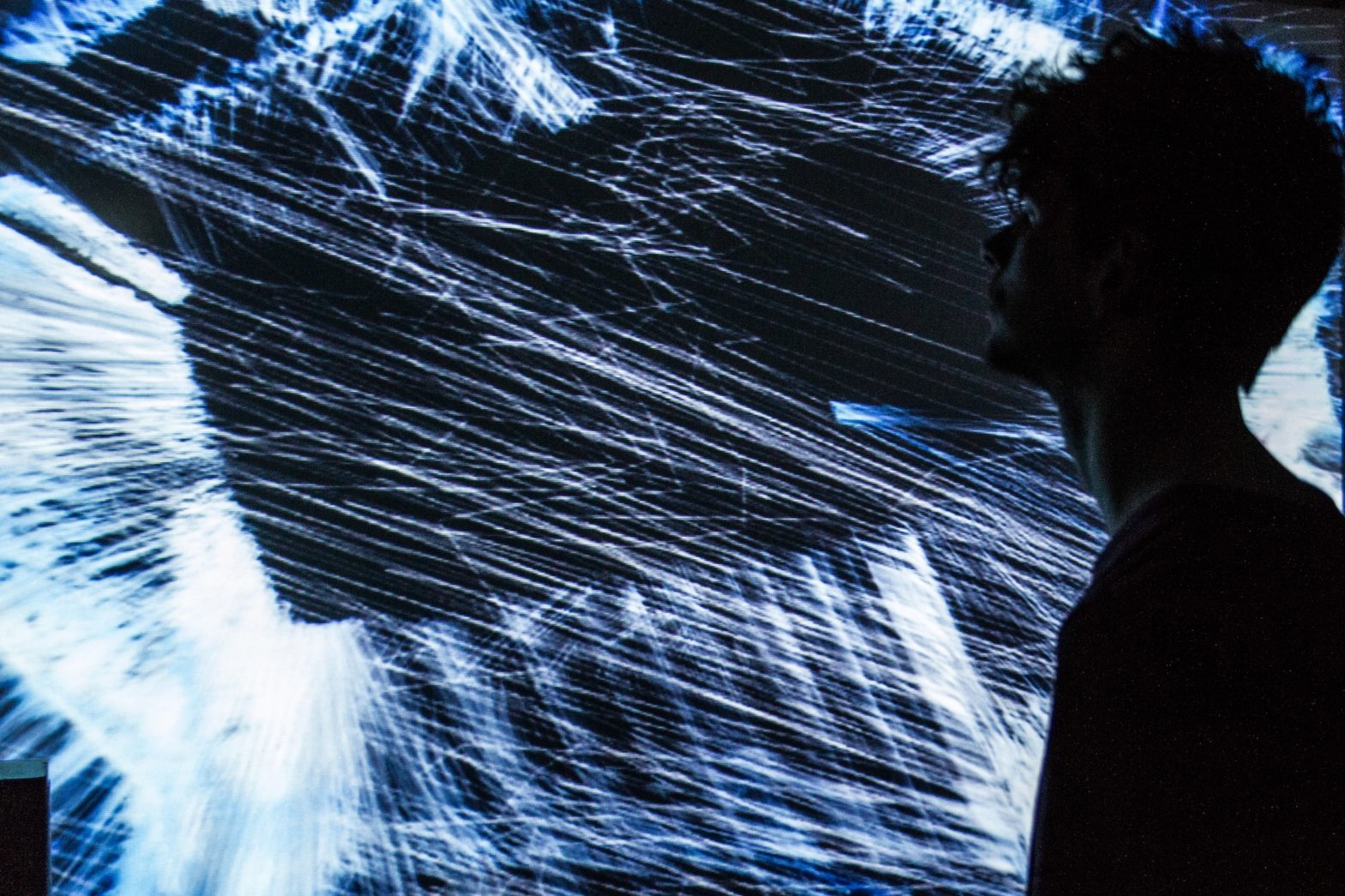
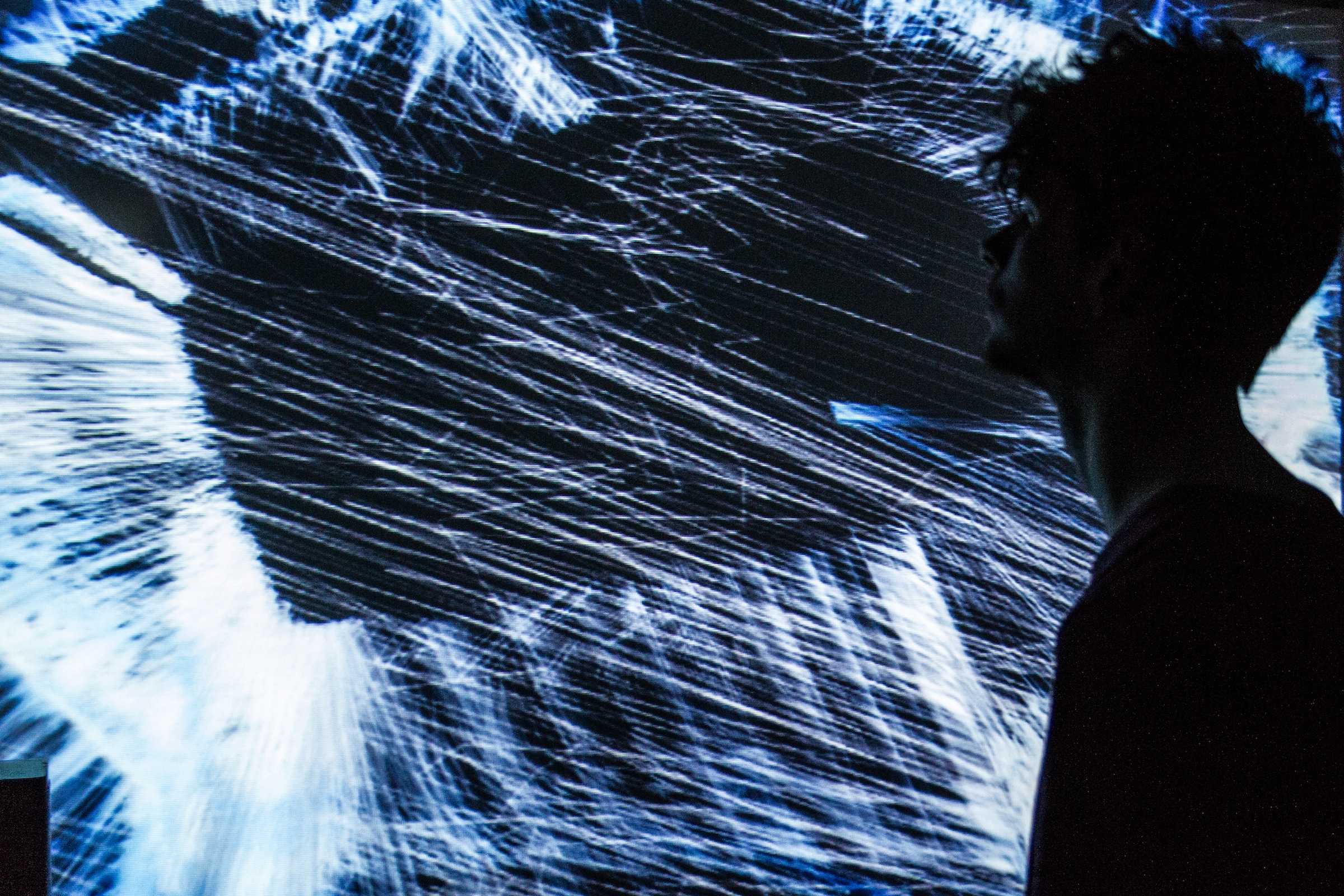
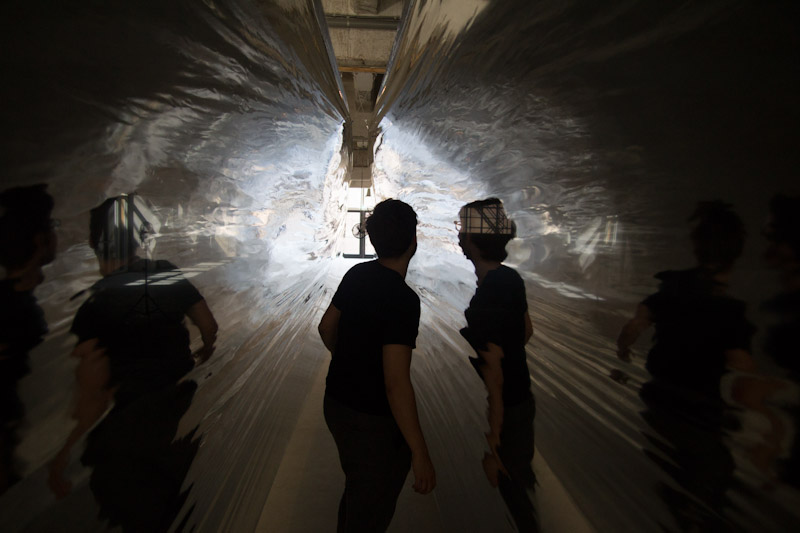
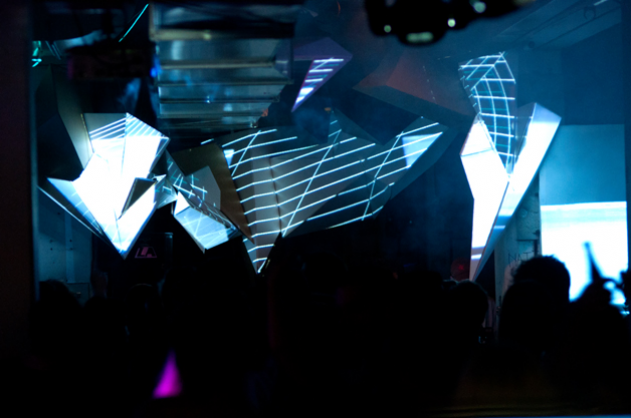
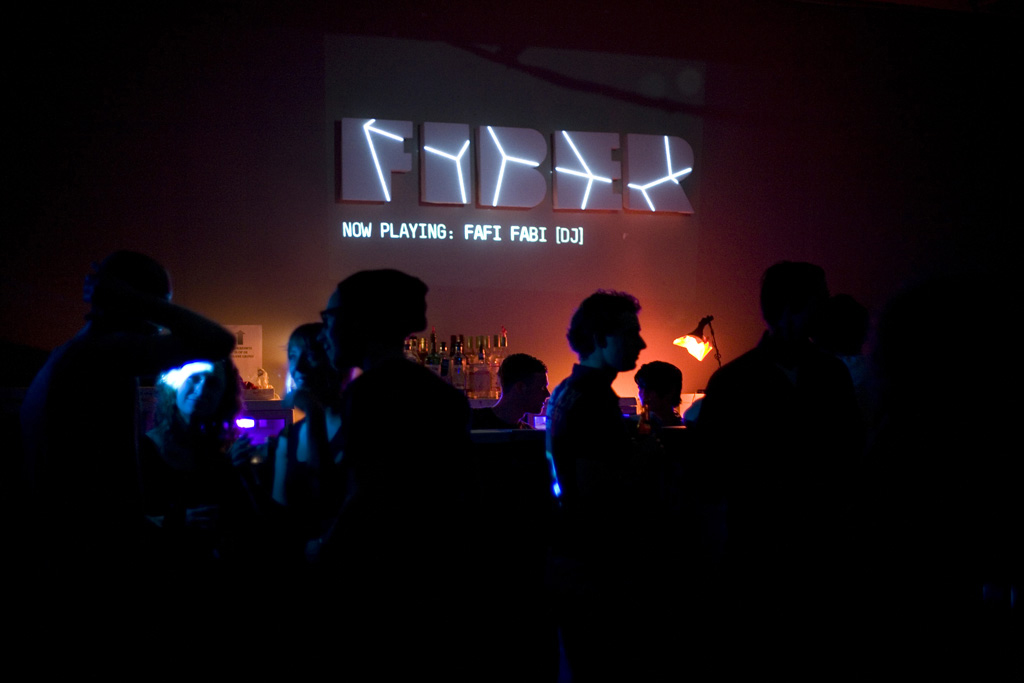
If you are still trying to figure out what to do this weekend, and if you are at all interested in cutting-edge music, arts and culture—and if you’re reading XLR8R, its a safe bet you are—you could do far worse than opting for the third edition of Amsterdam’s FIBER festival. The two-day event, held on May 15 and 16, is focused on “the intersection of audiovisual art, digital culture and electronic music”—and to find out what it’s all about we posed a few questions to FIBER director Jarl Schulp, the festival’s club and visual-sceneography curator Luuk Meuffels, and Arvan Rietveld, the owner of Field Records, an Amsterdam-based label which collaborates in FIBER’s production. And if you if you need yet more convincing, check out the festival’s very cool promotional trailer here.
For those of us who have never attended FIBER in past years ould you explain what the festival is all about? Schulp: FIBER is an Amsterdam-based organization with a strong focus on the synesthesia between sound, the moving image and emerging technology. The festival also explores the artistic potentials of code, software and technology and critically questions their influence on our culture and own perception. It’s a meeting place for creators and admirers of a wide variety of audiovisual and performance art and design.
We founded FIBER in 2010 with a group of like-minded audiovisual artists, designers, and communication/web experts from Utrecht and Amsterdam. Our goal was creating a meeting place for young creators of immersive and atmospheric electronic music and mediated spatial experiences. The worlds of deep and adventurous club music and the visual arts are often separated, but we saw strong connections also presented by renowned European festivals with bigger names. We felt the need for a space for up-and-coming creators—those studying or at the start of their careers—to perform in a professional environment and open up their knowledge to others. We thought of a way to bring them together and this turned out to be a festival that combined performance, stage, and a “lab” environment.
Now, almost 5 years later, we’re active in the curation of events, exhibitions, a regular music podcast, and the support of artists across many disciplines. And with this year’s FIBER Festival, we return to the beginning of our story.
Can you talk a bit about the ethos of Field Records, and describe the collaboration, along with how Field’s ethos that relates to the direction of the festival? Rietveld: Since 2008, Field Records has focused on publishing unique electronic music from a wide variety of artists. Based on the principles of minimalism and modesty, we started the label as a means of providing a platform for Dutch artists, but as time passed we made the step to broaden our horizons and started to invite a selection of global artists for various concepts and formats.
Schulp: We both have a strong interest in the artistic and cinematographic side of electronic music and performative art, always looking for clear concepts and a strong synergy between sonic and visual worlds.
Rietveld: In a way, it’s a choice of aesthetics and—maybe a bit harder to explain—a certain feeling about music. We’re not going for a one-dimensional sound or image. Both organizations seek a much more layered experience, in which an artist experiments with time, space, form and the actual structure of sound.
Schulp: Techno is a common ground, but we also have a great love for ambient. It’s interesting to find this shared interest in a certain grainy & decayed sound, through collaboration with the same local artists. For instance, FIBER has worked together with sound artist and techno producer Robin Koek, who combines field recordings and digitally processed signals. Robin is also one half of techno duo Artefakt, who released most of their music on Rietveld’s Field Records. Another example: A part of the FIBER members are visual artists operating within the collective DEFRAME. They VJed during various Field Records nights in Amsterdam. Without really working together before, we already shared the same feeling about certain aesthetics.
Rietveld: For me this clearly demonstrates that we both present and support a local scene of artists, DJs and producers.
Meuffels: For the upcoming FIBER Festival, we decided to take the musical collaboration in a different direction. The first idea that comes to mind is a dancefloor-oriented line-up. But after we started talking about what we were really missing in club evenings nowadays, we found out it was the “old” and adventurous chill-out space. Throughout the ’90s and until eight or ten years ago, this type of room was an important part of the night experience. Music styles as IDM, chill-out, and downtempo electronics were blended together by highly versatile DJs in an amazing and unpredicted selection. You could discover new music and at the same time have a conversation with someone you just met at the party. As FIBER, we think this is a very important experience we can offer our crowd.
Rietveld: Additionally, the festival’s Field Surrounding series envisages an authentic approach to sound by delivering mixtapes thriving on artistic freedom and quality. This element represent a more open, free-form approach towards the heritage of today’s electronic music and artists, and we believe it is also important to represent these roots in a physical setting. FIBER now offers the perfect setting to us.
There are so many talented and hybrid artists and musicians who are pushing the boundaries of space, for instance, or the notion of an instrument.
Why did FIBER originally choose to produce a festival that fused electronic music and art, rather than just a straight-ahead music fest? Schulp: As mentioned earlier, we have always been drawn to the intersection of art, music and emerging technology. There are so many talented and hybrid artists and musicians who are pushing the boundaries of space, for instance, or the notion of an instrument. What happens to our senses when we’re entering a performative space that’s not purely based on sound? We’re looking for these types of performances, installations, live sets, websites…you name it. And a festival is a powerful tool to bring together those artists who cross the borders of their own practice.
Rietveld: I connect with this idea. Diversity adds to creative richness and offers a much wider canvas for experimentation. Personally, I always consider music in a much broader context to have the right impact. Think of the atmosphere of the location, the acoustics, light design, visuals and how these elements are brought together in a spatial composition. The same can be said for artists that create media-art installation.
Schulp: FIBER is looking for that particular meeting point. So is Field Records in its own way.
Going into the initial 2011 edition, were you prepared for how much work this was going to be? Schulp: We came unprepared—literally, because none of us had ever organized a festival. But all of us had some experiences in a certain domain. I have a background in graphic and information design for art exhibitions, websites and promotional campaigns; Luuk has a background in VJing, stage design and media design. We brought the skills of the group team together, got support from a broader network of befriended artists and companies and collectively made it to the finish.
Back then, I never thought about the amount of work that needed to be done. The energy of the collective goal balanced it all out. Looking back at the first edition I’m still surprised how we managed to translate a digital process —co-creating the festival plans online in Google Wave (RIP)—into a physical one, namely producing the actual festival.
Was FIBER a success from the start? Schulp: In general, yes it was. Of course we have our ups, downs and demons, but this is the way things go. You start something from the heart—and further down the road, challenges in continuity, revenue and collaborations surface. But this is pretty normal for young organizations, I think.
FIBER had hiatus for a few years, in 2013 and 2014. Why was that? Schulp: After the 2012 edition, we all had the feeling we needed time off from the festival format. Diving back into funding applications, the creation of the artistic program, and kick-starting the production didn’t feel like the right thing to do. Furthermore, we all felt we needed a better organization structure to survive. FIBER was brought to life with the goal of organizing a festival, but clearly missed a solid organization. There was simply no time for it.
So after 2.5 years of a festival roller-coaster, we took a break and started thinking of smaller events, which could also provide more space to experiment with formats, artists and partners. This hiatus made it possible to work on a small exhibition at the Netherlands Media Art Institute and afterwards start our new event series called Coded Matter(s). By abandoning the festival for a while we had the opportunity to slowly build a new direction, artistic output and take the organization to a new level.
“Is it still possible to talk about a separate ‘digital culture’ nowadays, or is this just becoming ‘culture’?”
How would you describe “digital culture”? Schulp: Good question, because the term itself is becoming quite problematic, I think. We use “digital culture” as a way to describe the (re-)creation of culture through computational processes and to describe an aesthetic created with digital means. But as the influence of code, automated software and digital networks on our society is expanding rapidly, everything seems to become connected and digital in a way. A major part of the production and distribution of art, design and music is done with digital means. And look at the dawn of the Internet of Things, where all objects, cars, houses, fridges and mobile devices are communicating with each other. Is it still possible to talk about a separate “digital culture” nowadays, or is this just becoming “culture”? For us “digital culture” mostly underlines our exploration of the influence of digitality on for instance art, music, literature and culture in general.
Do you find it advantageous to be doing this event in Amsterdam, which is a city that has a reputation supporting the arts? Schulp: We’re grateful to be supported by local and national funding partners, like for instance The Amsterdam Fund For The Arts. For us this makes it possible to work at the intersection of art and music—and to take some risks. We still need to craft a good balance between experimentation and selling tickets, but with this kind of support it’s possible to do proper research, critically address artistic or technological developments, shape a tailor-made program and present up-and-coming names.
Rietveld: Speaking from our perspective, Amsterdam is acting as a magnet for electronic dance music. Just look at the rise of the Amsterdam Dance Event. During these five days, the city hosts a huge number of club nights, talks, and meet-ups around town. If you start going out as a young resident of the city, it’s possible to see all the big names in a few years. This is also the problem; people expect big names here. It is quite a hassle to promote more experimental programs, because the crowd looks out for big names.
Schulp: With FIBER, we try to balance this and combine influential DJs, performers and audiovisual artists from a niche scene with local names. It is interesting to see there’s also a counter movement, like the ANONYMOUS club night by Viral Radio and Sonic Acts, which took place in Amsterdam last year. Inspired by the ANONYMOUS hacker-movement all the identities of the performers are kept…well…ANONYMOUS. It’s a clear statement against the “headliners culture,” The lineup was presented like this: Anonymous (live), Anonymous (live), Anonymous (live), Anonymous (dj), Anonymous (dj), Anonymous (dj), Anonymous (kunst) and Anonymous (design). The next day the organisation released the line-up and among the great line-up where names like Laurel Halo and Kuedo.
What kind of crowd do you get at FIBER and Field Events? I’m assuming that it’s a bit different than the crowd at, say, Defqon 1. Schulp: First of all, we’re not organizing massive events, so we don’t attract a crowd who’s looking for big names. Our visitors are searching for a different experience and some of them are out to be surprised by unknown artists or musicians. Plus, we attract those music lovers who are in for a unique personality or niche name, like the live set by Convextion or DJ set by Neel.
Next to this, we’re a maker’s festival, which functions as a lab and meeting place. We’re attracting audiovisual artists, VJs, D’, producers, designers, creative coders, instrument builders and—not to forget writers and researchers with an interest in critical reflection on these area’s.
Rietveld: (Electronic) music lovers, people who look at the boundaries and like to experience something different. Therefore, or because of that, our crowd is generally also a bit older. Maybe that doesn’t sound positive, but it actually is.
This edition is subtitled The Subterranean: Exploring Networked Tools and Matter. Can you elaborate on that a bit? Schulp: This year’s theme, The Subterranean—Exploring Networked Tools and Matter—investigates artistic practices that create, navigate and excavate a hidden digital landscape. For us, The Subterranean is a metaphor for the vast network of innumerable computers, cables, servers, robotics and algorithms. We use it to paint a picture of a technological layer that is mediating our perception of the world.
Reitveld: To me, the Subterranean means darkness, exploring different territories. It’s the perfect setting to create an abstract, moody atmosphere for the people who like to be inspired and/or surprised.
Are there any artists who you are particularly excited to see/hear at the upcoming edition? Schulp: That’s a tough one. The installations, performances or DJ sets are, for me, linked together through the festival theme. We’re telling one story here, with different angles and chapters. Every part of this becomes relevant and exciting in its own way, and many connections can be found. The modular synth set by London Modular Alliance—who will perform new parts based on our The Subterranean theme—is in a way connected to the visual coding language vvvv used in the workshop by Berlin-based Christian Mio Loclair. Both are patching cables to route complex systems with unforeseen outcomes. I like these often “hidden” connections within the program.
Also special—we have two performance premieres this year: the AV-performances Divergence by Zeno van de Broek and False Awakening by Microseq. Both guys are from the Netherlands and have worked on their pieces for a long time.
What I’m also looking forward to is bringing all these wonderful artists, visitors and of course our FIBER team, together in the city of Amsterdam. The off-stage part of the festival, where there’s an exchange of ideas and knowledge and new friends are made, is for me just as important and inspiring as the artistic program. Meuffels: I’m pretty much focused on the club night, but can’t really pick a favorite from that part of the program. The artists in the club’s main room all have different qualities which will make a great musical adventure altogether. That’s what makes this club lineup strong I think; they’re all equal headliners with their own role within the musical story of the night.
Also have to say I’m very curious about the way the chill-out room will turn out in general. I really miss this kind of program in today’s clubbing landscape.
Rietveld: For me, Convextion and Felix K always bring something unique. They rarely play in the Netherlands, so this is a great opportunity. I also heard a lot about London Modular Alliance.
And what’s next for FIBER? Onwards and upwards? Schulp: After the festival, we return to our ongoing event series Coded Matter(s). These events are mostly compact evening program with an unforeseen mixture of showcases, presentations, performances and specialized workshops. With CM we’re exploring how code, software and complex systems influence art, design and music. We did one event on the creation of audiovisual instruments with the use of creative coding platforms, and the next one in June is all about the impact of new resolutions on visual culture.
Coded Matter(s) now forms a solid research backbone for the next festival theme, program and partnerships. We’re already conceptualizing a bigger event at the end of the year and this is, in a way, also connected to the preparation for a new festival edition. When this new FIBER Festival will happen is not set. But I have a few scenarios in mind. More important is a longer preparation time to come up with unique collaborations, new performances, adventurous places and to become a strong and valuable hub within our international network.
Meuffels: We’ll continue our podcast series with mixes from artists we feel musically connected with. We don’t just stick to one genre, but try to walk a path through these different styles that makes a great musical adventure.
French house trio Dan Ghenacia, Dyed Soundorom, and Shonky (a.k.a. Apollonia) have been on a fast upward trajectory since they joined forces in 2012. Alongside the trio’s notorious B2B2B sets and productions, they also run the Apollonia label arm—which is now 15 releases deep—putting out top shelf house cuts from the likes of Premiesku, David K, and Daze Maxim; alongside EPs from the label heads themselves.
The next release to land on Apollonia will be the latest EP from Dutch duo Makcim & Levi—whose first EP on Raum Music has been a staple in Apollonia sets the last year. The More Lettuce EP stays true to the label’s sound, with four cuts of gritty tech house aimed squarely at the dancefloor. “Tegel”—presumably named after the Berlin airport—falls in line with the city of its namesake with its grey scale atmospheres, low-slung groove, and sharp percussion. You can stream “Tegel” in full below, ahead of the EP release on May 18.
Night Musik is an alias of composer, producer, and multi-instrumentalist Shub Roy, a collaborator and touring member of Dirty Beaches. For the last two years, Roy has spent countless hours touring across the world with Dirty Beaches, taking him through “from the afterhours of Berlin and Tokyo, to the night trains of Russia and the barrios of Lisbon and beyond.” The result is the birth of his new solo project, Night Musik, and the first full length under that moniker, Transit. Album cut “Eternal” was inspired by the time Roy spent in Lisbon, soaking up the flourishing scene with artists such as DJ Nigga Fox, Marfox, and DJ Maboku. For remix duties, Roy enlisted Canadian experimental collective Yamantaka // Sonic Titan—who Roy used to be a member of—who’s remix recalls the hyper-activeness of footwork as much as it does the heaviness of Japanese psych. You can download Yamantaka // Sonic Titan’s remix of “Eternal” for free below.
As we reported last month, UK house big-hitter Laurence Blake (a.k.a. Citizenn) is to release The Human Interface, his debut LP, this summer via Damian Lazarus’s Crosstown Rebels imprint. With that news came a stream of the album’s lead single, “Tied,” and today a second track from the album has been made available via the Crosstown Rebels Soundcloud page. “Shutters” can be heard on the player below ahead of the release of The Human Interface on Crosstown Rebels on June 29.