We last heard from Usmev in February this year with his rework of Trulz & Robin’s “Adventure,” which saw the Barcelona producer add his club-ready touch to the almost beatless original to great effect. Now, Usmev is back with his latest EP, This Vibe, on Cymasonic Recordings, which shows the producer’s range with a melange of dancefloor focused pieces. Included on the release is “This Vibe (Vocal Mix),” a slamming, vocal heavy track opening with sharp hi-hats and looped chords, progressing into a hard hitting bassline. The EP will see release May 2 and in the meantime you can download “This Vibe (Vocal Mix)” for free below, with the “This Vibe” also streaming in full.
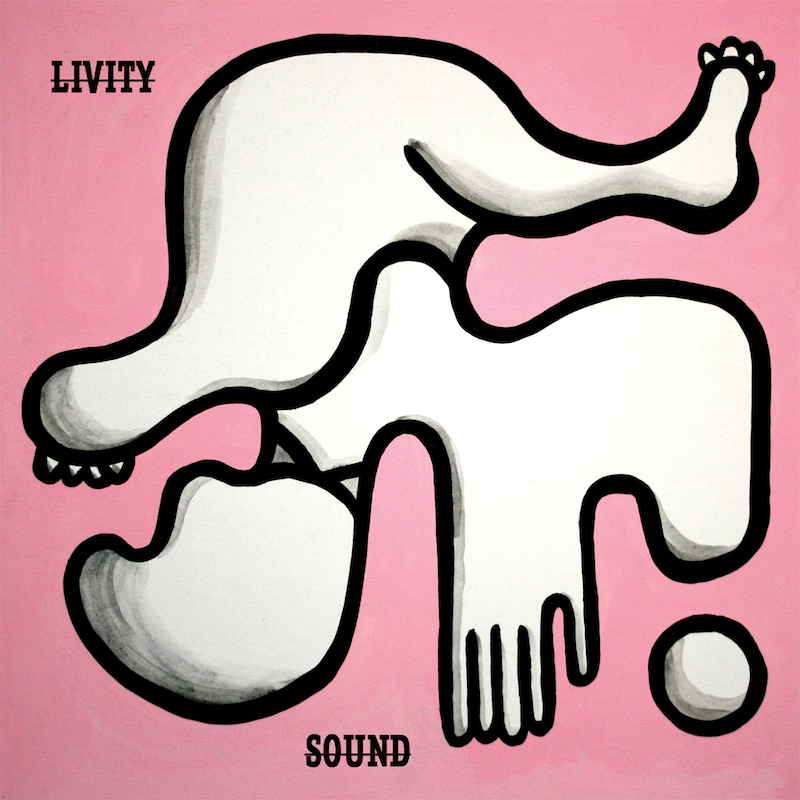
Pev & Hodge are set to deliver Bristol outpost Livity Sound‘s second release of 2015. The arrival of the two-track 12″ on May 11 marks the pair’s first collaborative outing since 2013’s Bells EP, although both have remained active in other solo and shared projects. According to a press release, the record’s two tracks are the result of jam sessions between the two producers, and are described as “frenetic, intense, and fully Livity Sound in style.” Hear previews of title track “21 Versions” and b-side “What Your Heart Knows” below.
Sónar has unveiled the final batch of artists scheduled to appear at this year’s Barcelona edition in June, making the 2015 line-up complete. Joining an already stacked festival bill that includes The Chemical Brothers, Duran Duran, FKA Twigs, Arca, Autechre, and more is Nazoranai (the formidable trio of Keiji Haino, Stephen O’Malley, and Oren Ambarchi), Barcelona favorite Pional, hip-hop producer Just Blaze, and Koreless, who will appear with visual artist Emmanuel Biard. James Ginzberg of experimental duo Emptyset will premiere a new A/V work with French artist Joanie Lemercier, and Evol and Davic Nod will play as part of an Editions Mego showcase.
Sónar runs from June 18–20; for a complete festival lineup and ticketing information, head here.
‘Real Talk’ is a series of artist-penned essays that appears on XLR8R from time to time.
This installment’s scribe is producer Kevin McHugh, the man better known as Ambivalent. McHugh’s production career began in 2006, when his ‘Roomies’ EP came out on Camea’s Clink label—but it was the following year that changed his life, with the release of “R U OK” on Richie Hawtin‘s Minus. The skeletal, late-night tweaker of a track was massive, and established McHugh as one of Minus’s mainstays. In 2012, after feeling a bit constricted by the techno label’s sonic template, McHugh amicably parted ways with the label; since then, he’s unleashed his inner househead via his Amber persona, served up some tasty techno in his LA-4A guise, and put out an nice array of fierce electronics (from Matrixxman, Alden Tyrell, himself and others) via the Clone-distributed Delft label. And he’s not done yet: his even newer label, Valence, just sprang into existence with the release of an excellent Ambivalent three-tracker. This essay sees the Berlin-dwelling artist posing the age-old question: Just what the hell is a DJ?
If you ask sports fans, they can tell you in solid detail about the rules of the game they love. Most of the time a squad of players move something from one end of a rectangle to a small portal on the opposing side of that rectangle, similarities abound. The differences are what define the games. Move the ball with your feet: That’s football. Pick it up and toss it: That’s rugby. Put it on a wood court: basketball. Put it on ice and it becomes some brutal thing where white people with sticks forfeit blood and teeth.
A slightly more vague set of boundaries define styles of music. I don’t want to wade into examples of what puts a track in or outside the box of what’s techno or house. But suffice to say, most fans can agree on how to classify whatever they’re currently hearing. The more subdivided the classifications, the differences become more nuanced. Still, most can agree on basic stylistic differences.
But what a lot of electronic music fans can’t seem to agree upon is a really simple, albeit fundamental question: What is DJing? More crucial: What is not DJing? The term wasn’t exactly simple at its inception, but it’s only gotten harder. The bounds are being tested all the time, and they seem to shift—not just moment-to-moment, but in how they’re applied to any individual DJ. Lots of tech riders include laptops or CDJs. As far as I know, only one includes cakes.
To wade in slowly, I’m going to say we have to cut a higher standard than “DJing is anything done by one who calls themselves a DJ.” The diplomatic definition might say that it’s any time a person presents a sequence of recordings to create a collective effect within the listener…yeah? Sounds pretentious, like an art-school homework assignment.
But you’ll also have to excuse any of us who hesitate at the notion that DJing is exclusively achieved by layering vinyl discs in the same tempo. Yes, that’s my personal introduction to DJing, one of my favorite ways to play, and it’s the origin of dance-music culture. But it would exclude Theo Parrish, who can sometimes forego beat-matching in order to play the best selection, or Function, who has played blistering sets of angular techno from a laptop. No fan of the art would begrudge either man his due as a Real DJ.
So what does Paris Hilton do? (Note to self-—bumper-sticker idea: WDPHD?) I’ll anticipate your response and follow up. If she’s not a real DJ, what does a real DJ do?
Full disclosure: I’ve faced the question myself. Lately I choose to play with Pioneer CDJs in clubs, and vinyl at home (if you’re asking: There’s not a chance I’m trusting one of 200 extant copies of a prized record to the geniuses at Easyjet. Current Discogs prices mean replacing my collection would require selling all of my organs—yes all of them). Previously, I spent time lugging multiple computing platforms and lengths of cables through clubs, airports and hotels. Before that I played what I called “live” but was far less “live” than my DJ sets. For a while I used the multilayered approach with lots of interlocking loops and tracks, but ultimately realized that my job was more about letting the music do its job.
Seeing KiNK play live—using vinyl, computers, machines and a lot of adrenaline—will frustrate any definition of the boundaries of DJing (or live music in general). Great artists can often do that. Is he a DJ? Certainly. Is he simultaneously many other things? Absolutely.
Maybe the technical questions are too murky. Let’s skip the question of how a DJ does what they do. I still have to ask, what does a DJ do?
Let’s talk about the music a DJ decides to play. I’ve heard a lot of fans and colleagues talk in awe of DJs who play “their sound.” I have to admit it’s something I hadn’t encountered as much when I started, but lately it’s a marker of a massively successful DJ to play several hours of records with a single constant groove, sonic signature, timbre and energy level. Many of the artists I once followed for their ability to manipulate a crowd through twisted, bouncing hours that resembled a motocross track have recently switched to bringing listeners over a flat autobahn through a cornfield. (No judgements,—some cornfields are transcendently beautiful). Others still carry the banner for the polyglots and omnivores—those who want music of many colors placed in elegant order, with a sommelier’s touch for vintage, provenance and taste. Is one of these a better model for DJing?
A word I keep hearing lately is “uncompromising.” It flatters anyone it’s applied to, as I think most of us in the modern era believe art is made in a hermetic womb indifferent to the outside world. But nightclubs aren’t museums. Is a DJ meant to present his or her vision of music regardless of who’s listening? Is the DJ expected to have a single, unbending vision, ruthlessly applied in any context? Conversely, how far should a DJ adapt to make an uninterested room start dancing? Maybe this is all theoretical bullshit, but I’ve faced it personally when looking out at a room of dancers and wondering about the limits of their expectations or patience. I’ll just say I’ve been both pleasantly surprised at times, and sorely disappointed at others.
I recently played at Berghain, a room famous for a very specific brand of techno, under my LA-4A alias. I had to think a lot about how the expectations of that room fit with what I wanted to present under that alias. I ended up digging out records I’d owned for 20 years, rare gems I’d forgotten to play, and some classics every DJ loves. The balancing act went both ways—some moments leaned into expectations, some went completely against the grain, and I felt the crowd was with me the whole time. At the end, I felt like I’d rediscovered my roots as a DJ. Finding the intersection of my ideas and the audience’s desires made me a better DJ, but it ruined my chances of being called “uncompromising.”
Another variable thrown into this mix of questions is: how has the definition of the art form changed over time? Last year, the venerable legend Derrick May lamented on Twitter about the way the scene has changed.
XLR8R Couldn't find the embed function for type: "twitter" and source: "".
“>September 19, 2014
No one would ever doubt the art of DJing embodied by Mr. May, nor would many DJs, young or old, withstand a comparison to him. I’d contend that he’s one of “today’s DJs”—he’s certainly not yesterday’s—and he’s still got the gift. I was lucky enough to play before him earlier this year; it’s clear he’s not resting on his laurels. Whatever time or planet he came from, he can smoke 99 percent of DJs. But how could we compare a young DJ to those who started before he or she was born? If two DJs play the same party, one who’s 23, the other is 50, which one is “today’s DJ?” Experience counts for a lot in this culture, but it’s not everything. For every young hack with 100,000 Facebook fans and laptop full of stolen mp3s, there’s a feckless senior living off what he did during the Reagan administration. Young and old DJs can suck, regardless of age. More importantly, every year a bumper crop of fresh DJs arrives, dedicated masters of their craft, and every year we hear stories of once-bright stars who burned out. Let’s agree that of all the confusing criteria for who is a DJ, age is not a factor.
So far I’ve asked a lot of questions, and maybe the guy who calls himself “Ambivalent” can’t be expected to take a single position in a debate. But why don’t I take a stab at answering them from my own subjective viewpoint. It’ll make for better sensational context-free pull-quotes.
First up: if you’re worried about Paris Hilton, Guetta, or any other mainstream Gollum corrupting your art form, then you’re probably already swimming too close to their boat. Yes, what they do is DJing. No, their version of DJing will never affect what happens in record shops or on Sunday mornings at Berghain. When punk went mainstream, no one confused Blink 182 for Fugazi; the latter cast a longer shadow and far outlived the former. Of course, the money went the opposite direction, so choose wisely.
Next question: what does a DJ use? The only people who should know which gear is used in the booth are the DJ, and the club’s sound technician. I guarantee that the most important information about a DJ set can be ascertained with your eyes closed and your body moving. I’ve always said that DJing is like sex—if you like it, you’re open to every available technique. Some techniques are awkward, others are easy; some are reliable classics, others require devices and tech support…and all are sufficiently documented on the internet. Do your own research, practice at home.
The next one is stickier, and I’m probably on the edge of getting in trouble here, but fuck it. I think there are two kinds of listeners: those who want what they expect, and those who want what they don’t expect. I am a nerd, and when it comes to entertainment, I’m a masochist. I want a band to play the obscure album cuts, I want a DJ who will make me twist my face like I smelled something awful. I won’t argue with the notion that playing to 10,000 people, threee times a week, 150 nights per year might require a certain streamlining, some smoothing of the edges. Andy Warhol said he loved Coca-Cola because “it tastes the same everywhere you go.” Things worked out well for Coca-Cola, and for Andy. There seems to be a heated contest for becoming the Coca-Cola of techno—everyone’s working on their “brand.” I wish them all success, they understand business in a way I never could, and to the victor go the spoils. I just prefer more surprises.
So to answer the big question—what does a DJ do? While there’s no definitive answer, and everyone’s answer is different, here’s mine:
I want to hear a DJ who loves the music I love and loves the music they play; who plays records I know and records I’ve never heard; who will play an mp3 or a dusty 45 if the moment is right; who cares less about having a “sound” and more about what they hear; who chases records to collect them as much as to use them; who listens to their audience as much as the audience listens to them; who never stops trying to achieve something and never rests on what they’ve achieved; who puts less focus on where they’re from, and more on where they are.
My answer to the question is this: a DJ is someone who plays music beautifully.
And I am pretty sure that can function independently of Coca-Cola.
Apron label head Steven Julien (better known as FunkinEven) will release a new EP as St. Julien later this spring. Apron started as an outlet for Julian’s own productions, but has expanded to include a corps of likeminded artists such as Seven Davis Jr., Lord Tusk, and new signee Brassfoot; it also scored a top spot in XLR8R‘s roundup of 2014’s best labels. As Resident Advisor reports, Julian has recently taken on production work for hip-hop artists like Earl Sweatshirt and Alchemist, following collaborations with Jay Daniel, Delroy Edwards, and Kyle Hall.
Entitled A16, the new record features a joint track with Budgie, who cropped up on Theo Parrish’s Wildheart imprint in 2014. Julien is also reportedly at work on a FunkinEven full-length, which should arrive sometime this year. A16 lands on May 18, and until then, a stream of EP cut “Evenbud (feat. Budgie)” can be heard here via RA, while the record’s complete tracklist has been posted below.
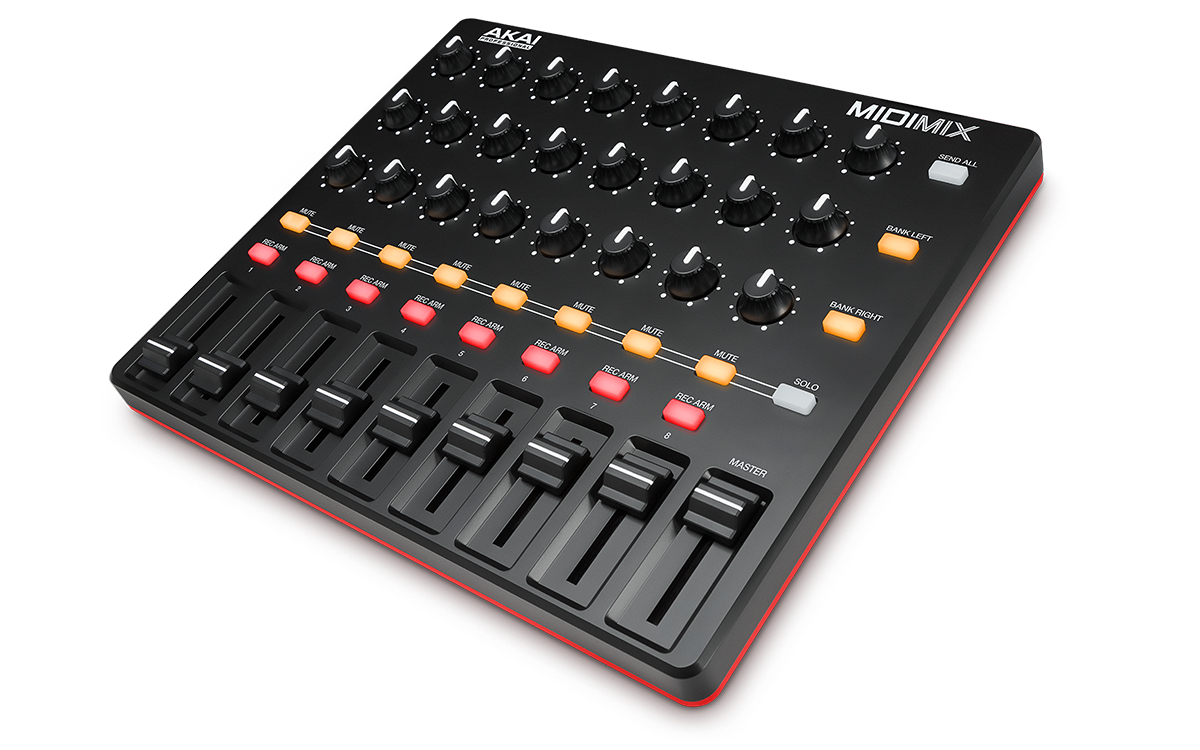
The MIDImix is a compact high-performance mixer that has the ability to control virtually any Digital Audio Workstation (DAW) with the press of a single button. The unit features eight individual line faders, each with three performance knobs, and two buttons for arming, recording, and muting the channel, as well as a master fader. It aims to give musicians an unparalleled, portable mixing solution for their projects.
If there’s one thing that can be said about the Netherlands, it’s this: Dutch people really know how to party. And importantly, they understand how to put on a party properly.
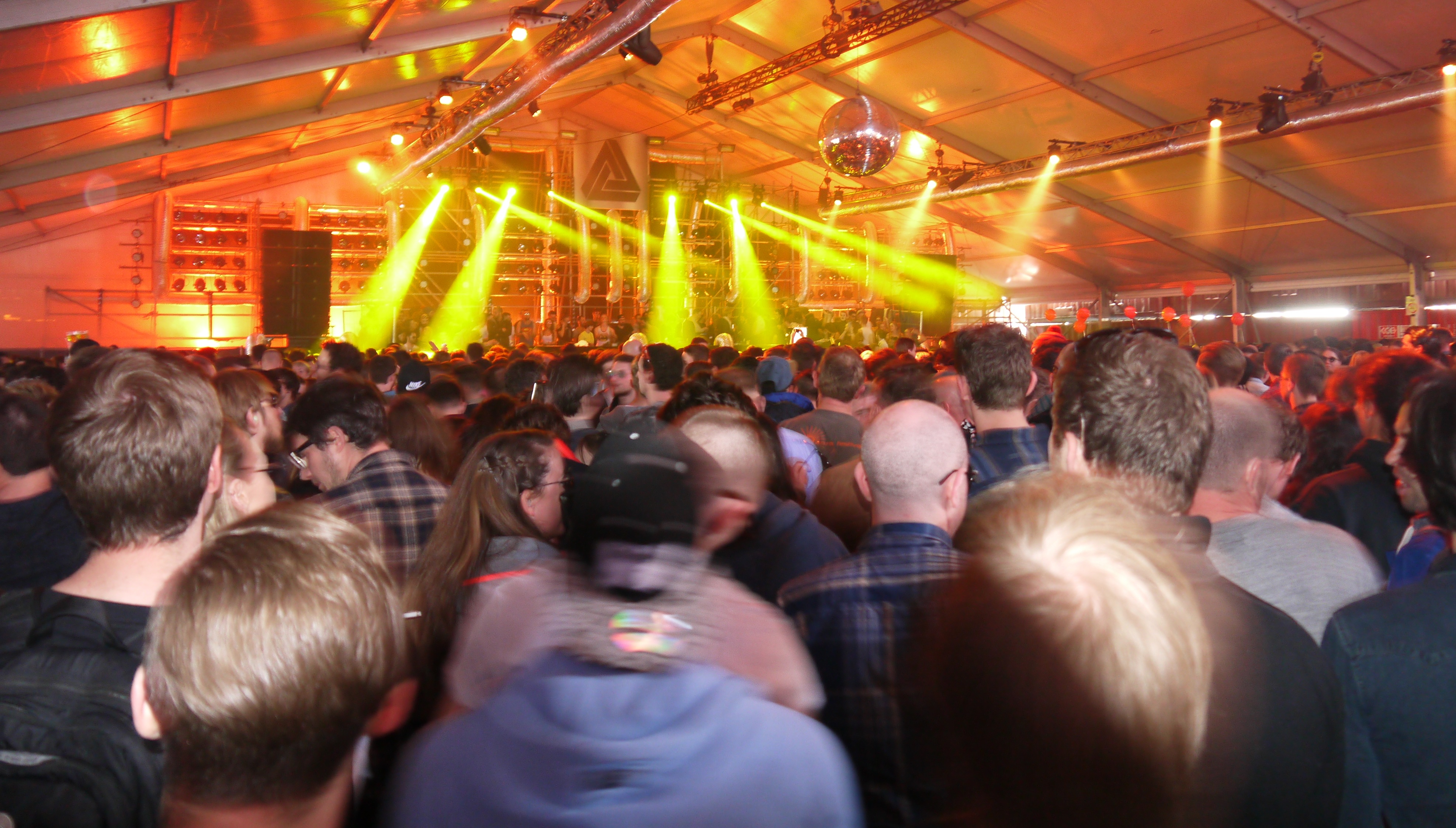
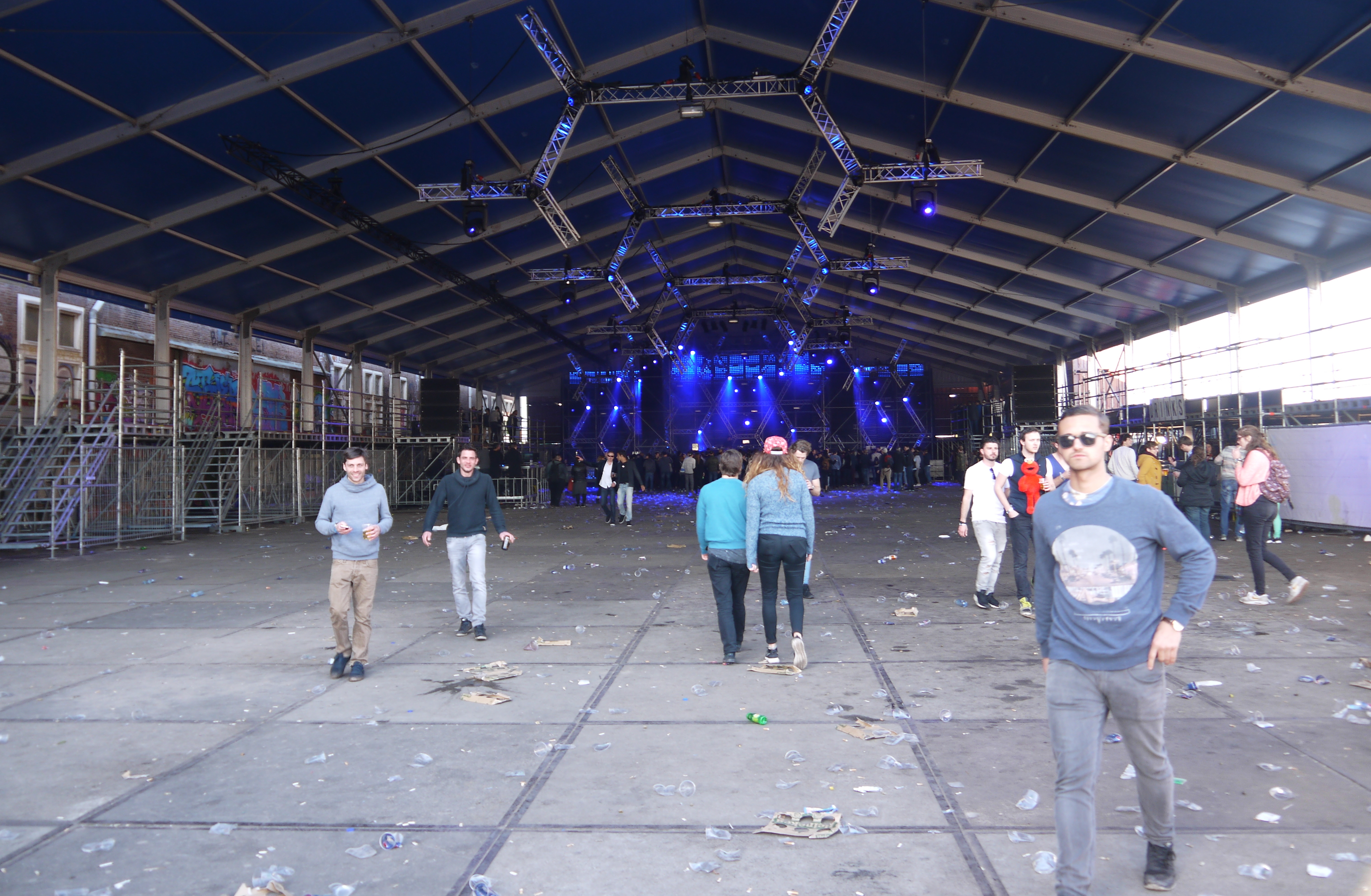
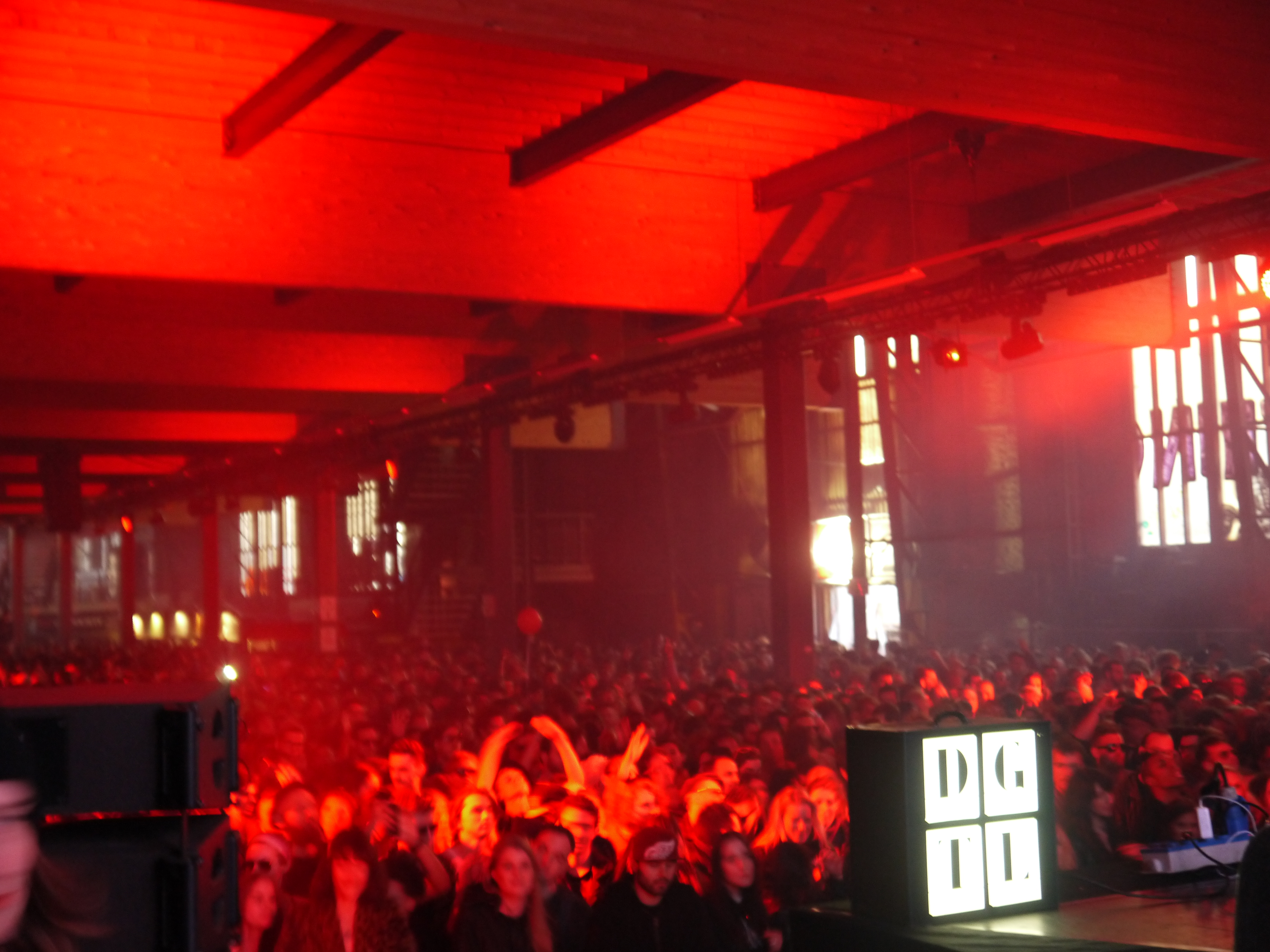
Easter weekend saw the great and good of clued-up electronic enthusiasts descend on an abandoned shipyard in north Amsterdam for the country’s first festival of 2015, and things went off with a bang. Spanning Saturday and Sunday, with after-parties each day and a smaller opening bash on Friday night, DGTL was serious about music, production, sustainability, and dystopian aesthetics; at times it felt like Escape From New York: The Rave Cut. We went, saw, heard, enjoyed, and—until a disgustingly early flight home on Monday morning just hours after our last moments on the dancefloor—conquered. After picking up the pieces, here are ten things we feel compelled to write home about.
The location alone is worth visiting.
NDSM Docklands is a stunning setting for techno—of which there was plenty. During the lengthy ten-day set up more than 200 shipping containers were brought to the site, some of which would eventually form venues for the music.
It was industrial to the core—while we’re not always fans of huge warehouses, in this instance these settings worked, and the whole area was cleverly used (not least positioning Red Bull Music Academy Radio at the top of a crane overlooking the entire area). Meanwhile, with those after-parties taking over from 11PM at the same location, if you were powering through until morning it didn’t take long to reach the next destination.
In terms of overall festival experiences, DGTL was hard to fault.
DGTL ranks amongst the most fun we’ve had in the last 12 months–and definitely the most fun we’ve ever had in a place once used for the loading and unloading of goods from boats.
In addition to laughs, of which there were plenty, the execution was impressive. The standard of food was high, with everything from real burgers (i.e., not frozen suggestions of beef) to fresh pizzas available. The sound systems in every area were good, albeit not mind-blowing. The atmosphere from start to finish was truly infectious; smiles, handshakes, hugs and shared medicines. Oh, and thanks to a moneyless payment system involving topping up innovative smart-wristbands, we can’t really remember queueing for very long- whether at the bar or obligatory sausage stand.
Interactive sustainability is a real thing here.
OK, so festivals with an environmentally aware policy are nothing new, or indeed particularly unique. Nevertheless, DGTL’s approach to not causing much of an impact on the environment was impressive.
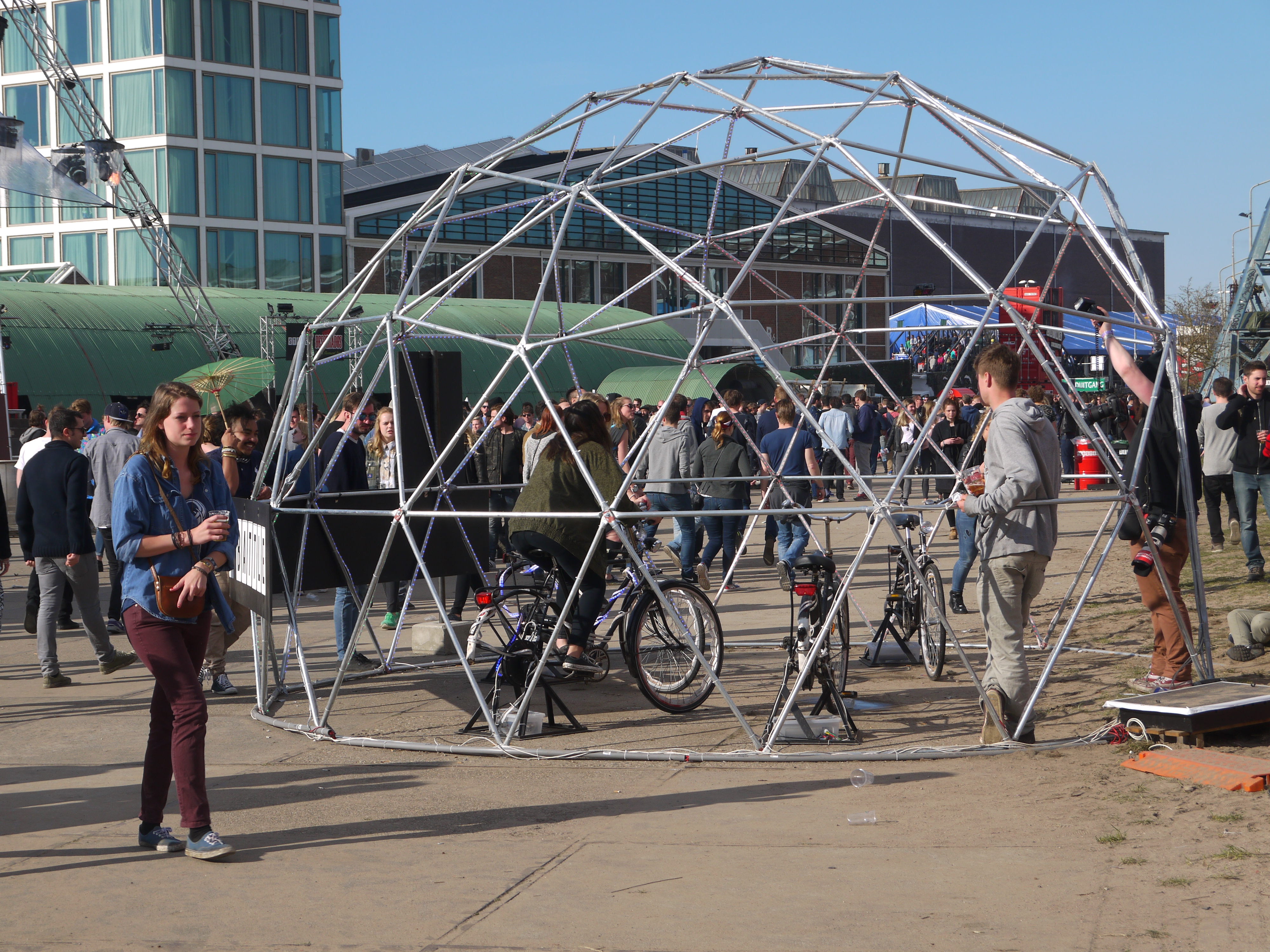
Billed as DGTL Revolution, the organizers were actively experimenting with a variety of power sources over the course of the weekend to gauge which worked best. These included wind turbines, a hydro-pumping station, solar panels and a human power station whereby passersby could hop on an exercise bike and, using the revolutions of the wheel, generate their own electricity. Meanwhile, the Electric Hotel—basically a place to charge your phone- was similarly running on renewables, and very useful at 10PM.
Happa is a name you should remember.
It’s safe to say we heard some solid sets during the course of our stay, but first prize has to go to the ridiculously enjoyable and refreshingly varied U.K. upstart, Happa. Finishing off the Stereo stage—a.k.a. a wrought iron bunker—on the final day needed something special, and Happa was it.
Following an intense and slightly garish introduction—from both an enthusiastic guy on the microphone and one hell of a huge synth and snare build—Truss’s “Brockweir” opened the scoring for some heavy-duty rave-accented techno, riddled with clanging noises and cerated high hats, broken electro drops and bassbin shaking dubstep builders like Tessela’s “Gateway“—concluding with some nifty EQ work, tearing up staccato kicks in a way that left us wanting much, much more.
Michael Mayer and Roman Flugel, minus the sun.
It should have been one of the busiest sets of the weekend- three hours from Kompakt hero Michael Mayer and fellow Germanic heavyweight Roman Flügel. But it didn’t quite work out as planned.
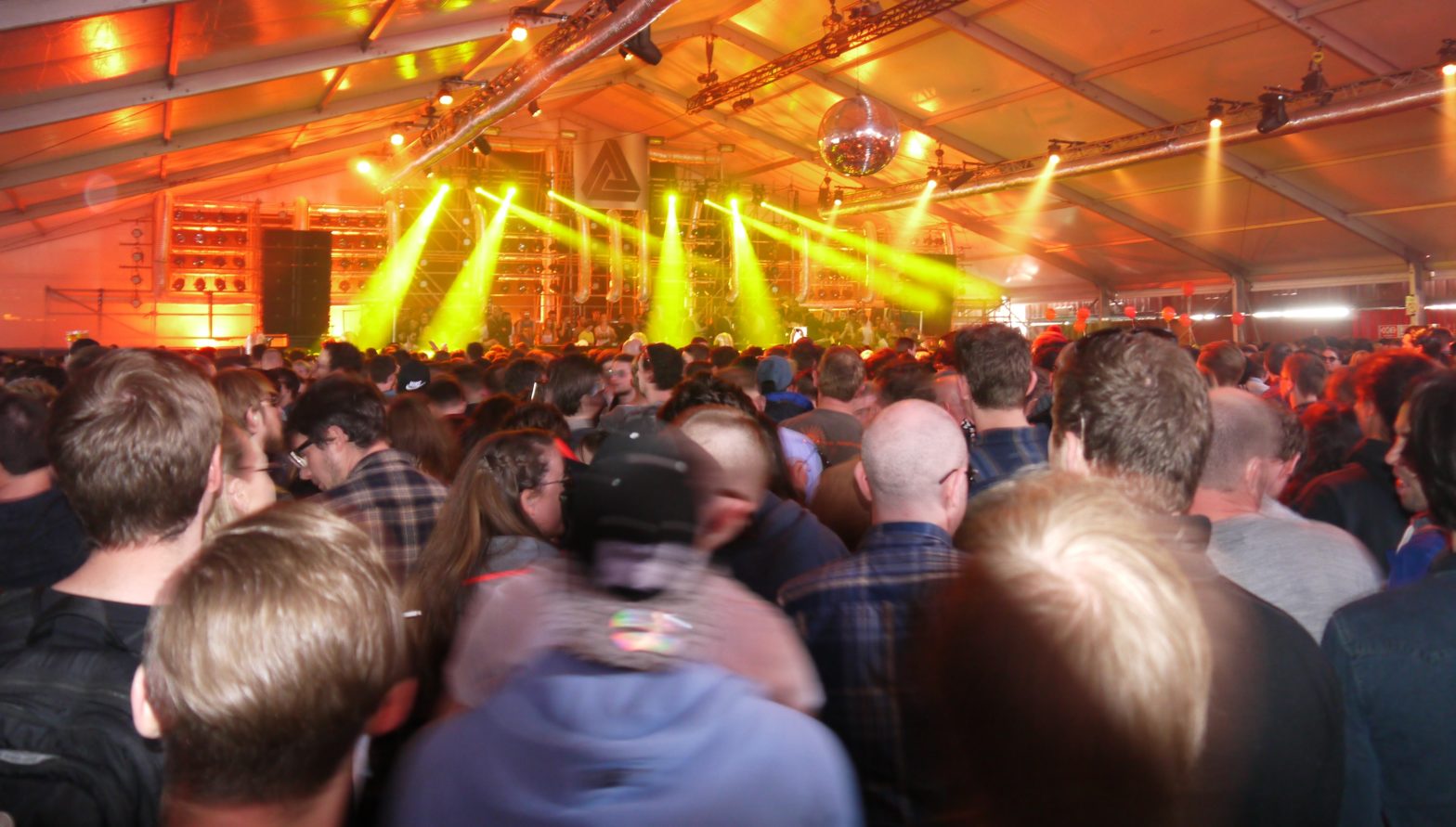
The pair were playing the huge Digital stage, which just 24-hours before had been heaving from front to back. Thanks to the canvass covering, though, and a surprise appearance from the sunshine, we arrived to find it largely empty, with most people standing outside, just in earshot, enjoying the rays. Nevertheless the duo persevered, slowly drawing listeners onto the dancefloor with wonderfully infectious percussive numbers, finishing up with a sizable crowd losing their minds. All good then.
Phono Stage, from start to finish, on Saturday.
Although it’s never a great idea to stay in one fixed spot at a festival boasting six arenas, each with several highlights on their respective bills—not least because it means you can’t go to the bar, or the toilet—we’re always pleased to see a line up that’s so good you could easily choose not to move, if the mood took you. Such was Phono on the first day.
By the time we got there Locked Groove was in charge, and living up to his name with a range of funky but banging tech house stompers that represent the antithesis of the subgenre’s throwaway pap; think Mr. G–in-looped-vocal mode. From there we were treated to Amsterdam’s own Steve Rachmad; a live performance from CW/A; the ever impressive Boddika with a set defined by Impact Units’ Tenshin; followed by overall show stealer Makam, who outdid the lot with an array of big-room-yet-heads-down, U.K.–bass-leaning monsters. In short, whoever was responsible for the programming here needs a substantial bonus.
The artistic side of the event was, in a word, mental.
As we already pointed out, DGTL puts an emphasis on aesthetics, and 2015’s edition lived up to our expectations. Which is probably putting it mildly.
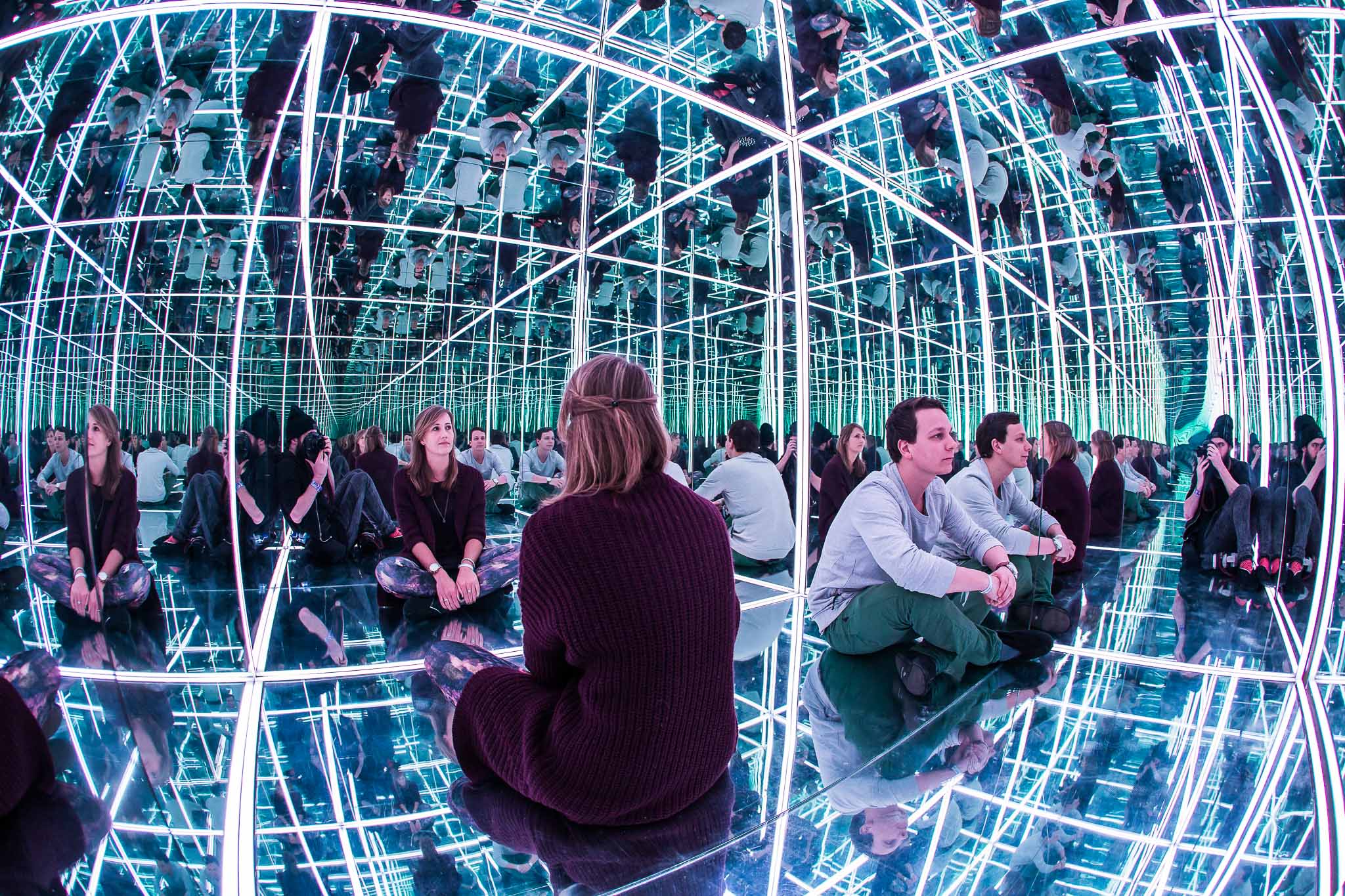
Dotted around the site was a perpetual pendulum, known as the Chaosgenerator—created by the winners of the festival’s Kinetic Art Pitch competition, which ran on wind; the Hypercube (pictured), open for anyone to sit in and feel like a character from Tron, and a fire-breathing mechanical dragon that played some pretty weird music. This is in addition to performers using CCTV puppets, the human disco ball Bella Berlin, and more.
Maceo Plex deserved to close his own room.
By the time the Ellum bossman took control of the booth in the arena his organization was hosting, the words “hot,” “packed,” and “sweaty” best describe the scenario. Although perhaps a little too hectic if you suffer from claustrophobia, enduring the chaos was well worth it.
A combination of notably progressive-leaning house and deep but driving numbers ensured what we saw of his three hours definitely impressed. Stand out moments like Poni Hoax’s Hypercommunication or, with its sparse ambiance and moody vocals, Plex’s own remix of WhoMadeWho’s Heads Above pretty much summarize how it all went down musically. Meanwhile, our damp t-shirts were proof of the energy inside.
Recondite’s apparently effortless live show.
It’s always impressive to see someone playing live properly. Recondite did just that in the Innervisions room (or shipping container) for 60 minutes on Sunday afternoon.
Despite this meaning missing the good weather outside, there could be no complaints. Going at it with a full hardware kit may be the latest way to show people you’re “serious about music,” but rather than this being another pointless exercise in knob-twiddling—only achieving what could be done through a laptop anyway—it was a real display of musical pedigree. From space-age synth melodies ringing out on a MIDI keyboard, to drum machines emitting the kind of toughness that can ruin subswoofers, the performance seemed fully impromptu (though in reality it was undoubtedly meticulously planned).
After-parties we wished would never end.
Thanks to the relatively intimate size of DGTL and the huge Scheepsbouwloods after-party venue, carrying things on into the early hours wasn’t a problem. Luckily, anyone who had chosen to ‘camp’ in on-site “chalets” (a generous description for what resembled a prison hut), automatically had entry to the nocturnal events, so you didn’t have to stay in the poky but adequate accommodations for long.
Sunday’s finale saw John Talabot deliver one of the best sets we’ve heard from him, followed by former Trouw resident Job Jobse taking his home crowd on a compelling, peak-time journey, showing why that club’s closing earlier this year is such a huge loss for Amsterdam. The only disappointment was the need to drag ourselves away before the last tune in order to ensure there was enough time to pack before heading to the airport.
Walrus is a DJ and producer hailing from Brussels who specialises in leftfield club music. He’s also one third of the Bepotel project, alongside Sagat and &Apos, which also has a label arm in Bepotel Records. At the end of this month, Walrus will release his latest EP, Club Jonathan, on the Roze Balletten label. The six track EP will be the second release on the Belgium label and is a nice blend of moody house tracks infused with jazzy acid tinged elements. In support of the release, Walrus has offered up his track “Mother Nature,” a swinging house cut that gallops along held together by jittering percussion and airy pads. You can download “Mother Nature” for free below ahead of the EP’s release at the end of the month.
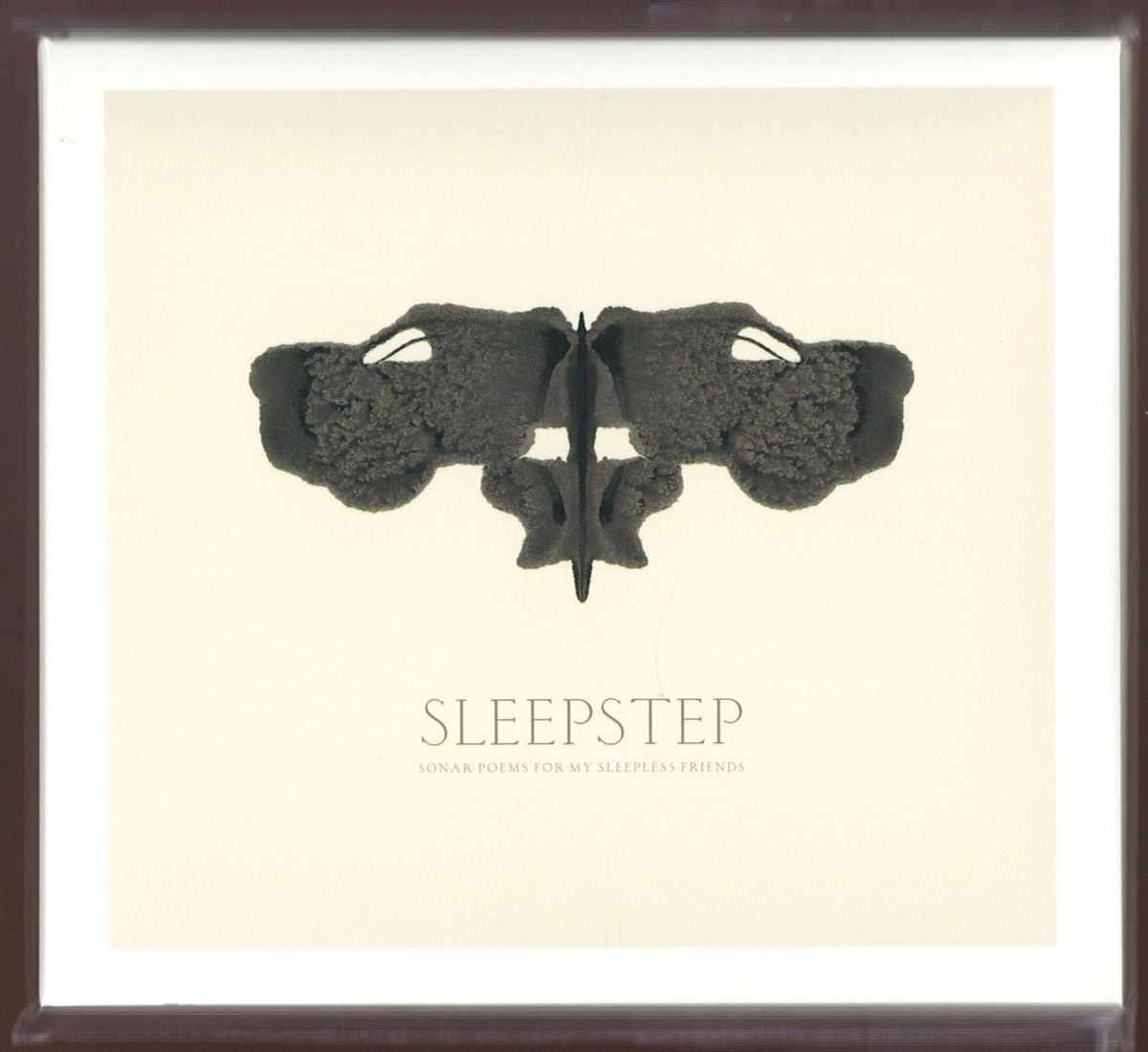
In addition to her long-standing relationship with techno, Dasha Rush no stranger to experimental electronic music—and Sleepstep is an impressive and highly conceptual culmination of her various talents and past projects. Its intention is to create a dream-like state that explores the liminal space where the waking world overlaps with sleep (and vice versa). The album’s production and sound design is on a level with the likes of Pole as well as Vladislav Delay, Alva Noto, and the rest of Raster-Noton’s past and present roster; silence, noise, spatial awareness, and sonic decay are used with a meticulous finesse that brings Rush’s slumberous hinterland to life.
More conventional dancefloor-oriented techno is vaguely hinted at on “Abandoned Beauties and Beasts,” but its churning atmospherics never give way to a proper beat. “100 Hearts” also explores minimalist, sci-fi techno sans drum machine; bleeps flicker like distant antennas, or like city lights over breathy pads, as bursts of noise spontaneously clack across the mix like shooting stars. Dub techno and reggae form the backbone of “Scratching Your Surface (Revisited)” and “Antares,” while “Fog, Dogma, and Bread” approaches similar territory, but somewhat ambiguously with a strong ambient bent. “Sleep Ballade” and “Lumiere Avant Midi” draw us further into a semi-lucid state with their melancholic ebb and flow forming a meditative, slow lope.
Dasha Rush’s voice shines on “Sail Away To Her,” where it takes the form of operatic drones that anchor the track’s softly burbling arpeggios and strings to create one of Sleepstep’s best and most emotional moments. On “Dance with Edgar Poe” and “Life Time Poem,” her spoken-word lyrics form the focus of the track, and at times are a bit distracting from all the lovely instrumental elements also occurring, but they never completely overtake and undermine the music. Finally, album closer “Outer Space” leaves us with a suitably celestial wash of mechanical sounds that elongate and fade away into distant nothingness. At last…sleep has arrived.
Late last year, Trade Nightclub hosted Link Miami Rebels for When Pigs Fly, an event in collaboration with New York’s Verboten that paired up four very influential electronic music icons and label heads for all night B2B sets. Room one featured the mouth watering match up of Sasha and Dubfire, with room two hosting Carl Craig and Matthew Dear.
We’ve been presented with the six hour B2B set from Sasha and Dubfire, which traverses all manner of house and techno and encompasses the full range of both artists. You can stream the full set in two parts below.