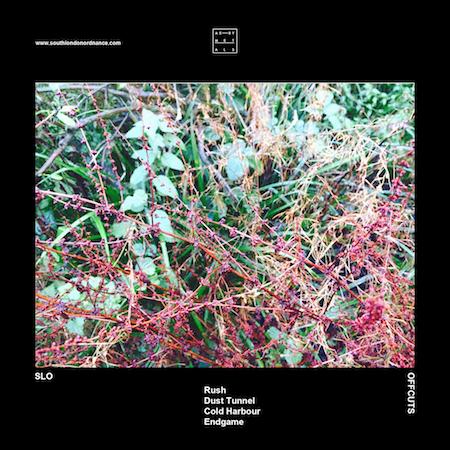
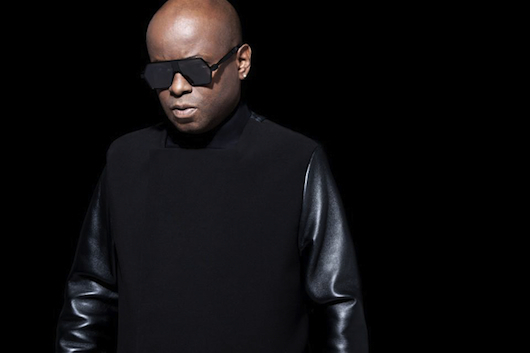
In anticipation of an upcoming EP for his own Aery Metals imprint (set to drop sometime next year), South London Ordnance has shared a collection of previously unreleased material for free download. While the tracks on offer have worked their way into the UK artist’s recent sets, he says they didn’t quite fit the bill for his latest record. “While they’re just ideas, I’d like to think they offer a bit of an insight into how the new stuff sounds,” he explains. “I’ve been writing so much new music recently and I’m really looking forward to releasing a lot of it in the new year. Hopefully people will enjoy these in the meantime.”
South London Ordnance has already released two 12″s this year—Contact via Hotflush, and Dead Cell on Aery Metals—and his four-track Slo-Offcuts EP can be streamed and downloaded via the player below.
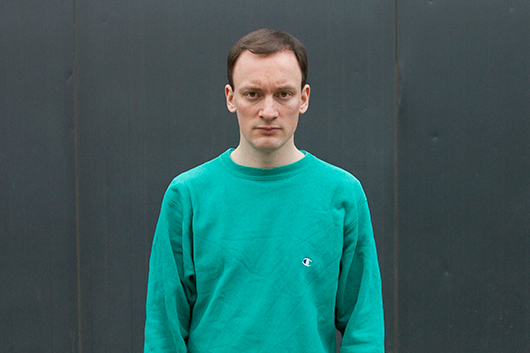
With very little fanfare, Daniel Ansorge (a.k.a. Barnt) has become something of a standout producer over the past few years. It’s because his metallic techno, whether weird or abstract, escapist or psychedelic, always feels somewhat at odds with the norm. It’s been that way since he debuted in 2010, and is still very much the case throughout his debut album, which drops next week. (For those who can’t wait, it’s worth noting that the LP is currently streaming in full exclusively here on XLR8R.)
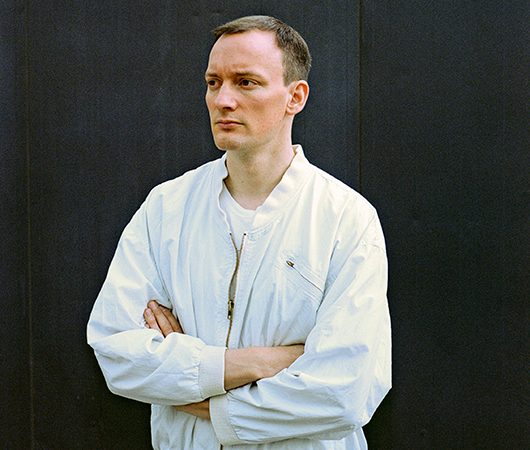
“I think it’s just a little misunderstanding,” says the thirty-something, wrapped in a high-necked jacket from his cozy-looking studio in Cologne. Though he excuses his poor English early on, we ultimately have no problem discussing everything from the cohesion of his imminent debut LP to Bauhaus aesthetics and plenty in between. “I just make music I feel I haven’t heard in the club before,” he says. “If I have a really good idea, obviously other people also won’t have heard this sort of thing, so they will say it’s weird, but for me, without being too arrogant, it’s just a new thing.”
That “new thing” tends to be a jarring mechanical hook, or an icy synth pattern that slithers above minimalist and metallic techno beats. If that sounds rather contrary to his Cologne locale—and the smooth techno-pop that inevitably comes to mind when thinking of that city and its defining label, Kompakt—you’d be right. Although he’s now close friends with much of that crew, it was actually back in the town of his birth, Kiel, which sits just north of Hamburg on the Baltic coast, where Barnt’s taste was fomented early on.
After going to watch a friend’s band as a teenager, he bought a tape on the way out, scratched over it at home, and then returned it, saying, “Now it’s better, let me in your band.” They did, but the group disbanded after one gig; however, the odd sounds of Wolfgang Voigt’s Gas project and his “non-traditional techno label” Profan became the members’ new pre-occupation. One could argue, then, that Barnt was into “outsider techno” 20 years before that epithet had ever been heard.
“I was into music super early,” says Ansorge, explaining that when his classmates were more into rock and grunge, he was already sneaking into clubs. “There was one techno club, it was really new back then. I was quite nerdy, I was always standing by the DJ booth asking people like Sven Väth what he was playing. I was a classic deck shark guy.” As it turns out, this sentiment hasn’t really dissipated over time; to this day, Barnt sees no division between the dancefloor and the home environment, admitting, unlike many, that he happily listens to club music at home. With that, maybe, we have something of an explanation as to why his tracks are slow burners that invite listeners to get lost in their wide-open synth patterns and slithering grooves.
For a little while, though, techno took a back seat, as Ansorge had an “episode over five years” with scratching and hip-hop. “I got so into it, it was like an affair,” he says before going on to explain that he took part in various DMC championships and was always showcasing his skills behind the decks. Far from being a distractive aside, though, becoming a turntable wizard taught Barnt some invaluable lessons. “In the DMC, you do routines,” he says, leaning in close, as he does when discussing the nitty-gritty details of his art. “It’s like juggling and live arranging. You develop a sense for the beginning, mid part, and how to arrange stuff, so it made it easier for me to get into production.”
That was around six years ago, so though it may seem like Barnt is something of a newbie talent, he has in fact been honing his craft for a while. As a DJ, of course, he goes back even further. For years, he had been playing in the local Cologne scene and occasionally in places like Dusseldorf. “I was playing weekly 12-hour bar sets, which was normal,” he laughs. “Now, people get excited about four-hour sets, but back in the day, I was playing 12 hours regularly.” The catalyst that saw him start getting international bookings, almost overnight, came around three years ago. Daphni dropped a Barnt track in his Resident Advisor podcast and not long after, “Geffen”—a track that still gets a lot of play—came out on Matias Aguayo’s Cómeme label.
The pair first met soon after Ansorge moved to Cologne. Together with another friend, Christian S, the threesome would organize special events such as “a mini festival in a snack stall in the middle of a park.” One party saw Rebolledo make his European debut and at another, Matias heard the then-unreleased “Geffen.” “He demanded the CD-R directly after I had mixed in the next track,” remembers Barnt. “He was an important part of the more alternative side of the Cologne scene. He not only called things into question (the commercial side of the business), he also took action. I could relate to that. His energy and thoughts are still very inspiring today.” Since then, quality hook-ups have come thick and fast: Fabric resident Daniel Avery has announced himself as a fan, Optimo was so taken with Barnt’s music that the duo demanded a test pressing of one of his tracks ahead of its Boiler Room set, and then Hinge Finger came calling.
“I was always a big fan of Joy Orbison and he is really open minded,” explains Ansorge. “I think he was looking over the channel for some stuff, and in my online mixes I often featured a UK track, which is something Germans don’t usually do—they usually stick to their house formula and there isn’t much crossover. But he was looking over here, I was looking back to the UK with my mixes, and so he asked me for something.”
Though more than happy to oblige, Barnt is not someone who can be rushed. With a background in art (as well as biology, which gives him an interestingly scientific and artistic approach to things), he appreciates that the creative process must not be hurried; as such, it took him over a year to send back the music that would make up the His Name EP, which was released on Hinge Finger in October of this year.
“That’s usually why I only do stuff on my own label and Cómeme,” he says. “Because I can take all the time I need. I’m quite different to many nine-to-five producers. I only go to the studio when I feel good and when I want to. I only finish tracks that are effortless. I try to keep the joy of producing like it’s a precious thing. If I was in the studio nine to five, it would be more like a job, and I think people would hear that.”
“Maybe it comes from studying arts,” he posits. “It’s obvious there that you don’t have an idea every day. But there are things you can do instead—you can go to a museum, you can read something inspiring, and maybe two weeks later, you have an idea because of that. So if you accept this, I think you are way more productive than if you sit in the studio and have to finish a track. Some of my friends say you can’t fake what you are—it’s either in you and you can transform it, or it isn’t and you have nothing.”
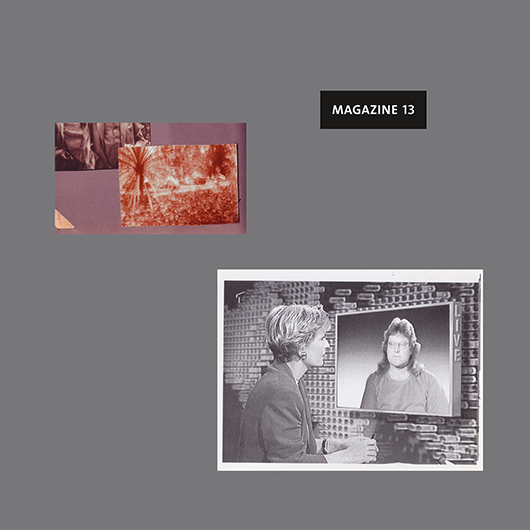
It’s clear there was something in him when writing Magazine 13, his debut album and a coherent piece of work Barnt made in a couple of months earlier this summer. “When I produce, I have dancefloors in mind,” he says, though the album will work as well in some back room basement as it will on headphones during a nice autumnal walk. It’s well paced, unhurried, and unfussy. Melodies slowly unfold and creep into the listener’s brain; thin, glacial keys hang above military drums; and there are shades of everything from Kraftwerk to ELO in the bleakly futuristic synth lines.
“I don’t use many effects,” admits Barnt. “I think they have a strong characteristic and in the end, you just hear the effect and not the sound source. It means people think my music is unfinished, like “Geffen,” but it’s like I read somewhere, maybe I have a Bauhaus style: things only happen when they have to. There are no ornaments. It’s like a mix between strict and raw architectures but then doing as much as possible within that.” Once again, the dichotomy of having studied both arts and science comes to the fore. Throw in the fact he played piano as a child, and loved it though was also annoyed by his own limitations (“I was really hurt that other people were better than me, I knew I could never be a concert pianist”) and the very make-up of Barnt and his creative process becomes increasingly clear.
Aside from his own music, another creative outlet for Ansorge is Magazine, the label he runs with John Harten (a.k.a. Crato) and Jens-Uwe Beyer, two old friends that actually moved with him from Kiel to Cologne in search of “a bigger city experience.” It’s a stylistically focused project, and its founders are not just strict about who and what they release, but also insist that before music is discussed, relationships must be formed. “We always felt we shouldn’t do a label unless we really knew we would add something,” says Barnt. In truth, the label almost never happened, especially once the economic crisis of 2008 kicked in and vinyl sales plummeted. A couple of years later, though, a spontaneous get together with Kompakt’s The Field, Ada from Pampa, and the original Kiel friends led to the birth of Magazine. “We were in the studio and all of a sudden, we had this really great music, so we decided we had to do the label.”
Given Barnt’s desire to never rush or force anything, he appreciates the fact that it has taken him longer than average to get to the stage where he is at. After doing various jobs and working in galleries until recently, he’s now exclusively working on music and loving it, but he doesn’t take it for granted. “I decided to never be financially dependent on my music or art,” he says. “I think that is really important—that there is no need to force it and for it to bring money in. So right now, it’s happy times as I’m earning, but if it’s not like this forever, I am prepared to work a job rather than compromise.”
As our conversation comes to a close, we ask Barnt if he’s ever as frustrated when producing techno now as he was with playing piano as a youth. “No, not at all,” he replies. “I think if you are really talented, you don’t do interesting music, you just copy what is there. I don’t even understand my own music really, so I’m happy about the limitations I have. They have become my biggest strength.”
Despite its somewhat playful-sounding title, “cola-light” is a dark, brooding production from Slovakian beatmaker—and head of the Sonic District label—Kepikei, who plans to issue his “Velour Workout” b/w “Soma” digital single early next month via the UK’s Get Some imprint. Beginning with an ominous bass drone, the track gradually builds into a dense assemblage cold synth tones. “cola-light”‘s rhythmic content isn’t far behind, as airy hats eventually give way to a salvo of heavy kicks and snares, balanced by the presence of reverberated snaps and tasteful bits of a skittering 808 percussion. Officially out on December 8, Kepikei’s forthcoming “Velour Workout” b/w “Soma” single can be previewed after the jump.
To mark the 35th anniversary of his career, Detroit techno veteran Juan Atkins will release a new album as Model 500 early next year. The forthcoming Digital Solutions LP is Atkins’ first full-length outing under the alias in 16 years, following from his 1995 and ’99 albums for R&S, Deep Space and Mind and Body. As Resident Advisor reports, live appearances of Model 500 often included collaborators Mike Banks, DJ Skurge, and Mark Taylor, but Digital Solutions will arrive as a solo effort via Atkins’ own Metroplex label in January 2015. No previews have been shared as of yet, but the album’s complete tracklist can be found below, along with a pair of new Model 500 live performance dates.
01. Encounter 02. Electric Night 03. Hi NRG 04. Standing In Tomorrow 05. Station 06. Storm 07. The Groove 08. Control 09. Digital Solutions
Jan. 24: Astropolis L’hiver 20.5: Model 500, Le Quartz, West Mar. 12: Unsound Adelaide, Freemasons Hall, Adelaide
Mutant Beat Dance—the pairing of Traxx and Beau Wanzer—will supply Rush Hour with a two-track EP next month. Nation label chief Traxx first joined up with Wanzer (who we recently profiled as part of our Get Familiar series) back in 2009, turning out a combination of EBM, acid, and Chicago house via labels like Rong, Discos Capablanca, and L.I.E.S. The duo’s forthcoming PolyfonikDizko 12″ comes tagged as “pure jackbeat,” and previews for both tracks on offer can be heard via the player below.
PolyfonikDizko is set for release on December 8, and will be limited to 450 vinyl copies with silkscreened jackets.
Following behind the release of his immersive sophomore full-length, Sagrada, earlier this year, LA producer/saxaphonist and Non Projects label head Brian Allen Simon (a.k.a. Anenon) has enlisted a handful of beatmakers to contribute to a new remix EP. The five-track effort includes reworks from burgeoning Los Angeles talents such as Gossamer, D Tiberio, and Afterhours, as well as Japanese producer Fumitake Tamura (a.k.a. Bun) and Stones Throw affiliate James Pants.
Dropped today, the Sagrada Remixes EP can be streamed in full below and grabbed as a name-your-price download via Bandcamp. In addition, Anenon’s recent contribution to our Real Talk series of artist-penned essays can be read here.
A burgeoning producer and Detroit native, Appian will land on London’s Fina label next week with the four-track Chatter EP (which features a remix from fellow Detroit artist Monty Luke in its run). Pulled from the record’s b-side is “Operator,” an understated techno workout lined with the type of electro-soul one would expect to hear on a record produced in the Motor City. Spanning five minutes, the track sees Appian cleverly toying with his array of sonic elements, as a handful of sneaking synth sequences and pillowy chords bend around the production’s snapping assemblage of drum-machine percussion. Officially out in vinyl form on November 24 (and digitally on December 8), the rest of Appian’s Chatter EP can be previewed after the jump.
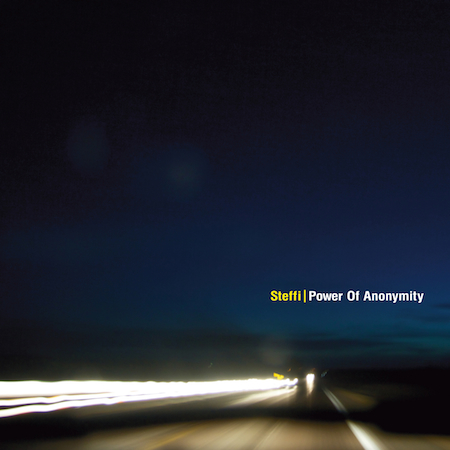
A week ahead of its official release via Berlin institution Ostgut Ton, Steffi‘s Power of Anonymity LP has been made available to stream in full. The album is the second full-length offering from the longstanding Dutch producer and Panorama Bar resident (full name Steffi Doms), and is said to take a more dancefloor-directed approach than previous outings on the label. “I wanted to start working on my new album without any personal or external expectations, and I was seeking an emancipated, unshackled approach in the album’s construction,” Doms says of the effort. “After almost 20 years I got the feeling that I’ve come full circle, so I wanted to make an album that I, as a DJ, would like to carry in my record bag.”
Power of Anonymity is officially due out on November 24, and the LP can be heard in its entirety below.
Yesterday saw the Huntleys + Palmers imprint add a new record to its catalog in the form of the Mechanical Turk EP from Mehmet Aslan, a producer who has landed a few tracks on the London outpost’s Highlife sub-label in the past. Across its three tracks, the new record sees Aslan blending facets of traditional Turkish music with his penchant for house and techno workouts. Closing out the new release on its most hypnotic note is “New Africanism,” a track which wraps lush string movements and a stumbling synth bassline around thumping kicks and clattering layers of unconventional percussion. Out now, the rest of Aslan’s Mechanical Turk EP can be previewed after the jump.
Over the past few years, Mister Saturday Night has undergone something of an expansion. In 2012, the two DJs behind the long-running party, Eamon Harkin and Justin Carter, added a label arm to their operation, and following a slew of original releases (including this year’s extensive ‘Brothers & Sisters’ compilation), the pair is now presenting a new mix CD, ‘Weekends and Beginnings,’ which drops this week. Still, at its core, Mister Saturday Night is a party, and even while facing the growing difficulty of finding suitable venues in New York City, both the intermittent Saturday night party and its weekly summertime cousin, Mister Sunday, appear to be bigger than ever. With years of experience under their belts, it’s fair to say that Harkin and Carter are essentially experts when it comes to throwing a proper bash, which is why we asked if they’d be willing to share a little bit of their knowledge with our readers. While acknowledging that there are countless elements that go in to throwing a good party, the duo felt like it could be most helpful by focusing on something very specific: setting up the DJ booth. Despite the fact that this task is at the absolute core of any successful event, it’s something that’s often overlooked, even by veteran promoters. The men of Mister Saturday Night know better, and have shared a few of their secrets about how to do things right.
Mister Saturday Night and Mister Sunday are portable parties. Saturdays happen at all kinds of different places on an irregular schedule, and even at Industry City, where we did Mister Sunday every week for almost half a year this year, the entire DJ booth and soundsystem gets set up and taken down every time a party happens. With the impermanence of our set-up, we’ve had to come up with systems and key pieces of equipment to make sure we’re comfortable no matter where and when we’re throwing a party.
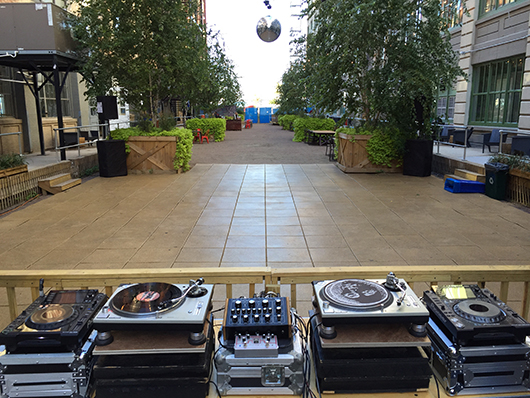
Kill The Vibrations Justin Carter: A consequence of throwing parties in all kinds of spaces is that we’ve learned (the hard way) that feedback and needles skipping can really make DJing difficult. The first time we did a party at Market Hotel (a Brooklyn loft space that closed down back in 2010), everything sounded great at soundcheck, but as soon as a couple of dozen people were on the dancefloor, the needles wouldn’t stay on the turntables. Thus began our obsession. We often hang a turntable coffin from the ceiling with big ratchet straps. When we’re outdoors, we try to set up the booth on a concrete platform or some other surface that is totally immovable.
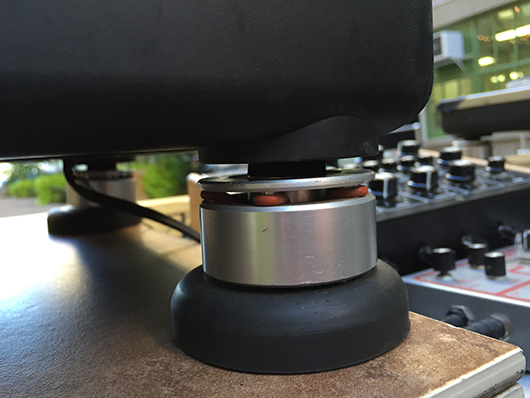
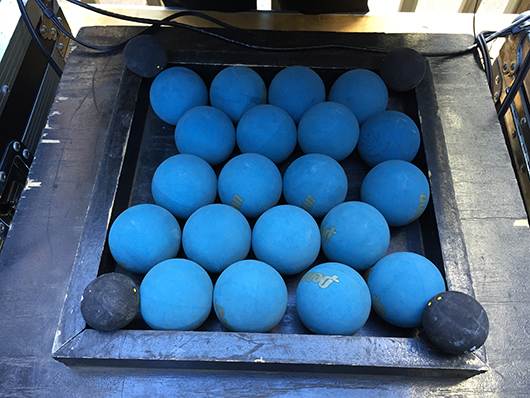
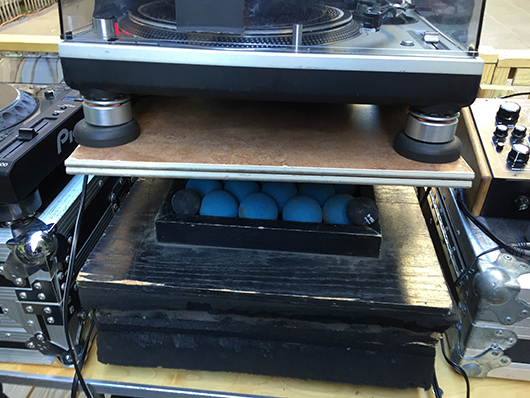
Even when you remove the bounce, there can still be feedback. That’s why we asked Ted Wohlsen, who used to do sound for us (until he went back to school to learn how to build boats… very smart dude), to build a set of dampening platforms for our turntables. He made a multi-layered, multi-directional column of foam and dense wood. On the top of that column is an inset, raised lip that holds a dozen or so squash balls. On top of those squash balls, there are two sheets of marble just large enough to hold a turntable. As an extra measure of protection, we use Isonoe Isolation Feet and Sorbothane Boots. Needless to say, not much vibration finds its way into the tonearms, and so there’s very little in the way of feedback.
Where The Records Live JC: It’s important to have plenty of space for records. We set up a big table directly behind the DJ booth and always have some empty milk crates around. I have an organization system made up of four categories: low tempo, organic uptempo, heady jams with drum machines, and party jams with drum machines. I try to keep it broad enough that I don’t get stuck in one genre for too long and so that when I’m putting records back on the shelves at home, it doesn’t take long; but I also try to narrow it down somewhat, just so I don’t have to look through all my records every time I turn around to pick the next song. It’s really important to have a system and a comfortable place to look through your records.
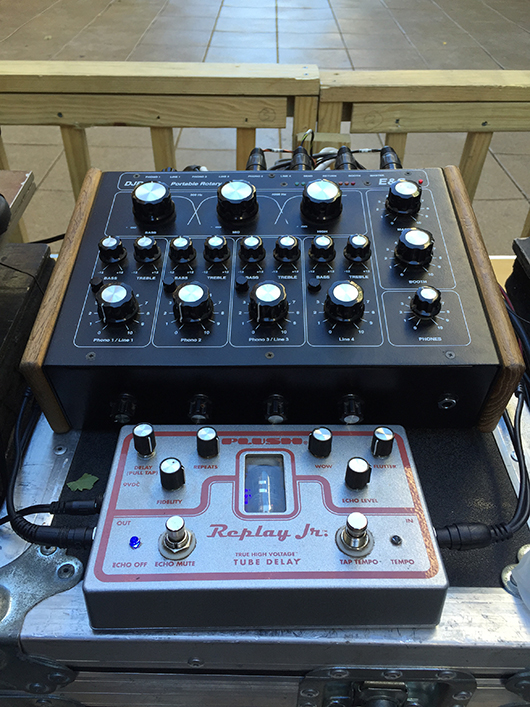
DJ Mixer Eamon Harkin: We’ve been using the E&S DJR 400 mixer for a couple of years now and it’s become a really critical part of our set-up. (It’s actually so important that we have a back-up one as well!) The totally analog construction adds color and texture to the records, which really helps when mixing records from different eras and genres together. We also use the isolator frequently to add energy into tracks with live EQ. When you develop a strong connection to a crowd each week, and you know your records well, having a tool like the E&S, which allows you to eke extra energy out of those records in a way you know will work on your dancefloor, is a very cool thing. And because the E&S is portable, we take it on the road when we tour.
We also route a Fuchs Audio Plush Replay Junior guitar delay pedal through the E&S to give us a delay effect in our sets. We use this quite sparingly, but when we do, it allows us to create space and air, allowing for transition between certain tempos and different genres. The tube on this particular model gives really nice distortion as well, so it gives an extra richness not normally heard in a delay effect from a regular DJ mixer.
Booth Height and Booth Placement EH: We always place the DJ booth either on the same level as the dancefloor or at an elevation of no more than one foot. Creating an intimate connection between the DJ and the crowd is really key to playing well as a DJ and for us, being right there on the dancefloor (or slightly elevated if it’s a bigger dancefloor) is what gives us that audience connection. You need to feel what the dancers are feeling and you need to be able to see those facial expressions and read those emotions. We hate playing on stages, not only because it creates separation between the DJ and crowd, but it also creates the weird dynamic where the dancers all face and watch the DJ. DJs are not interesting to watch and we don’t want to be watched and dancers should be dancing with each other and not all facing one way like they’re watching a rock band.