Rising Norwegian producer Magnus August Hoiberg (a.k.a. Cashmere Cat) made a name for himself with his starry-eyed, cinematic hip-hop remixes and 2012’s Mirror Maru EP, all leading up to his first vinyl release, the Wedding Bells EP. Out on February 11 via Glasgow’s pioneering LuckyMe label, the four-track Wedding Bells record will see Hoiberg expanding into the lustrous, unbridled world of hyperactive label peers Hudson Mohawke, Rustie, and S-Type. Until Cashmere Cat’s new EP drops, its full tracklist and a preview of each of the EP’s cuts can be found below.
1. With Me 2. Pearls 3. Wedding Bells 4. Rice Rain
To his credit, Darren Cunningham has remained a truly uncompromising and incomparable artist since introducing the world to his Actress moniker in 2004. His vision of what dance music can (or, perhaps, should) be consistently toes the fringe of genre expectations, setting trends in the world of house and techno as much as it bucks them entirely. So it’s no surprise that Ghettoville, Cunningham’s fourth full-length album, hardly sounds like anything previously released by Actress. His project has always been one of exploration and experimentation, but with its gaze locked on the dancefloor more often than not, helping to lend the music an air of levity despite being so cerebral. However, levity is a characteristic that Ghettoville conspicuously lacks. And in the absence of those hedonist inclinations, Actress colors in his dense, hour-plus-long LP with opaque smears of rhythm, sooty atmospheres, and decaying memories of pop music.
There is decidedly little joy or beauty to be found in Ghettoville. Cunningham has explained as much, telling Pitchfork, “I wanted this record to sound brittle, as if you were an addict and you feel like the world is crumbling around you.” But as the spiritual “sequel” to Hazyville (a lively and, on occasion, downright playful record) and the actual successor of R.I.P‘s delicate mysticism, Ghettoville‘s lack of lightness lingers over it like a thick plume of smoke, dirtying and sometimes even choking its music.
Lead track “Forgiven” sets the tone with a seven-and-a-half-minute meditation on a loop of a detuned guitar pitched down into oblivion, with a slow and simple beat carrying the instrument’s death rattle through the muck. Tempos only pick up marginally in the album’s top section—when Cunningham plays around with sleazy hip-hop on “Corner” and teases at dopey dance music on Quaaludes with “Rims”—before returning to the same kind of ultra-slow dirge that opened it. Like “Forgiven,” “Contagious” is essentially a destroyed version of instrumental hip-hop made to resemble a long, ominous drone. It’s a novel enough idea that works well within the seedy conceptual landscape of Ghettoville, but not necessarily one that needs to be revisited multiple times and at such indulgent lengths.
Following the oily wallop of his first five tracks (which surprisingly account for nearly half of the record’s runtime), Actress lets Ghettoville open up a bit to allow some dim slivers of light through the haze. “Birdcage” signals a drastic change in mood with its stomping and relatively quick-footed house beat, working out a funky, percussive groove with a focused economy of sounds. It’s easily the most fun Cunningham has on the album (there’s even a spritely flute melody in the mix), and comes almost like a gasp of oxygen after being submerged under Ghettoville‘s swampiest region. Things stay above the surface for sometime, as the astral “Our,” the bewitching “Time,” and the borderline rave-ready “Gaze” give the extensive tracklist some of its brightest and most vital moments. But these songs are foreigners marooned in Ghettoville‘s mutant underbelly, as Actress seems to have let his fixation on “the darkness of human nature” and that element’s bastardized kind of electronic music run amok without considering the potential consequence of leaving a beleaguered audience in his wake.
Somewhere amidst the bog of gritty detritus that surrounds Ghettoville exists an engaging experimental album in line with the lineage of Cunningham’s otherwise untouchable discography. Be it because of his current creative headspace or the implications of the record’s overall theme, the 15 tracks on offer feel scattershot and, in a couple of rare instances, insubstantial, even when they go on for twice as long as they should. An artist like Actress will always have a vision that reaches beyond the tropes and mores of contemporary music (though, industrial-leaning techno cuts like “Street Corp” and “Frontline” resonate on the same trendy frequency of the L.I.E.S. label and its ilk), but the downfall of such lofty intentions is occasionally overshooting the mark. And though his misses may make Ghettoville appear lopsided and drab, every on-point production buried in the heap makes mucking through Cunningham’s warped ideas rewarding work.
The reigning Norwegian king of cosmic disco, DJ/producer Todd Terje has been consistently wowing us over the years with his untouchable collection of singles, landing loads of critical accolades and high-ranking slots in just about everyyear-endlist with each infectious dancefloor production he drops. And now, following a considerable streak that dates back as far as 2004, he has finally announced that he’ll release his debut full-length album this spring. Playfully titled It’s Album Time, Terje’s upcoming 12-track LP is said to “[show] that its creator does not hold himself in so high a regard that he must dispel with sheer fun or twist of fate,” proving that “dance music of all kinds can be witty, humorous, clever or found in strange places and—maybe most importantly—is able to fool and overcome itself.” The record will feature previously released singles “Strandbar” and “Inspector Norse,” as well as It’s the Arps b-side cuts “Swing Star Part I” and “Swing Star Part II,” not to mention an unexpected collaboration with legendary Roxy Music co-founder Bryan Ferry. Before Todd Terje releases It’s Album Time via his own Olsen label on April 8, its artwork and tracklist can be found below.
1. Intro (It’s Album Time) 2. Leisure Suit Preben 3. Preben Goes To Acapulco 4. Svensk Sas 5. Strandbar 6. Delorean Dynamite 7. Johnny and Mary (feat. Bryan Ferry) 8. Alfonso Muskedunder 9. Swing Star Part I 10. Swing Star Part II 11. Oh Joy 12. Inspector Norse
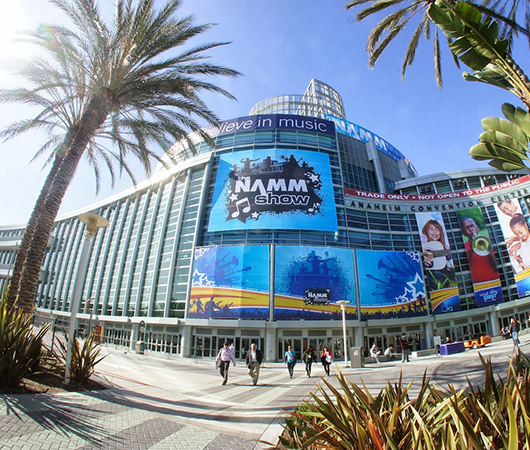
NAMM is to music gear what CES is to consumer electronics, E3 is to video games, and the ’80s were to personal finance: spectacularly overwrought excess, as companies large and small blow huge chunks of their marketing budgets to flaunt new gear. Each year, the event takes place over the course of four days in Anaheim, California, under the big-eared shadow of Disneyland. It’s generally overrun by suited sales folk and aging rockers whose hairlines have receded into their bellies, along with gearheads who fly in from around the world to get face-to-face (and hand-to-knob) time with the people that make their musical tools. As part of the latter contingent, we picked through the roughly six million mandolins and generic DJ controllers—and came across some oddly memorable happenings in the process—but ultimately honed in on the most exciting gear NAMM 2014 had to offer.
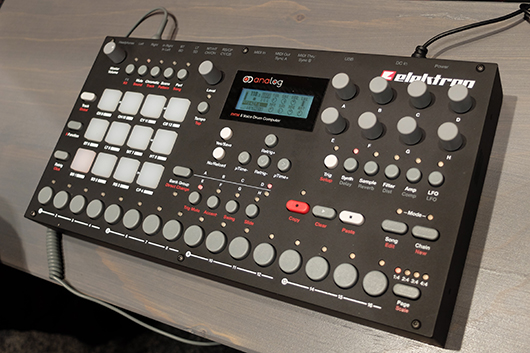
Elektron Analog Rytm Hot on the heels of its Analog Keys synthesizer, Elektron unveiled its newest drum machine at NAMM, the de-voweled Analog Rytm. It brings MPC-style drum pads to the company’s iconic box design, making for a slightly wider footprint. Analog Rytm combines an eight-voice analog drum machine with sample playback, and allows for realtime playing via the 4×3 grid of velocity- and pressure-sensitive pads. It’s got an analog multimode filter and analog distortion circuit (deployable per voice), along with an analog compressor and distortion on the master voice. Various effects and Elektron’s rock-solid step sequencer, along with some super-cool performance-oriented beat controls, make this a drum machine to drool over.
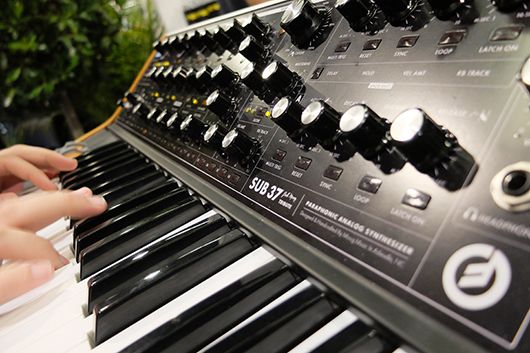
Moog Sub 37 Building upon the beefy foundation of its own Sub Phatty, Moog‘s Sub 37 is the celebrated company’s newest analog synthesizer. Think of it as a fatty Phatty: With a keyboard extended to 37 keys, the Sub 37 has same multi-pole Moog filter, along with Multidrive circuitry and a variable feedback control for even more layers of rich, saturated overdriven tones. The larger size provides more space on the front panel, which brings with it many more controls for editing of most of the functions that were hidden on the Sub Phatty. This makes it more programmable and immediate, and 256 on-board memory slots let users save plenty of their own tweaked sounds. Where the Sub Phatty was monophonic, the Sub 37 is paraphonic, which means that although they share the same single VCA and VCF, you can play each of its two oscillators independently. It’ll cost $1495 and should be available soon.
A pair of enthusiastic NAMM attendees
Roland Aira This is a bit awkward, but Roland‘s Aira—which may be a thing, or, uh, multiple things—looks really cool. It’s too early to tell, certainly, but Aira may finally represent a return to form for the Japanese company, which of course has classic machines like the 808, 909, and Juno under its belt. We’d love to say more about it, but an embargo prevents us from doing so until next month. Stay tuned.
China Pavilion It was the best of China Pavilion, it was the worst of China Pavilion. It was China Pavilion, the saddest pavilion of them all.
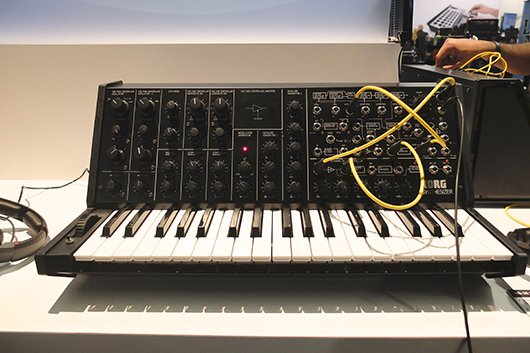
Korg MS-20 Kit Last year, Korg re-released its legendary MS-20 synthesizer in the form of the MS-20 mini, which was essentially a perfect recreation of the original layout and circuitry in a smaller form factor. In 2014, the company has upped the ante, at least physically: everything is back in full size, from the case to the keys to the 1/4″ jacks on the patch bay. Much like the mini, it allows for both MIDI and USB MIDI input. And here’s the weird part: users assemble it themselves. There’s no soldering involved, just a box full of pre-soldered parts that can be put together in an hour or two using a screwdriver. Street price is $1399.99, and it’ll be available as a limited-edition release in March.
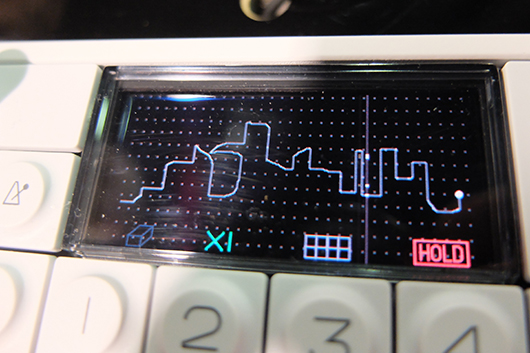
Teenage Engineering OP-1 Update The idea of a “firmware update” doesn’t generally spark much excitement, but not so with Teenage Engineering‘s OP-1. The Swedish company used NAMM to unveil the latest feature additions to its flagship portable synthesizer, and they didn’t disappoint. The new “Sketch” synth engine essentially turns the OP-1 into an Etch-a-Sketch, allowing users to draw sequences manually using the machine’s knobs, creating weirdo rhythms and melodies on or off the grid. (To erase and start over, one only needs to shake the synth, of course.) There’s also a new sound designer based on the DBOX drum synth, along with a much-requested global tuning feature that lets users detune the synthesizer as they wish, making it decidedly more band-friendly.
Pioneer CDJ-2000 Millennium Falcon Because Millennium Falcon.
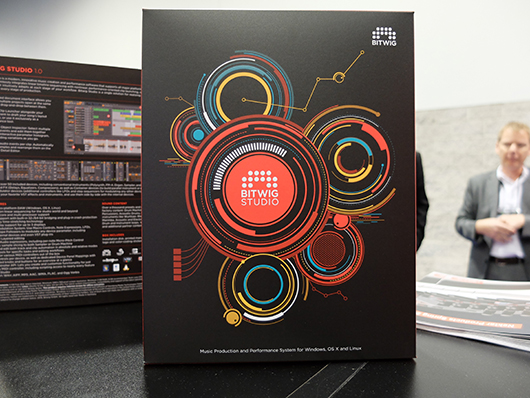
Bitwig Studio It’s been in development for ages, and now it’s finally (almost) here—namely Bitwig Studio, which has been touted as a potential competitor to Ableton Live’s throne in the DAW game. The software won’t officially be hitting shelves until March 26th, but it’s getting close; retail delivery dates have been set and boxes have been printed. Bitwig’s NAMM booth was aflutter with activity, as MIDI controller manufacturers like Livid Instruments, Nektar, and Novation were all showing off their integrated controller mappings for the software. Indeed, this promises to be one of its big selling points—all-in, non-denominational third-party support and accessible scripting for MIDI controllers. Along with tons of modulation power, super flexible window layouts, and hybrid tracks that mix audio and MIDI data, the time for reckoning is drawing near.
Lasers There seems to be no end to the companies producing lasers and LED lighting equipment for clubs, as evidenced by the sports stadium-sized hall reserved for them at NAMM 2014. The aggregated aural and visual noise made the rest of the show feel sedate by comparison, and the hall was mostly full of old people, which created an extremely unique vibe.
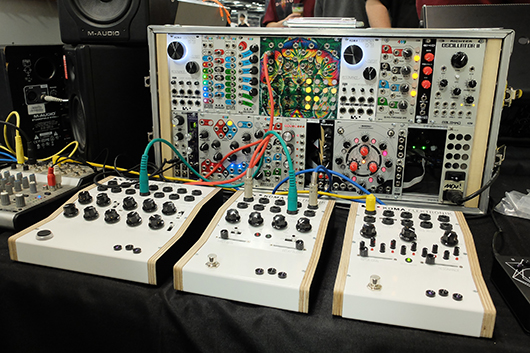
Modular Madness The deep recesses of NAMM—namely Hall E, also known as “the basement”—have become the de facto hub for all things modular. This year the likes of Harvestman, WMD, 4MS, and Koma Elektronik set up shop in a joint booth, showing off new modules to expand the possibilities of modular synthesis. Make Noise’s new reverb, Tiptop’s Circadian Rhythm sequencer, and Pittsburg Modular’s Phase Shifter were also among the many modular standouts at the show.
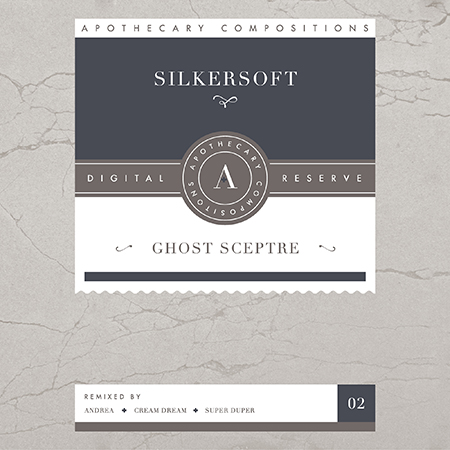
Labelled as an “enigmatic mood creator hailing from Germany,” Silkersoft lives up to that self-description throughout his forthcoming Ghost Sceptre EP. And “Sleep” is no exception, serving as a hazy journey through minimal beats, whispered vocals, and carefully executed layers of piano. The track softly weaves in and out of quiet interludes, which pair with samples of gentle streams to create a graceful-yet-haunting ambience. On February 4, the rest of Silkersoft’s debut EP will arrive on limited cassette and digital formats courtesy of Druid Cloak’s Apothecary Compositions label.
After drawing too many house heads to San Francisco’s Golden Gate Park every year, Claude VonStroke and the Dirtybird crew’s legendary annual BBQ dance party was shut down a few years back. Now, news has come that the label will issue a new comp in its honor before reinstating the BBQ dance party as an international tour later this year. The 11-track release (12 if you count VonStroke’s continuous mix of the contributions) incorporates new productions from a host of Dirtybird regulars such as Justin Martin, Catz ‘n Dogz (pictured above), Christian Martin, and Justin Jay, alongside a number of newcomers, all in an attempt to celebrate “the O.G. Dirtybird BBQ vibe.” The Dirtybird BBQ comp will arrive on February 25; in the meantime, its artwork and tracklist are included below.
01 Justin Martin “Buggin” 02 Shiba San “Okay” 03 Catz ‘n Dogz “Drop It” 04 SecondCity & Tyler Rowe “I Enter” 05 Ghostea “Breathing Room” 06 Christian Martin “Martian Landing” 07 Nick Olivetti & Alli Borem “Da Noyz” 08 Justin Jay “Le Voyou” 09 Galen “ICANCU” 10 Cause & Affect “The Tickle” 11 Ardalan “No Excuses” 12 Claude VonStroke – Continuous Mix
For more than a decade, Kompakt has only slightly tinkered with the formula which yields its annual Pop Ambient collection. Now on its 14th edition, the compilation continues to be curated by label co-founder Wolfgang Voigt and still largely depends on a revolving cast of producers, with regular contributors such as Mikkel Metal, Marsen Jules, and Thomas Fehlmann (along with Voigt himself, both under his own name and as Gas) appearing on Pop Ambient‘s latest incarnation. While the label’s steadfast dedication to the original aims of the series is admirable, it may also explain why, in a rapidly changing musical environment, Pop Ambient can’t help but seem less and less vital with each new arrival.
Speaking purely in musical terms, Pop Ambient 2014 is one of the strongest editions in recent years. The return of Ulf Lohmann (a name early-aughts Kompakt listeners should be familiar with) after a six-year hiatus is certainly welcome, and the German producer bookmarks the comp with two of its more unique pieces, boding well for his new stockpile of work, which is poised to trickle down from the label throughout the year. In addition, Thomas Fehlmann and Marsen Jules turn in predictably worthwhile efforts; veterans to the form, they seem to have figured out what balance of textural space and melodic linings fit perfectly on these collections. Furthermore, Wolfgang Voigt himself again delivers some of his own compilation’s highlights with the almost aggressively droning “Ru?ckverzauberung 8” (Ru?ckverzauberung being a recurring name/theme in his work) and an “Ambient Mix” of The Field‘s “Cupid’s Head” under his highly regarded Gas moniker (it’s worth nothing that the remix first appeared as a b-side on the vinyl-only Cupid’s Head / The Gas Remixes 12″ late last year). Serving as Pop Ambient 2014‘s second-to-last piece, the gorgeously stretched 10-minute composition accomplishes the tall task of living up to Gas’ reputation as one of ambient techno’s most consistently brilliant projects.
Still, although the record offers up its share of musical high points, there is something lacking about Pop Ambient 2014. Somehow, the act of simply putting these compositions together in compilation form seems to do each contribution a bit of a disservice. Almost all of the artists featured here have the chops to make more complete works, and to relegate the talents of a Thomas Fehlmann, a Ulf Lohmann, or a Gas to simply be partial components of what is essentially a glorified playlist ultimately draws away from the impact of their compositions. When the Pop Ambient series started in 2001, it may have made more sense to string together the highlights from disparate and limited ambient releases in the Kompakt catalog, but in today’s electronic music realm, ambient music is no longer a hard-to-find commodity or an afterthought of a label’s catalog. One need only to look at the success of imprints such as Editions Mego, Spectrum Spools, and Kranky, or artists like Tim Hecker, Oneohtrix Point Never, and the now-defunct Emeralds trio, to see that ambient electronic music is a style that can be appreciated in its full form by a wide range of savvy music listeners, not just electronic music connoisseurs. One is left to wonder then, what is gained (or, for that matter, lost) by only offering the bite-size chunks Kompakt does on in its annual ambient compilation.
With all that said, there is surely still value to Kompakt’s long-running Pop Ambient series. At its core, the collection continues to prove that ambient and experimental electronics do not always have to be aggressive or bizarre, but can also be rendered into beautiful compositions that provide listeners with a musical platform for quiet and unhurried introspection. As a series, Pop Ambient may gradually be losing its vitality, but its musical perspective does not have to. Moving forward, an adjustment to the delivery platform would do much to make Pop Ambient‘s sound more relevant.
Igor Ivanov’s and Sami Blanco’s AT/NU project is based in a hyperreal and transcendent space, taking cues from trance and techno to create glossy, high-definition tunes. Ahead of their Psi Grove release for the 1080p label (out on February 11), the two producers have shared album track “Shift.” Floating pads and effervescent FX whirl around casually before a striking percussion pattern drops in to fill out the track’s low-end. Mid-range synth melodies and unobtrusive shakers accent the slowly developing production, remaining firmly planted in half-time rhythms throughout. AT/NU scatters reverb-laden vocals that cascade across “Shift” as high-register synth stabs harmonize and fade into its trance-y conclusion.
Throughout the week, a whole lot of material gets posted here on XLR8R. And while we know—and love—that some hardcore readers will eagerly pour over every single news story, interview, podcast, video, and MP3 download that appears on the site, we also realize that for most people, it’s impossible to see everything, which means that some quality XLR8R content is likely to get missed in the hustle and bustle of everyone’s daily lives. In the interest of making it easier for everyone to catch up, every Friday we present The Lowdown, a weekly wrap-up of the top 10 tidbits from our site.
1. This week’s XLR8R podcast was put together by mysterious Werkdiscs bossman Actress (pictured above), who will be releasing a new full-length, Ghettoville, next week.
2. Our latest contest caused quite a stir, as our readers were presented with the chance to score a pair of AIAIAI’s TMA-1 X headphones. Enter now before it’s too late.
3. Just a few days after whipping the gear world into a frenzy with news of a TR-808 relaunch (of sorts), Roland shared a video chronicling the making of the TR-909 and hinting that the legendary rhythm box may be in line for a similar reboot.
4. Veteran Ed Banger affiliate Feadz released a new album this week, along with a crazy animated video for the song “Metaman.”
5. Following a long development period, an official release date was announced for the cross-platform Bitwig Studio production software.
6. In a busy week for gear news, the folks at Elektron unveiled the Analog Rytm, a forthcoming eight-voice drum computer.
7. The most popular offering in our Downloads section this week was a remix of LA-based beatmaker Computer Jay, whose “Binary Fix” was reworked by Portland bass specialist Eprom.
8. As if his XLR8R podcast wasn’t enough to get people excited about Ghettoville, Actress also posted a full stream of LP cut “Rap.”
9. Admist the flurry of gear announcements coming from this week’s NAMM conference, M-Audio rolled out the Trigger Finger Pro, an updated version of its classic workhorse controller.
10. UK producer/singer Sampha unexpectedly reissued an EP of “early productions” that was first released on CD-R in 2010.
An expanded version of the The Lowdown is also available via a weekly email newsletter. Those interested in an even more in-depth round-up of XLR8R content, including a complete listing of all the free downloads we’ve offered in the past seven days, should sign up by entering their email address below.
This new remix from Botany represents the first material to surface from the Texan producer since his deubt LP, Lava Diviner (Truestory), landed towards the end of last year. Taking on “Lady Queen,” a song from Dog Bite‘s (pictured above) recent Tranquilizers album for Carpark, Botany’s craft continues to appear in fine from, as he takes the considerably dreamy pop of Dog Bite’s original song into even more immersive territory with enveloping waves of grainy textures and alternating series of transfixing rhythmic patterns.