
Lifting the Lid – UK Duo Akkord Peels Back the Layers of Mystery Surrounding Its Music and Identity

Electronic music undoubtedly has more than its fair share of enigmas. Within the sphere of underground dance music, anonymity has become a cliché to the extent that, more often than not, the facadé of mystery is even less exciting than the unremarkable reality it usually shrouds. What sets British electronic outfit Akkord apart from this morass of faceless musicians, however, is that as the veil of anonymity has been slowly peeled away, the process has, at times, seemed to pose more questions than it’s answered.

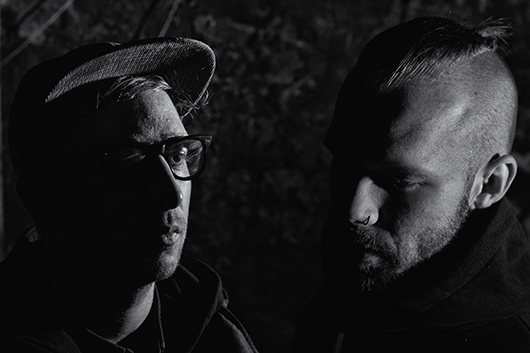
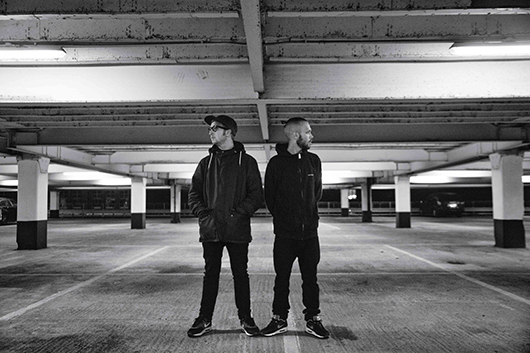
Even before the information was officially revealed, educated guesswork across the internet identified Manchester-based producers Liam Blackburn (a.k.a Indigo) and Joe McBride (a.k.a Synkro) as Akkord’s key players, but rumours persisted of shadowy additional players lurking in the background. (An official promo shot, for example, sees the band represented by three blacked-out figures, rather than two.) Similarly, the manner in which the band’s music has been slowly drip-fed into circulation has felt equally cryptic. The first two Akkord EPs arrived in the form of super-limited, eponymous white labels and even after signing a deal with Fabric’s new offshoot label Houndstooth, the band has continued to find creative ways to premiere new material—flyer packs, phone hotlines, and cassettes have all been employed to tease the duo’s debut album. Add to that the fact that the limited amount of interviews Akkord has given to date have been littered with vague talk of lofty concepts like sacred geometry and the golden ratio, and the sense of mystique around the outfit quickly mounts up.

Of course, all this clever image management would mean nothing if the music itself wasn’t worthy of attention. Fortunately, with its combination of pinpoint-precise drums, haunting atmospheric lines, and clean, powerful bass tones, Akkord’s sonic palette packs enough complexity and intrigue to equal the pair’s image. The outfit’s first white-label EP, released roughly 18 months ago, grabbed listeners’ attention with its sleek blend of minimalistic techno rhythms and subtle garage inflections. In the intervening months—via a second white label, a handful of live shows and mixes, and Navigate, the duo’s debut EP for Houndstooth—a more expansive picture of Akkord’s aesthetic has formed, one which touches upon the vintage UK sounds of grime, garage, and early dubstep, all filtered through the group’s meticulously detailed and decidedly futuristic production style.

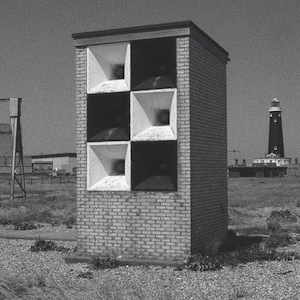
Akkord
At the end of this trail of breadcrumbs is Akkord’s eponymous debut album, which sees the group fully revealing itself, both in a literal, biographical sense—the sleevenotes reveal the names of those mythical satellite members—and sonically, offering, across its 10-track duration, the fullest exploration of Akkord’s sound yet. But while the cloak of mystery may have been lifted from around the group, speaking to Blackburn and McBride only reveals that there are still a number of fascinating contradictions at play behind the project.

The most fundamental discrepancy between Akkord’s public-facing image and its inner workings lies in the fact that, despite maintaining a face of measured precision and meticulous forethought, Akkord’s existence to date has been built largely around unplanned spontaneity. “When we signed the deal with Fabric, we didn’t have an EP or an album,” Blackburn recalls. “We went home that day and spent three days just making loads of tunes, and that’s where the Navigate EP came from. As soon as that got released, we just started on the album. It was really quick, it’s just happened in a flash. It’s pretty mad.”

“Most of the album we made in a two-week period of really solid getting on it for seven hours a day or something,” McBride adds. “That way it was more natural, rather than spending years trying to find a perfect sound.”

As it turns out, it was this lack of a concrete game plan that led to the duo’s decision to remain unnamed at the time of the earliest releases. “The whole anonymous thing wasn’t a long-term thing,” Blackburn explains. “We just didn’t want anyone to associate the sound or the image with anything we’d done previously. That was the purpose of it; it was just an in-the-moment kind of thing.”

“We didn’t really know what we were doing with the project at that time,” McBride continues. “It was just a bunch of tunes that definitely weren’t Synkro & Indigo tunes.”

The producers’ desire to draw a line between Akkord and their previous work makes sense; although this latest project is still in its relative infancy, Blackburn and McBride have been close friends for more than five years, and this is far from the first time they’ve collaborated. Separately, as Synkro and Indigo, the two artists have clocked up releases on labels such as Exit, Apollo, and R&S, including several collaborative works. They’ve also been jointly involved in running a label, Mindset, since 2008, and launched a second imprint, Electro Magnetic Fields, together earlier this year. Still, despite all of this shared history, Akkord is undoubtedly set apart from anything these two have done before. First and foremost, the key difference is the near absence of melody this time around. Although the producers’ solo efforts have touched on techno, drum & bass, dubstep, and ambient electronica, their releases have almost always felt awash with warmth and color. Akkord’s sound, on the other hand, is almost entirely driven by percussion and bass, with traditional lead elements stripped back to leave just the faintest suggestion of melodic progression.

As for the references to additional group members, they stem from Akkord’s desire to leave future plans for the project somewhat open-ended. The oblique promo shots and indirect references may conjure images of some kind of production illuminati pulling the strings from the shadows, but in reality, Blackburn and McBride simply don’t want to close off the project from the influence of casual collaborators. “The whole point of Akkord was loosely based around a collective,” Blackburn explains. “We wanted to keep it open for people to get involved.”

In the case of Akkord’s debut LP, this open invitation has resulted in the involvement of Manchester-based producer Biome (on “Rocendal”) and Bristol’s Troy Gunner (on “Folded Edge”). The pair is quick to affirm, however, that these tracks are still credited to Akkord, as opposed to Akkord and a featured artist. “It’s more like a collaboration for outputs that we do with other artists that might relate to the same sound that Akkord is doing,” McBride explains of the distinction. “There are no solid plans to work with certain artists. It’s just like, if it happens and it works, and it sounds like it should be Akkord, then it can go out as Akkord.”

Of course, exactly what Akkord sounds like can be hard to pin down. On the one hand, there’s an undoubtedly futuristic and forward thinking tone to the group’s debut album; the rhythmic patterns are, at times, almost inhumanly intricate, and there’s a crispness to the production that makes everything sound unmistakably contemporary. At the same time, there’s a distinctly nostalgic undertone to the record. On first listen, the LP invites comparison to the sonic innovators of mid-’00s dubstep—the tribal percussion is reminiscent of Skull Disco-era Shackleton, while the mood-shifting basslines and imposing atmospherics bring to mind Vex’d, Emptyset, and early Kode 9. In a way, the album almost feels like something of a statement, as it’s picking up the loose ends of a genre that much of the UK has abandoned in its mass exodus into house and techno.

“Everyone seems to have neglected the UK,” Blackburn acknowledges. “The UK sound has become an amalgamation of loads of other things. House and techno—yeah, it’s good, but the broken-beat sound is very British. Early hardcore, grime, and jungle, that’s what we’re into and that’s the shit we’re going for. But we’re trying to fuse it together with this more modern sound: the more clinical, bass-heavy sound. There are no plans, we’re just doing it and this is how it’s turning out.”

This affection for the UK hardcore continuum also appears to be present in the group’s desire to seek out creative ways of unveiling its music. The hand-stamped white labels, mysterious phone lines, and cassette releases all seem to harken back to pre-internet days, when dance music undoubtedly required more of an investment of time and energy from the listener. “We just didn’t really want to shove it down people’s throats,” McBride explains. “If you’re interested in the music, then you’ll go and find out about it. We’re kind of like that with the music we listen to and the music we buy.”

“It’s to make it fun for us as much as anything though,” he continues. “We like doing limited releases; we enjoyed hand stamping the first bunch of tunes we put out as Akkord. It was like a journey for us too, just experimenting with putting out music. We learnt a lot from it and still are. We’re still trying to do new shit, stuff that we haven’t done before. We’ve just done the cassette thing, and again, that’s just from us wanting to do something that we’d never done before. It fits with what we’re doing and it makes it more enjoyable for us, and more enjoyable for people that follow us and buy the music.”

This sentiment of giving the listener something of substance to dig into carries through into the group’s conceptual ethos, too. The pair is quick to assert that it doesn’t want to force the influence of ideas like sacred geometry upon anyone, yet the duo is certainly happy to scatter a trail of clues throughout its work.

“There are links there if you look at the album,” McBride explains, “although we’re not trying to shove it down people’s throats. For example, track six on the album is called ‘Hex_ad,’ which is the Greek for six, but also, the track itself is a mixture between 3/4 and 6/8 timings. If you listen to the rhythms within it, there are some pretty technical polyrhythms and stuff. It’s just stuff that we’re interested in.”
It’s not too hard to imagine how a fascination with such ideas influences Akkord’s music. After all, it doesn’t take a huge leap to get from the emphasis on minimalist beats and precise arrangements in the pair’s productions to the concepts of mathematical purity that the duo describes. While it might seem almost pretentious at first, the idea of tapping into ancient, pre-religious concepts has clearly proven to be an effective source of inspiration for the project. Blackburn, in particular, speaks enthusiastically and at length about the benefits of allowing such symbolic ideas to guide his music-making, and expresses hope that listeners might connect with the concepts through Akkord.

“It’s just nice to share it with everyone else,” he explains. “It’s really fascinating stuff. Some people will just see it as hippy bollocks, but in a way, that’s kind of ignorant. It is in a way, but it depends which angle you look at it from. If you go back into ancient cultures and research the Flower Of Life, for example, you’re going to find a lot of knowledge that’s very, intriguing. If you’re a designer or an artist or a musician, geometry in itself is a very good tool to use. It just works; it’s nature’s laws, if you know what I mean. You can tap into people’s psyche or consciousness with it, just by using it.”
Pedestrian “Wood Eye”

Budding producer Pedestrian has certainly made the most of 2013, adding releases for Born Electric and 2nd Drop to his run, as well as having his “Hoyle Road” tune appear early on in Breach’s recentDJ-Kicks mix. “Wood Eye” is a new one-off freebie from the UK talent, a track which defly chops an array of vocal and melodic lines around a clattering procession of relaxed rhythms. With its thick, gooey low end and spacious wash of refracted jazz and soul, “Wood Eye” is the kind of electronic production that invites listeners to sink deep into its sonic landscape.

Wood Eye

Zed Bias Boss

A certain cool, removed aesthetic has always permeated Zed Bias‘ catalog. He’s been a key player in the UK garage and broken-beat scene for over a decade, and has graced both the UK charts and underground with equal poise and capability. On his latest full-length for Loefah’s refinedly dirty Swamp 81 imprint, Zed Bias wears a well-earned and well-represented title, Boss.

The opening track, “Eingang,” sets a clear precedent for what we’ve come to expect from Zed Bias—finely tuned production that is sparse but forceful, and elegantly funky. A rhythmically cut vocal sample rides a simple bassline of monophonic stabs, with the occasional reverb-drenched chord extending out to produce tension. The builds are finely tuned and even at its most pared-down points, “Eingang” is impossible to sit still to.

What makes Zed Bias’ music so potent is the stuff that separates functional producers from actual artists; he effortlessly intones the core elements of a genre or style while subtly shifting them to stake his own claim. On “Ye,” we hear familiar bits of the ‘Think’ break, chopped and flanged; it’s not a new idea per se, but Bias does it so delicately and precisely that the result is current and fresh.

If anything, his subtlety may require a little bit of extra effort on the listener’s behalf. It’s not so much that one needs to sit down and pore over the minutiae to enjoy Boss, but more that the album format speaks to at-home listening, which these days often means laptop speakers or earbuds. That won’t really work for this record. Without some responsive sub bass, a song like “Boss Skank” could sound like a simple looped beat, and though the album is very tidily mastered, the record is at its best with some air to move around. Knowing this, it wouldn’t be absurd for one to ask if Boss would have worked better as a series of individual releases. Perhaps that was the thinking behind pressing it on an ambitious (translation: pricey) 4×12″ heavyweight vinyl format.

Questions of format aside, “Tug” is a real standout, with an atonal base of a resonant staccato bell over a moving 4/4 stomp, offset by the odd bit of octaving bubbly pops and a half-open hi-hat ride. A synth chord alternately wavering and falling in pitch closes phrases of the track and leaves a nice space in the mix when it goes missing for a few bars. The digital format of Boss also features an alternate mix of “Tug” that features the same elements and phrasing with a slightly different affectation—it’s a bit grittier and less minimal, but it offers an interesting glimpse into a less refined take on the composition.

Boss doesn’t leave much to be desired—it’s a polished work that takes a tour through an established artist’s contemporary work and delivers from front to back. It’s thinking-man’s club music with a healthy dose of soul and style, and like much of Zed’s catalog, it’s bound to age well.

Chits “Looking So Good (Mess Kid Remix)”

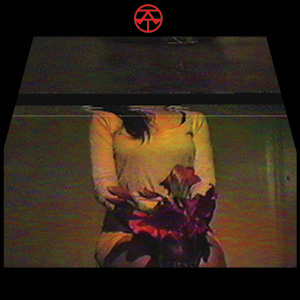
On his recently released Custom Hype EP for Astro Nautico, Pennsylvania-based producer Chits has crafted a signature sound out of techno/hip-hop hybrids that rely on slowly unraveling emotive melodies. This remix of his “Looking So Good” tune by Mess Kid (pictured above) stretches that formula out over an increasingly active beat. Sliding drum and vocal patterns intertwine and break apart before a spongey kick establishes the production’s consistent bottom end. Mess Kid explores the spaces between each instrument in his remix, breaking down the track into a submerged house cut before finally rushing toward a robust finish.

Looking So Good (Mess Kid Remix)

Looking So Good (Mess Kid Remix)

Shadowlust Trust in Pain

Shadowlust is the new collaborative project from L.I.E.S. stalwart Svengalisghost (a.k.a. Marquis Cooper) and 51717 (a.k.a. Lili Schulder), with Cooper doing the beats and Schulder singing and programming the synthesizers. Considering the former’s catalog and listening to Trust in Pain, the pair debut LP, it’s clear why these two decided to work together. Cooper has worked to meld industrial and assorted “wave” influences into house tracks in the past, and this LP uniformly deals with those sorts of barbed grids. It does so in a more subdued way, however—those looking for arrangements with that titular pain might be disappointed.

There isn’t a lot to grab onto here, but as a mood record, Trust in Pain is extremely cohesive. Cooper’s tinny, staggered patterns underpin Schulder’s rigidly percolating synthesizers and breathy, mostly wordless vocals. There is probably a better historical reference point (Chris & Cosey perhaps, but drained of much of that outfit’s catchiness), but perhaps “Factory Floor on downers” comes close—there is something similar in the way Schulder and that group’s Nik Colk Void let their wispy moans echo out into the abyss. Maybe an abyssal plain is a better way to describe the landscape here, though. It isn’t a claustrophobic or cavernous landscape as much as one where there is neither a peak nor drop in sight. Many acts dealing in similar territory—for example, Streetwalker, whose Beau Wanzer shared a 12″ with Cooper earlier in the year—use these elements to convey a tensile, punishing feeling of sexuality, referencing EBM’s S&M overtones. Shadowlust feels like the unwound inverse of that approach, the musical equivalent of the kind of exhausted, dead-eyed sigh one might exhale in the aftermath.

The Lowdown – This Week’s XLR8R Top 10 with Moderat, MK, Jonwayne, and More

Throughout the week, a whole lot of material gets posted here on XLR8R. And while we know—and love—that some hardcore readers will eagerly pour over every single news story, interview, podcast, video, and MP3 download that appears on the site, we also realize that for most people, it’s impossible to see everything, which means that some quality XLR8R content is likely to get missed in the hustle and bustle of everyone’s daily lives. In the interest of making it easier for everyone to catch up, every Friday we present The Lowdown, a weekly wrap-up of the top 10 tidbits from our site.

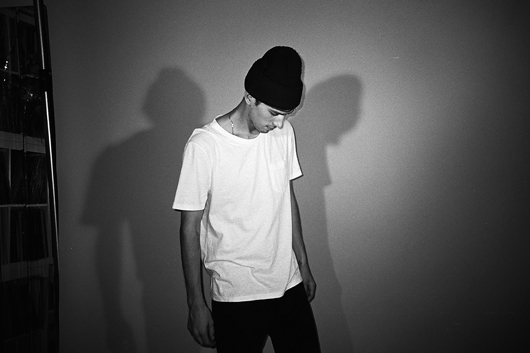
1. The latest installment of In the Studio took us to the bedroom production lair of SoCal beatmaker and Stones Throw affiliate Jonwayne (pictured above).

2. German outfit Moderat will be kicking off 2014 with the release of a new single, “Last Time,” which will come backed by a new remix from UK producer Jon Hopkins.

3. We tapped house legend MK for a new chapter of our Hi-Five series, and got the LA-based producer to list five of his favorite ’90s house jams—that he didn’t make himself.

4. This week’s contest gave XLR8R readers the chance to score a Synth Kit—essentially, it’s a collection of pieces made for building DIY analog synthesizers—from Korg and littleBits. Enter now before it’s too late.

5. There was a lot of Moderat-related activity this week, as a detailed and lengthy video surfaced that found Modeselektor (who make up two thirds of the group) explaining the production processes behind the II album.

6. The latest XLR8R podcast was delivered by Swiss techno veteran Deetron, who released his long-awaited sophomore LP a few weeks ago.

7. UK house starlet Maya Jane Coles remixed “First Fires,” a song from the new Bonobo LP, and a stream of the track was posted online.

8. Toronto duo Azari & III announced that the pair would no longer be working together.

9. At the end of this month, Hotflush boss Scuba will be releasing his own remix of Paul Woolford’s “Untitled,” but ahead of that, a stream of the tune has appeared online.

10. Pioneer announced the impending launch of the CDJ-900NXS, a recharged version of its CDJ-900 line.

An expanded version of the The Lowdown is also available via a weekly email newsletter. Those interested in an even more in-depth round-up of XLR8R content, including a complete listing of all the free downloads we’ve offered in the past seven days, should sign up by entering their email address below.

Subscribe to the XLR8R Lowdown

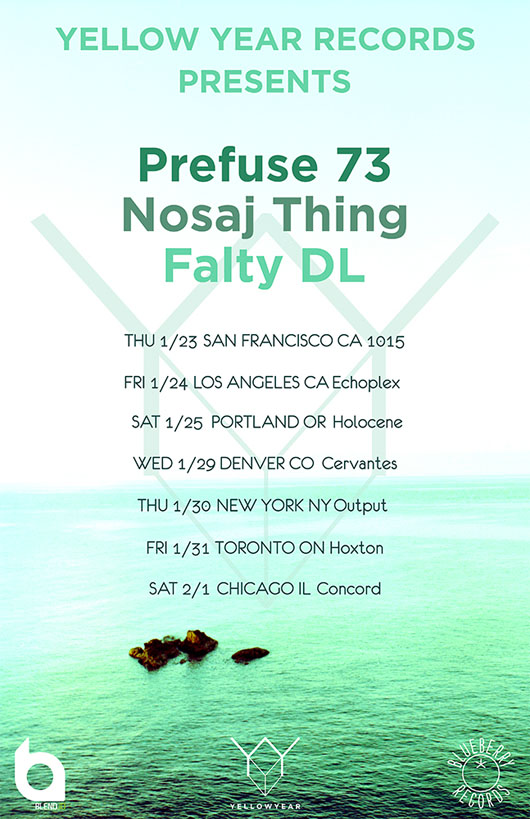
Prefuse 73, Nosaj Thing, and FaltyDL Plot North American Tour

Early next year, Prefuse 73 (pictured above), Nosaj Thing, and FaltyDL will embark on a brief North American tour together. Named after Prefuse 73’s recently launched imprint of the same name, the seven-day Yellow Year Tour will find the trio of innovative artists making their way up the West Coast and across to NY, with stops in Denver, Toronto, and Chicago sprinkled in as well. The full list of forthcoming January tour dates are included on the flier below.

Download an Edit of Aphex Twin from Maceo Plex

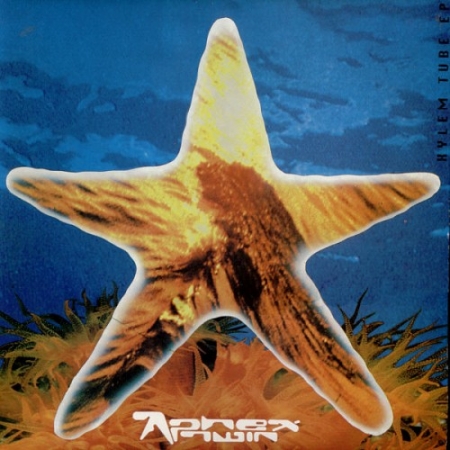
Pulling no punches, tech-house giant Maceo Plex posted an edit of Aphex Twin’s classic “Polynomial C” track—originally released on the legendary artist’s Xylem Tube EP for R&S (artwork above)—to his SoundCloud as a free download, saying, “Dear haters, this is not a remix, it’s an edit, and the intention is to make it possible for a DJ to play Aphex’s beautiful classic in a modern techno set.” The DJ/producer’s tweaked version of the ambient, breaks-heavy tune can be streamed and downloaded for free in the player below.

Imami “Melted Love”

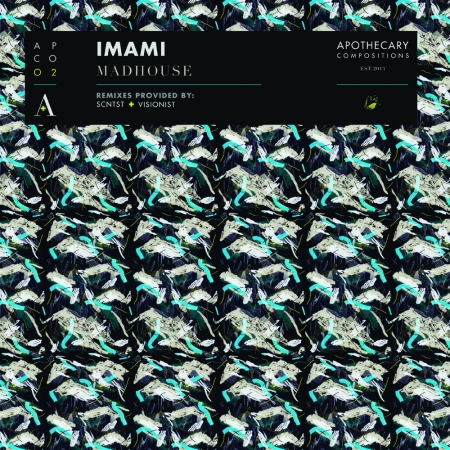
Enigmatic UK producer Imami doesn’t commit to any specific style or genre on Madhouse, his debut EP set to release via Druid Cloak‘s Apothecary Compositions imprint on November 25. “Melted Love,” one of the record’s five original tracks, finds Imami flirting with shuffling kick patterns, a repeating vocal phrase, and gritty hi-hats while a major key vibraphone melody lackadaisically moves in and out of the mix. The track’s seemingly random assortment of elements provides an ear-catching contrast, and eventually moves into a mild-mannered breakdown before retracing its footsteps back to the opening arrangement.

Melted Love

Watch Bok Bok and Kelela Talk Collaboration and Making ‘Cut 4 Me’

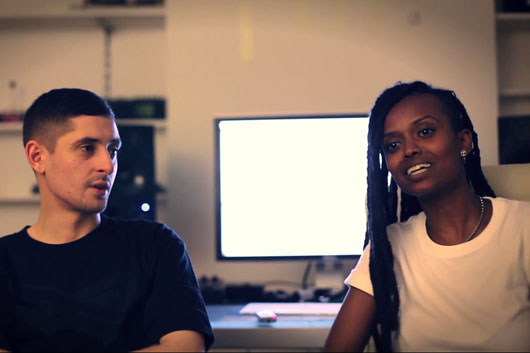
Following the release of her Cut 4 Me mixtape via Fade to Mind, Los Angeles vocalist Kelela has made her way around the globe—including a stop in London, where she performed alongside Night Slugs boss Bok Bok (who produced two tracks on her mixtape, not to mention collaborated with her on a live mix). Following their performance together, both artists sat down to discuss their approach to collaboration and illuminate the process behind creating Cut 4 Me. The eight-plus-minute interview with FACT TV finds Kelela and Bok Bok talking about what attracted them to each other’s music, and how Bok Bok approached writing beats (or at least modifying existing productions) to accommodate the singer’s vocals. Furthermore, the pair talk about what they enjoy about performing live together, and give hints of what each has planned for the not-so-distant future. The full interview can be watched in the player below.

Page 1494 of 3781
1 1,492 1,493 1,494 1,495 1,496 3,781