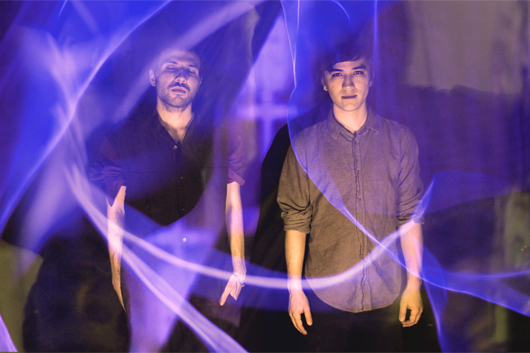
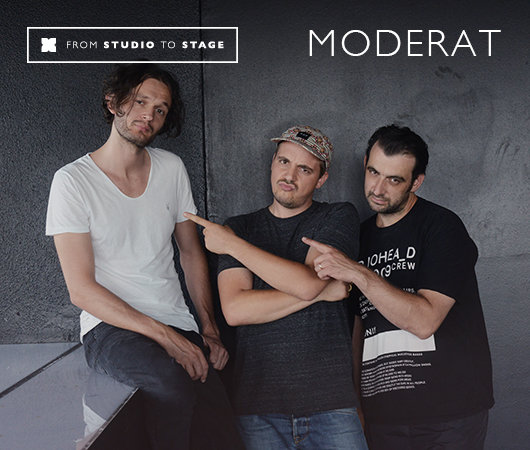
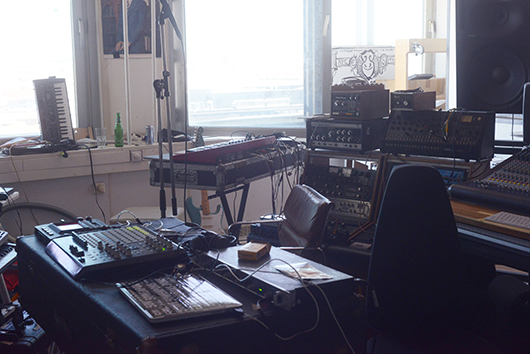
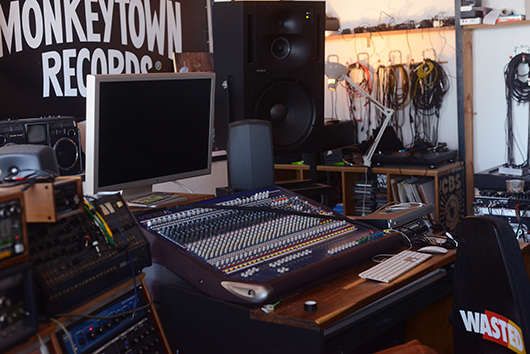
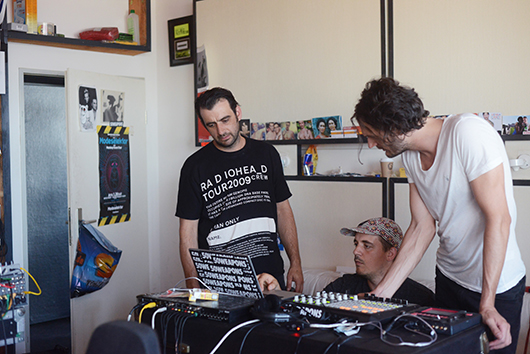
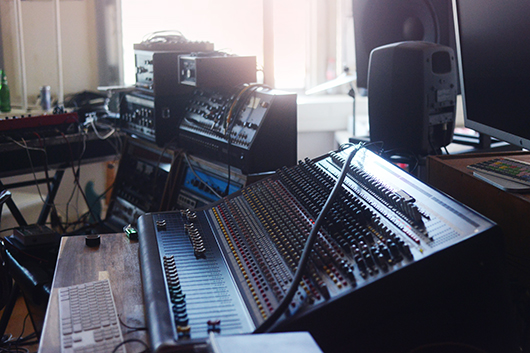
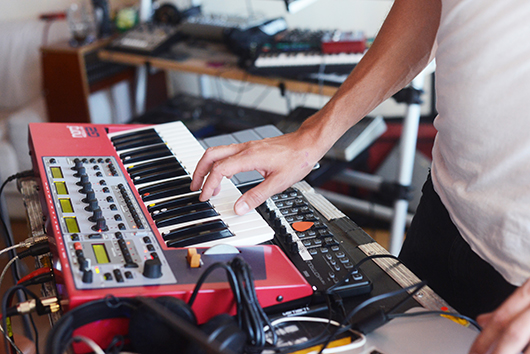
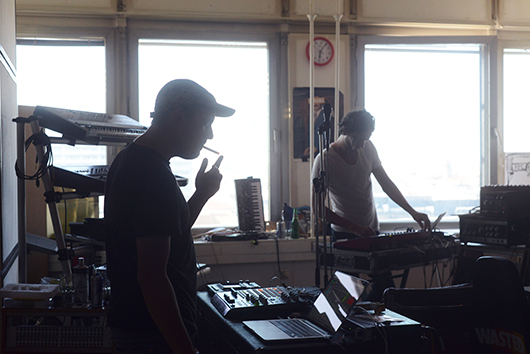
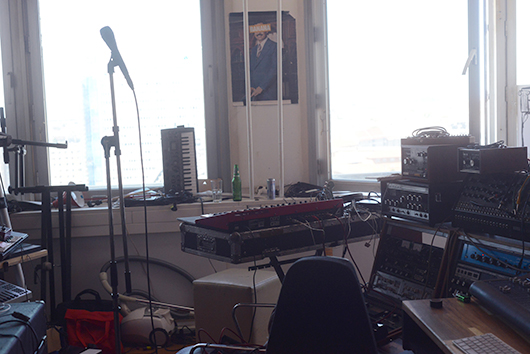
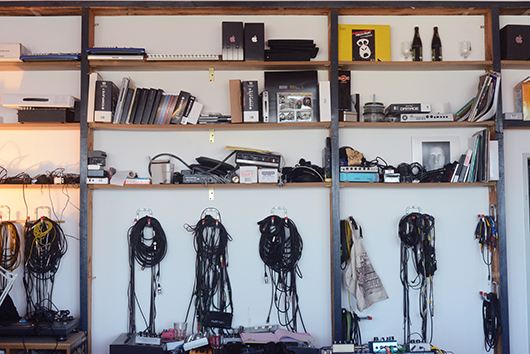
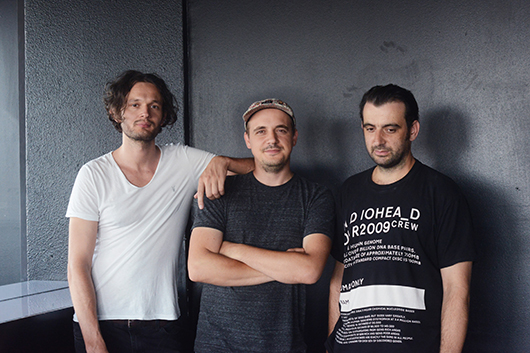
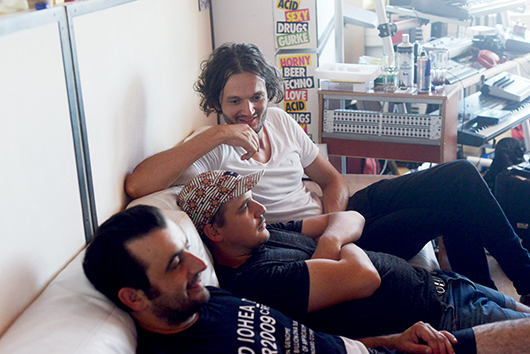
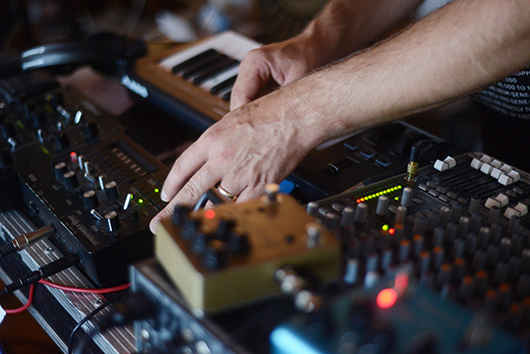
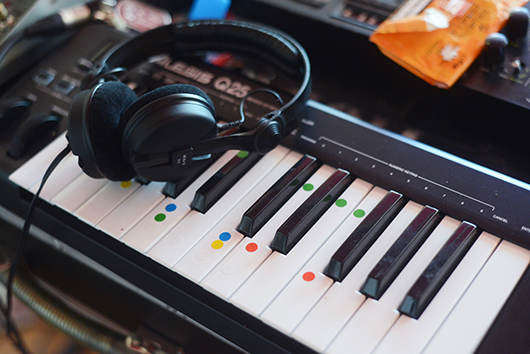
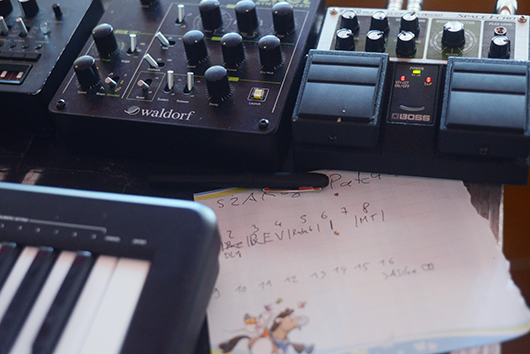
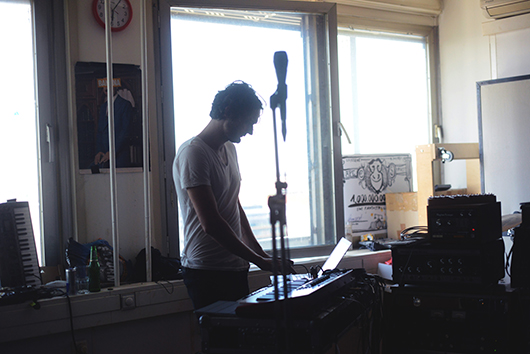
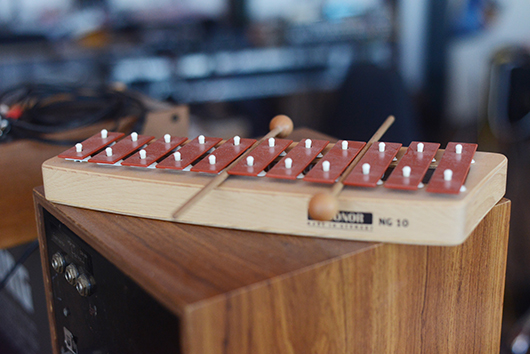
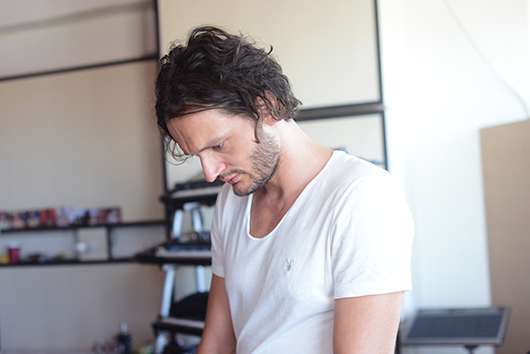
This is a big week for Moderat. Not only will the German trio—which consists of Modeselektor (a.k.a. Gernot Bronsert and Sebastian “Charlie” Szary) and Apparat (a.k.a. Sascha Ring)—be releasing its long-awaited sophomore album, II, but it will also be debuting a brand-new live show at London’s Eastern Electrics festival. Curious to find out more about the nuts and bolts of Moderat’s technical process, last week we paid a visit to the trio’s Berlin studio/rehearsal space, which is located on the 12th floor of a high rise near Alexanderplatz. (For the record, it’s actually Modeselektor’s permanent studio, but for the time being, it’s also serving as Moderat HQ.) While there, we spoke at length with Apparat and Szary, who detailed both the production methods behind II and the challenges of translating the LP to the live arena.
XLR8R: Tell us about the recording process for the new album.
Apparat: The last time, when we made the first record, it was pretty much based on old ideas from all of us. We just had a folder and we put all of the ideas in there and we kind of recycled them. This time, we wanted to start the same way, but it didn’t really happen. At some point, we just ended up starting to make new music from scratch.
Sebastian “Charlie” Szary: We set up the [studio] every week in a new constellation… Then we had sessions and we recorded and in the end, we had a magic loop of eight bars to start with an idea.
When you guys would assemble these eight-bar loops, would it be a drum pattern? A synth line? How raw were these ideas before you started working on the songs?
A: It’s a little different for each of us actually. Whenever Gernot starts with something, it’s mostly beats. For me, these days it’s mostly some kind of melody or some kind or chord sound. And Charlie’s stuff is always…
SS: Arpeggios!
A: Arpeggios, also some kind of weird loops.
SS: Sometimes I’ll record a lot of things, field recordings.
A: He has a big library of tour field recordings on his phone. We always use this stuff and put it in the background of a song. It’s not even fancily recorded, it just brings things to life a little bit.
With three of you in the group, how do you make decisions? Do all three of you have to agree on something?
A: Yeah, that’s the rule unfortunately. We always call it a democratic process, but actually, in our system, each of us has to agree. That causes lots of discussions. Quite often, we have the same opinion, which is really cool and makes things easy. And then some other times, it’s always two against one, but it’s always different [combinations]. It’s not like Modeselektor against Apparat.
SS: It’s Sascha and Charlie, Sascha and Gernot.
A: At some point, you have to start convincing the last guy, and of course a little bit of compromising is involved if it’s three people working on the record. We really try hard to please everyone and make everyone happy with the results.
Are there any kind of set roles while you guys are recording? For instance, we assume that Sascha is probably the only one doing vocals.
A: Yeah, that’s [true]. It’s not like there is a drummer, a bass player, and a guitar or something. Basically, each of us can do everything, which again makes things complicated, because there are three producers in the room and everybody has an opinion on the smallest thing. And everybody would maybe do it in a slightly different way.
SS: I love to work on the computer, but Sascha and Gernot think differently. They’re like, “He’s so slow on the computer. Don’t give him the mouse.” But I can sit for a very long time. [laughs]
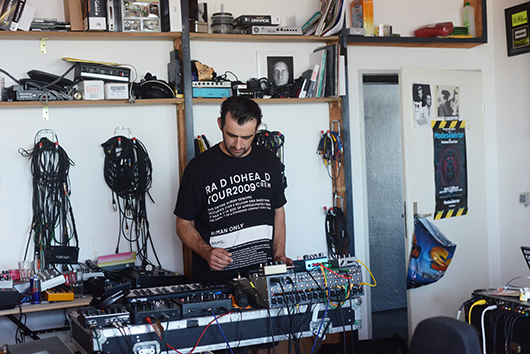
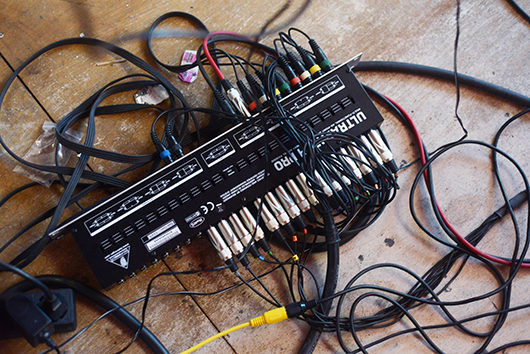
A: Yeah, he’s very patient. Charlie is [also] always the one who connects stuff. Sometimes there is a moment where, for some strange reason, he feels like it’s time to activate [a certain piece of] gear. And then he runs around with cables and stuff, to connect everything to patch bays, and suddenly we start jamming.
SS: Only I know which cables are working or not.
A: Half of them are broken.
SS: I did night shifts—so did Sascha—and I tried things out in different variations. That took sometimes a whole night. I need silence. It’s hard to have someone in the back who’s watching over your shoulder.
The press release for the new album says that you spent six months recording the record and it took 10 years off your life. Was it a difficult recording process?
A: We said that because the whole discussion problem wears you out. You go to the studio to make music, and you end up talking a lot. At some point, you’re like, “Why can’t we just play fucking music without talking?”… The [new] record wasn’t especially difficult. Just working together with three people in this constellation—producers, opinions, everyone—it’s tough.
Your studio has a lot of gear. How much of the record was made in the box and how much was made with outboard gear?
A: A lot of the record was made in the box. We really need total recall, just because of the way we work. We always work on eight songs at the same time, and it would be really difficult to do it a different way.
Were the sounds actually generated in the box, using soft synths and VSTs?
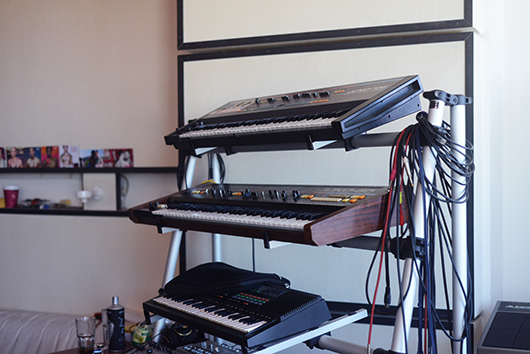
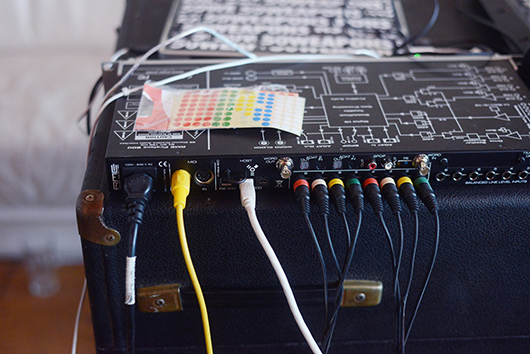
A: We never really sequence synths with the computer. MIDI connections are not existing [in our studio], basically. All the MIDI cables are broken! So what we would do were recording sessions, like jam sessions [where] we would track endless shit. And we would go through it—Charlie would go through it on the night shift. So, for sound generators, we really use outboard [gear]. But for mixing and all kinds of stuff [like that], everything happens in the box.
Are you using Ableton, ProTools, Logic?
SS: We’ve been using Logic. We’ve been using Logic since we started making music. I started using Logic on the Atari in the ’90s.
A: And I used Cubase on an Atari and I planned [to keep] using it, but I switched to Logic for those guys.
SS: I also used Cubase on the Atari. But yeah, we use Logic mainly. But for arranging, we also use iPad tools. There are a lot of little helpful things, applications.
A: One day I went to buy a cable, and I was kind of pissed off because we didn’t really get anything done [that day]. And I walked by the little Apple booth, and I was like, “Okay, fuck, now I’m buying an iPad.” I refused to buy an iPad for three years, and then I just walked by and I got one. I installed all of these tools and it actually sparked some new ideas. It’s not completely useless. It’s not just a toy.
With so many outboard options in the studio, how do you go about choosing what to use each day?
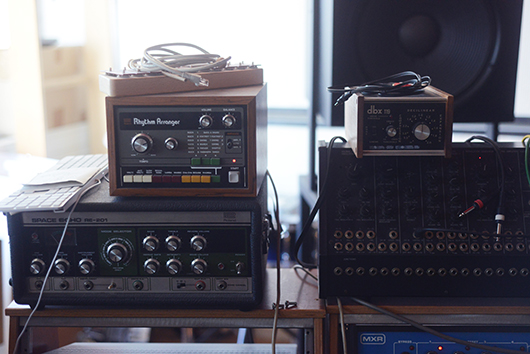
SS: Sometimes you wake up and you think about a very cheesy CR-78 drum loop.
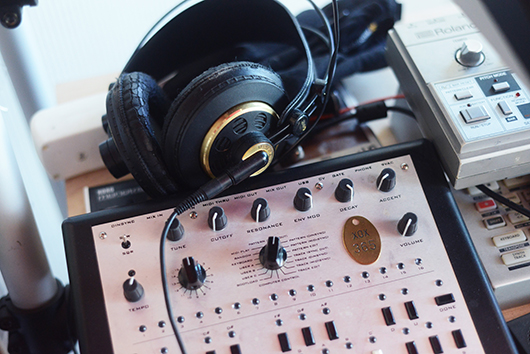
A: It’s often a very spontaneous thing. Like in a song, you say, “I need this snare.” Then you set up a Vermona drum computer and very often it was not the sound you were searching for. But it happens very spontaneously, and those are the good moments, when you have this idea for some reason, and it actually works out. That’s really cool.
Looking back at the album, was there a particular piece of gear or anything that featured really prominently on the record?
A: There’s this plug-in called iZotope Iris, and we used it all over the record [to create] these weird, old-school-sounding little vocal samples. [The vocals were all recorded] live, and then I put them into the sampler and they instantly sounded kind of crusty and old, which we really liked… And we really love the Teenage Engineering OP-1. Each of us has one. I had already played with it a lot, on airplanes and stuff. I make little ideas [on my own], but in the studio, I’ve also realized it’s a really good sound generator. It sounds really digital, but in a nice way, an interesting way.
You guys are getting a new live show ready now. In the studio, it seems like the roles are pretty fluid. For the live show, are you having to define who is doing what for each track?
A: Luckily, we already did that four years ago and we’ve kind of stuck to the concept.
What is the live set-up like?
SS: When we started [playing live], we had a little problem because we had to change the software [we were using]. For over 10 years, we had played with software made by Sascha, Safety Scissors, and Joshua “Kit” Clayton. It’s based on Max MSP and it’s a simple eight-track live looper. You put loops in and they are all in sync. It can play them half time, double time—you can make funny, simple things.
A: It was the mother of Ableton Live, back in the day.
SS: And then Ableton Live came, but we never played with Ableton Live. But for [Moderat], because we wanted to try out some synchronizations with light and video clips, which can be done easily in Ableton Live, we put in a computer with Ableton Live, and we tried to sync another one, which was my part.
A: First, we had to convince Gernot to use Ableton Live. He was so stuck to the old software, because he can play it like a guitar. It took a long time, but we finally convinced him to use Ableton Live. But what’s really ridiculous is that you cannot synchronize two computers with Ableton Live in a totally tight way. I don’t know what’s wrong with them, but it should be so easy. If MIDI sucks, they should program their own protocol and invent something. But you can’t really synchronize two computers perfectly. With the old software [we were using], it just worked.
SS: [Now the live show has] just one computer. I put my computer away, in the trash. [laughs] On the first Moderat live tour, I received a lot of signals from Gernot and Sascha on our own mixer [so I could] process those signals with effects. That’s what I do now. I don’t have a computer. I have little drum machines, pedals, a synthesizer, and a microphone.
A: Basically, back in the day, he was like the creative front of house, on stage. Our signals went to Charlie, and he was mixing it and he did lots of effects and stuff. Now we have a front-of-house mixer, but we want to keep Charlie’s role because it’s really important for the effects and his little machines and stuff, so he gets split signals from us.
I mostly only play the lead sounds. That’s my job. And Gernot plays probably 80% of the track from the computer—he jams it together. And the combination of the more human lead stuff I play and the computer backing and the human effects makes it… I think [the results proved themselves well] during the last tour, so we wanted to keep the concept.
Are you playing the leads on an actual synth, or is it all through software?
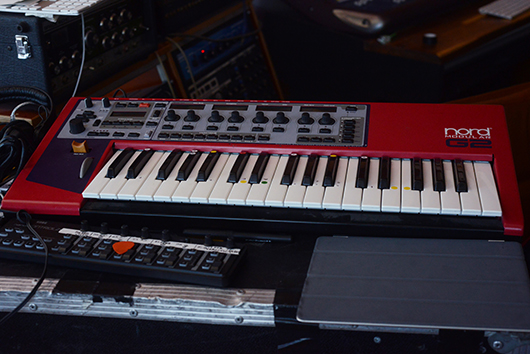
A: On the last tour, I used a Nord Modular, an old one, the G2. And I reprogrammed all the sounds, just because I wanted to have more access to the parameters. Only using samples was a little too limiting. {In the new live show,] I still use the Nord for the old sounds, and I [also] use the synths we used on the record—I run them on my computer. I also run Ableton live, but it’s not synchronized, because that doesn’t work.
SS: Yesterday we spent more than three hours trying to synchronize [everything].
A: Now we do it the 1960s way, with audio triggers. So yeah, it’s a Nord, and it’s software stuff, but everything runs through the computer. Even the synth runs through the computer, because I’m still effecting the Nord with Ableton as well.
Can you specifically lay out what gear is on stage? What does Gernot have?
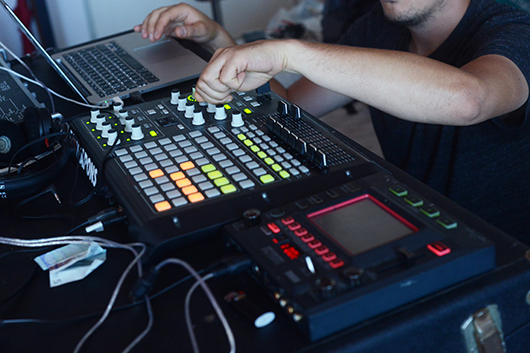
A: Basically, just a laptop, now with Ableton Live. He also uses an APC controller and he has a Kaoss Pad that is a MIDI controller for a custom program for live application. He’s kind of the engine of the set. He plays mostly everything live with faders.
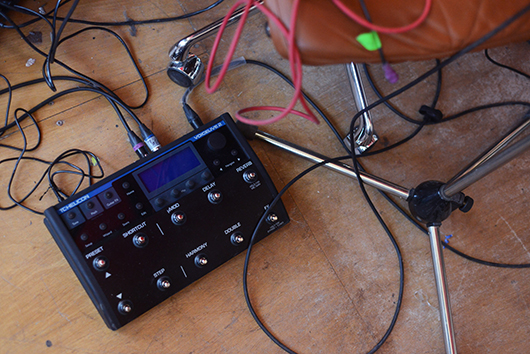
I have the Nord, I have a computer, I have a microphone, I have a TC-Helicon vocal effect for the pitched things on the record, and I have a Guitar Rig system. I don’t play guitar much—[only] for two songs—but Guitar Rig is really powerful for every kind of effect, so I use it a lot.
SS: You have an iPad.
A: I have an iPad, but I only use it once. I play an iPad solo. [laughs]
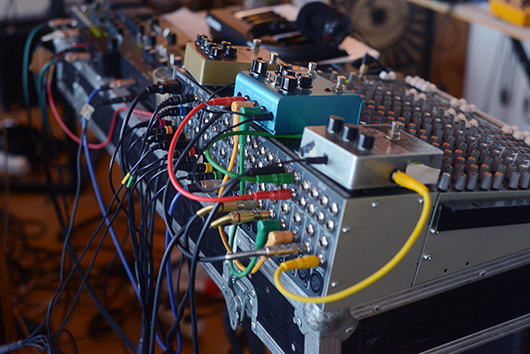
SS: I have a mixer [that receives] a lot of split signals from Sascha and Gernot, and I have distortion, two delays, and a little Waldorf Rocket synthesizer, which is very simple. A little MIDI keyboard, and then a Monotribe drum machine, which is synced to an Ableton Live audio trigger. There’s only one memory [with the Monotribe]—you can only save one sequence. For every song, I’m writing a new sequence from scratch, but it’s very easy. I have headphones.
AA: I think the special thing about this is that Charlie has all of our signals on his desk and he can do whatever [he wants]. He always supports [us]… The set becomes much more dynamic, because he supports everything. When [some sound] goes up, he will turn a bit more distortion, and then more reverb, and suddenly, there’s more going on.
On the new album, there are lots of songs with vocal elements, but only a couple of them are prominently vocal tracks. On the songs where there’s a pitch-shifted vocal or just a vocal snippet, are you still generating that live?
A: Partially. It really depends on the song. For some songs, it doesn’t really make sense because it’s totally repetitive. You can just sing it once and loop it the whole time, but I’d rather focus on something else or play something. So it really depends on the song. For some things, we do it.
It’s not our approach to necessarily play everything possible live with this show. I did that with my last Krieg und Frieden theater experimental show—everything was to be live, no backings were allowed. [With Moderat,] it’s completely different. Everything is about perfect synchronization between music, light, and video. And still, [we maintain] the freedom to improvise, and [leave] some space between all of [the elements]. That’s the main thing. If we loop something, the video has to loop as well, [along with] the lights, and all that. So, trying to figure it all out, that’s the main difficulty.
The video element—can you tell us anything about it?
A: We still work with these Pfadfinderei guys from Berlin, a visual collective we’ve worked with for years. They’ve developed [a new] stage concept… It’s six projectors in some special [arrangement], and there’s also an operator, because they do a lot by hand, but it’s also synchronized with the sound, so [the visual aspect has] the best of both worlds somehow.
With the live show, are you trying to make it sound as much like the album as possible, or do you want it to sound like its own thing?
SS: We try to make an interpretation of the songs from the album. But sometimes it makes no sense to take elements from the record and bring them on stage. For example, those field-recording noises, they make it very…
A: They’re just disturbing somehow. We make [the music] more simple and more direct.
SS: Of course, it’s interesting to lay in another synth line, or another synth sound to play a lead [part]. Sometimes we realize that [the new] sound would have been better to have on the record.
A: Actually, that happens quite often during rehearsals. We’ll be like, “Fuck! We should have had the record play like that.” [laughs]
How much improvisation is happening on stage?
A: A lot of this [music], it has a song structure, so you’re limited. But what we can definitely do is sometimes play another bridge and play the chorus again. Stuff like that will happen on stage and we will look at each other [and gesture], and this gesture is gonna mean “one more time” or something. So, the lengths of the tracks will never be the same. If the set sucks, it will probably be a very short version. And sometimes, we’ll play nine-minute versions of [our songs].
The other thing is, what Charlie does can be quite improvisational, because he plays arpeggios and he programs drums in real time. And what I do, of course I play mostly the same things, but sometimes with little variations, and that’s why I’m using the Nord, because I want to modulate.
The kinds of shows you guys are playing, are they going to be mostly festivals? Theaters?
SS: We will start the beginning of August with a live tour. The first part will be a lot of festivals, which means limited time and a special festival set-up. In the fall, we will start a concert tour of Europe by bus.
Are those later shows going to be in venues where a band would normally play?
A: Totally. It’s going to be concerts at 10 o’clock in the evening.
SS: The bus is going to be parked in front, with everyone looking inside.
A: It’s funny, because in the States, it’s been that way for ages. Those venues were always used for electronic music as well. Here, it was always separated between clubs and venues, and now it’s kind of crossing over. We decided this [Moderat live show] is definitely more of a concert thing, and it needs to [happen] at a concert venue.
What are the main challenges of doing a concert show, as opposed to doing a club show?
A: I think you’ve got two options if you play a show. You can play banging, and try to make the people sweat, or you can try to take the people on a trip. At some point, we decided; we have some banging moments, but it’s mostly about the whole journey. We need to take people on a trip. And that’s something which is easier in a concert venue, because of its set-up. People will look to the stage anyways, the sound is only coming from one side, and it’s a little bit like going to the movies somehow.
SS: I remember on the first Moderat tour in 2009, we did a US tour… In Los Angeles, we played at the Palladium—which is a big theater—with a very interesting line-up: Deadmau5, Tiefschwarz, a lot of big-room techno artists. Moderat at this time was totally unknown in the United States. Modeselektor and Apparat [were known already] of course, but a lot of kids didn’t know about this project. We set up our stuff, and I think we were the only ones [on the bill] with a screen set-up, a real screen with back projection on the stage.
A: We were the only ones with a show, actually. It wasn’t that common to have a show as an electronic act four years ago. It’s a really new thing.
SS: Deadmau5, he had—he still has—the structure of intro, banging, and a big cinema thing. But yeah, we had a show, and it was like a concert, and I saw those kids in front on the barrier, with [Deadmau5] masks. I think it was a very polarizing moment. The kids watched the show, and it was totally packed, and I think they enjoyed it.
A: It worked surprisingly well. I thought it was going to suck big time, but I was really surprised how well it worked.
When we go up to the stage now, it will be the same. I’m not sure if it’s going to work— maybe [the situation] got worse, or maybe it’s totally different. In the concert venues, it’s going to be easy, because the people will come for our show and they know what’s going to happen. That’s the best audience you can have.
SS: But generally on festivals, it’s always a problem. Not a problem, but people get so much input from the big stage. The whole day, acts are playing, you have changeover time, and then the next one is coming. Sometimes, it’s not easy to get [people ‘s attention]. Sometimes we don’t know who is playing before us or who is playing after us. It’s a very compressed thing.
A: We did some research about what other [artists] do before we started producing the live show. And the craziest we saw was the Swedish House Mafia “live” show. From the first second, the strobes started, and they didn’t stop. They just went on! And that’s a little bit what people do at these kinds of festivals. Everybody tries to flash the [audience] as hard as possible. And I think what we will do is definitely switch off everything and do the opposite and calm down the situation.
From a technical standpoint, what are you most concerned about with the new live show?
A: Not much, because now we actually have people who have to be concerned about that. [laughs] We only care about our audio stuff, and the rest, we haven’t even seen anything about the video part—only a 3-D rendering.
SS: Yesterday we saw the first images.
A: Only images, no moving stuff. We trust everyone involved, so it’s okay, but it’s also not so easy to let go and let the other people do [their job]. But that’s what happens right now—everyone does his job, we’ll put everything together in a venue here that we rented, and then we’ll see what’s going to happen.