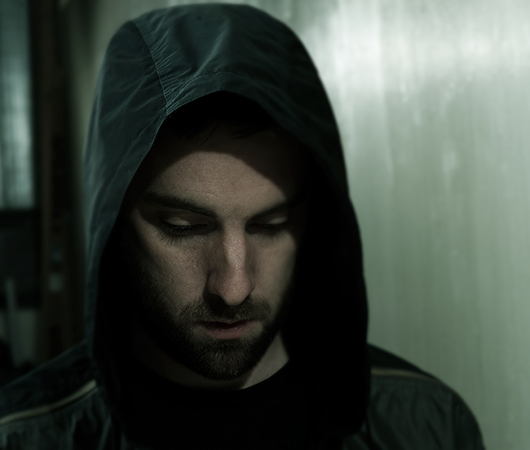
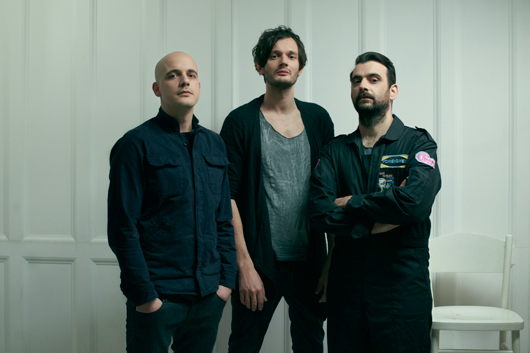
After making a name for himself across a string of top-notch singles and EPs back in 2010 and 2011, Hackman has spent the past 18 months—in lieu of delivering, as promised, a debut full-length—lobbing a number of remixes and a few decent, but still somewhat underwhelming releases, most of which involved collaborative efforts. The “Fists of Ham” single follows suit, repackaging a previously available digital freebie into a two-track 12″ that is fine enough, but ultimately lacks some of the qualities which made his earliest efforts so essential.
Hackman’s “Fists of Ham” first appeared in January of 2011, when XLR8R (among other sites) was enlisted to offer it as a free download (we’ve since taken it down at the label’s behest). The tune—a glorified edit of Joanna Newsom’s harp-folk song “Jackrabbits”—was an intriguing, melodically rich cut that more or less fell in line with the bass-infused, pop-tinged garage hybrids Hackman had proven extremely adept at producing at the time. In its new form here, the track’s sonics have been given a welcome tune-up. A new mastering job (and/or possibly a second mix) has yielded a crisper and warmer overall aesthetic, making for a much more professional and club-appropriate product. Although its arrival may be a bit lackluster, “Fists of Ham” is not a bad song at all; led by a pleasant procession of delay-washed harp strums and held together by thick low end and Hackman’s proclivity for percussion, the song is clearly aimed at the dancefloor, but is also rich and alluring enough to serve simply as a rewarding listen.
Still, one can’t help but wonder how, after 18 months, does “Fists of Ham” now warrant an official release? Interestingly enough, the b-side remix from Dutchman Felix Lenferink makes the best case for the value of this record. With its soulful, half-time skip and deliciously swung chords, the tune in many ways outshines Hackman’s original, perhaps only because we haven’t had a chance to dive into the track many times before.
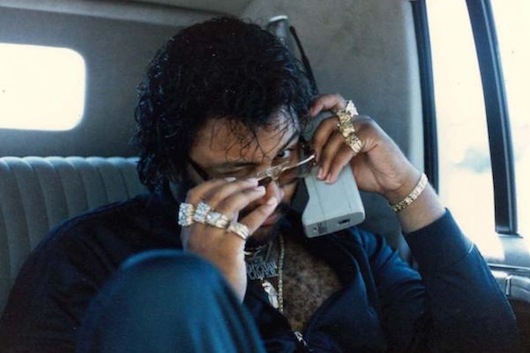
Hip-hop- and soul-centric label Stones Throw has just unveiled its plans to release a career-spanning anthology from pioneering hip-hop and electro artist Egyptian Lover. Known for seminal tracks such as “Egypt, Egypt,” “Dial-A-Freak,” “Girls,” and “Freak-A-Holic,” Egyptian Lover started out in the early ’80s making electro mixtapes of artists like Kraftwerk, Rick James, and Zapp, adding beats over the music with his signature Roland 808. The artist born Greg Broussard went on to release loads of 12″s, EPs, and LPs over the span of nearly three decades, much of which will appear on the forthcoming compilation from Stones Throw. Though we have no specific details as to the contents of the anthology, we do know that it will consist of classic and unreleased tracks taken from Egyptian Lover’s original reel-to-reel master tapes, and will appear as a box set and 12″ single sometime in 2014.
It’s no overstatement: This year’s fall/winter lineup for The Warehouse Project in Manchester is absolutely stunning. Announced today, the extensive list of DJs, bands, and assorted performers set to appear September 27 and New Year’s 2014 includes massive names like Carl Craig, Richie Hawtin, Maya Jane Coles, Oneman, Joy Orbison, Jamie Jones, Cassy, Four Tet, Seth Troxler, LFO, Pantha du Prince, Madlb, Moderat, Flying Lotus, Zomby, Martyn, Ben UFO, Disclosure, Nicolas Jaar, Jackmaster, The Knife, Julio Bashmore, Motor City Drum Ensemble, Bicep, Kyle Hall, and the list goes on and on. Each of the events in The Warehouse Project series have been announced save for the New Year’s Eve/Day parties, and can all be perused here. Ticketing information can be found here, and a cool-looking trailer for The Warehouse Project 2013 can be seen below.
XLR8R Couldn't find the embed function for type: "vimeo" and source: "<iframe src="http://player.vimeo.com/video/70735814" width="530" height="298" frameborder="0" webkitallowfullscreen="" mozallowfullscreen="" allowfullscreen=""></iframe>".
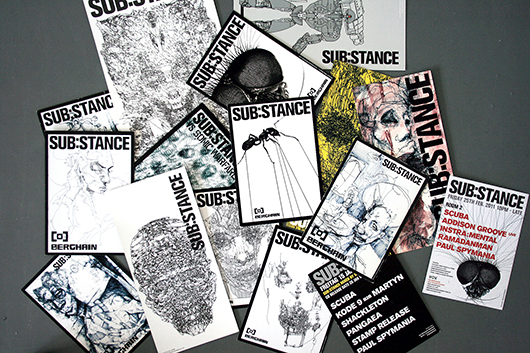
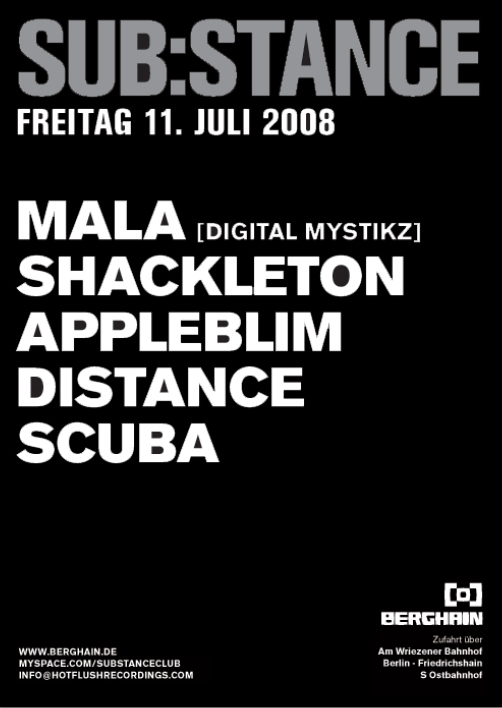
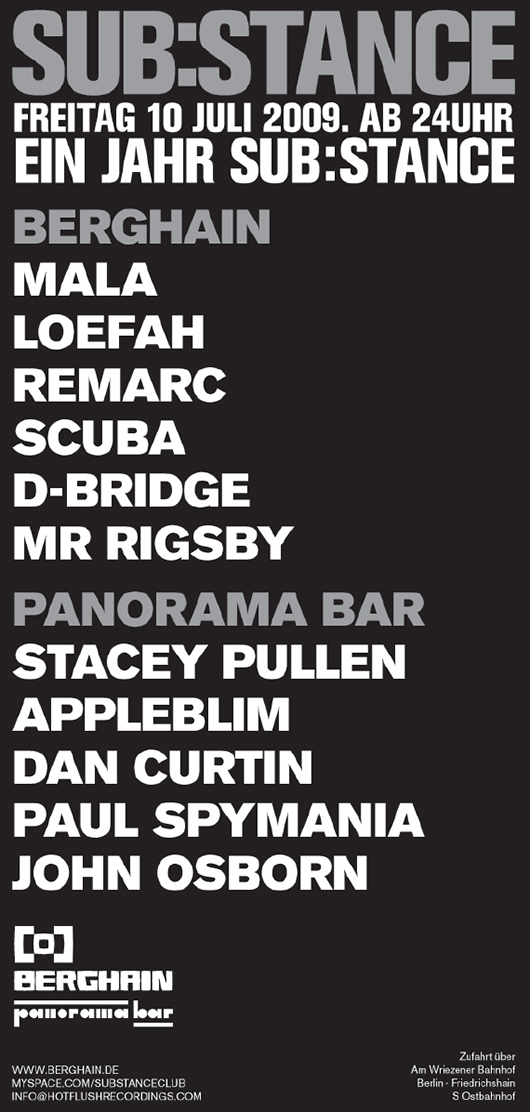
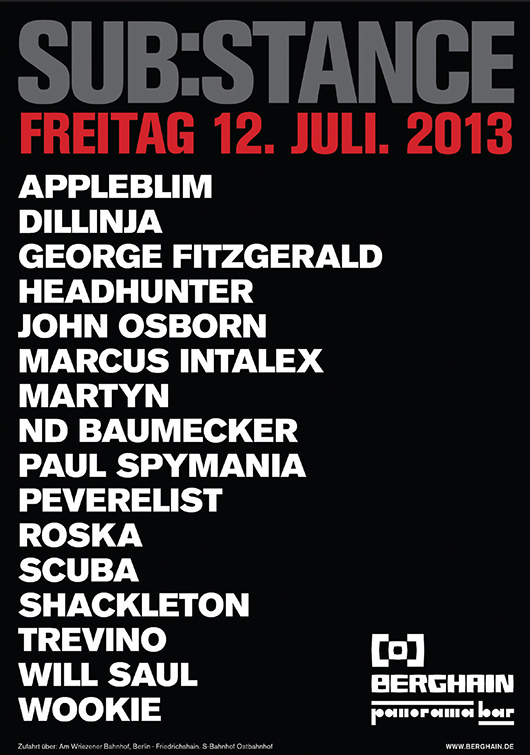
Contrary to popular belief, scenes do not always need a party to gravitate around. The proliferation of faceless internet oddballs in the last few years has proved this. Still, having a meeting place or central, galvanizing club can help artists push their sounds to the next level. For example, dubstep may mean something entirely different these days, but the mythologizing of London’s FWD nights as some kind of primordial soup for ’00s UK dance music is as persistent as ever. Around 2007, many artists who attended those formative dubstep parties began incorporating influences from the continent, and some, like Hotflush boss Paul Rose (a.k.a. Scuba), up and moved to Berlin to experience them firsthand. It was in Berlin that Rose, along with his friend Paul Fowler, started Sub:stance, a night that would help define the mutation period immediately following dubstep. After five strong years, the final Sub:stance party took place earlier this month, and a compilation of tracks by some of the party’s main personalities is dropping this week. In recognition of this landmark, XLR8R called Rose to ask about Sub:stance’s history and influence.
XLR8R: This part is already out there, but would you mind detailing the party’s original circumstances? What made you start it in the first place? I’m from London originally, but I moved over to Berlin in late 2007. It was at a stage where the whole dubstep thing was splintering off and going in different directions. It had become popular in a big underground way in the UK around 2006, and by the end of 2007, it was quite a big deal over there. There were loads of different sub-genres emerging, and the one I was interested in was the techno-influenced one. One of the reasons I moved to Berlin was that I was interested in the techno scene that was going on here, and specifically in the Berghain club itself, and one of the things I wanted to do when I moved over was to start a big night, one that hadn’t really been done before in Berlin, doing that kind of music.
The guy who I started it with, [Paul Fowler], who was at that time my booking agent and friend, and I, we were trying to put our heads together to think of a decent venue to do it at, and we kind of thought that Berghain would be out of the question, really. We were the first outside promoters that they ever worked with. We just speculatively got in contact with them and hooked up a meeting, went in to speak to them, and pretty much the first thing they said to us was, “Do you want to do a Friday night every three months?” It was a massive surprise to us that they offered that, and obviously we kind of took it with both hands and tried to keep our poker faces on during the first meeting. But it was a huge opportunity they gave us, and a big risk for them, because it was embracing a completely different kind of music. Berghain had been and still is predominantly a techno club, and for them to put time and resources into a leftfield dubstep night was pretty amazing. Actually, it shows how open-minded [they are] and how seriously they as a venue and as a management team take the whole musical and artistic side of what they do. It was really refreshing working with them; they take such an open-minded view towards music despite the fact that they have the Saturday night where it’s just straight techno. It was actually really easy to get it going, much easier than we thought it was going to be.
From the very first one, the party was a big success. We were sold out the first night, which was a complete shock to all of us; we had a queue, God knows how long it was, from when we opened. As it’s gone on, the music has gradually changed, and obviously there have been periods where it’s been really good and periods where I haven’t felt so happy with it. But we always wanted to end on a high, and it’s really nice to have been able to do that. It’s not often that a club night can run for five years, so being able to bow out of it with lots of interest after doing it for [that long] is great.
Do you think you would have kept doing the party if it wasn’t such an immediate success? To be honest, I expected it to be much more of a long haul than it eventually was—I was expecting to have to build it up and slowly build an audience. But actually, I knew there was a gap in the market, in the city, in terms of putting on this kind of music, but I didn’t expect it to catch on quite so quickly. I think the venue was completely prepared to do that as well. We were shocked when so many people turned up on the first night, and we didn’t do presale, so we had no way of knowing how many people were going to come. We all saw it as a kind of a long-term project.
Obviously to have success is great, but then you have to keep it going and keep it interesting. Certainly, the first three years were just great event after great event. I think what happened after the third year is that the music really started changing and it wasn’t so obvious who we were going to book anymore, so we had to look at different parts of the UK scene. The premise wasn’t that it was just going to be a dubstep night—it was really like looking at what was cool and interesting in UK music and putting it in a context that it wouldn’t usually be heard. I think in the last couple years, UK music has dropped off a bit in terms of being interesting anyway, and it’s been much more difficult [in that time] to program interesting line-ups without rehashing what we’ve done in the past. That’s part of the reason why we’re stopping. The UK sound now gravitates toward house, and in the context of a house and techno club, there’s not much point in doing a special night where you’re just playing… house and techno. What I’ve been doing and what we’ve been doing for the label reflects that now. We fit much more in Panorama Bar on a regular Saturday, which is what we’re moving towards.
If things have gone completely house and techno now, what influence, if any, would you say Sub:stance has had? Like I said, the last couple years have dropped off in terms of musical innovation in the UK, and I think the UK is the place where musical innovation tends to happen, in Europe anyway—I can’t really include the US in that, but certainly in Europe. I think there was a lot of potential in the dubstep-techno crossover thing, and I don’t really know why it didn’t run for longer. Personally, I always wanted to play at slow tempos and play house, and I think that was always what I was going to do, but there were plenty of other producers doing interesting stuff and, for some reason, I guess the infrastructure wasn’t there to support it. Sub:stance certainly was the biggest night in the world supporting that kind of sound, but you can’t run a scene on one club night, especially when it’s in Berlin. It definitely had an influence on the Berlin club scene, generally speaking, which is pretty one-dimensional house and techno—actually, very much house. To be honest, there are techno nights, but the focus of the Berlin club scene is very much on house. And I think we were able to show that you can get people into a venue in large numbers with a slightly more adventurous music policy.
I don’t necessarily think the baton has been picked up by other venues and promoters. There was a venue called Horst in Kreuzberg which unfortunately recently closed—the reason they closed wasn’t to do with popularity or music, it was because of some bullshit they had with the council. But they were doing some interesting nights for a good couple of years. Apart from that, there wasn’t too much else really, certainly not people trying to do stuff on a larger scale. I don’t know. Berlin’s a funny place. It’s not a place that you look to for musical innovation at all, and I think that is reflected in the mindset of the promoters and the venues. I think Berghain is really the only place that’s got a genuinely forward-thinking staff in terms of music. I’m not saying that people don’t like more interesting music, but they don’t seem to be willing to put their money where their mouth is, in terms of putting stuff on and taking risks and supporting the scene in that way. Maximum respect to Berghain and everyone that works there, because they didn’t have to do that. They could have quite easily just put on more house and techno.
Did you have the same crew for the whole five years? Initially it was [Paul Fowler and I] with Andreas (ND_Baumecker) and Andre from Berghain, and then a little bit later Gideon became involved as well. Michael, who is the boss there, was also involved in quite a lot of the discussions and [he was the one] who signed off on everything, as I believe he does for all the artistic decisions at the venue. We have to say a huge thank you to him because he really believed in our vision and supported us in pretty much everything we wanted to do. It was basically the same team doing it for the whole time, which made it quite cool. It was a little bit emotional on the last night to be honest, having done something for that long and having the same team for all of it.
How did that last night go? It was great! Really, really good. It couldn’t have gone better, actually. Good music, great atmosphere. It’s always a bit of a problem there—you’re probably aware of the door policy at Berghain, and they definitely don’t relax it at all. The only downside of the night was seeing certain people get turned away. But that always happens, and that’s kind of unavoidable and there’s nothing you can do about it. The door staff, they have their own little fiefdom at Berghain and you can’t really influence them in any way unfortunately. But other than that, it was a lot of fun, and it was a good way to sign out on it. I’m still doing stuff there—we’re going to be doing Hotflush nights more regularly next year, but that’s a bit different [from Sub:stance].
What were some of your most memorable nights? The first two or three were amazing, because of the kind of unknown aspect to it. We had a really busy first night, but then we thought, “Oh okay, we’re going to drop off.” There were nerves jangling for the first few. The most memorable nights were the birthdays where—normally we just had the Berghain room—we’ve had the whole venue for four of them. Obviously the Panorama Bar is such an amazing place to hear music; it’s a lot smaller, more intimate. And we heard some really good sets in both rooms. We had Gilles Peterson playing in Panorama Bar, which I don’t think will ever be seen again, which was amazing, and Dillinja playing downstairs, playing his old stuff at Berghain which again, I don’t think that’s ever going to happen again. We had Monolake on the second birthday doing a proper surround-sound set in the Berghain with five stacks all independently controlled, which was pretty incredible. Mount Kimbie playing one of their first live sets in Berlin, in Berghain, was amazing. We were able to put on so many different things. And it’s great to have the freedom to do that kind of stuff. It’s pretty uncommon actually that you can get away with doing that kind of thing in a club and have two hours of dubstep and then an hour of drum & bass, and an hour of more experimental electronic type stuff, and have a crowd that will go with that. It’s pretty special.
With the compilation, was it important to showcase the party’s original sound, versus the more house and techno direction it’s gone in? To an extent. The compilation is still pretty house and techno focused, but it’s just what guys are doing these days. It was more important for me to get producers who have been involved with the night. That was kind of the key thing, and then I let them do their thing—I mean, I didn’t A&R it at all. I just asked a few people to make a track, and the tracks that came in are the tracks on the compilation. Everyone who is on there has been a part of the project from the start pretty much, so it’s more a collection of interpretations of the project, generally speaking. Obviously the artwork is a key thing as well, and has been since the very start of the party. It’s a good little synopsis I suppose, of the project as a whole, but obviously musically it was all made recently, so it’s got a more modern bias. I don’t know if it would have necessarily been desirable to have tracks that were made five years ago, I’m not sure, but I’m pretty happy with the way it stands as a kind of synopsis of the project in general.
Newcomer Jengan Skies (a.k.a. Drew Kennedy) has unveiled his debut offering in the form of the sultry “Clams”, which sees the London-based artist chopping a slew of vocal samples alongside his own assemblage of original grooves. Perhaps the most impressive takeaway from Kennedy’s debut effort is his gracefully programmed drumwork, which smoothly carries “Clams” through its four-and-a-half-minute runtime. It’s also worth mentioning how cleverly the producer smartly paces his track, initially employing a minimalist style before introducing his club-friendly beat.
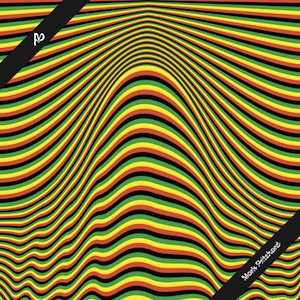
For a producer with a bona-fide classic album under his belt—Global Communication’s nearly two-decade-old ambient opus 76:14—Mark Pritchard keeps a pretty low profile. His latest EP under his own name finds the Sydney-based musician fluently traversing the breadth of Simon Reynolds’ “hardcore continuum” with an effortlessness that makes the benign neglect of his work seem truly baffling. The stylistic range on display on Ghosts points to a possible explanation: Pritchard doesn’t have one signature style, although he continues to flirt with footwork tropes as he does in his Africa Hitech project with Steve Spacek. He’s equally adept at a number of different sounds, which always makes it hard to predict how his latest project will play off whatever’s hot at the moment. As for this EP though, it is as unassuming as it is accomplished; “Duppies” introduces itself with the metallic screams of a bird of prey over impatient, threading footwork kicks, only to veer into gut-wrenching LFO bass lifted from dubstep, jungle breakbeats, and hoovering rave stabs. In a little under eight minutes, Pritchard has summarized 20 years of genre upheaval, but the energy on display is too mental to make it a merely academic or retro exercise.
The four other original tracks are no slouches, either. “Manabadman” is a three-minute blitz featuring drum & bass MC Spikey Tee covering every available surface with verbiage over combustible UK funky rhythms. “Ghosts” and “Get Wyld” also take off, despite their vanilla vocal samples. The former trampolines off its restless, sub-heavy bass drum into a kaleidoscopic explosion of geeked-up synths and popcorn snares that provide more than enough flavor to recuperate the robotic voice dryly informing us that “There were ghosts.” “Get Wyld” widens its stance into a broad-shouldered hip-hop swagger, but the toughness allows Pritchard to backdoor the EP’s prettiest melody. Although there’s nothing particularly innovative about Ghosts, and its references tend toward the obvious, it’s testament to Pritchard’s talent that he can throw together something this fresh out of standard-issue parts.
Danish producer Brynjolfur has dabbled in classic acid and house textures in the past, so he certainly understands how to milk those sounds for all they are worth. The video for his latest track, “I Love You” (out now as part of The Pink Collection compilation from Eskimo, the label helmed by Lindstrøm, Prins Thomas, and Aeroplane), pairs those sounds with images of an attractive woman seemingly come to life in a medical laboratory, realizing her own physicality and beauty for the first time as she interacts with the world around her. Brynjolfur’s production provides the soundtrack for her discoveries, utilizing classic ’80s touchstones like saccharine strings, thick snares and claps, chorus-soaked Juno chords, and punchy kick drums while the retro imagery plays out.
Russian imprint Fuselab—a label we highlighted in last year’s Welcome to… Russia feature—has continued to expand its output into diverse territory over the past few years, and its latest offering, an EP of remixes for St. Petersburg-based singer Gayla Chikiss, continues in that vein. Appropriately enough, the EP utilizes a number of St. Petersburg talent to rework Chikiss‘ “Don’t Be Afraid”, enlisting the likes of Nocow, Hmot, and—featured here—Kontext. The budding Russian producer’s patient, ethereal, and dubwise remix can be grabbed here for free, while the rest of the Don’t Be Afraid Remixes EP can be heard after the jump.
At this point, it seems like the trio of Modeselektor and Apparat (a.k.a. Moderat) has done everything but actually release its sophomore LP, II, so it’s no wonder that the band has finally been forced to share more of its new music before the album drops next month via Mute. Our latest taste comes from NPR, who included the closing track from Moderat’s forthcoming full-length, “This Time,” in today’s broadcast of All Songs Considered. The track can be streamed in full here, before II is released on August 6.
Here, “Jam The Network,” a cut pulled from Hyetal‘s just-released Modern Worship album, is treated to a music video by experimental video-production duo The Great Nordic Sword Fights. The computer-animated clip quickly slips into its comically nonsensical narrative, which can perhaps be summarized as the final race between two rivals in a psychedelic racing video game released circa 1996. Somehow, the strangely endearing video manages to keep up with the tune’s often breakneck pace, complementing its frenetic moments with a string of glitched-out washes of color.