A week in advance of the release of the controversial producer’s much-anticipated double album With Love, Zomby has made the second disc available to stream in full. Much like the first disc—which was streaming last week via Pitchfork Advance—the second part of Zomby’s latest is a sprawling series of creepy jungle- and dubstep-informed vignettes. While the whole thing will be dropping via 4AD on June 18, the second disc of With Love can be streamed—again courtesy of Pitchfork—over here.
Home to notable acts such as UNKLE, DJ Krush, and, of course, DJ Shadow, Mo’ Wax will be celebrating its 21st anniversary next year, and have announced plans to mark the occasion with a retrospective exhibition of memoribilia, art, and the like from the label’s history. With the first exhibition set to take place in London in 2014, label boss James Lavelle (pictured above) and his crew have launched a Kickstarter campaign to help raise money for the event, which they hope will be able to tour internationally after debuting in London. The proposed Urban Archaeology exhibition will include “never before seen artwork, proofs, paintings, toys, and clothing, as well as personal notes and other memorabilia,” from the Mo’ Wax archive. Depending on how much supporters are willing to offer up for the cause, an array of gifts are being offered, with one price point even granting contributors the label’s entire back catalog on vinyl. A video of Lavelle’s own explanation of the project along with a peek into the Mo’ Wax archives can be found below. More information about the Kickstarter campaign is available to peruse here.
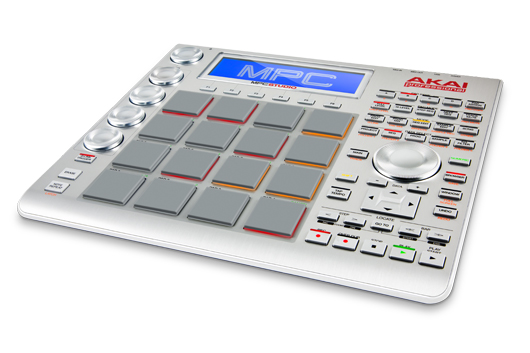
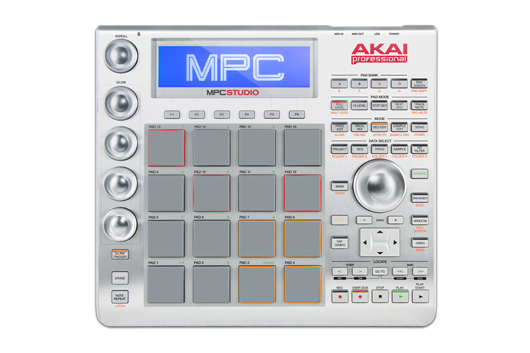
In its 2013 rebirthing of the venerable MPC line, Akai has released a slew of beat machines meant to both maintain and elaborate upon the platform’s time-tested workflow. The MPC Studio—which fits somewhere between Akai’s tricked-out MPC Renaissance and its diminutive MPC Fly iPad accessory—is a slimline, USB bus-powered MIDI controller that’s plenty powerful and small enough to fit in a backpack.
How It Looks
Despite being just an inch thick, the Studio feels sturdy. Its brushed aluminum and plastic case feels like it can withstand plenty of finger drumming on the pads which, importantly, feel every bit as good as you’d expect (they’re the same as you’ll find on the more expensive Renaissance). There are still eight pad banks, four of which you access with the shift key function, and each lights up as yellow, orange, green, or red to show velocity and event data. A large LCD screen provides all key track data, meaning that it’s easy to work on the unit without looking at the computer screen. That said, an articulating screen would have been nice; as with many screens of this sort, it’s meant to be viewed from directly above. Also, unlike the Renaissance, there’s no built-in audio interface here, so any extensive sampling will likely require a computer’s native inputs or a separate external interface. Finally, the option to use the Studio as a standalone, portable beat machine would have also been welcome.
How It Sounds
As with the MPC Renaissance, The Studio pairs nicely with Akai’s MPC Software. The two were built hand-in-hand, and Akai offers 128 tracks to sequence, with an included 6GB of sounds and samples. The software works either standalone or as a VST/AU plug-in inside a DAW; while it isn’t quite as polished as that of, say, Maschine, it’s every bit as deep and sophisticated. Whether it’s chopping samples, recording beats, adding FX, or chaining patterns into a song, the workflow is all intuitive and very much in line with the old hardware. After some familiarizing, it’s easy to work without looking at the computer, while also having the option of turning to the screen when the real estate is needed for time-stretching or overall song construction. As hoped, the swing options sound very close to the original models as well.
The Bottom Line
The Studio is a solid alternative to Native Instruments’ Maschine, especially for those who grew up on Akai hardware. While there’s more competition out there than back when Akai dominated the beat-making landscape, the Studio is significantly more portable (and cheaper) than Ableton’s Push or Akai’s own Renaissance, and it still brings the familiar MPC workflow to the table. Whether it’s Ableton, Native Instruments, or Akai, the beat-machine hardware and software is impressive across the board. The decision, then, is figuring which best suits any given production process.
The Moscow-born, New York-based producer Slava has dropped a video for “Girl Like Me,” one of the highlights of his recent Raw Solutions LP for Brooklyn’s Software label. Directed by Eugene Kotlyarenko, the video takes a highly stylized look at some unsettling and cathartic subject matter which—when paired with the sparse synths and echo-laden juke beats of Slava’s track—becomes a thing of disturbing beauty.
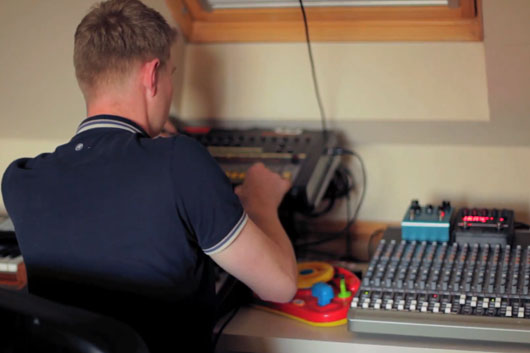
Though he didn’t go Against the Clock, UK producer Addison Groove was enlisted by FACT TV to demonstrate how he builds live tracks using a TR-808, x0xbox, a few guitar pedals, and a modified Fisher Price toy. Going in on his arsenal of gear, the artist born Tony Williams builds a fast-paced techno effort for the video’s first four minutes before explaining what each piece of equipment’s function is and how they are all used together to make beats on the fly and often used in the man’s live sets. The full video can be watched below.
Border Community boss James Holden has shared a new mix ahead of the release of his second album, The Inheritors, on June 17. The announcement of the record back in March was long-awaited, with this being the UK producer’s first proper follow-up to his 2006 debut, The Idiots Are Winning. His DJ set for Resident Advisor’s podcast series was allegedly conceived as a “companion piece” to the record and is a sprawling, sometimes beguiling listen. Featuring artists from such diverse backgrounds as the scuffed techno of Andy Stott, the neo-kraut of Jonas Reinhardt, and the free jazz of Pharoah Sanders, the mix should give listeners a taste of The Inheritors, which is said to be influenced by ceilidh music, pentatonic folk scales, and ancient pagan rituals. The mix is available to download, along with a quick interview with Holden, over at Resident Advisor, here.
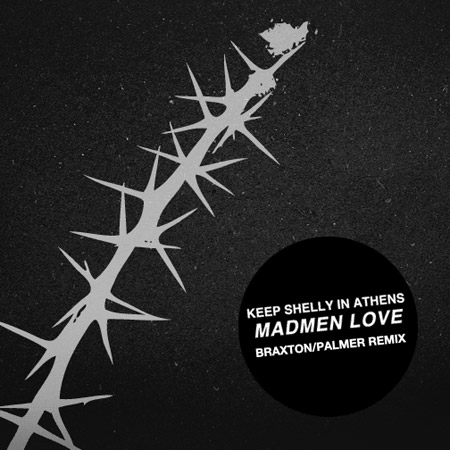
Olympia-bred Braxton/Palmer had his blueprint set in stone since the outset of his remix for indie-pop darlings Keep Shelly in Athens. On his version of “Madmen Love,” lush chords swirl alongside deep kicks and reverb-drenched vocals which zig-zag in the spaces between his trademarked squelching bassline. While Keep Shelly in Athens is no stranger to forward-thinking music, their latest single for Cascine might be the most off-kilter thing they’ve ever done, a droning, skittering slab of trip-hop tinged paranoia. But Braxton/Palmer’s surprising five-minute remix turns the affair inside out, bringing all the hallmarks of his sound to the tune and burying the vocals from Sarah P. underneath a persistent house groove.
Though his career is still in its early days, Leon Vynehall‘s knack for brilliantly fluid textures and weirdly ear-pricking sample manipulation has lent his music an exceptional quality amongst the flood of peak-time, subby house that the UK has been turning out over the past year. Set for release on Will Saul’s Aus imprint, this record, the Brighton producer’s most high-profile 12″ yet, sees him refine and soup up his strong points with a pair of twin tracks that continue to trump many of his contemporaries’ efforts.
“Brother” has been popping up in various DJs’ sets for some time now, with good reason. A chunky thumper for the feet and fists, it’s a floor track through and through, capable of slapping most dancefloors into consciousness with its UK garage-influenced array of sliding subs and a brusquely stepping, chrome-finished rhythm. Those textures that always lurk behind the beats in Leon Vynehall’s music are present here in clipped, quick-fire cymbal hits and stretched vocal snippets, attaching to the otherwise just functional track an odd character that makes it much more engaging.
The b-side “Sister” is a more panoramic offering that recalls the work of Floating Points, albeit while exuding a classic deep-house feel with its oiled massage of bass and heartily pulsing drum rhythm. Strands of melody gradually intertwine with rapidly shifting arpeggiated synth keys, forming what’s actually quite a touching buildup before the second drop. Granted, it’s not particularly original, but it’s achieved with panache, sensitivity, and a level of technical skill that sets this effort above the crush of similarly minded producers.
First spotlighted in our January Bubblin’ Up feature on the new crop of Bristol heads, the Young Echo collective—consisting of Vessel, Kahn, El Kid, Zhud, and others—irregularly gathers around the boards to broadcast a haphazard, club-repellant internet radio show, complete with left-field cuts, sound malfunctions, and a loose flow. That same approach applies to the new mix which the group of artists dropped today. While the second half of Young Echo’s podcast for FACT steers towards grime and trip-hop, it starts out showing off the odd ends of the collective’s music taste—including long ambient and orchestral stretches interspersed with off-kilter beats and spoken word. Young Echo’s debut LPNexus is out this week via RAMP, and the Bristolian outfit’s mix can be streamed and downloaded here.
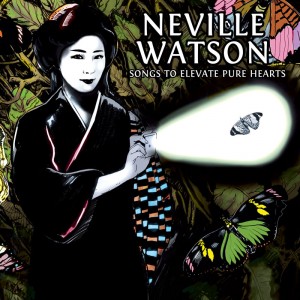
Neville Watson is one of dance music’s elder statesmen, and Songs to Elevate Pure Hearts, his debut album, comes almost two decades into a career that’s seen him run his own record store, a label, and put out an impressive array of 12″s under his own name and a glut of pseudonyms. Though new producers these days are seemingly picked up for full-lengths before they’re old enough get past a bouncer, Watson has followed a classic career path, and Songs to Elevate Pure Hearts is the work of a producer steeped in dance history.
Watson’s sound is unapologetically analog, loose, and unshackled. There’s a roughness to Songs to Elevate Pure Hearts, a grit and crackle that dates the production but also makes it stand out amid the sheen of the overproduced norm. In recent years, Watson has forged a successful live partnership with KiNK—a Bulgarian producer whose records revel in bombastic energy—and though there’s little of KiNK’s main-room buzz at work here, Watson does seem to share his production methodology of making things feel live; tracks like the sardonically titled “Everything I Know About House (I Learned On Facebook)” flow with an elastic energy, the machines’ whir almost audible beneath chuntering drums and an oscillating low end.
Much of the album’s charm lies in Watson’s ability to do a lot with the sparsest of elements, and unlike many of the producers pushing ’90s house revivalism, he displays a keen ear for melody that lifts his work beyond simple rhythm workouts. The title track centers on a serpentine bassline, hi-hats that clatter like a cutlery drawer being tipped down a fire escape, and the occasional “Ooh baby” trailing off in dub echoes. It’s a spartan sonic palette, undoubtedly, but its judicious deployment is the product of a hand that knows the value of restraint. “Against the Tide” adopts the same “less is more” philosophy, a late-night jam with filtered synth stabs soaked in reverb and peppered with the product of a vintage MPC. Watson’s elegy to the early ’90s, the aptly named “Son of House,” provides the record’s standout moment, coupling the simplest of synth leads with a bassline crafted for Balearic terraces at sunrise.
Though his success at targeting a dancefloor is undoubted, Songs to Elevate Pure Hearts stumbles when Watson switches his focus away from the club. Beatless workouts like opener “Dark Star” or “The Girl from Kowloon Tong” are undercooked, and feel more like efforts in box-ticking the prerequisites of an LP than genuinely interesting moments. “Axiomatic” is more successful, its pitch-shifting hi-hats hammering over rubbery bass notes, but again it’s a strong idea that fails to evolve. This is Songs to Elevate Pure Hearts‘ overriding weakness; it feels less like an album, and more like a collection of very good EPs bolted together.