Longstanding sonic adventurer Anton Zap is in the midst of prepping Water, a new full-length collection that gathers some of the Moscow-based producer’s previously released—but rather hard to come by—tracks along with a handful of new productions. Before the LP drops next week via R&S offshoot Apollo, the seven-track effort can now be streamed in full. As the hypnotizing video for the record’s title track hinted at when we premiered it last month, Anton Zap’s upcoming album is a serenly textural event which effortlessly floats between moments of adventerous beatmaking, ambient techno, and pure sound-design magic. The entirety of Water can be streamed below before it officially drops on June 18.
The XLR8R Music Player requires Adobe Flash Player version 9 or later. Click here to install.
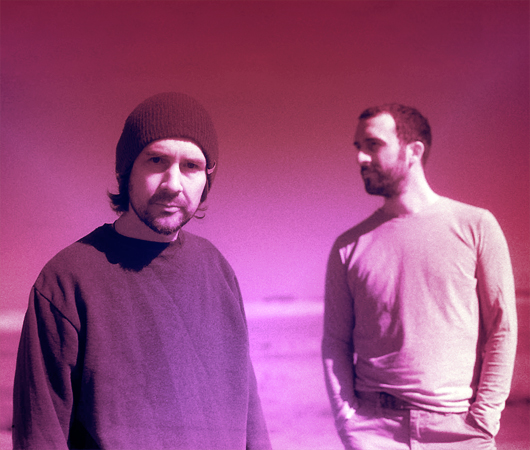
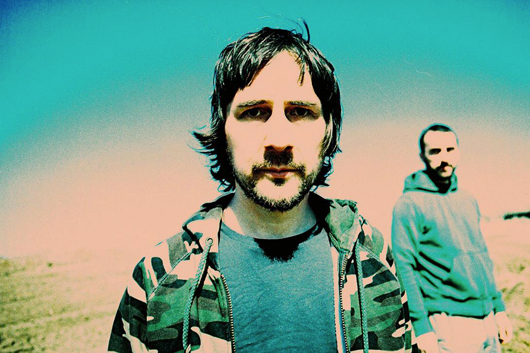
Lifted from the 2002 LP Geogaddi, that quote was the central mantra of Boards of Canada‘s bewitching “Music is Math,” a song which heralded a monumental album that made good on the fascination with numerology and predeliction for occultish themes that the Scottish duo had only hinted at on Music Has the Right to Children. It was a powerful moment for Michael and Marcus Sandison, because it essentially revealed that the brotherly producers were interested in more than merely writing downtempo IDM or technicolor trip-hop tunes. But there was something else in that song, something hidden in plain sight or at least obscured by the initial shock and awe of listening to Geogaddi. Notoriously secretive (well before that became a thing), Boards of Canada had subtly revealed a piece of itself in that esoteric vocal sample; this was a pair of artists acting as a conduit to the lost collective consciousness of yesteryear, conjuring memories of informational film reels, secluded communal living, early environmental activism, and mind-altering hallucinatory excursions, then shaping and handcrafting those remnants of the past into the colors and sounds of contemporary life. In the years that followed, the idea of “the past inside the present” came to define the duo and its music, but since the incandescent The Campfire Headphase LP first appeared in 2005, something drastically changed. Boards of Canada had a new vision.
From the beginning, Michael’s and Marcus’ music has always been inextricably linked with the past, as if the reason why it takes them so long to release new work is because it has to traverse actual decades before the world can hear it. And the Scotsmen’s first three full-length albums weren’t just masterful works of nostalgic futurism—they were also inspirational enough to spawn a litany of imitators and a handful of splinter genres (e.g. “chillwave”). Given that, any die-hard fan’s first listen of Tomorrow’s Harvest will undoubtedly trigger questions and confusion. Because now—instead of evoking the romanticism of a half-remembered history with crunching beatwork, evocative soundscapes, and spectral melodies—Boards of Canada is exploring a desolate and dystopian idea of our not-so-distant future, sharing its ominous predictions through some of the most clear-headed and forward-thinking production the group has ever released.
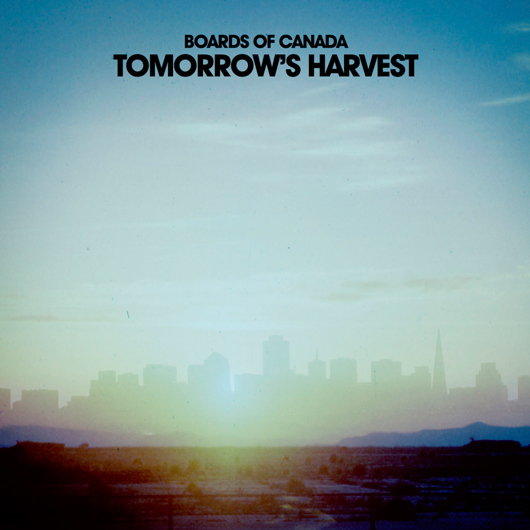
“We’ve become a lot more nihilistic over the years,” Michael recently explained in an extremely rare interview with The Guardian. “In a way, we’re really celebrating an idea of collapse rather than resisting it. It’s probably quite a bleak album, depending on your perspective.” He’s not wrong, but it feels like the veteran musicmaker is severely underplaying the darkness of Tomorrow’s Harvest. From song titles like “Sick Times” and “Reach for the Dead,” to the overtly macabre musical overtones, to its forebodingly prophetic name, right down to the time-ravaged imagery adorning its artwork, Tomorrow’s Harvest paints a picture of the lost civilization our contemporary culture used to call home. It’s an arid landscape riddled with the decaying structures of once vital cities; littered with bleached-white bones and neglected possessions; pocked by the ramifications of careless corporate industry and intense climate change; populated with malformed wildlife and nomadic clans; and haunted by aimless radio transmissions and the churn of propellers from helicopters surveying, searching, or watching overhead. This is the soundtrack of a grim inevitability. As Marcus points out, “If you look again at the San Francisco skyline on the cover, it’s actually a ghost of the city. You’re looking straight through it.”
Not unlike the authors of contemporary dystopian works The Road and Children of Men, Boards of Canada doesn’t explain in so many words how or why it arrived at the world of Tomorrow’s Harvest. However, the Scots have left their fans plenty of clues to hypothesize on and help them work out their own conclusions. “There’s actually more use of subliminals on this record than on any previous album we’ve done,” says Michael, “so we’re interested to see what people will pick up on.” And if there is any group of listeners dedicated to uncovering the mysteries of laboriously conceived and intricately produced music, it’s theirs.
The warbled voice which inhabits the outstanding “Nothing is Real”—an utterly satisfying song for any dyed-in-the-wool fan of classic Boards of Canada—delivers a specific and succinct message over the track’s phantasmic bounce; it’s entirely conceivable that isolating the frequency and deciphering its words would further illuminate the inner workings of Tomorrow’s Harvest. “Collapse,” placed in the actual center of Tomorrow’s Harvest (no doubt a clue to the album’s core theme in and of itself), is an airy synth piece said to be a palindromic composition, a theme which deeply inhabits the album. Even the record’s overall structure resembles a sort of Ouroboros-like mobius strip. From the chilly foreshadowing of “Gemini” to the moonless epilogue “Semena Mertvykh” (Russian for “Seeds of the Dead”), the dread of history repeating itself soaks through to the marrow of Tomorrow’s Harvest. Listening to the album from the outside inwards—first track, last track, second track, second to last track, and so on—might help uncover some of these mirrored similarities, not to mention put “Collapse” as the final word of that rearranged tracklist.
After the lights go out on the eerily sparse “Sundown,” we’re greeted with the steady anthemic charge of “New Seeds,” the only song on the album that offers a glimmer of outright hope to those of us traversing its barren terrain. If the brothers are indeed “celebrating an idea of collapse,” then it’s possible that this imminent destruction has been embraced with the intention of starting over—eschewing our oftentimes destructive lifestyles for, perhaps, something reminiscent of the simpler eras referenced in Boards of Canada’s early work. And “Come to Dust” only solidifies the band’s intent immediately afterwards. Essentially a reprise of “Reach for the Dead” (there’s that palindrome again), the lush and vaguely uplifting piece of beat-driven kosmische music evokes the feeling of watching juxtaposed time-lapse footage of a budding plant and an unfinished skyscraper reach towards the sunrise à la Koyaanisqatsi or Baraka.
Conjuring this kind of intensely metaphorical imagery feels entirely deliberate on Tomorrow’s Harvest, as the Sandisons have long been interested in filmmaking. Back in 2005, Michael told Pitchfork, “[We used to get] our friends together to make films. We had our crappy early-’80s bikes and went out with my dad’s super-8 camera making films.” And maybe because they are in fact trying to tell a cautionary tale of sorts, Boards of Canada’s new album is the most purposefully cinematic milestone in their discography, a collection of vignettes and snapshots torn from a greater narrative and pieced together like an impressionistic sci-fi film. Early on, the punch-drunk “Jacquard Causeway” sounds like radioactive sprites frolicking in the dusty wake of a lumbering behemoth, and later, its more playful sister track, “Palace Posy,” returns to see these carefree creatures happen upon a chorus of nomads in the midst of a dusk-lit song and dance. (Given the latter song’s anagram of a title, we’re almost directly told exactly what those people are celebrating.) And while it directly recalls the quiet majesty of Music Has the Right to Children and touches on Geogaddi‘s kaleidoscopic mysticism, “Sick Times” gives us a panoramic aerial view of the landscape before diving back down to hover in the shadows of its dilapidated ruins and come to land on the dry, sandy earth.
Plenty of more straightforward filmic references also abound. “We’re very much into grim ’70s and ’80s movie soundtracks,” Michael told The Guardian, before going on to cite the likes of iconic horror auteur John Carpenter and seminal Italian composer Fabio Frizzi as heavy influences on the new album. Furthermore, he shared that Boards of Canada set out to give Tomorrow’s Harvest a “VHS video-nasty element” that included both the band’s production approach and a stylistic kind of structuring. “We even went to the extent of timing changes in the music and the composition of the pieces in really specific ways to give an impression of something familiar from soundtrack work that was around 30 years ago,” Michael explained. Whether or not all of this comes across immediately or gradually or never at all, everything put into each track is part of the subconscious experience that Boards of Canada so painstakingly created for the dense and invigorating Tomorrow’s Harvest.
In speaking to Pitchfork about The Campfire Headphase eight years ago, Michael said, “People will look for secret things now in this record even if there aren’t any,” which Marcus corroborates when he says, “Instead of listening to the music, [fans] start looking for some hidden things immediately.” The same thing could probably be said about Tomorrow’s Harvest, so it’s important not to treat the record only as a scavenger hunt—no matter how much fun that can be. Like any great work of art, we may never fully understand every nuance and subtlety woven into the LP, but that doesn’t mean those elements whispering their hidden messages are any less integral. Maybe the glimmering sprawl of “Split Your Infinities” wouldn’t be as arresting without the unintelligible chatter sunken into its second half, but its presence isn’t necessarily an invitation to dissect the music until all of its parts are laid bare.
There is a joy in the illusory nature of both the mythos and the music of Boards of Canada, something which exudes an appreciation for depth, detail, and concept. It’s the same thing that drove fans around the world crazy with speculation and hope when Warp‘s marketing campaign for this album slowly unfurled. Very much in the same way, Tomorrow’s Harvest thrives in the excitement of directly confronting us with the unexpected and the unknown. After all, it’s those things that we thought we heard or that seem to be connected that are the most intriguing and keep people returning to Boards of Canada’s albums long after they’ve been released. Still, like commenter Rooksby wrote in the comments of Michael’s and Marcus’ interview with The Guardian, “Some secrets should remain secrets.” Because no matter if the Sandison brothers are reformatting our history through their own reflective lens or peering through a dusty looking glass to see what today’s conduct has wrought for our future, there will always be something just out of reach to ponder while soaking in their inexplicable music.
Parisian DJ/producer Djebali gave away a tune of his on XLR8R last year to celebrate his birthday, and he continues the tradition by once again offering up a celebratory free download. The track in question, “Emotional Traffic,” is basic but effective; starting off with a minimal, clap-heavy rhythm, it soon introduces a brightly looped sample into the mix. The result emanates pure summertime vibes with a classically minded French filter-house twist.
Gold Panda‘s 2010 LP, Lucky Shiner, was as triumphant a full-length debut as any producer has had in the past three years. Since then, his output has been steady, if somewhat understated—a handful of singles and EPs have surfaced, each seeming to find the producer tinkering with scattered ideas and in search of a concrete direction to take his craft. Listening to his sophomore album, Half of Where You Live, it appears that he’s settled on a direction that’s not so far removed from the dusty beatscapes and homemade house and techno of his debut; Gold Panda is still making sample-based, melodically rich music with a poignant personal touch, but now that approach is yielding even better results.
Given the three-year gap, Lucky Shiner has aged nicely, save for maybe the hook-laden “You,” which has become a casualty of over-rinsing, not to mention a misguided appropriation or two. Still, the choice to not entirely overhaul the core sonic ideas presented on his past LP proves to be a smart one. With Half of Where You Live, Gold Panda sounds like himself, but he’s more refined aesthetically, and much more mature musically. That is not to say that this LP does not have its share of enticing hooks or flashes of pop-like accessibility, but that those moments are a bit more withheld now. “Brazil” is an early example of such; built atop a percolating house beat, the tune unfurls a dense set of reversed samples topped with only a few glimpses of outright leading melody and a voice which reminds the listener of the song’s title over and over. In the moment, the song is immediately appealing and almost uplifting—it’s the kind of track that might work as well at a sun-soaked festival as it would on a long summer drive—but when “Brazil” completes its five-minute run, there are no sticky refrains left rattling around one’s head, just the warm feeling the track leaves behind. Many of the LP’s other efforts strike a similar balance—”An English House” employs a particularly Lone-indebted glow with its drum-machine-led house, “We Work the Nights” densely piles heavenly strings and ringing guitar strums on top of one another, and “Flinton” works a simple piano progression into a warbly, jazz-touched exercise.
At their core, Gold Panda’s productions live and die by the strength of the samples chosen and the way in which they are manipulated. On Half of Where You Live, the man’s craftsmanship as a sample-based producer shines—the dusty textures, chords, and melodies he lifts from various vinyl sources are not manicured to perfection; instead, they’ve been plainly reshaped to hold their essence while staying within the desired context of the track. It has been said that Gold Panda sought to create a “city album” with this LP—a record that would reflect the impressions he felt whilst touring the globe and being introduced to a range of different cultures and geography—and it’s hard to imagine how he could have accomplished this without the extensive use of samples. These bits of anonymous audio allow Gold Panda to tap into worlds that would have otherwise been off-limits, or at the very least unreachable. Still, one can almost sense his respect for the sources from which he pulls these sounds. Though they may be chopped to fit a more appropriate rhythm, the samples are largely celebrated for what they are; they haven’t been processed beyond the point of no return, and are instead allowed to provide a theme for each particular production. One can also hear this sort of “respect” in the fact that Gold Panda does not overdress the themes and atmospheres that the samples create, as bits of rhythm and melodic adornments are added solely to help serve the cause. It is this reluctance to interfere too much that makes tracks like the aforementioned “Flinton” and “An English House,” the Dntel-esque “The Most Livable City,” and sparse closer “Reprise” really work.
In the end, Gold Panda’s second LP is bound to turn off some of his existing fans. There is no second-coming of “You” or “Marriage” to be heard on the record, and though its efforts are miles away from experimental, they do render the album a bit less accessible than the man’s previous full-length. Despite that, Half of Where You Live is a considerably more rewarding album, one that creates lush, sophisticated, and disarmingly inviting music using the simple building blocks of sample-based beats and deeply personal musical storytelling.
Leeds producer Liston is proving himself to be surprisingly dexterous as his tenure at the XVI label continues. Having already proven to be more than adept at making chilled, flickering garage tunes—as we heard in April when his “All on You” track was featured—the beatsmith is now exercising a more laidback and soulful approach on tunes like “Yan See.” Liston’s track has the constant whirr of a runout groove in the background, relying on drum sounds from the golden age of hip-hop and a spitfire bassline to lead the thing forward. Compared to the semi-romantic soundscapes that packed every corner of “All on You,” “Yan See” is almost considerably more bare bones, making maximal use of an effectively minimal arrangement. This side of Liston was recently spotlighted in a compilation of soul-sampling productions called Selected Cuts (download it for free here), with word of a more garage-rooted EP due sometime this summer.
Throughout the week, a whole lot of material gets posted here on XLR8R. And while we know—and love—that some hardcore readers will eagerly pour over every single news story, interview, podcast, video, and MP3 download that appears on the site, we also realize that for most people, it’s impossible to see everything, which means that some quality XLR8R content is likely to get missed in the hustle and bustle of everyone’s daily lives. In the interest of making it easier for everyone to catch up, every Friday we present The Lowdown, a weekly wrap-up of the top 10 tidbits from our site.
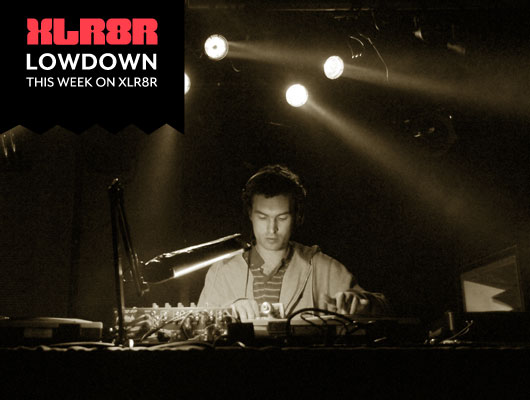
1. This week’s XLR8R podcast came from Bristol veteran Peverelist (pictured above), who delivered a fresh dose of the low-end-heavy sounds of his hometown.
2. Following a trip to Montreal for the 2013 edition of the annual MUTEK festival, our review compiled a list of 13 things we wouldn’t forget about the festivities.
3. As we do at the start of every month, we kicked off June by assembling a list of the top 20 tracks from our Downloads section during May.
4. The always unconventional Moodymann unexpectedly dropped a new album this week.
5. The latest installment of our In the Studio series found us paying a visit to the Los Angeles studio of Fade to Mind bossman Kingdom.
6. Ahead of his forthcoming new LP, Siriusmo premiered a new video for album cuts “Itchy” and “Corner Boy” here on XLR8R.
7. UK duo Disclosure released its much talked-about debut album this week, and we added to the conversation by taking a look Deep Inside the LP.
8. Our newest Bubblin’ Up artist is LA beatmaker and Anticon signee D33J.
9. Barcelona producer Alizzz gave us his bombastic—and Rustie-reminiscent—“In Chains” as a free download.
10. It was a big week for new electronic albums, which helps explain why so many people were taking a look at our review of Immunity, the stellar new LP from UK producer Jon Hopkins.
An expanded version of the The Lowdown is also available via a weekly email newsletter. Those interested in an even more in-depth round-up of XLR8R content, including a complete listing of all the free downloads we’ve offered in the past seven days, should sign up by entering their email address below.
Can we just go back to calling this dubstep? London’s Beneath, a fixture on Martin Clark’s Keysound label, makes tracks that are both dubby and steppy and even occasionally employ a bass sound approximated by “wub.” Just as importantly, last year’s Illusions EP—which was really more like an LP—was visceral and bleak and formally well defined, nautical miles away from the polite, slinky forms designated by descriptively impotent terms like bass music or post-dubstep. Remember that Keysound delivered London collective LHF’s Keepers of the Light album last year—in name and deed, a convincing statement that the sound was far from exhausted. At its strongest, the music produced in the name of keeping the faith has been a welcome reminder of the strict, martial pleasures of dubstep per se: steely machine funk for the end times, intended for sinew, gristle, and eventually the ears.
That’s not to say that staying within a particular bloodline doesn’t have its own pitfalls. Dusk + Blackdown followed up their spectacular Margins Music with the limp Dasaflex, which, in its attempt to sound ebullient, mostly sounded faint, weak, and airless. Beneath’s “Strike a Pose” b/w “Bellz” single, for the young Niche ‘N Bump label, delivers a fine dose of rigid funk, but in other respects comes across as dry and utilitarian. In short, these are stolidly respectable tunes. A-side “Strike a Pose” falls just shy of the quality found on the shadowy Illusions. The atmosphere laid out by its Zamboni bassline, decorated with a few coarse braps, is like a staircase that leads back to its own base. The drums, aerated by numberless rimshots as evenly spaced as steel rivets, are a strange mixture of torpor and hyperactivity. But the sense of congestion clears up without much trouble on “Bellz,” where Beneath flogs another lumpy, menacing circus melody with inflexible rows of hi-hats. Swing Ting‘s UK funky–oriented “Bellz” remix is a somewhat looser and much brighter cousin to the original. Overall, it’s a decent package, albeit one lacking in the nuance that—along with those drums—marks Beneath’s best work.
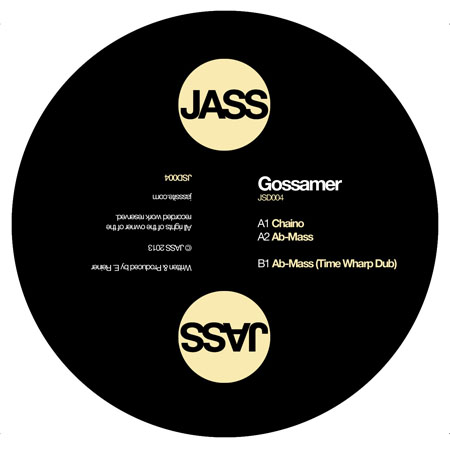
After dropping a few enticing digital releases, the JASS imprint—helmed by budding East Coast producer Time Wharp—has been quiet for some time, but that will soon change when it drops its first 12″ later this month. Responsible for the forthcoming vinyl outing is Gossamer, an LA-based producer who delivers a stripped-back piece of lumpy house—complete with a metallic melody that sounds inspired by the internal rattle of a live pinball machine—on “Chaino.” The upcoming record’s a-side fortifies its bouncing lead with an unstoppable assemblage of dense drums and continues pushing forward by piling on extra claps, hi-hats, and toms. Gossamer’s “Chaino” b/w “Ab-Mass” 12″ hits stores on June 18, with a digital release to follow on July 2. A preview for the rest of the forthcoming effort—including a dub from the JASS label boss himself—can be heard after the jump.
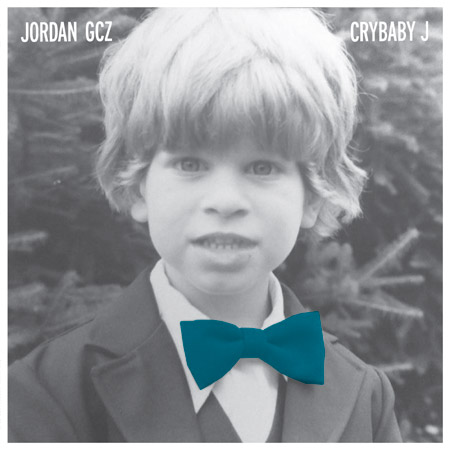
Jordash (a.k.a. Jordan Czamanski) has a full-time gig as part of Amsterdam’s DJ/production duo Juju & Jordash, but will soon branch out in his own direction. While Juju & Jordash will continue with business as usual, Czamanski has started his own imprint, called Off Minor, and unveiled the Jordan GCZ alias, which will helm the inaugural 12″ for his new label. Featuring the tune “Crybaby J”—which, according to the press release, is semi-autobiographical—the 12” will be rounded out with a “Dub Mix” of the original production on the flip. Jordan GCZ’s new tracks are due sometime in June, and can both be previewed below.
After playing it out for years, Dutch DJ/producer and 4Lux label head Gerd‘s edit of the classic NY’s Finest tune “Do You Feel Me” will see an official 12″ release at the end of next month. Gerd’s “No-Kicks-Re-Interpretation” comes 20 years after the ’93 original was first issued, and—as the title implies—finds its editor removing the original track’s four-on-the-floor slam in favor of letting the jumping piano chords and wandering bassline push it along. While no exact release date has been set, we’re told to expect the re-interpretation to drop sometime before the end of July via Gerd’s own label. Until then, a preview of Gerd’s edit can be heard below.