Archie Pelago Readies New 12″

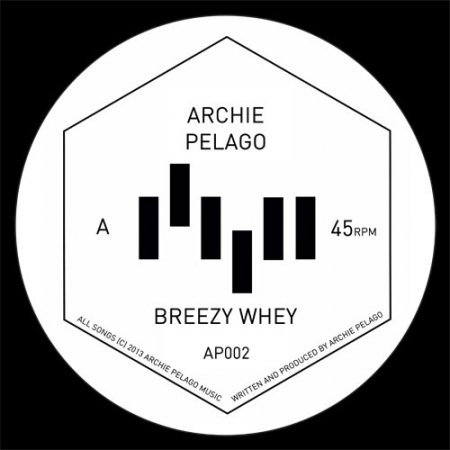
The increasingly prolific Brooklyn trio Archie Pelago has announced it will soon follow up the recent release of its excellent Sly Gazabo EP with another record for its eponymous label. Descriped as offering two of the band’s “most euphoric tracks to date,” the “Breezy Whey” b/w “Backflight” 12″ will mark the second release for the fledgling Archie Pelago Music imprint, and is set to arrive on July 22, along with a remix of the b-side by UK producer Thefft.

Deep Inside: Disclosure ‘Settle’

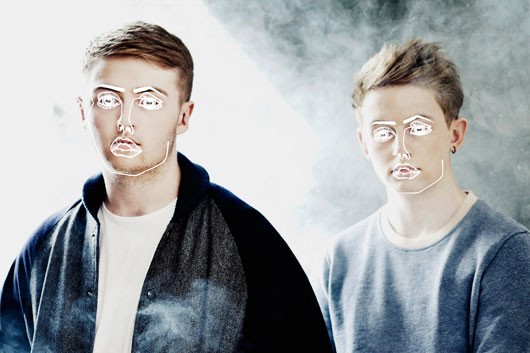
Any discussion of Disclosure, the English duo of Guy and Howard Lawrence, seems to be fraught with controversy. The pair released its first single while the brothers were precocious teenagers (Howard is still yet to reach 20), and has followed it with a catalog that combines a whole history of underground dance music with the hookiest contemporary pop. This irks a lot of people. Common critiques maintain that the brothers are either too young to fully appreciate their influences (though growing up near London surely helped to accelerate their maturity), are perverting them via streamlining, or both.

These are of course underground frustrations, ones based at least in part on the pop world’s lack of frustration. While partly valid, these claims ignore the history of past club music-to-pop crossovers—acid house’s “summer of love,” for one, saw experimental Chicago tracks reinterpreted in New Order’s chart-topping singles and massive British raves alike. Disclosure is merely another part of this lineage, and from an “underground” standpoint, it is better to maintain indifference. They are a pop act through and through, and there is really no solving the “problem” of Disclosure, other than to perhaps acknowledge that underneath the sheen, there are occasional flashes of eccentricity.

Settle, the duo’s debut album, confirms the project’s pop ambitions. In conversation, Guy is disarmingly lax about the pair’s process. In a way, he has the air of a super-producer, the sort who might appear on YouTube composing a ubiquitous, million-dollar single in a matter of minutes. “Ninety percent of the time it’ll be like, I’ll be producing a beat and getting an idea going, and then Howard will be with the singer coming up with a theme for the song and the lyrics, and just throwing ideas and melodies around,” he says. “With a song like ‘Latch,’ we actually had the whole song finished and written, but it had samples all over it. It had no lyrics or anything—it was all cut up, with vocals from an old house track. And then in the studio we cut all the samples off, and just put [Sam Smith] on it instead. That was the only song where we started with a vocalist that was already complete, if you know what I mean. [On] ‘White Noise,’ we had nothing at all. When AlunaGeorge came into the studio we were like, ‘we’ve been on tour for a month, we’ve got nothing for you, what do you want to do?’ A couple of days before I’d made a little bassline, or a little melody, and that was it. She was like, ‘I really like that,’ so I just put some drums under it and we went from there. It varies every time.”

Guy describes Disclosure’s “only brief” for the album as being “a nice mixture between pop-structured songs with vocals and instrumental club tracks,” and in fact the record does just this, pairing an array of collaborations with trackier, more purpose-built material. Still, there are some basic similarities—pitch-diving melodies, hollowed-out basslines, perky rhythms situated between tech-house and UK garage—that unite these sides. Whatever the brothers’ ambition, the album’s sameness is a testament to how closely pop, at least in the UK, is aligned with dance music. Settle hints at unconventional (for pop music, anyway) moves in a couple of places. “When A Fire Starts To Burn” is underlined by a barreling melody that is a bit Detroit techno, while “Second Chance” is of a piece with the spacious, choppy pop that has sprung up in Mount Kimbie’s wake.

Overall, though, the LP is marked by its collaborators. The result is less about Disclosure making a statement than a “producer” album, an effort featuring a hodgepodge of cuts that only sit together by virtue of their producers’ tendencies. There was “no set formula” to the eight collaborative cuts, but there was a hands-on aspect throughout the recording process. “We always make sure we’re with the singer every step of the way, whether they’re writing vocal lines or lyrics,” Guy says. “We never send dubs or things like that to people; we don’t really like working like that.” Settle is clearly a selection of tracks that have been honed by the brothers and singers alike, and as a result, the vocals are able to breathe, free of processing. “We’d already chopped up vocals two years ago,” Guy recalls. “I don’t think we need to prove to anyone anymore that we can do that. I still like all that stuff, but we always want to push ourselves and we just thought [that] for the album, writing songs with vocalists made more sense. I don’t think we ever had a conversation, we just kind of knew that we wanted to do it like that.”

Although Howard works on the lyrics (both in collaboration with the guest vocalists and on the songs he sings himself, like “F For You”) more than Guy, the older brother maintains that there is often little behind them. The brothers might attempt to shift pop paradigms by inserting dance-music reference points, but they further the age-old tradition that a hook can be about virtually anything. “The things that the songs are about are not always what they appear. With ‘F For You,’ for example, it sounds like [Howard] is being a fool, like it’s a love song. But it’s actually about him being infected with a cold,” Guy reveals. “A lot of the songs I don’t really know the meaning myself, to be honest. [Some] are love songs. A lot of the songs don’t have much meaning at all, like ‘January,’ featuring Jamie Woon. That’s just a song about stuff. ‘Twenty-second of January’ is the main lyric, and it’s like, nothing actually happens on the 22 of January. It’s not a special day for us at all—it just sounded good in the song.”

This might all be fuel for the anti-Disclosure fire, but Settle is at least commendable for its unabashed, upfront sensibility. As a collection of pop tracks, it surely succeeds. To judge it on a deeply artistic basis seems to miss the point, as this was never the brothers’ ambition—it is really more of a compilation than anything else. Although Guy insists that the two have no formula, it is clear that they have plenty of grasp on what it takes to make a radio-ready single, and this is truly the focus—it’s just done over and over again, with slightly different singers and arrangements. Guy mentions that he would love to eventually write a record with a thoughtful, narrative scope, and cites Kendrick Lamar’s recent good kid, m.A.A.d city LP as one of his favorites. But for now, he says, “it’s quite a tall order. I don’t think we’re quite good enough!”

Hi, Doctor Nick! – Moving to a New City for Music and How to Enter a New Scene

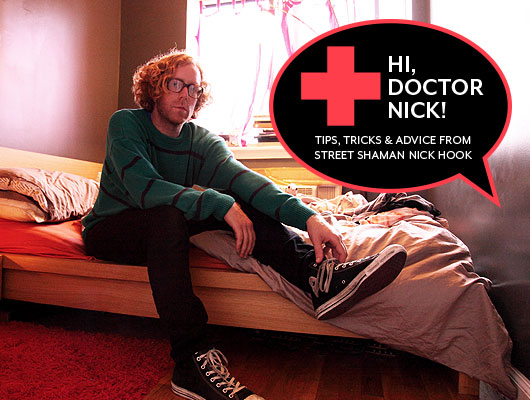
The 2013 edition of Red Bull Music Academy may be over, but there are still plenty of resources out there for those looking to glean some knowledge about the music industry. Here at XLR8R, we’ve got Nick Hook. Our resident advice columnist and all-knowing street shaman is here year-round, popping in every Thursday morning to share his wisdom about music, gear, production, travel, DJing, touring, romance, and whatever else our readers need assistance with. The good doctor is just an email away, so hit him up at [email protected] and let the learning commence.

Hi. It’s sunny and nice in New York. I went to see Flatbush Zombies and The Underachievers on Tuesday night. Kids were high as hell, moshing, rushing the stage… it was amazing, true raw energy. That’s missing sometimes right now. If I had a million, I’d sign them and it would be on.

I had an amazing jam with Gaslamp Killer, Pick a Piper from Caribou’s band, and Little Shalimar at the Gaslamp show last Friday. xxxy was amazing at this party after. Now I’m being a good boy post-RBMA. I’m actually going to bed at a normal hour. xo to those guys.

I’m heading out to Sónar in Barcelona next week. I’m setting up a studio on Thursday and Friday with Ableton to mess with the Push. Hit the Doctor Nick email if you are out there and wanna come by. It’s gonna be fun.

xxxx

Hi Doctor Nick,
I’m a DJ/Producer planning to move out to California in a few months. The reason for the move is to advance my musical career, as it seems like a better place for musical opportunity and to be creative. The thing about where I’m at in the Midwest is that the electronic music scene is small, and you can only go so far. I’m working my buttocks off to achieve that ‘international status’ that I envision myself possibly immersed in one day—after I have enough money.

I’m going to head out to Cali and find a job, and try to keep up on the rent and keep working on music. As far as a musical career goes, besides working hard and believing in what I do, what else can I do to secure a career for myself? You seem to be pretty busy, and doing what you like to do. It’s a hard thing to explain, but I want this badly and I do have confidence in myself. Man, I wish I was better at explaining this shit… all I can think of is this being an article on the site… LOL… fuck.

I just don’t wanna be that guy man, when I’m 33, still “chasing” something. I’m a hard worker. I just want to solidify myself, you know? Any advice really at this point is appreciated. Big ups.
Jm

Okay. Let me preface this: I am from the Midwest too. I moved from St. Louis to NYC in 2004. I rolled up in a Honda Civic with a couple of ounces of weed, some unemployment checks, and some shitty gear. I left my girlfriend back there for a few months cuz the whole thing seemed so outrageous that I didn’t think it was a good idea for her to pack up and quit her whole life to facilitate me. I ended up going back two months later and got her, and here I am now living in New York. I actually still own a house in St. Louis that I’m trying to rent, if anyone needs a crib. I bought that shit for 2000 down cuz I never thought I would leave.

Also, I’m 34 and I feel like I’m chasing something. I’m glad I feel that way. It keeps me hungry and inspired. I hope to feel that way ’til I die.

Another thing—stop tripping about that status. “International status” doesn’t mean anything. It really doesn’t, trust me. I think that’s one of the problems of all this—people just want that “status” so bad. Just work hard. Keep working hard. Push yourself. Be prepared to be ready if those opportunities come, whether it be a songwriting session or a DJ gig. Cuz what if you get into that situation and you can’t succeed? Then you probably won’t be getting any status.

That said, I feel like I didn’t choose to move to New York. It almost chose me in a sense and I was ready to roll. I’m glad I did, and I think that you should be willing to sacrifice things when you see an opportunity arise. The more I travel and go back to my hometown, I’ve kinda started to realize that nothing really changes. I find that in the best way in NYC cuz I couldn’t love this place any more than I already do, and in the worst way in St. Louis, cuz I feel like everytime I go back, I enter into this time vortex and it’s like I never left. To me, that’s why it’s okay to take a chance and go somewhere; worst case, you’re just gonna roll back. Living in a bigger city has been amazing because I feel like in most places I’ve been, the maze just ends. In smaller scenes, people are a little more competitive—in a bad way—about letting people take gigs, opportunities, etc., because there are only so many to go around. In NYC, I’d say we are always happy for everyone to do their thing and try to help people do their thing. There is sooo much opportunity here in the city and when someone makes it, they start traveling, and eventually are able to put their friends on. I wouldn’t be here without certain people that took a chance on me and now I’m starting to get to do it a bit on my own and it feels pretty amazing.

Just get into the thick of things, but don’t rush. You see cats move into your city with this thirst to make it and sometimes the biggest mistake is the overhustle, where you are thinking, “Yo dude. Chill. We’ll trade numbers eventually, make tunes eventually.” Just let it all unfold. I think in a new city it takes a minimum of one year to really get started. Let that first year be groundwork of learning your city, how you fit in, what scene you like, who throws the parties. I moved to New York in 2004 and I really feel like it took until 2007 for me to meet the people that I wanted to meet, and then ’til 2009 to actually be creating with them and be a full part. The other thing is to offer help. I have a cat working for me now that was literally after me for a whole year. I was a little scared at first, but then eventually I had him through and slowly he’s been helping me in a bunch of ways, and hopefully I’m helping him back and giving him opportunities to “solidify” or whatever you wanna call it on his own.

I think the other thing to keep in mind is how people perceive you. In my case, people know they can holler at me and I’ll most likely be down to work. I’ve never been difficult with business because I’ve found that it kinda works itself out if you are working with the right people. Between you growing and progressing in your skills, and being down most of the time, it snowballs.

The thing I also learned mad early was to diversify. I never realized how much one opportunity could bring me to another. I never thought 100 million people would listen to some song by this girl named Azealia the day we recorded it. That brought me to Japan just to record and then I got to DJ, and now I’m going back to Korea in July cuz they liked me from that trip. The same thing led me to relationships with all of these gear companies and now they also let me come to places and play with their equipment. Sometimes, it’s even for money cuz they know we are using the gear in the studio and touring with it, so we can give real feedback. All of this came from the most unglamorous job of “engineer.” That job let me chill with my friend El-P for the last month and be involved with helping to make one of the best records that will come out this year (in my opinion) and get to record Big Boi, a hero of mine. Anyways, I’m rambling now, but yeah.

Good luck my G.

Hi, Doctor Nick! appears every Thursday on XLR8R. Do you have a question for Doctor Nick? Please submit your inquires to [email protected]. Nick Hook can help you.

Octa Push “Green Limo”*Senseless*

Bass music and kuduro veteran duo Octa Push first came to prominence in 2009—which seems like quite a long time to gestate, form a sound, and adapt it to the increasingly hectic climate of 2013. But the Lisbon pair is finally readying its first full-length, Oito (out June 17 via Senseless), with the multi-genre inspired “Green Limo” leading the charge. Octa Push’s tune arrives in a wash of neon synths, with a backdrop borrowing liberally from UK garage and a percussion section spliced straight from the DNA of afrobeat.

Green Limo

Kelpe Fourth: The Golden Eagle

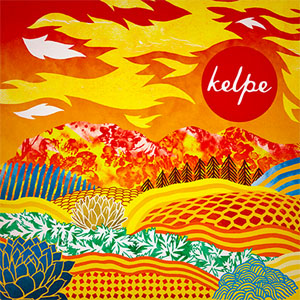
Although he never truly went away after delivering a handful of noteworthy releases in the early and mid aughts, one can’t help but feel like Kelpe has blossomed a second time during the past year or so. Fourth: The Golden Eagle is as quality a record as Kelpe has ever made, and perhaps because it appears on his own newly inaugurated DRUT imprint, the London producer’s latest LP makes for one of the most distinctive outings of his career.

Though Kelpe has evolved and followed a number of sonic paths over the years, at his core, he’s always made beats. Lively and colorful beats, sure, but always electronic productions rooted in the rhythms and structures of instrumental hip-hop. Fourth: The Golden Eagle is no different in this sense; in some ways, it finds Kelpe building beats with a more straightforward approach than even his most recent output. Still, there is a distinction to be made: Kelpe is a pre-LA-beat-scene producer. The influence of artists like Flying Lotus and Teebs has certainly seeped into Kelpe’s work in one way or another, but Fourth: The Golden Eagle is built on the groundwork laid by producers such as Prefuse 73, Dabrye, or Merck-era Machinedrum much more than that of the Brainfeeder clan. Still, this LP does not sound as if it were reaching toward a past heyday; rather, it sounds refreshing. The SoCal beat scene’s tendency to squeeze its elements with heavy-handed compression is drastically peeled back, and a vibrant, open, and enjoyably bright sonic palette is revealed. Kelpe manages to tuck a wide array of understated elements into his productions too, though rarely to excess—every record rub, spurt of noise, miniature synth bleep, and hit of distant-room percussion has a purpose and is presented with pristine sonic detail.

A major focus on Fourth: The Golden Eagle is Kelpe’s exceptional synth work. Whether it be rich analog chords, spiralling leads, or prickly synth FX, Kelpe melds together a truly rich assemblage of analog tones across the entire LP. Songs like “Beaks of Eagles” (a particularly Prefuse-reminiscent cut), “Nice Eyes in My Size,” and “Outwhere” use keyboard layers to create gliding beds which lay just behind the crisp percussion and orchestrated layers of chopped samples, while “Go Visible” and “Single Stripe” bring their bleeps and bloops to the forefront, bending and twisting restless synth leads in patterns that are rewardingly unpredictable.

Kelpe is a veteran producer, and on Fourth: The Golden Eagle, he strikes the kind of smart balance that comes from years of experience, deftly varying the individual songs while still making a record that is cohesive as a whole. Almost a decade after debuting, Kelpe’s ideas are somehow still fresh and clearly benefitting from a production ability that has been well honed over time.

XLR8R in Conversation with Martyn at MUTEK 2013

Last week, XLR8R was invited to attend the annual MUTEK festival in Montreal. During our four days in attendance, we witnessed plenty of memorable moments—13 of which were spelled out in detail in our festival review—but our participation actually went beyond merely checking out the various shows and parties. XLR8R was also invited to host a couple of public conversations with MUTEK artists, one of whom was Martyn. We’ve excerpted a portion of the discussion here, specifically the part where the Dutch-born, DC-based producer (and 3024 label boss) told us about his new audio-visual show.

Let’s talk about the new show that you’re doing. It’s called The Air Between Your Words and it’s an audio-visual thing.

A thing. [laughs] Basically, when I started writing my new album… Usually, when I make music, I have sort of a visual idea. But once you finish the music, there’s not really a way to express your visual ideas. You just put the tune on a record and it becomes an audio file, basically. I was always interested in doing something much more visually, and I worked together with a guy called Erosie, who does all the artwork for the label and usually for all of my releases. We just sat down while I was gathering ideas for this new album [and thought about] how to make it much more of a visual experience. I was already doing live shows, but I wanted to make the live show a little bit bigger, a little bit better, and [to have] more of a message, as well.

The other reason why I started doing this was that while touring and seeing a lot of other people play live shows with an audio-visual component, I started noticing that a lot of those shows were much more about technical ideas, like flashing LEDs and stuff exploding or whatever. It was almost like a freak show sometimes, like, “Why do you have to have a visual show?” “Well, because. Because everyone has a visual show.” So basically, a lot of shows have a lot to do with a technical feat than a narrative or a story.

Obviously, I put the bar very high for myself to say that now I’m doing a show that has a clear narrative. I think the narrative also will form itself by doing lots of these shows.

When you were thinking about putting the show together, was there any artist you saw and thought, “I like that,” or anyone who you thought was doing a particularly good job? It’s been a tricky issue with electronic music for… forever.

Forever? I don’t know. It is definitely something in the last few years where the festivals are getting bigger. People make music, they do albums, and after a while, you have to think of a “next step,” and usually people go the audio-visual route or a live show or something with lights.

There are two shows that I really like, audio-visually speaking. There’s Flying Lotus’ show, basically because I’ve seen it so many times. I’ve done a lot of touring with him, so I know the ins and outs of the show and what goes on behind it. I think it doesn’t have that much of a narrative and it’s still sort of a technical story. It’s called Layer 3 and basically, he stands between two screens and they project from the back and from the front. So you create a sort of 3-D effect. He plays with it a little bit during the show, so there’s kind of a story to it. He uses a lot of live action from his videos and stuff like that. I really like that show.

The other one I like is Hype Williams, which is no show at all. Hype Williams plays live, it’s two people; basically, it’s just dark the entire show and then, all the way at the end, there are 15 minutes of stroboscope and that’s it. So it’s the most anti-visual show you can imagine. But the most powerful thing about it is that it’s analog and doesn’t rely on the technical—flying cubes and all that. That makes it powerful and much more of an experience than all those shows that have computer-animated graphics.

With a lot of audio-visual shows, there’s a video or graphics sequence, the artist has to follow along, and there’s an issue of losing the spontaneity of a DJ set or even an audio-only live set. Is that something you’ve had to think about? Is keeping room for spontaneity important?

Yeah. With the live shows that I’ve done so far—the ones that I do without visuals—I have a discography that I can tap into. A lot of my music is rich in sound [and] there’s a lot of stuff going on. There are always lots of layers of beats, melodies, bass, and extra added sounds. If you start freestyling with all those different elements, you can go lots of different ways. So I always try to keep it very spontaneous. Usually, you have some sort of starting point, maybe two or three tracks in the beginning that get you into the groove. Then you have a target where you want to end, so that you know that you have to complete the journey between those two points. And [you] always have a sort of finale, something that sort of builds up to an ending, whether it be something really loud or really subtle. In that way, you keep it quite spontaneous. The more you master your controls and the more you program your effects and things you like to use, it personalizes the music.

As far as the visuals, I’ve done the show with different people. There is a set amount of graphics that we use that are sort of tied to songs. But it’s also very much improv, because every VJ, just like every DJ, has a personal style. So one show might be completely different from another, but I hope there will be some sort of narrative that you can understand and has a beginning and an end, rather than a trick that has a loop of eight minutes and you see that seven times and then the show is over.

How many times have you done the new audio-visual show so far?

It’s funny, we’ve done it twice for an actual crowd. [MUTEK is going to be] the third one. But we did a big art festival in Holland and they gave us two weeks of prep time with the venue. They were like, “You can do the show every day,” just to test it or to make sure everything worked. So we did the show a lot of times, but for a crowd, it’s obviously a very different story. It’s still in its infancy, but it’s also exciting to try and not make mistakes.

The Durian Brothers “Angstbirne”*Fat Cat*

The Durian Brothers‘ latest offering can easily be imagined as the backdrop to a tense, climactic car chase at the end of any given action flick. On “Angstbirne,” the German trio employs brooding and hypnotic percussion that pairs with thick textures and vuvuzela-esque synths to help create a dramatically atmospheric track. The lumbering track is set to appear on The Durian Brothers’ forthcoming split EP with Ensemble Scalectrik, which will be released in the near future via Fat Cat.

Angstbirne

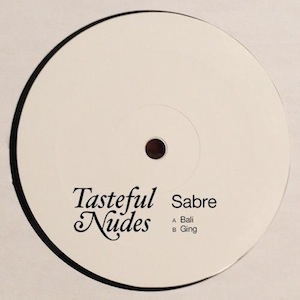
Sabre “Bali” b/w “Ging”

For its second release, Chicago label Tasteful Nudes turns to rising Portuguese duo Sabre for a pair of eclectic and colorful house tracks. Both “Bali” and “Ging” blend robust warehouse rhythms with larger-than-life melodic elements; encompassing the sounds of classic hardware driven techno, world percussion elements, and vibrant synth work, they form a pair of dance tracks stuffed full of warmth and personality.

A-side “Bali” is a little all over the map, but manages to hold things together around the backbone of a solid, summery 4×4 groove. Thick fuzzy chords jostle for space in the mix amongst loops of bell-like percussion and warped synth melodies that bear a distant resemblance to electrofied sitars and steel pans. Whether it was Sabre’s intention or not, the resulting meld of vying Eastern and Western influences comes across like a fitting aural representation of the track’s Indonesian namesake. Ultimately, the more traditional house impulses win out, as the production builds toward a final climax of bright, off-beat hats and driving synth chords.

On the flip, “Ging” is a slightly more straightforward house cut built around delayed synth melodies and a classic, meaty 303 bassline. There are notable nods to the sounds of both ’80s Detroit and ’90s Berlin in the collision of squelchy synths and minimal kick-and-hat rhythms, but Sabre keeps things rooted in its own relaxed house style by dropping the pace to a carefree, sluggish stomp and layering in a hazy, washed-out chord progression. Both tracks here are excellently produced though, combining some serious moves acquired from classic dance tropes with plenty of subtle creative touches and a really natural, melodic warmth.

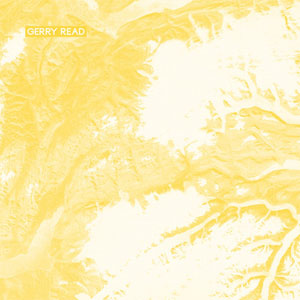
Gerry Read “Crave” b/w “Enjoy a Day Out”

While the specifics of his background and identity are still somewhat hazy, at this point it should be crystal clear why UK producer Gerry Read is a talent worth keeping a very close eye on. His ongoing partnership with Ramp offshoot Fourth Wave has proved to be one of the more fruitful working relationships in contemporary electronic music, allowing space for Read’s creative, humanized take on house and techno to develop naturally across the course of several 12″s and an excellent full-length LP (or two, if you count March’s super-limited Saucepan Jams Vol. 1.) This latest outing for the label sees Read developing his style further, stepping ever-so-slightly away from his more headphone-oriented comfort zone to create a pair of tracks built around the meatier, dancefloor-ready template of classic Chicago house.

“Crave” is a wonderfully sluggish, churning take on the bare-bones sampler/drum machine formula. Read builds the production out of simplistic chord samples, white noise hi-hats, and a relaxed, subby bass lick, then creates movement by layering on filters that shift around the frequency spectrum in a manner akin to a cassette tape that’s been left out in the sun. It’s hardly revolutionary stuff, but as with the majority of Read’s work, everything hangs together with a brilliantly earthy, natural quality that’s often difficult to find in club music.

B-side “Enjoy A Day Out”, meanwhile, is a construction of rhythmic loops that intersect to create a buoyant, heavily swung beat out of unintelligible vocal syllables and abruptly sliced instrument samples. At its opening, the mesmeric rhythm and abrupt timbral changes tread familiar territory, akin to much of Read’s full-length debut Jummy, but around the three-minute mark, a surprisingly direct kick-and-hat rhythm propels the tune into far livelier territory. It pushes the track squarely in the direction of the dancefloor, providing a solid, deceptively funky backbone around which Read expands on the sampled backdrop with a host of melodic, mid-range synths. As with the a-side, it’s hardly a complete reinvention when compared to either Read’s previous outings or his vintage house influences. The adoption of danceable drum-machine rhythms seems like a good direction for him to move in though and if nothing else, this latest pair of tunes is a pleasant illustration that, as a producer, he’s still got plenty to give.

Ministry of Sound Launches New Imprint, Previews First Release

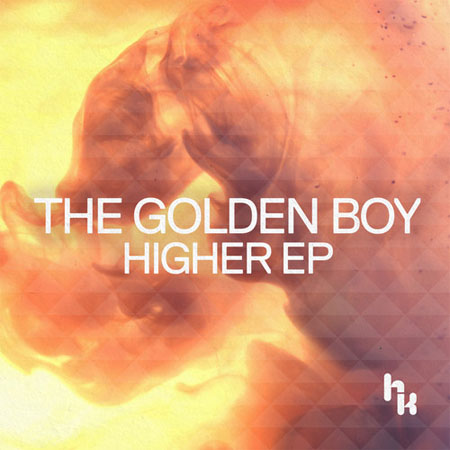
Longstanding electronic institution Ministry of Sound has launched a new imprint known simply by the name HK, announcing that the label’s first release will arrive later this month via UK producer The Golden Boy. The Birmingham-based producer chosen to deliver HK’s inaugural record is not entirely unfamiliar to the XLR8R pages, as he gave us a sumptuous free tune from his EP for Kerri Chandler’s MTDL digi-label back in March. The young producer’s Higher EP will officially launch the Ministry of Sound-helmed HK imprint when it drops on June 17, but before then, The Golden Boy’s forthcoming three-track effort can be previewed below.

Page 1682 of 3781
1 1,680 1,681 1,682 1,683 1,684 3,781