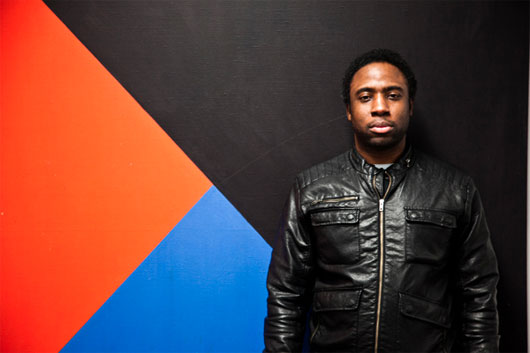
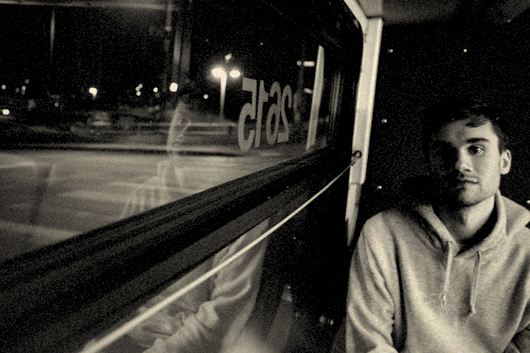
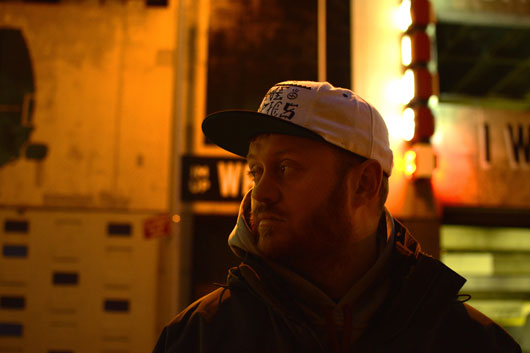
Detroit-based DJ/producer Monty Luke (pictured above) has announced that his fledging Black Catlogue label’s fifth release will be a five-track compilation that is said to continue the imprint’s “commitment to off-kilter, futuristic, global dancefloor devastation.” Alongside a cut from Luke himself, Modern Underground Music V.2 features contributions from London’s Ibrahim Alfa, San Francisco’s Lance De Sardi, West Coast producer AbJo, and relative newcomer Kneco Uqdah Jr.. The tracklist for Black Catalogue’s forthcoming compilation can be perused below, where you’ll also find a full stream of Luke’s EP opener, “Shape of Things.” You can also preview snippets of the rest of Modern Underground Music V.2here.
A1 Monty Luke “Shape Of Things” A2 Ibrahim Alfa Jnr “3” A3 AbJo “For What It’s Worth” B1 Lance De Sardi “The Power Of Suggestion” B2 Kneco Uqdah Jr. “July ’12”
On his 2009 album Midtown 120 Blues, DJ Sprinkles declares that, “House is not universal. House is hyper-specific,” suggesting that the genre’s utopian birth story is anything but. In truth, house’s early years were often the product of disparate, fiercely independent personalities and spaces, which is why today’s landscape can feel suffocatingly homogenous, particularly if one doesn’t know where to look. Beneath the deep-house facsimiles and Ibiza-fication, though, there is a rising generation of producers taking inspiration from the genre’s freeform legacy. That being said, despite attempts to lump the following four producers (and their like-minded contemporaries) under the nebulous banner of “outsider house,” their music doesn’t necessarily sound alike, and they couldn’t truly be categorized as operating within any sort of concrete ‘scene.’ Still, they are united by one thing in particular: a shared desire to embrace house as a medium for their individuality.
Photo by Erez Avissar
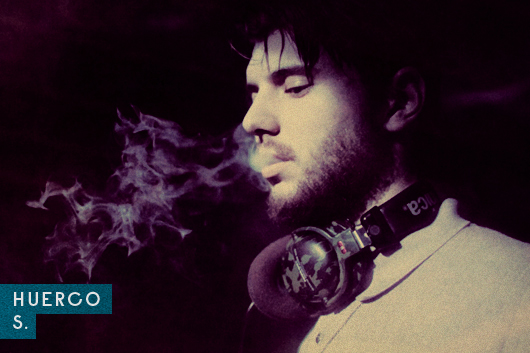
Like many of his contemporaries, 21-year-old Brian Leeds seems pretty nonplussed about the production process. Before moving to Kansas City, MO, a year and a half ago, he was honing his craft on FL Studio (which he still uses) on his mother’s computer in Eastern Kansas, where he grew up. Now working with a hodgepodge of equipment—Casio keyboards, tapes, and a mixer—Leeds creates dissociative arrangements as Huerco S. His tracks recall house via occasional signposts only: an old-school rhythm here, a resonant square bassline there. They are grit-saturated and loose from the grid, and he’s quick to agree that an assortment of similar US and European experimenters have had an influence on his music. “Wania, Börft, all the General Elektro stuff, Meakusma, Marcellis on Workshop, Dean Blunt…,” he rifles off, before acknowledging classic tracks from New York, New Jersey, Detroit, and Chicago in addition. While he may be able to find kin in these sounds, Leeds’s music is particularly unique in its almost psychedelic approach to composition. “It’s like digging into the Earth and finding a bone and dusting it off. It’s still ancient and raw,” he says. “Even if I had tons of gear, I think it would still sound [the way it does]. Precision isn’t the endgame.”
As his profile has risen in the last year, he’s been offered some remix work, most recently of Jay Weed’s “Tunnel.” Given that the song’s ultra-precise bass music is perhaps the polar opposite of his usual style, it’s not surprising that Leeds describes his rework as a “deconstruction.” He claims he usually tries to, “contort and hint at the original track, [and] view it through a kaleidoscope,” but on “Tunnel” he tried to eschew the bass of the original and “focus on the higher textures.” This willingness to forgo popular structures carries over to his latest work, a nearly beatless album which is still in production. He has an array of other music in the pipeline as well: a 12″ for Future Times, a reissue of his Opal Tapes record from last year via online retailer Boomkat, and a record as Royal Crown of Sweden, set for release on Anthony Naples’ as-yet-unnamed label. As it turns out, Leeds and Naples are also touring North America together in the next couple of weeks.
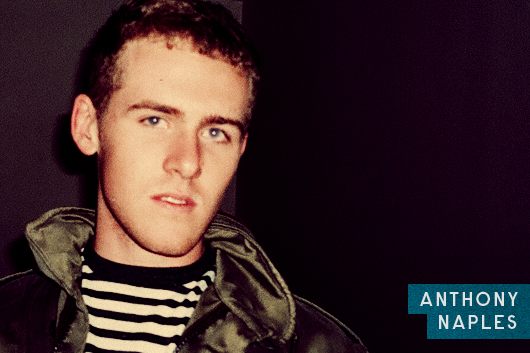
Raised in Florida but now a New Yorker, Anthony Naples has lately had the unenviable task of following up a hit debut single, last year’s “Mad Disrespect.” Recent trickles of new material—he remixed Brooklyn trio Lemonade and released an uncharacteristically brutal track via Opal Tapes last month (which he describes as a one-off)—are set to turn into a deluge in the next month or so. Between a proper follow-up 12″ on Mister Saturday Night (the label and party behind “Mad Disrespect”), a self-released white label, an EP for Trilogy Tapes, and a remix for Paul Woolford‘s Special Request project, Naples is countering sophomore expectations with a variety of experiments.
While “Moscato,” the forthcoming Mister Saturday Night record, was conceived around the time of its predecessor and thus has a similar sound, the other releases are the product of recent forays into hardware, a change that the producer hopes to further incorporate. Originally computer based, Naples describes his new set-up as involving more “pushing [of] buttons.” “In the last few months I’ve gotten a drum machine and samplers,” he says, and this has made for a more “rugged” sound. “I want to [compose] really spontaneously and just record,” he continues. “A lot of the stuff I’ve done in the past I’ve had to think about so much because of the workflow issue, and now that I’m realizing you can do things [as] a mixture of both [hardware and software], there’s no reason to go back to any other way.”
This newly instinctual approach seems ideal for an artist who has never put much stock in the concept of polish. “I’ve never EQ’d a single thing,” he claims. “I don’t think it really matters.” Naples’ debut may have graced its fair share of year-end lists, but he is uninterested in trying to replicate its success, as setting out to produce a “chartable” single is at odds with his methods. He describes his tracks as “genre studies,” the results of “getting really attached to one idea for a month.” “I’m not trying to do anything in particular,” he says. “I’d just like to refine what I’m doing based on what I have.”
This modest approach may be in part due to his relationship to New York, where he feels he is “not part of any group.” “I’m friends with Nick [Dawson (a.k.a. Bookworms)], Matt Gardner, who records as Terekke, Justin [Carter] and Eamon [Harkin] (of Mister Saturday Night)—I go to their parties a lot,” he explains. “But I don’t have a lot of friends that make music, so there’s never talk of music. A lot of the time, I’m less inspired because I have no one around me who talks or cares about it. My roommate has to put up with me blabbering about the new Levon Vincent record. My girlfriend doesn’t want to hear about it either.” Even so, Naples praises the L.I.E.S. imprint for “reinvigorating the city,” and the rawness of his new material certainly hints at the label’s influence.
On the whole, Naples will continue to only produce when the mood strikes him, but lately he has been hard at work getting his DJ skills up to par, both for the upcoming North American tour with Huerco S. and for a string of European dates that includes stops at such prestigious venues as Berlin’s Panorama Bar.
Photo by Sam Jackson
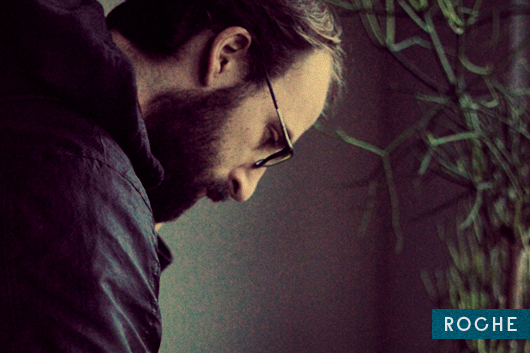
San Francisco’s Ben Winans started Roche as a hip-hop project around 10 years ago, initially releasing through his own, now-defunct Solos Records. Over the past decade, Winans has shifted away from hip-hop toward an earthy, psychedelic house sound, a change that really culminated on 2010’s Degage EP, which he describes as a “turning point,” the result of digging deeper into dance music in prior years.
“[One of] the initial [producers] that got me into dance music was Theo Parrish,” Winans says. “He has tracks that are just straight-up hip-hop tracks. Through that, I was able to give [dance music] more of an open-minded listen. I could hear the elements of hip-hop in his dance productions and it stopped being about whether it’s a dance song or hip-hop song—’those are good drums, nice chops, nice bassline.'” He mentions Daft Punk in a similar light: “a track like ‘Da Funk’ is almost more of a hip-hop song.”
While absorbing these productions, Winans was also having formative club experiences at San Francisco’s Gentlemen’s Techno party, thrown by C.L.A.W.S. “I only went once or twice, but it changed my mind on the whole scene aspect of dance music,” he says, as it represented a “dark room” alternative to the garishness of rave culture. Still, Winans is not particularly drawn to making “club friendly” music: “I am into the further leanings of house and techno. I don’t want to have the dancefloor as a premeditated thought. I might every once in awhile; maybe if everyone thinks I’m a weirdo I have to try to make something normal. But that stuff usually ends up being the weirdest.”
Although actual clubs are generally far from Winans’ mind, the loose, on-the-fly aspect inherent to DJing is frequently present in his productions. Two of the tracks on his recent Mathematics EP, Auragan, were more or less finished in one take (he’s currently putting together a longer EP for the label, with a spring release date). On the other hand, his 100% Silk EP, A Night At The Haç, featured a more involved process of editing. In his words, he was trying to, “cater to the vibe of the label while still doing [his] own thing.” Winans hasn’t always produced in such an open way, though. “When I was doing the hip-hop stuff it was like, ‘I’m doing this, fuck you, I don’t care what you think,” he remembers. “Now, I’m more open to constructive criticism.”
Winans also hones his tracks playing live. “Most shows are local SF shows, which gives me the opportunity to bring out a ton of gear. [In that setting,] I can mess with any aspect of a track,” he says. Faraway shows in Hong Kong and New York have limited the amount of gear he was able to bring, but Winans saw them as a different sort of opportunity, explaining, “with limitations you go in different directions.” He hopes to test these limitations on a European tour later in the year with his 100% Silk labelmates Bobby Browser and JM II in tow.
A listen through 22-year-old Delroy Edwards‘ SoundCloud reveals a producer who’s at least as interested in footwork as he is in house, though it’s the latter that’s pushed him into a kind of spotlight. Thus far, all of his releases have appeared courtesy of Ron Morelli’s L.I.E.S., an imprint dedicated to a variety of raw and reckless electronics. Edwards, now based in Los Angeles, met Morelli when the two worked at A1 Records in New York together. It was Morelli, he explains, who convinced him to move away from footwork.
“Ron was playing me the first few L.I.E.S. releases, and it was sort of similar to the stuff I was making—abstract, sample-based, beat-driven footwork, at the time. And I just thought I could try my game at making house tracks.” “4 Club Use Only,” Edwards’s first 12″, was a direct result of Morelli’s encouragement. “Ron was like, ‘you should make me a record,'” he remembers. “I was into house more as a DJ—I hadn’t really tried producing it.” DJing is still a priority for him, and he will be touring Europe with Morelli in the spring.
If L.I.E.S. is known for a back-to-basics approach, Edwards fits right in. He explains his set-up as quite minimal: “I really don’t have much. My set-up is super simple, it’s just shitty stuff that I come across—simple keyboards and drum machines—and I record to cassette most of the time.” Moreover, he does little in the way of editing, and says that most of his tracks are simply live jams (he doesn’t, however, plan to play live shows).
“I’m just more into the rhythms, and just rough tracks,” he says. “House music these days is so convoluted. And I feel like the simpler the better. Use what you have and make the best of it.”
After years of precision-tooled dance records, this stripped-down approach inevitably prompts ideas about a “new trend.” But as Edwards points out, this spirit has been in dance music since the beginning. “House has always been outsider, you know,” Edwards says. “It’s just coming back. Once people are adjusted to the sound, producers are able to go off and get deep with it.”
Seattle producer Kid Smpl, the burgeoning artist who was featured just yesterday as part of Bubblin’ Up Week 2013, has given us his rework of “Fiction” by The xx. The muffled vocal samples and warbling overtones within Kid Smpl’s production quietly create the kind of “night bus” atmosphere that he’s gradually become known for, a mood which is complemented by delicate piano chords that echo around the minimal instrumentation. “Fiction (Kid Smpl Remix)” seems at once contained and virtually endless, and feels something like drifting slowly into unconsciousness.
Nondescript. When it comes to describing dance tracks, there are few adjectives less enticing. Yet Pirates Poetry, the new EP from German duo Switchbox, is exactly that. Released on Maceo Plex‘s Ellum Audio, it’s not surprising that the tunes fall within a very particular style of tech-house, but it is a bit surprising that they would be so damn forgettable.
The title track kicks things off, and for the first few minutes, it’s an entirely standard piece of tech-house. The beat is straightforward, the pads are light and unobtrusive, and the whole thing is underpinned by lurching bass tones that are weighty without overwhelming the production. On the other hand, the song feels remarkably safe right from the jump, and Switchbox doesn’t really take any sort of a risk until a vocal from NAtz is introduced just after the three-minute mark. Unfortunately, her voice isn’t particularly compelling, and she ultimately brings little more than a moderately nonsensical piece of speak-sung poetry to the proceedings.
The Jupiter Jazz remix of “Pirates Poetry”—a joint effort from Maceo Plex and Danny Daze—is better. The pair picks up the tempo and toughens up the percussion, crafting something that immediately feels better suited for the club. The original’s rumbling bass has been removed, but a warbling bassline has been put in its place, making the entire production more of a standard-issue Ellum Audio cut. If Maceo Plex and Danny Daze had simply stripped out the vocal, the improved production might have made the tune more of a “must listen” affair.
Pirates Poetry wraps on a bit of an unusual note, concluding with a Switchbox remix of Swedish producer dreamAwaken‘s “8 Bit in a Bit.” It’s another polished slice of cruising tech-house, and the first track that doesn’t include a guest vocal. The drum sounds are crunchier than those found on the EP’s other two selections, and the synths are overdriven just enough to give the song a sort of rough-and-tumble edge. Nevertheless, it’s ultimately a very tracky outing. Sure, all the elements sound good on their own merits and the tune has been precisely assembled, but it also lacks invention and doesn’t have much in the way of “wow” moments. Much like the rest of the EP, it’s functional, but even for the tech-house diehards, it’s probably not going to take up permanent residence in too many record boxes.
It’s inspiring when a person can run a label as organized and accomplished as Spontaneous Rhythm—having released records by the likes of Divine Interface and Coppice Halifax—yet can still find time to construct such a well-crafted track as “Asiko.” What’s even more inspiring is that said person is merely 19. Without utilizing his label to release “Asiko,” the Manchester-based producer known as Howes lends us this dark and gritty house track as a lone freebie which leaves us with the feeling like we just spent a long night on the dancefloor.
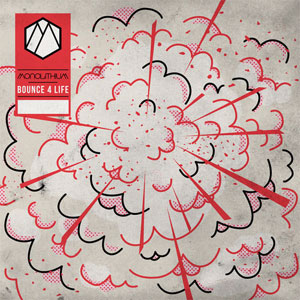
Between 2011’s Simon & G-Funk EP and now, Canadian producer Monolithium has made giant strides in terms of the power and presentation of his work. Aligning himself more with his label’s international roster of beatsmiths than any particular rising Canadian scene, the Bounce 4 Life EP finds the artist injecting more of his own personality into his production and making his best record to date in the process.
The EP’s title track opens the record, and presents a hybrid form that is actually a bit misleading. Listening to “Bounce 4 Life,” it’s easy to get the impression that Monolithium’s prodcutions solely aim to fuse the worlds of hyperspeed techno and urban bass music—the opening cut in particular sounds like an attempt to craft a “banger” of sorts by combining these worlds. The track offers up an unrelenting assemblage of perfectly placed skittering drums and tuned toms, which match up well with the song’s juicy bassline; still, the vocal samples and quasi-garage chord progression are just a bit too easy.
That said, “Bounce 4 Life” appears to be just a surface-level teaser, one that simplifies Monolithium’s formula in order to entice the listener to dig deeper into his dense sound. Of the original productions that follow, “Spiral Face” best highlights Monolithium’s talents. Incorporating bits of 8-bit synths and a few of the other cheesier bits of modern production—tuned snare rolls, bit-crushed vocals, etc.—the song is still a robust bit of R&B-tinged, garage-indebted techno, somewhat reminiscent of Jacques Greene’s Ready EP, but with less of a hardware touch. In some ways, the song is the EP’s most sophisticated effort, coyly moving between half-time and full-time rhythms while seamlessly rolling out gorgeous arpeggiated melodies and sweeping chords in long-winded, immersive movements.
The trio of remixes from trap wunderkind Ryan Hemsworth, budding low-end champion KingThing, and Error Broadcast labelmate H-Sik are rendered mostly unnecessary by the strength of Monolithium’s originals, but in the end, they do little to detract from the fact that Bounce 4 Life is one of the most convincing examples to point to when speaking of Monolithium’s potential as a forward-thinking producer.
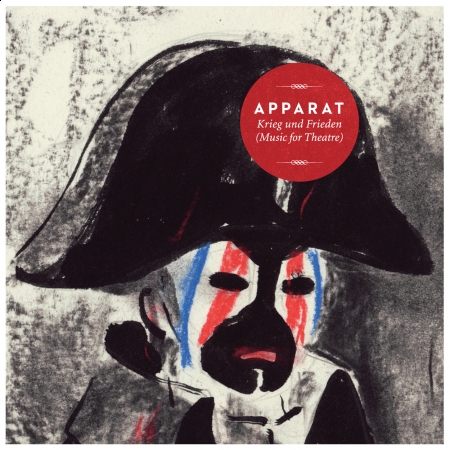
Berlin’s Sascha Ring (a.k.a. Apparat) has announced the impending release of Krieg und Frieden (Music for Theatre), an album based on the music he composed for Sebastian Hartmann’s theatre production of Tolstoy’s War and Peace. Apparently, Ring worked with a 30-piece ensemble to produce his original score for the play, which was commissioned by renowned German arts festival Ruhrfestspiele. “This is anything but conventional theatre. It’s a free space, where a bunch of freaks can go wild,” Ring said in a press release. “It starts with the lights and stops with the actual actors. At night, we worked on the music in the empty hall. It was kind of magical.” The finished work was recorded with members of Apparat’s live band, with Philipp Timm on cello and Christoph Hartmann on violin. Mute will release Apparat’s Krieg und Frieden (Music for Theatre) on February 19, but you can stream and download our first taste of the music, “A Violent Sky,” below.
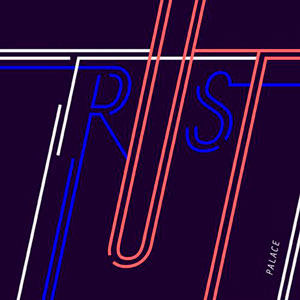
Although Unknown to the Unknown boasts a tradition of nonconformity, calling DJ Haus and his cronies iconoclasts wouldn’t be entirely correct; the odd—and sometimes jarring—aesthetics in the label’s album art and videos drip with nostalgic pop-culture references, and its musical output has paid homage to—and, in some cases, revitalized—a number of obscure or moribund genres. UTTU’s latest single, “Trust,” by East London’s Palace, is no different in that respect, as it provides a reverent yet interestingly modern twist on grime-tinged garage.
Those familiar with Palace may remember last year’s “Mandy” single, also delivered via UTTU. Fans of the sounds therein might be pleased to discover that “Trust” carries on in a similarly gritty manner, although it’s a bit subdued in comparison. The song’s crisp, skittering hi-hat and snare-driven garage rhythms give it a solid, firmly planted groove that holds even as the grimy, foreboding lead swivels malevolently. At first listen, the mischievous vibes of “Trust” seem as though they would have been an excellent fit for UTTU’s Tales From the Darkside Halloween comp, but the track seems to benefit from having been released as a standalone single—like many other UTTU offerings, it’s most potent in a short burst.
The two other cuts on the record, remixes by labelmates 5kinandbone5 and Mista Men, pick up where Palace’s original left off, but quickly veer off into foreign territory—which is both good and bad. The former starts off with sparse percussion and bass that slowly creeps into a more full-bodied sound, but the fast-paced energy from the original doesn’t seem to be present in this rework, and Palace’s sounds don’t readily lend themselves to this sort of reinterpretation. That’s not to say that 5kinandbone5 does a terrible job; the remix just seems average in comparison to Mista Men’s, which imbues Palace’s eski sounds with the duo’s characteristic garage-meets-house swing with catchy results. But even this rework—as danceable as it is—can seem a bit formulaic for Mista Men after repeated listens.
Taken as a whole, the excellent “Trust” and its associated remixes present a solid offering on UTTU’s part, and also showcase the wide breadth of sound that the label has at its disposal. However, the so-so nature of those remixes ultimately ensures that the release doesn’t feel like much more than that.
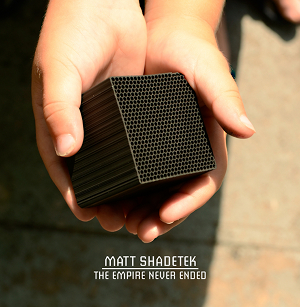
Dutty Artz co-founder and Brooklyn DJ/producer Matt Shadetek is set to release his second full-length album, calling it The Empire Never Ended. Featuring the likes of Brooklyn rapper Troy Ave, fellow Dutty Artz owner DJ /rupture, and—oddly enough—weirdo rapper Riff Raff, Shadetek’s 12-track effort apparently aims to work on the streets of Brooklyn. “In the summer in Brooklyn you can always tell what’s hot because you hear it coming out of cars,” Shadetek said in a press release. “I wanted to make something that could work in my own city. Not overseas, not on a message board, but on the street where I’m raising my family.” While Dutty Artz is set to drop the album on March 26, you can find The Empire Never Ended‘s artwork and tracklist, as well as preview “La Vida Loca” and “Madness,” below.
1. Visions 2. Cracks w/ Nikko 3. La Vida Loca feat. Troy Ave
XLR8R Couldn't find the embed function for type: "soundcloud" and source: "<embed allowscriptaccess="always" src="https://player.soundcloud.com/player.swf?url=http%3A%2F%2Fapi.soundcloud.com%2Ftracks%2F68099213&color=ff6600&auto_play=false&show_artwork=true&show_playcount=true&show_comments=true" type="application/x-shockwave-flash" width="100%" height="81">".
4. Logos 5. Jaguar 6. Don’t Give It All Up w/ DJ /rupture, Aku Orraca Teteh & Jahdan Blakkamoore 7. Madness
XLR8R Couldn't find the embed function for type: "soundcloud" and source: "<embed allowscriptaccess="always" src="https://player.soundcloud.com/player.swf?url=http%3A%2F%2Fapi.soundcloud.com%2Ftracks%2F73946033&color=ff6600&auto_play=false&show_artwork=false&show_playcount=true&show_comments=true" type="application/x-shockwave-flash" width="100%" height="81">".
8. Washington Ave 9. Triple Fat Goose 10. Psychomatic 11. Bout It Girl feat. Riff Raff 12. Palm Tree Garden
In the age of promising young talent, one 19-year-old named Ben Swanwick (a.k.a. Dosage) comes to us from Leeds with “Bring it Back,” a house number which gets into deep space as it continues bouncing into weirder and weirder territory and makes use of angry, pitched-down vocals and oddball clicks. It’s a definite plus that this production comes across as both aggressive and heady, as the vibes perfectly complement its immediately danceable arrangement.