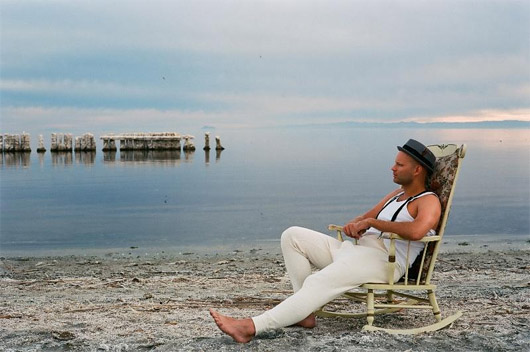
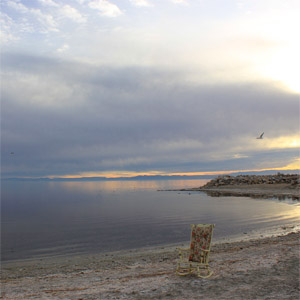
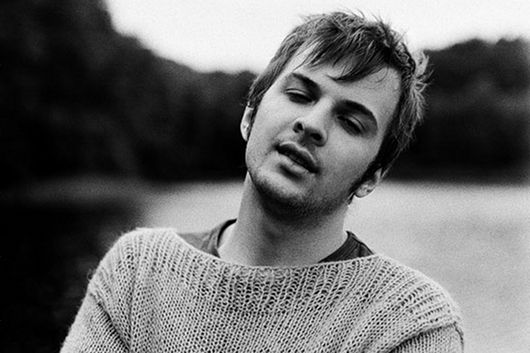
After serving for years as the drummer for Danish outfit WhoMadeWho, 2012 saw Tomas Barfod step out on his own with a solo full-length, Salton Sea (and an impressive XLR8R podcast too). Now, the LP’s standout track, “November Skies,” will see a release as part of a special EP alongside a stacked lot of remixes, including one from Sepalcure. The EP, which is set to drop November 26 through the Friends of Friends label, has also enlisted some its usual suspects—like Nite Jewel and Jerome LOL—to rework the pop-flecked techno track. You’ll find the full artwork, tracklist, and a stream of Sepalcure’s “November Skies” remix below.
01 November Skies ft. Nina Kinert (Original) 02 November Skies (Nite Jewel Remix) 03 November Skies (Sepalcure Remix)
04 November Skies (Jerome LOL Remix) 05 November Skies (Touchy Mob Dub Remix) 06 November Skies (Sekuoia Remix)
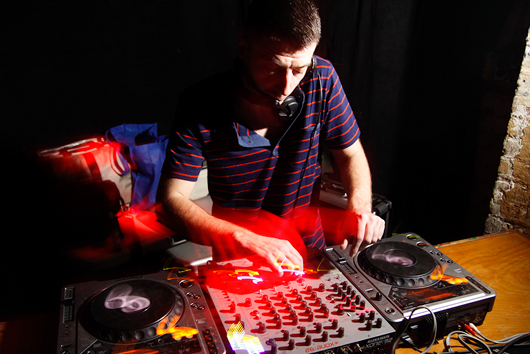
Hemlock label boss Untold is ready to embark on his first tour in over a year, which will find him traipsing across North America. Starting in Brooklyn on November 17, DJ/producer Jack Dunning will criss-cross through major cities along the Candian-American border before making stops in California, Chicago, Colorado, and a host of other cities until he wraps it all up in Boston during the first week of December. During our recent Chatterbox session with the artist, we discovered that Untold’s true inspiration may very well stem from happy hardcore, but we’ll see if he’ll actually unleash any of that during his upcoming tour. You can check the full list of dates below.
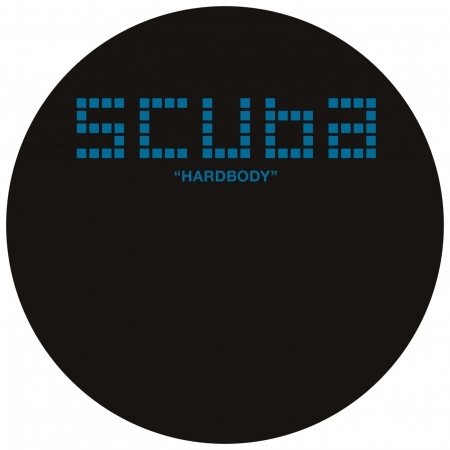
Hotflush boss and Berlin-based DJ/producer Paul Rose (a.k.a. Scuba) will soon follow his recent “Talk Torque” single with another one-sided 12″ for the track “Hardbody.” Rose’s latest production was premiered on Jackmaster’s BBC Radio 1 show, and is said to “[explore] a deeper house sound” than its most recent predecessor, utilizing “lush synthwork, glacial arpeggios, and soft female vocals.” You can make the call for yourself and take a listen to Scuba’s “Hardbody” before it drops on December 10, below.
Having recently returned from a US tour, the classic-house-obsessed Hive Five featurees of Bicep have decided to give away one of their most widely requested tracks, “Feel It,” as a way to celebrate the London-based duo’s Feel My Bicep blog running four years strong. “Feel It”—which the pair describes as having a “NY/UK garage crossover feel”—boasts soulful vocal snippets riding out a wave of iron-pumping, four-to-the-floor beats and quick synth stabs, and recently appeared in their Beats in Space mix of unreleased exclusives Bicep dropped while in New York last month. You can download a WAV version of the tune via Mediafire, and if you’re still in the mood for more dancefloor sounds à la Bicep, check out the pair’s recent Night Trax mix after the jump.
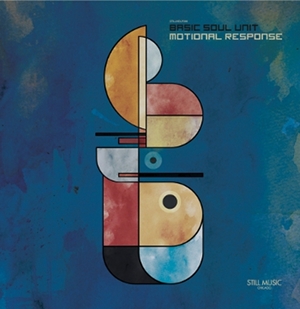
DJ/producer Stuart Li (a.k.a. Basic Soul Unit) is readying his debut LP to be released next month via Chicago house label Still Music. The Toronto-based artist is said to have paid his respects to Detroit and Chicago club music on the 11-track Motional Response, producing a record of deep house and techno with an analog approach. No stranger to the Midwestern sound, Basic Soul Unit has quite a back catalog of singles and 12″s released through various Canadian imprints, including his recent split EP with Eddie Niguel. Still Music boss Jermone Derradji offers a remix of “Breathe” to round out the collection of previously unreleased material, the artwork and tracklist of which you can check out before it drops in December.
01. Across the Room 02. Breathe 03. Clouds 04. Sandpiper 05. All Over Me 06. This 07. Backseat Lover 08. Intersection 09. Mind Forest 10. Let Go 11. Breath (Jerome Derradji Remix)
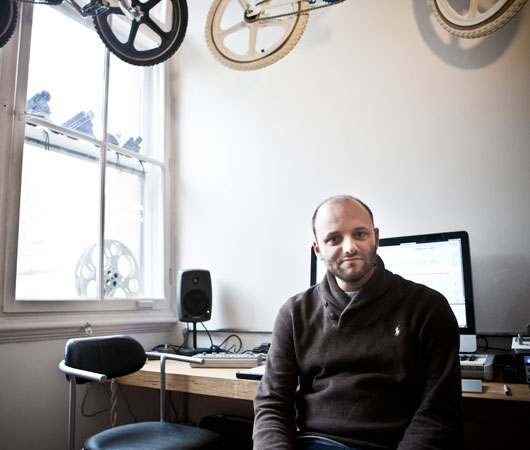
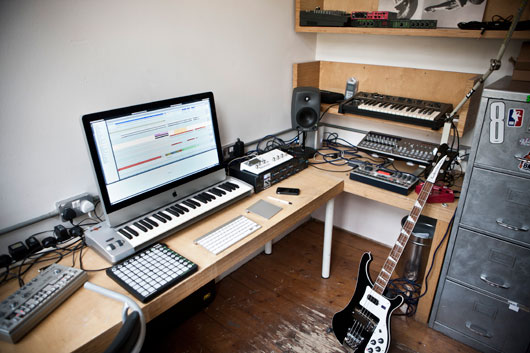
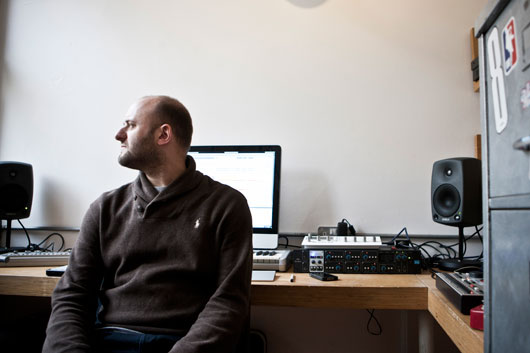
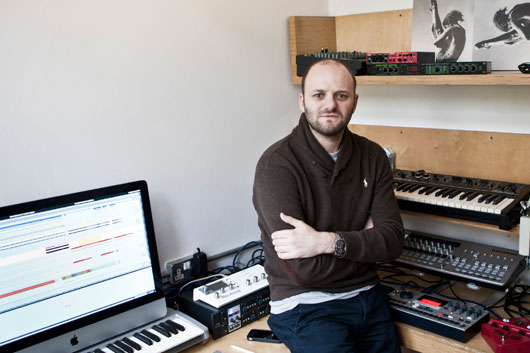
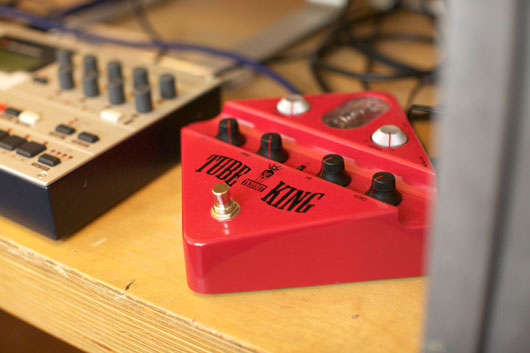
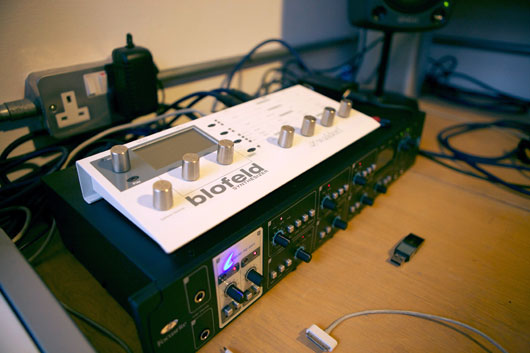
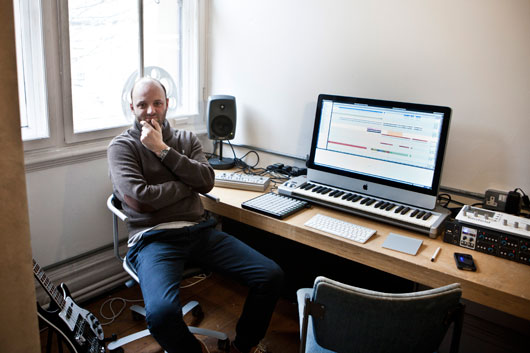
Listening to Andy Stott‘s distinctive brand of dark and sludgey dub-techno, one might imagine that the Manchester producer crafts his work in a lightless bunker or some dank, cobweb-strewn studio full of esoteric keyboards with giant dials—basically, a place with a proper mad-scientist vibe. As it turns out, the truth is far less ominous. Until recently, Stott could be found piecing together his dense tracks in the dining room of his apartment, but just a few weeks ago, he set up shop in the corner of a friend’s photography studio. Considering the sounds found on the Manchester producer’s breathtaking pair of 2011 EPs, We Stay Together and Passed Me By, and now the ambitous Luxury Problems full-length, we were understandably curious to find out more about Stott’s process and jumped at the chance to take a look around his new space.
XLR8R: Where exactly is your studio located? Andy Stott: My mate Mat is a photographer and I rent a little section of his studio space, which is really handy.
And that’s in Manchester? Yeah, right bang in the middle.
And how long have you been in that particular space? Not long at all, just over a month. Before that, I was just writing tunes in the dining room at home.
With less gear? No. [laughs] Even with records as well. I’d get a new piece of gear and I’d say to my partner, “I’m just going to step out,” and she’d ask what was going on, and then I’d come back with a new unit and she’d be like “Where’s that going to go?!” [laughs] It got beyond a joke, and we have a three-month-old boy now, so it just wasn’t practical [to keep my studio there].
Do you like that better, having a specific place to go to work on music? I think so. It puts you in a different mindset. You have no interruptions, and you’re not distracting anyone—which was always in the back of my mind when I was working at home—and nobody is distracting you. I think it’s really important to have somewhere specific to go, especially when you’re paying for it, it makes you use it. [laughs] Joking aside, it’s been really good to have a space specifically for the purpose of making music.
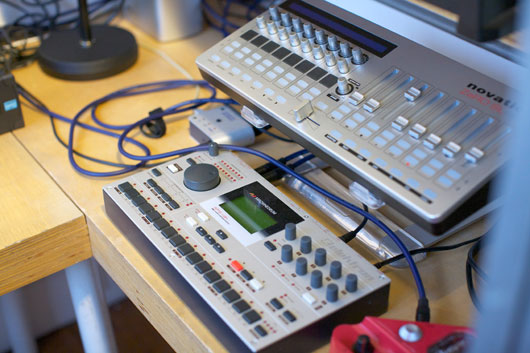
How long have you had the Machinedrum and what do you usually use it for? I haven’t even had that 12 months, actually. I use it like you would use any other drum machine, but you just get so much more control with every sound on it. It’s really good for bottom end. It’s really punchy. It is pretty much the master, everything runs through that.
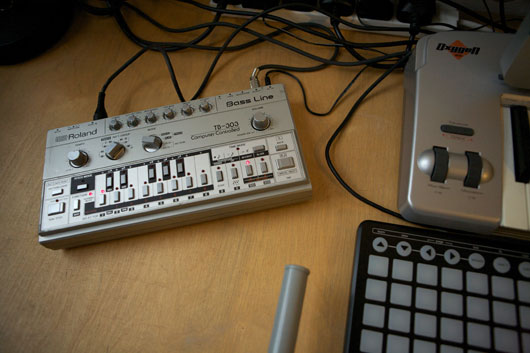
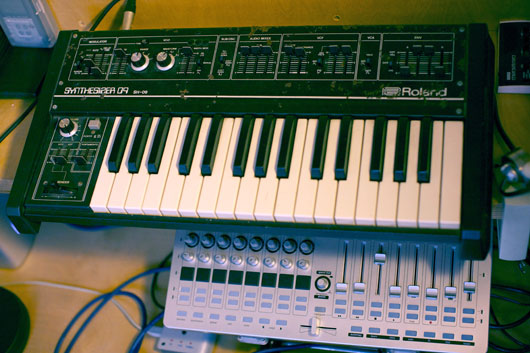
How long have you been putting the rest of the pieces together? You have some vintage units—would you consider yourself a collector? Not at all. I’ve got some bits scattered about here and there and other ones that people have borrowed. Miles from Demdike Stare, he’s got my SH-101, which I’ve been asking for back—I think he’s had it for nearly two years now. All of sudden, I’ve felt like I wanted to use it, so I’ve been trying to get it back [from him]. But the SH-09 is his actually, so we’re trading off. And the SH-09 has started doing some funny things since I’ve had it, so I don’t think he’ll be too pleased about that. [laughs]
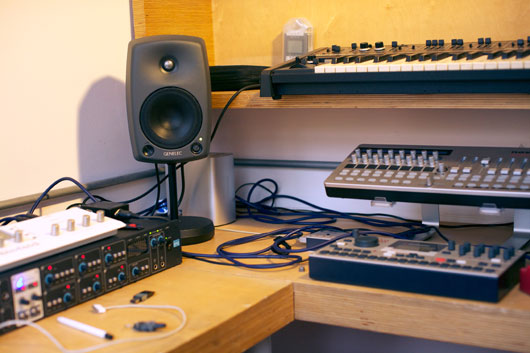
It looks like the only monitors you have are those small Genelecs? That’s it.
Your productions are so bass-heavy though, how can you gauge the low end on speakers of that size? [laughs] The way they’re set up, I just have them right. Before I moved into this studio, and I was using them in the dining room at my home, I’d have to stand in a certain place to hear the bass. But now, I just have to roll back a little bit in the chair and I can hear exactly what’s going on. I’ve got my eye on a sub, but I don’t know if that’d be good, especially when Mat [who I share the studio with] has clients over. But I love those monitors, they make such a difference.
Do you do a lot of field recording? I wouldn’t say I do a lot, but I’ve done some and I’m definitely going to do more. A lot of the stuff that was done on We Stand Together and Passed Me By—and even Luxury Problems—was done on my iPhone. But now, I’ve got a Zoom field recorder and I’m going to go out and hopefully get some nice crunchy stuff. With the phone, it’s so easy, because your phone is always with you. Especially when I was in London and on the underground, there was some really good stuff down there.
How do you usually process those sounds? In the Machinedrum? No, those just go into the computer and I mess with them in Ableton.
Are you usually just using the stock Ableton tools or do you have any third-party plug-ins that you like? I just have one [third-party] plug-in, the Slate Digital VTM. It’s a reel-to-reel tape emulator. But before that, I’d build little things with the FX in Ableton. That’s nice, because I can just save them and go back to those settings at the drop of a hat to adjust them [if I needed]. That’s what I love about Ableton, you have a fair bit of freedom to build your own [signal chain].
Was that the same approach you took with the vocals on Luxury Problems? Yeah, that was all in Ableton.
And the vocalist [Alison Skidmore] recorded those on her own, without any music to go by, and then sent them to you? Yeah. There’s a little thing in the background—I don’t know if you can hear it on the album—but on the pure, dry recordings that I got sent, you can hear a little metronome in the background. I told Alison to just do what she was going to do and not think about it, and she sent me some beautiful things that were already really layered before I even did any tricks or anything.
How long does that process take for you, to make patterns out of those raw tracks? Some of them, you get [the tracks] and there’s not a lot to do. I’ll just take the section I want and have a little mess around with it, and then I’ll sit and let it loop for a while and see if anything [about it] annoys me. It’s a lot of taking little sections and butting them up to other sections. Sometimes, I’ll get a feeling that something is missing, and then I’ll scroll through the file with a fine-tooth comb and try to find something in there that would fit. [Once you have the patterns], then you’ve got to treat everything and make it sound cohesive.
Is there any kind of equipment you think is currently missing from your studio, or are there any improvements you’d like to make? A Minimoog would be nice; a Voyager would be really nice. I’ve got a Vermona reverb unit on the way, and I’ve been looking at the Roger Linn and Dave Smith Tempest, but I can’t make my mind up. So, at the minute, I’m keeping my eye out for an original LinnDrum and that’s about it. It’s just that financially, I have to be realistic. [laughs]
So you’re looking to add more analog equipment than anything digital? Well, I started off using Reason, which I still use actually. And through listening to other material and stuff that I was trying to do early on, what I was doing just didn’t sound like what was on those records [that I wanted to sound like]. There is definitely a difference between digital and analog, and I think I’m getting to the point where I just want that sound. I don’t want to mess about trying to emulate it with software.
And do you like the physical aspect of analog too—the knob turning and all that? There’s just something about that feeling, of really being hands-on. [For me,] it’s just the best way to work.
German composer Nils Frahm (pictured above) broke his thumb, a tradegy for anyone, but particularly for a pianist. In response, Frahm composed a nine-track “mini album” with his remaining functional nine fingers, and called it Screws after the four screws he now has in his thumb. Despite the horror story, Screws, which is available for free download, is about as mellow as it comes, with simple piano melodies slowly and quietly floating in the air like clouds. Argentina-based artist Plasma Rüby offered us his take on “Si,” where he added a bit of electronics into the mix while maintaining the serenity of Frahm’s original. This track will be offered as a part of a package of remixes inspired by Screws, which will also be available for free download via Frahm’s website on December 3, the same day Frahm’s mini-album will be officially released via Erased Tapes.
Over the past two years, Tensnake‘s career has largely consisted of the German producer carefully tip-toeing around a proper follow-up to “Coma Cat,” the all-everything jam that established him as the hotly tipped house maven he is today. While nothing Tensnake has released since has breached those heights, the scant few singles he’s offered—”Mainline,” for Defected, is just his fourth post-“Coma Cat” offering, counting the Live package—have all been built on the same tenet that “Coma Cat” was: that fans of underground dance music appreciate shameless, bold anthems as much as anyone, and that fists can pump as righteously in Berlin as they do in Ibiza, given the right soundtrack.
“Mainline,” featuring Syron on vocals, attempts to be just that; it’s as fearless as “Coma Cat,” but lacks its singularity. Defected is a perfect label for Tensnake, as his clippy vocal figures owe much to Marc Kinchen’s dubs for the label. Built around a delicious but overly familiar three-chord organ vamp, “Mainline” offers plenty of space for Syron’s trad-y diva stylings. “You’re working on the mainlines of my love!” she wails, before Tensnake nabs the voice and chops it into his stew. The pieces—which include a simple, staccato bassline—fit together perhaps too seamlessly; like a choreographed cheer competition, there’s a sense of inevitability and planning to “Mainline” that undermines its enthusiasm. It’s masterful execution but stone-simple conceptually, perhaps the first time Tensnake’s formalism has overshadowed his playfulness.
The b-side’s dub edit is preferable mostly because it adds some shade to the track, which is otherwise like a photo taken under direct, bleaching light. Here, the organs are dulled to a matte gray, as Tensnake lets short, sharp snippets of Syron’s performance rub against the track’s bass. But no one looks to Tensnake for sturm und drang; the cheap thrills really are what people are here for. Tensnake’s gift is never making them seem all that cheap. “Mainline,” short and bright and melodically rich, doesn’t seem cheap either, just a bit threadbare.
The Cleveland native known as Freeze-Tag (a.k.a. Marcus Alan Ward) first debuted under his production moniker last year, and he’s since followed up with his cover of Little Dragon‘s “Twice,” a song that creates a sense of creepy melancholy that its video matches with an undead-feeling shadow animation. Freeze-Tag’s version is also haunting, but more electric; the downtempo keys and swells of orchestral strings on the original are replaced by digital touches, like pulsing bass tones and astral, reverb-drenched synths. He adds a personal flare by singing the lyrics himself, employing a silky R&B croon to overlay the hazy and beatless soundscape.
When Matthias Zimmermann first popped up last year on Sound Pellegrino with the Isla Dub EP, the German producer appeared a bit unsure of how exactly to channel his talent—his debut release split equally between melodious, tropical-tinged house music and darker, more cacophonous club fare. A string of similarly worthwhile EPs followed, but Zimmermann still sounded unsure of exactly what shape his various affinities should take. With his latest release, it appears Zimmerman’s search for his own sound is still underway, but not without landing in some intriguing territory along the way.
If there’s one thing that jumps right out while listening to the Botanica Dub EP, it is the fact that there sure are a lot of drums to be heard. For the most part, the three tracks offered up are funk-tinged house tunes filled with filtered stabs, glowing chords, and seductive basslines. But between all that, Zimmermann fits an—at times—jaw-dropping amount of tight percussion and rapid-fire drums in between his 120-plus-bpm, four-on-the-floor workouts. These extra rhythmic elements are not quite clattering in nature, but are instead used more like miniature FX, filling the space left open by the producer’s syncopated rhythms. It’s an impressive feat, and one that really adds a unique sound to the EP without going too far with the concept. In other words, even whilst the organized sound arrays fire almost everywhere within the stereo field, it’s hard to lose track of the core beat, which remains squarely aimed at the dancefloor.
With its bright, disco-esque samples, interlocked rhythms, and expert craftsmanship, Botanica Dub is a solid EP with an undeniable groove. Still, its three tracks aren’t exactly stunning, as they’re all essentially chasing after the same idea—a rolling house base plus sampled stabs with an extra infusion of intricate rhythms. In the end, this may not serve to be Zimmerman’s breakout effort, but the results here are worthwhile. With the increasing talent he’s displayed over the past year, it seems likely that it’s only a matter of time before the German producer strikes a resounding chord within the club-music world.