The elusive producer known as DJ Funeral has unveiled his latest upcoming project, another four-track record for Samo Sound Boy‘s and Jerome LOL‘s Body High imprint. Judging from its preview, which you can stream below, the RIP Tribute EP lives up to its morbid name with a sound that is equal parts bombast and foreboding darkness: There are colossal, marching band-like drum hits, frantic arpeggios, blaring synths, and mechanical, echoing percussion. Although Body High has already sold its stock of limited-edition RIP Tribute CDs, you can grab a digital copy of DJ Funeral’s latest on November 13. (via FACT)
01. RIP Tribute 02. Last Breakfast 03. Out There 04. Just An Eskimo
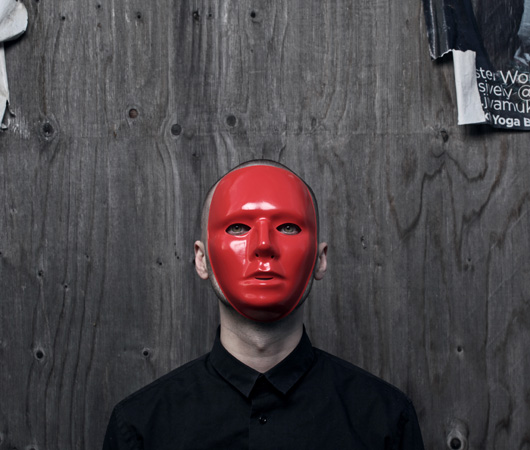
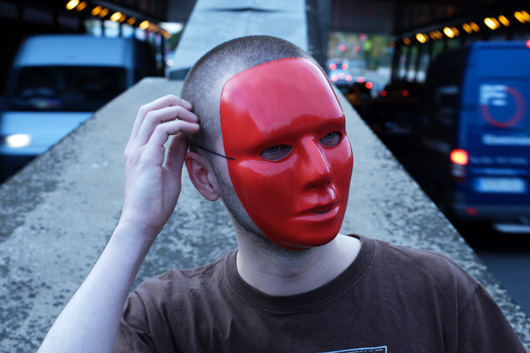
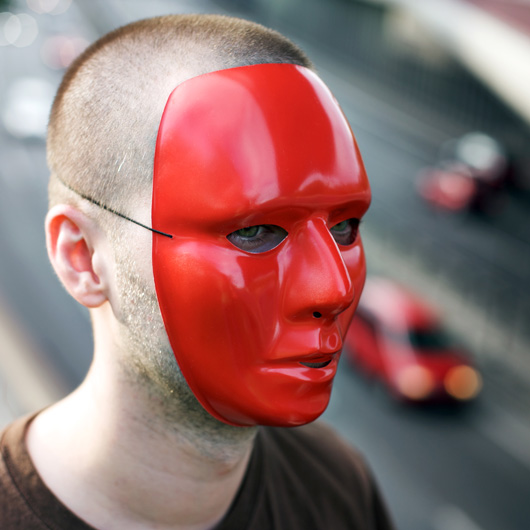
As a ritual item, masks are a universal human fascination. These objects may be simple, yet they possess a transformative potential that’s as powerful as it is mysterious. Tribal rites in places as far flung as West Africa and Bali use masks as vehicles of temporary possession, seeing them as crucial for the performance of ceremony. To don the mask in such a situation is to be freed of previous identity, history, and personality—but this comes at the price of playing a subservient role to an inhabiting alien presence. This is something that Sebastian Kramer discovered when he first put on the creepy red mask that would come to define Redshape, the production alter ego that has dominated his output for the past six years.
Prior to 2006, Kramer had been a successful producer under his own name, with a discography of singles rooted in the tough and loopy sound of late-’90s techno. For example, his 2004 LP, Principles & Tactics, was described by XLR8R as, “a whopping 60 minutes of mechanical repetition and four-to-the-floor hypnosis.” Once he put on the mask though, Kramer was no longer himself; instead, he was some kind of entity brought to life, the spirit of techno’s past born into the physical world, a musical version of the computer-generated Puppet Master from Ghost in the Shell.
Square
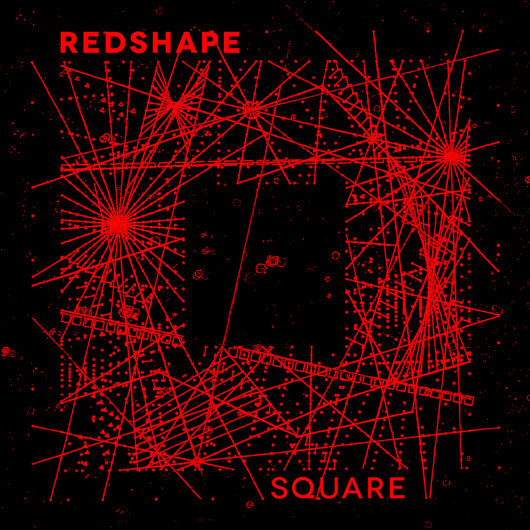
Slowing the tempo down and letting his less brutal tendencies emerge, his early Redshape productions—like the mammoth “Unfinished Symmetry”—all pointed towards a Detroit reference point that bore an uncanny resemblance to the works of Carl Craig. In contrast, his album work has so far been irreverent, pushing against the boundaries of expectation and dancefloor appeal to strive for something less heavy. In 2009, Kramer released The Dance Paradox, his debut album as Redshape and an LP that tempered its harder edges with live percussion, downtempo flourish, and a dose of jazz. And while that record was experimental, it was nowhere near as divergent from his body of work as Square, the latest Redshape LP, which is being released via Germany’s Running Back imprint. Yet within its ambient excursions and moments of late-’90s backpacker hip-hop, it also manages to be Kramer’s most consciously plotted release to date, with a strong internal narrative that could almost be described as being cinematic in scope.
“I’m really interested in albums in general,” says Kramer through a playful German accent. “Like in every kind of music—especially rock albums or even hip-hop albums. I’ve wanted to achieve such an album, but done with the methods of electronic production. Brian Eno for example was a big influence for me, as well as DJ Shadow, old Moodymann stuff, and Carl Craig.” For Kramer, the reason that Square feels so internally cohesive is because it was intended that way. In his mind, the LP isn’t a collection of tracks compiled, but is rather a thought-out narrative spread across 12 segments. He explains, “I wanted to take my abilities and the techno way of doing things, but produce something which could stand on its own.”
Perhaps the most immediately striking thing about Square is the inclusion of ambient passages “Orange Clouds,” “Landing,” and “Departing.” Like tonal wormholes, they sit in the spaces between, serving as blocks of solid music that generate a monumental amount of space through algorithmic reverb. Too long to be interludes and too short to be songs, they are the cables that patch things together. In fact, Kramer says the album was born from its ambient pieces, which were in turn created from both a respect for ambient music as well as a desire to replicate the tape-based experiments of Brian Eno and Robert Fripp. From there, it was a matter of letting the ambient works dictate the direction of the album. “If I produced a track, I always put it in chain with the ambient pieces and if it didn’t fit the mood, then I’d throw it away and try something else,” he says before adding, “which is maybe why it’s less abstract or experimental with harsh sounds. It’s more fluid for some reason. That’s why it’s easier to understand than music I’ve done before. I wanted it to be very easy to follow.”
This effort is aided by the LP’s overall sense of cinematic scope. There’s an indebtedness to the screen that peeks out from the corners: dialogue from Depression-era Hollywood in “It’s in Rain,” the video sheen and coastal imagery of “Atlantic,” and the hardly veiled titular homage of “Enter the Volt.” But it’s also in the album’s overall structure, as its ambient pieces conveniently slice the record into consumable acts. Yet if Square was a film, it wouldn’t be a Hollywood picture; instead, it would be shot in the first person and disturbing in nature, something strange like Gaspar Noé’s Enter the Void. Much like that movie’s floating vantage point, Square offers a procession of moments that lead the listener far away from the established identity of Redshape, only to return again at its end.
The Dance Paradox
Coincidentally, Enter the Void served as inspiration for the album’s darkest moment. “Enter the Volt” is a disturbing journey into bleak industry, one where dissonant swells and a randomly generated machine scream shimmer above a stripped-down beat. The feeling it gives is a deliberate kind of gut-level wrenching, with Kramer’s voice echoing over waves of disturbed shadows and saying, “Hello?/I’m lost/Where are you?/Somebody?/I don’t see anything.” It marks the album’s furthest depths, the precise inspiration behind it so heavy that Kramer prefers not to comment, saying instead, “I was thinking of Enter the Void. The camera, the neon lights, the dark atmosphere of the film, together with that sex thing. I wanted to put all that weirdness in one track.” Underscoring that unsettling feeling is the music itself, which he says features a “fixed scale with a computer generating notes randomly between two octaves.” It’s a technique that’s employed throughout the LP and is used as a point of contrast against the various passages and layers that were more deliberately composed.
Square is a record of many contrasts, and if “Enter the Volt” marks its darkest point, then “Atlantic” represents its lightest. Kramer explains, “I was watching a movie, Snow Falling on Cedars. That is kind of a good movie for me, I was thinking that it’s really nice, really harmonic. So when it was over, I went into the studio and began playing that breakbeat and also the seagull, which is actually a rimshot from the Tempest.” Inspired by coastal cinematography, the song is a transoceanic flight spurred on by digital bird calls and undulating samples of waves. It would almost sound like Drexciya, save for the fact that its rhythm is so loose; it’s all toms and flanged cymbals, an open, above-water journey instead of a claustrophobic, electro-funk descent. “Atlantic” also contrasts in the sense that it features dynamic, live-played elements. He says, “The bassline is a 32-bar bassline I played live on the Moog, and it gives a harmonic direction to the whole track for the pads—which are all Oberheim SEM. I wanted it to have a really nice moment, because when I was finished with the track it was spring. I really liked to listen to the track in the car when it was really sunny. I don’t always have a connection to my tracks, but with ‘Atlantic,’ I do have that connection, because I myself know what it should trigger.”
“Starsoup” offers the album’s most straightforward cut for the dancefloor. The last song to be composed for Square, it stands out from the rest in the sense that it’s the only one that feels club ready. This can be traced in part to its genesis, as the inspiration for the song came from a track Kramer heard during an extended set by Daphni. “He was playing a marathon set for like eight hours or something,” explains Kramer. “He was playing one track—I tried to write it down, but I put down the wrong record. It had that arpeggio break and I thought, ‘Wow, that’s great. I want to do a track like this as well.'” He’s emphatic when talking about his intentions behind the song, “I remember when Dance Paradox came out, people were moaning, ‘Why is there no track like “Unfinished Symmetry” or a long track we could all play on it?’ And I thought, ‘Okay guys, this time I will put a track you can all play on it.'” Yet this doesn’t mean that “Starsoup” is divorced from the internal narrative of the LP. Once again, the film influence returns, with repeated blurts of dialogue and crowd noise repeating in the background like runaway tape machines while a hollow analog synthesizer traces angular shapes over a constantly lurching kick drum.
If “Starsoup” is the record’s most accessible moment, then easily its most challenging comes towards the LP’s end with “Until We Burn.” Compared with this song, the rest of the album feels rather safe, as “Until We Burn” explores turn-of-the-millenium backpacker hip-hop with a production made garish by the hyperbolic and flamboyant freestyling of Space Ape. This wasn’t necessarily Kramer’s intention; “I gave him the title as inspiration and he overdubbed it over the original track,” he says. “When I got it back, I was like, ‘Wow, that’s great.’ I would have never expected something like that. Maybe I would have never meant for the track to go in this direction with a refrain and stuff. I just expected spoken words at points. But with this song he sent back, I was really proud actually and I didn’t touch it again.” It’s a decision that has already proven controversial, as the producer explains, “Techno people tend to listen to techno tracks. There are some people that really hate ‘Until We Burn’ because there’s a vocal in it. Not because of what he’s saying, but just because there’s a vocal in it. And [to them], this track is shit because of it.” Stopping before things become too emotional, he bounces back and says, “That’s okay, people can have their own tastes.”
Elsewhere on Square, there are other gestures outward, namely experimental material that is at times playful and at others serious. During “Paper,” Kramer feeds a bassline through an Alesis 3630 compressor—the same one that provided its crunch to the work of Daft Punk—to generate a pulsating buzz reminiscent of Mr Oizo’s “Flat Beat.” Unsurprisingly though, whatever goofiness such associations provide is immediately erased by the scratching sound of paper being crushed and torn. Booming, tuba-like bass notes further confuse matters, creating a wonky, yet clinical environment that’s finally pushed back towards humor with a casually tossed-off, two-word spoken cameo from Redshape himself. He explains, “[The arrangement] was ready, I was listening to it on an airplane and I thought somebody should say something. Like, one word. And that’s what I did with that ‘Um, okay.’ That was like the funny hint there to make the track less serious. Because [the song] is quite serious. It sounds quite brutal, but on the other hand, it’s ironic, something that’s good when it’s bad.”
Considering that it Square departs so far from Kramer’s established discography, it’s odd that the record ends on familiar ground with “The Playground (Square Remix),” a new version of the very first Redshape track. He says, “Actually, for some reason, I’m in love with that track… [But] when it was [first] released on my label, I was really unhappy with the sound of it. It sounded too hard on the record, kind of brutal, which this track actually is not. So I always felt that this track should be re-released in a proper way.” Knowing that, the inclusion of an updated version here is symbolic, as it connects the many stylistic offshoots explored during the course of the LP back into the greater Redshape project—something that Kramer says is “really all about doing two-track records.” The song is left largely intact, with mellow, live-played percussion substituted in for the dry, upfront punch of the Reason drums he favored six years ago. In a way, this sets the stage for Kramer to shift gears and begin working on defying the assumptions that this latest Redshape album will invariably prompt within its listenening audience. But that’s the power of the mask—to be free of association and fixed identity for the time spent under its influence.
There’s no stopping Doctor Nick. The man is in the midst of a European tour, but Nick Hook has still set aside the time to some drop knowledge for his weekly advice column here on XLR8R. The good doctor’s knowledge runs the gamut, as he can wax poetic about music, travel, production, DJing, and a whole lot more, so keep those questions coming to doctornick@xlr8r.com. We’ll let Nick take it from here.
Hello from Paris. Plzzzz send in more questions. Tell everyone! Anyways, I had to slap this dude in the face in Vienna while I was DJing because he came at my face while I was playing “Fall in Love” by Slum Village. I warned him not to talk shit, but he kept going. So I would like to start off this week’s column by advising you to have respect when going to voice your opinion to a DJ. We wouldn’t come to your job and tell you how to do it. Just leave, or go chill with the other 99% that seems to be having the time of their life.
Also, shout out to all the good friends that have made this European trip very fun and productive: Doc Daneeka, Teki Latex, RBMA Term 2 squad, Canblaster, Brodinski, Holger Haddad, Cid Rim, LuckyMe, Novation, Goshia (even though she didn’t come see me), Boston B, Social Club, and Andrea Balency. It’s been tite.
Let’s all finish the rest of the year off like beasts so 2013 can be even better.
Hi Doctor Nick, I started making music less than two years ago. I worked hard and pretty quickly got signed to some labels, a couple of which are quite well known, and put out a few well-received vinyls. From that, I got to tour around and had a lot of fun playing music in some pretty interesting places in the world.
I was really excited and now I’ve just sorta lost my enthusiasm for both the scene I’m associated with and the business side of music that I’ve been exposed to in this brief period. I’ve been much less productive than I was in my first year of production. Any advice on how to catch that spark again? Milhouse
We’ve touched on this in weeks past, and I don’t wanna sound like a broken record, but maybe don’t force it. Let it happen. I would try and make music without any premise. Don’t think in any one genre, just make whatever comes. Don’t write it for a label or a group of people. Maybe that will shed some clarity on where you really wanna be. I hear you on the business thing. Every week, I feel like I want to quit, especially when I see how many vultures got into our game. You’d think with way less money in it right now, it would have weeded people out, but I guess not. Also, buying new gear has always helped me think of things in new ways and be inspired.
Or maybe just take a break for a minute. Sometimes I’ve learned so much by not making music that when I come back with some clarity, the whole thing has such a pure feeling that great things happen.
Speaking of great things, this column only functions when we get questions—and lots of them, so hit me up! In the meantime, I’ve decided to write in a question myself.
Hi Doctor Nick, I wanna be on the guestlist for your show, but I wanna make sure I’m being respectful, and I feel like I don’t really know the rules. Nick Hook.
Every time we all play shows, you guys all drive us nuts and make us feel like assholes cuz you ask all the wrong questions at the wrong times regarding the list.
1. If the show is eight dollars or less, don’t even think about it. It’s fucking eight dollars, especially if we put on the show ourselves. Odds are we paid for your favorite DJ to come into town cuz we love him too. We aren’t making a penny and are probably trying not to lose them. Everytime I feel like someone tells me they NEED to be on the list at a five-dollar show because they’re broke, I see them buying 500,000 drinks at the bar for everyone else and I get really sad.
2. Don’t ask to be on the list at 8 p.m. when the doors are already open, and really don’t ask day of show for that matter. We have 500,000 things to do, and when you start calling at 5 p.m. after we already had to deliver the list, it’s just making us feel bad to say no. Don’t put us in that position.
3. If we haven’t talked in three months, don’t pop up and ask to be on the list when I’m opening for someone awesome and the ticket costs 35 bucks. The only exception to this rule is if you are a tight female, and you really want to re-enter our lives. We still hate you for that, but we are feeble men. What do you want from us?
4. Ask three to five days before the event, or even the second you see that you wanna go. We want you to come and chill with us.
5. Sometimes the list gets fucked up, or yes, there is a line. Just deal with it.
6. Don’t take offense if we can’t get you in, especially in the bigger cities like New York. I try to make sure everyone is happy, so at some shows, person X takes precedent over person Y and then vice-versa for the next show.
7. When you get in, make sure you are respectful. When you are our guests, you are speaking on our behalf. Don’t go in other people’s dressing rooms, be nice to the staff, and don’t drink all of our stuff. Just be nice. The only exception to this rule was once when Dances with White Girls and I went into Egyptian Lover’s dressing room while he was playing and drank all his Grey Goose. I’m sorry EL, I owe you a bottle. You are still my hero and got me into music that was higher than 120 bpm.
I think that’s it. Maybe I’ll add on when I remember a rule from a show.
Until next week. I’m listening to Lukid’s new record right now, Lonely at the Top. Check it out.
Hi, Doctor Nick! appears every Thursday on XLR8R. Do you have a question for Doctor Nick? Please submit your inquires to doctornick@xlr8r.com. Nick Hook can help you.
It’s been a while since we’ve heard from Luxembourg Lomo-wave producer Sun Glitters, but he’s back with a single called “Mouth” for us today. Keeping in line with his usual shoegazey style, dreamy, pitch-shifted vocals linger in the production’s reverberating atmosphere of rustic percussion, as the sound of rattling chains drags through a viscous bassline. “Mouth” is taken from a two-track 7″ that will be available on December 18 via Lefse.
Just a couple of months after the release of his playfully titled Adventures in Rainbow Country EP, Addison Groove and 50 Weapons are offering up a pair of remixes of that record’s standout track, “I Go Boom.” DJ Rashad and Doc Daneeka have been enlisted to re-work the song, and both do their best to individually breathe new life into the bombastic track.
Addison Groove’s original “I Go Boom” was anything but subtle. Built from the man’s trademark 808 grooves, the four-plus-minute tune moved and shifted between sections and ideas at a breakneck pace, throwing in rolling snares, sampled percussion fills, space-age FX, classic chords, and a cheeky vocal sample. In truth, the track was a little outlandish, but Addison Groove pulled it off so well that major complaints were hard to muster. “I Go Boom” came off as a song that didn’t take itself too seriously—a dancefloor-friendly hybrid that valued big beats (and their expert execution) at the risk of losing some of its gravity. However, while this largely worked for Addison Groove’s original, it ultimately seems to have made the song a strange choice for a remix 12″.
The a-side enlists one of juke’s hometown heroes, DJ Rashad, who pretty much does exactly what one would imagine with his rework, pushing the tempo into footwork-friendly territory where skittering hats and dirty kicks and snares meet with the original’s repurposed elements. It may not be a mind-blowing rework, but the chopped chords and beefy alternating rhythms further show that Rashad’s take on juke is still fresh. Daneeka’s b-side effort takes a slightly different shape, dunking “I Go Boom” in a bath of rich chords and sidechained cymbals that lands it somewhere between rolling house and half-tempo bass music. The Welsh producer’s rework here is pleasantly reminiscent of his earlier work, taking on a bit more warmth than we’ve been accustomed to hearing from Daneeka’s 2012 output (particularly on his Murdah Strings EP for Roska’s Kicks & Snares). In the end, the remixers do deliver a quality product, but one that is still overshadowed by the fact that maybe the world just didn’t need a 12″ of “I Go Boom” remixes.
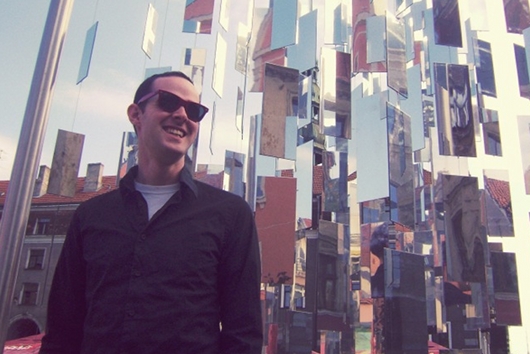
Hound Scales, a recent San Francisco transplant now residing in New York City, is a producer of decidedly somber house music. Today, we have a remix from Cloaka (pictured above) of that artist’s “Bokhara Stitch,” which is about as dark as the original production; slightly haphazard metallic rhythms are sewn into a crisp hi-hat patterns, classic four-on-the-floor beats, and groaning low end to an almost unnerving effect.
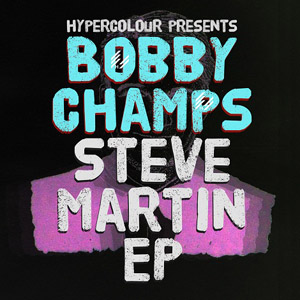
Although Bobby Champs has only two official releases under his belt, he has already honed in on a specific sound and style. The Brighton-based producer’s first record, the Drag Queen EP, was published earlier this year and delivered four tracks of punchy techno peppered with cheeky vocal snippets, a formula best personified by “Charlie,” which employed a sneering “Doing drugs, selling drugs” hook over a dark, stark clomp. His sophomore EP, Steve Martin, employs similar elements: chunky kicks, elastic percussion, eyebrow-raising spoken samples, and a neat, glossy finish.
“NYC Panther” starts with a straightforward, marching kick and dark synth stabs, but adds the flavor of unusual vocal samples that come in full sentences or clipped phrases. “I know kids that are 18 years old driving Mercedes Benz/Here I am, three times 18, and can’t afford Benz,” laments one disembodied voice. The airtight beats all smack and pop like a basketball being dribbled against concrete, each of them a testament to Champs’ exacting hand as a producer.
The EP’s tracks do share a certain sonic commonality, but overall, they feel like three independent—and overly straightforward—singles. For all their cheekiness and precision, Champs’ production lacks challenging and compelling ideas that might unite the songs—emotionally, stylistically, or otherwise—more effectively. The EP’s most notable motif is its verbal content; on “Steve Martin,” a vocalist flickers in and out of the mix talking about “the best kid in town,” which vaguely relates to the topic on “NYC Panther.” But the relationship doesn’t seem much deeper than the fact that both tunes layer cheeky vocal samples about fortunate young people over clipped, smacking percussion and tightly wound breaths of flashing synths.
As a result, the Steve Martin EP feels more like a few homogenous tracks rather than a cohesive statement; ultimately, it goes a bit stale by the end of a straight-through listen. In fairness, Champs’ work here is not without merit; he demonstrates the ability to craft clean, biting singles, and his choice of vocal samples is as weird as it gets. It would be a shame if Champs has already begun to draw hard and fast lines for the limits of his sound, because he’s laid the groundwork for a precise, strong style. It may be a little limited now, but there’s plenty of time for him to improve.
“Fairy Floss,” a new track by multifaceted Austrian artist Abby Lee Tee, follows the free download of “Techno Hearts” we posted back in February, and is significantly less abstract, although still open to interpretation. The video for the tune—which is part of a three-song EP currently available as a “name your price” download on Bandcamp—features a girl dressed in green garb who silently engages with the viewer throughout a series of dream sequences that supposedly reflect her childhood. She returns to the other side with a prize, giving the gauzy video and the heavily textured song a pleasant ending. Described by Abby Lee Tee as a single composition rather than a music video and a song, the music indeed matches the introspectiveness of its visual counterpart.
Steve Hauschildt, one third of Ohio’s Emeralds (who we spoke to just this week about its brand-new Just to Feel Anything album), is readying the release of his Sequitur LP, and has decided to let “Constant Reminders” go as a free download before it drops on November 12. On the relaxed synth-pop cut, what could be a computer-generated voice or Hauschildt’s own voice passed through a vocoder (or both) sings a melancholy melody alongside a playful and poignant synthline, all of which is bolstered by the proudcer’s softly bouncing drum-machine patterns.
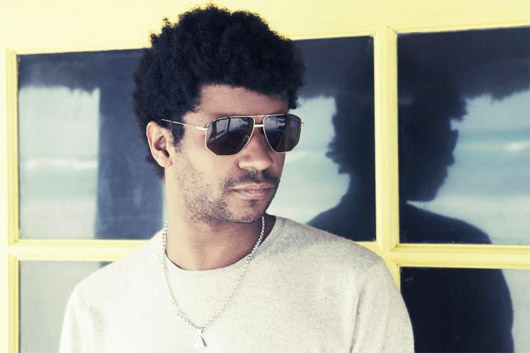
Disclosure‘s “Latch” continues steamrolling across the internet with word of another remix, this time from Hot Creations co-owner and deep-house mastermind Jamie Jones (pictured above). As to be expected, Jones takes the track from his fellow Londoners into a bit smoother territory, lacing the bass/pop hybrid with an extra skip and an irresistible bassline. With a video, a T.Williams remix, and now this remix, “Latch”‘s and Disclosure’s momentum seems to show no signs of letting up any time soon. You can stream the new reworking of the single below; notice that it comes with the familiar Latch: The Remixes artwork, hinting that although there still is no official word, a proper remix EP may very well be on its way. (via FACT)