One of our picks for the Best Releases of 2011 was a monolithic offering of subterranean techno from Manchester’s Andy Stott, called Passed Me By, a record which the DJ/producer will soon follow up with a new LP. The eight-track Luxury Problems is set to drop on October 29 via Modern Love, and is said to feature vocal contributions from Alison Skidmore (who was, incidentally, Stott’s childhood piano teacher) on more than half of its productions. You can check out the artwork and tracklist for Luxury Problems below.
1. Numb 2. Lost and Found 3. Sleepless 4. Hatch the Plan 5. Expecting 6. Luxury Problems 7. Up the Box 8. Leaving
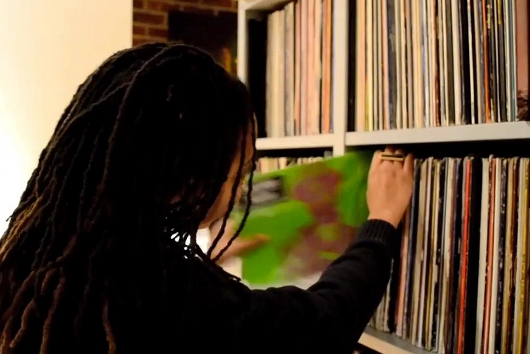
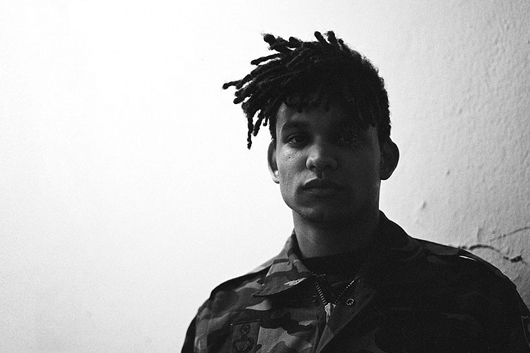
On occasion, we here at XLR8R HQ just need to let loose a bit, and oftentimes that hankering is expressed through music, like, say, banging, tropical-tinged house music. With that in mind, we have this remix from London’s Shy One (a.k.a. Mali Larrington-Nelson, pictured above), who adds a bit more structure to French Fries‘ innocently named collaborative tune with fellow Parisian Bambounou, “Hugz.” The 21-year-old producer swoops in and removes the last two letters from the frequently used word “fuck,” effectively softening the vocal sample and making the tune radio safe. However, her remix still retains the original’s salacious intentions both on and off the dancefloor, as the body-moving production is equally hedonistic. On a related note, be on the lookout for Shy One’s sophomore effort, an LP entitled Bedknobs and Boomkicks, which is dropping soon via Hyperdub and Rinse affilate Scratcha DVA‘s label, aptly named DVA Music.
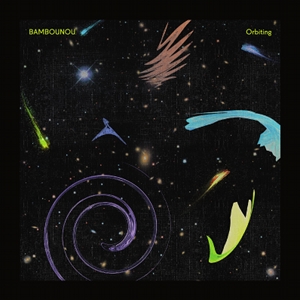
Bambounou has announced that his first full-length album, Orbiting, is on its way, courtesy of Modeselektor’s 50Weapons imprint. In a press release, the 22-year-old Parisian producer born Jeremy Guindo says he started with a minimalist approach for his LP, and strove for a balance of key techno tracks and dancefloor bangers. “Even though I feel the tracks are all quite different within their own right, they still come under the umbrella of ’90s house and techno mixed with some kind of bass music,” Bambounou explains. Before it drops on November 23, you can listen to a snippet from Orbiting, check out its tracklist, and scope its artwork, below.
01/A1 Hyper 02/A2 Any Other Service
XLR8R Couldn't find the embed function for type: "soundcloud" and source: "<embed allowscriptaccess="always" height="81" src="https://player.soundcloud.com/player.swf?url=http%3A%2F%2Fapi.soundcloud.com%2Ftracks%2F59566859" type="application/x-shockwave-flash" width="100%">".
03/A3 Mass 04/B1 Data 05/B2 Capsule Process 06/B3 EX06 07/C1 Let Me Get feat. French Fries 08/C2 Off The Motion 09/C3 Great Escape 10/D1 Challenger 11/D2 Splaz 12/D3 Orbiting
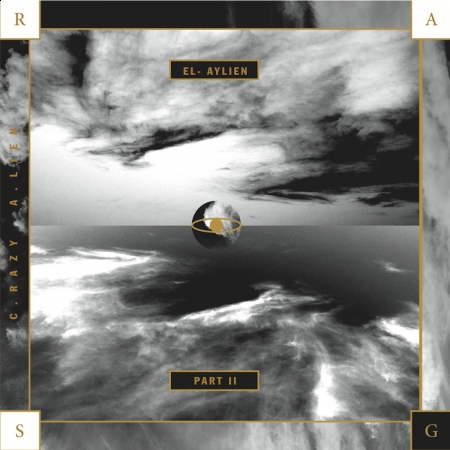
Arguably one of the most interesting space cadets currently inhabiting LA’s fertile musical landscape, prolific experimental beatmaker Ras G keeps things cosmic on his latest offering for Matthewdavid’s Leaving Records label, the El-Aylien Pt.II: C.razy A.lien EP. The seven-track record is the follow-up to the producer’s first installment of the El-Aylien series, which we premiered back in 2010. Once again, before you nab your copy of Ras G’s limited-edition cassette tape and 7″ over on the Leaving Records website, here, you can listen to the galactic traveller’s latest mini-odyssey in full, after the jump.
The XLR8R Music Player requires Adobe Flash Player version 9 or later. Click here to install.
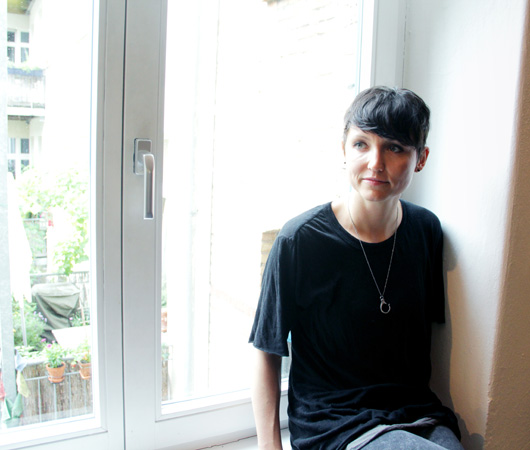
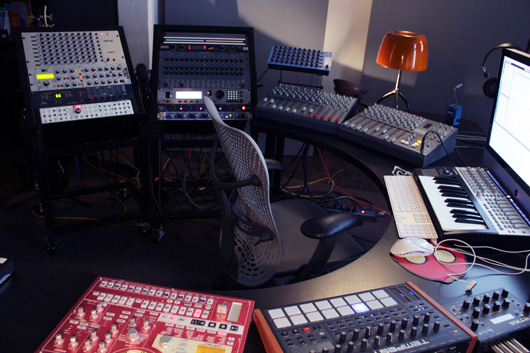
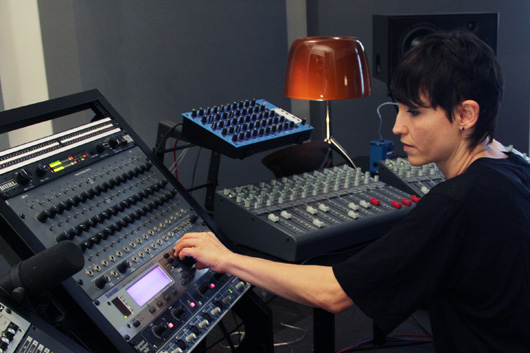
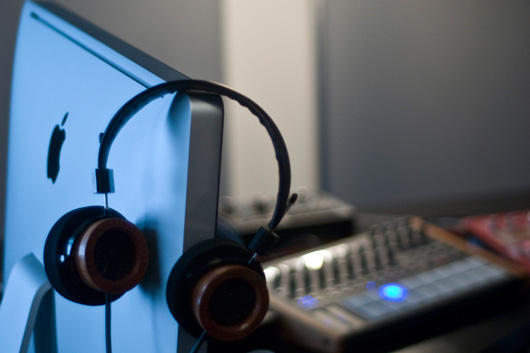
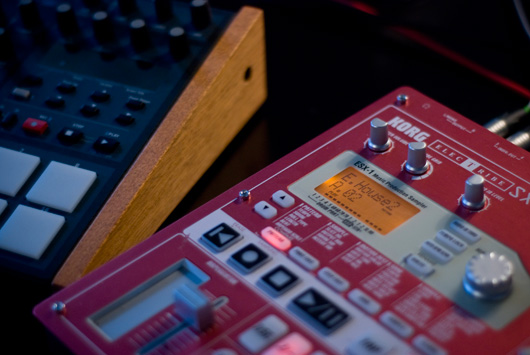
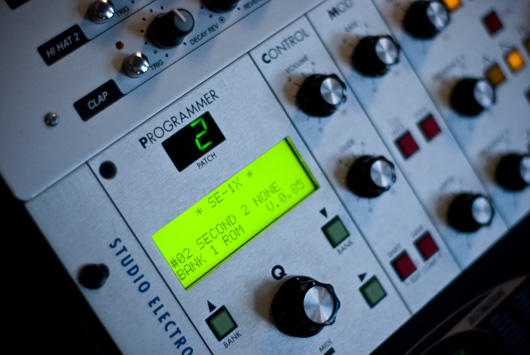
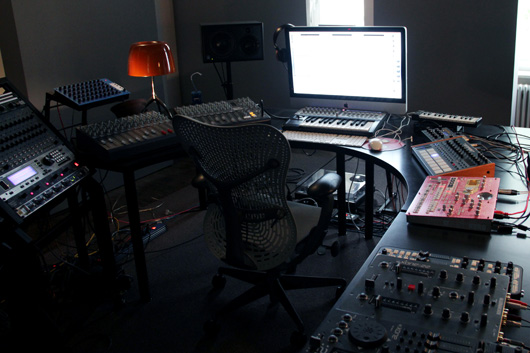
On a day-to-day level, it’s easy to overlook the impact of Magda (a.k.a. Magdalena Chojnacka). That’s not a slight, as the Polish-born, Detroit-reared artist has been a major force in electronic music for more than a decade. It’s just that she carries herself in a decidedly un-flashy fashion, allowing the focus to instead remain on her DJ/production prowess and varied musical palette. Magda will likely always be remembered for her association with Richie Hawtin and the Minus crew, but last year, she made a move toward greater independence, launching the Items & Things imprint with fellow Minus breakways Marc Houle and Troy Pierce. Curious for more details, not to mention eager to get a look at the place where she cooks up her tunes, we paid Magda a visit at her Berlin studio over the summer, where she told us about her production history, studio setup, music-making process, and the piece of gear that changed her life.
XLR8R: When did you start producing music? Magda: I started producing with Marc Houle in the late ’90s. I didn’t really know much. I was just messing around. I was living at his house at the time, and he had a really good studio, with old synths and all kinds of fun knobs to twirl. So, I just started experimenting with some stuff, note by note.
You were already DJing at that time. Yeah, and I was also psycho-editing at that time. I was really into editing everything. So, he would make some stuff, and we would just go in—I think we used Acid—and chop everything up. He was like, “You’re crazy to spend so much time on that.” But to me, it was really fun.
Marc definitely taught me a lot about old gear and the whole concept of [music production] and just sent me on my way. Then I got into Ableton. I didn’t have any equipment. I remember the first piece of analog equipment that I bought was actually during the bus tour that we did with Minus in the States. We stopped by this gear shop and I saw this machine that I still have.
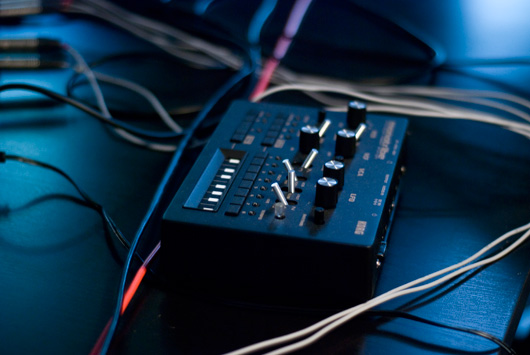
What was it? It’s a Music and More ADX1. It’s such a nice, little, simple drum machine. There are just five different sounds, but it’s perfect to play around with. We had a little setup on the bus. Then, living here in Berlin, I still worked mainly digitally, but having that little thing, I thought, “Okay, I like working this way better. I like this hands-on experience.” Also, there were so many plug-ins and different VSTs out there that I just got overwhelmed. I got too much, and I didn’t really know how to use everything properly. I didn’t take the time to really get into one or two or a few plugins really well. It was just a mess of stuff everywhere.
At some point I decided, “This is too much. I’ve got to figure out how I want to do this.” So I started going to this gear shop here, SchneidersBuero, which is pretty addictive. You go there, and you can try out all the little synths and everything. I started buying equipment, but it took some time and a lot of experimenting. Sometimes, you read about stuff. Sometimes, you just like how it sounds. It took years, but now I really have the pieces I want and it’s a setup I’m comfortable with. I’m still into buying gear, but it’s not at such a fast pace.
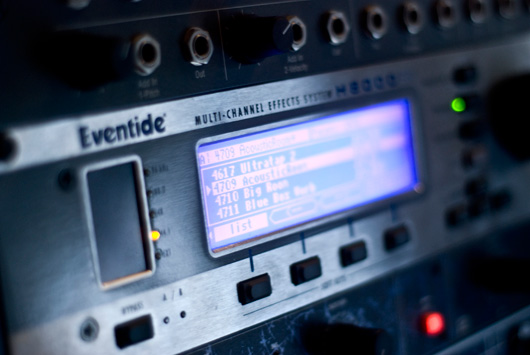
What is your favorite piece of gear? My favorite piece of equipment is the Eventide H8000. It’s a multi-effects processor. This thing is ridiculous. Just the way it sounds, it’s crazy. It’s got thousands and thousands of reverbs, delays, multi-effects, and mastering suites. That thing, you don’t need anything else, really, you can do everything on it. Also, it’s got that Eventide sound, which is so warm and analog. It really changed my life.
Is there anything new, gear wise or technology wise, that you’re lusting after? I want a LinnDrum. I definitely want some really high-end EQs, a nice preamp.
Are you still producing in Ableton? I definitely use Ableton still, but all the sounds, they’re all analog. My AD converter goes into Ableton.
Do you not use any samples in your work? Very rarely.
When you’re making tunes, do you have a set process? It’s always different. But the way I’ve been working lately is I’ll make a drum pattern on one of my different drum machines and send the MIDI notes out to one of my synths, just to see what happens. I’m not sitting there, putting in note by note. I just let it go, and then I edit it down. There’s a lot of experimentation, especially with the Eventide. The thing is so great. You run one sound through it and get crazy stuff, enough to make one song. So yeah, there’s a lot of experimentation, that’s pretty much most of [my process].
You came up with Minus. Was it intimidating to learn to produce in that environment? At the time, it was okay. It was such a small label, maybe there were just four or five of us. It was more just friends just hanging out, messing around. So, I didn’t feel any pressure. There was no, “Oh, you’ve got to put a record out now.” It was never like that. I knew I enjoyed this next step, so naturally I started to do it. I never felt I had to. Luckily for me, I was able to DJ quite a bit without having records out. It took some time for me to really learn [how to produce] properly on my own and feel comfortable.
You mentioned that Marc Houle was your initial mentor. He and I work so well together, because I’m very good at saying, “This is good. This is bad. Take this out. Put this in.” He was the technical guy. He could make five songs in 10 minutes. Sometimes, when I was DJing, I’d call him up and say, “Hey, I need an acid song for tonight.” He’d say, “What kind?” And I’d respond, “You know, late-’80s acid house.” Then he’d send me something. It’s so funny. He’s just very fast and he’s such a nerd and he’s great. So, he definitely taught me a lot.
How long have you been in Berlin? I’ve lived in Berlin for about nine years, but now, I’ve moved to Switzerland. My studio is in Berlin, so I go back and forth.
Do you think that has affected your production approach? Absolutely. There are so many interesting people you meet here, whether they do experimental music or techno or something else. I’ve met a lot of old-school German producers who have really crazy equipment I’ve never even heard of. You just learn a lot from seeing and hanging out with them. It’s definitely been more helpful than me staying in New York or Detroit, where I probably wouldn’t have met such a wide range of people.
What prompted the move anyways? Frustration. Doing parties in New York and being shut down constantly for people dancing or noise complaints or this or that. It was really annoying. I came here—Zip invited me to play a Perlon party—so I said, “Yeah, let’s check it out.” I was used to throwing parties in New York, where everything ends at four. I was at his house, and I asked, “So, when can we go to the party?” He said, “Relax, we’ll go around five.” I was like, “At five we’re going to go? What time do I play?” He said, “Oh, 11:30.” I was like, “11:30 in the morning? Okay, I guess. I don’t get it, but fine.” I was so excited and I was thinking, “It’s fine. It’s okay if I don’t play to anyone.” Eventually, 11:30 came around and even more people came to the party. I thought, “This place is nuts.” And the thing is, everybody was friendly—the bouncers, the staff. It was such a different atmosphere, and I knew I had to come here.
Now, you’re doing Items & Things. What was the impetus for starting that and breaking off from Minus? We just felt that musically, we were going in a different direction. It was a natural progression, just children leaving home, birds leaving the nest.
How do you see Items & Things being different? The three of us come from different backgrounds. Marc is definitely a new wave guy. Troy is a little more industrial. I’m more of a Prince/funk/disco person. We just wanted something more than the stripped-down Minus sound. [In particular,] the stuff that Marc was producing didn’t fit anymore. Rich didn’t really see it, he wasn’t taking it for Minus. We all felt at the same time, “We should really do this on our own. We really believe in this music.” And we were getting so many cool demos from people, so why not do it? We just wanted to get this music out there. It felt like the right time.
Do you, Marc, and Troy ever work on tunes together? Sure. I really enjoy going to Marc’s studio, especially because he’s got so much gear. He’s got a drumkit, he’s a crazy drummer as well. It’s super fun, we just go nuts there.
And you guys all bounce ideas off each other? Absolutely. It’s really important to have people for feedback. We all get stuck in a sound or listening too long, and you just need a fresh ear. Marc will call me up and say, “Can you listen to this? I don’t know if it’s good or bad.” I’ll do the same. We definitely give each other pointers and try to help each other as best we can.
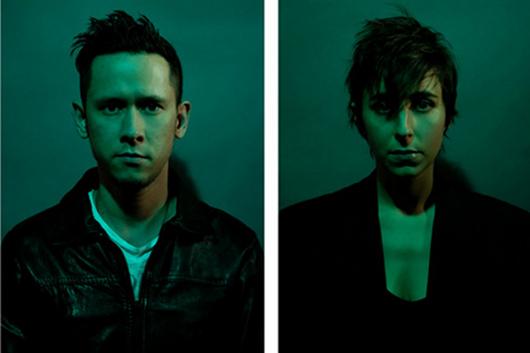
London’s The Eyes in the Heat (pictured above) is all set to drop its Program Me album on October 1 through Parisian label Kill The DJ. The forthcoming record will feature 14 songs from the dark electronic duo consisting of visual artist/vocalist/producer Zizi Kanaan and producer Oliver Ho (a.k.a. Raudive). Here, we have a remix of “Blood,” a decidedly minimal tune featuring Kanaan’s anguished vocals, from fellow London-based producer and Throne of Blood affiliate Daniel Avery, in which he strips the vocals and adds a punchy and acid-tinged beat.
Today, not many of the artists who led the forward-thinking Montreal techno scene of the early aughts have found a way to remain relevant; some have buried themselves deep enough into their specific niches that we’ve all but lost track, while others have seemingly halted their efforts altogether. Scott Montieth has remained an exception though, and in the midst of his 13th year producing as Deadbeat, his latest album, Eight, only further proves why. Incorporating the Berlin transplant’s unwavering dedication to dub techno and detailed sound design, Montieth again expands his repertoire on his new LP, forming an image of a veteran artist who has evolved in style and tone while still remaining true to his to roots.
Dub techno can be a polarizing genre, with newer generations of listeners likely associating the style with minimal techno more than with its place at the roots of genre behind pioneering outfits like Basic Channel and Rhythm and Sound. In the early to mid ’00s, Montieth and his contemporaries (perhaps most importantly at the now defunct ~scape imprint) brought the sound into the digital world, taking the foundation of echoed sounds, half-stepping rythyms, and massive bass into their computers and mixing in intricate digital textures and experimental dancefloor flavors to land on a new wave of dense, subdued techno. On Eight, many of these facets are still at the base of Deadbeat’s work. His nuanced approach to detailed percussion and airy, hi-fi touch marks the album’s high-end spectrum while the dub-influenced patterns serve as the songs’ most basic structures. However, Deadbeat cloaks these pillars of his sound with a new intensity, sharpening his tones into tougher forms and incorporating much more analog girth into his productions, both of which are likely the result of the Berlin resident’s new studio space and recently acquired analog toys: a Moog and Prophet 600 synthesizer.
These newly introduced tones are immediately detectable, but are by no means overpowering. The first pair of album offerings, “The Elephant in the Pool” and “Lazy Jane” (which features Canadian producer/instrumentalist Danuel Tate), are the most straightforward combinations of Deadbeat’s past and present, as the dub aesthetic lines up directly against the thicker sounds to form sturdy hybrids. Shortly thereafter, Montieth blurs those same lines to greater effect, landing on the album’s most rewarding moments with “Wolves and Angels”—a sequenced, synth-led roller which slowly journeys into an immense sonic atmosphere—the deep, textured four-on-the-floor techno of “My Rotten Roots,” and the bass-loaded, percussion-laden, and free-flowing closer, “Horns of Jericho.”
Through it all, it’s unclear if Deadbeat has adapted to the current musical landscape or has just managed to evolve as an artist in a way which rings true within the context of his newer contemporaries. As with all of his records, Eight takes on a slightly different shape than anything before it, further solidifying the man’s reputation as a producer capable of continuing to refine his techniques while landing on new and powerful ideas with each release.
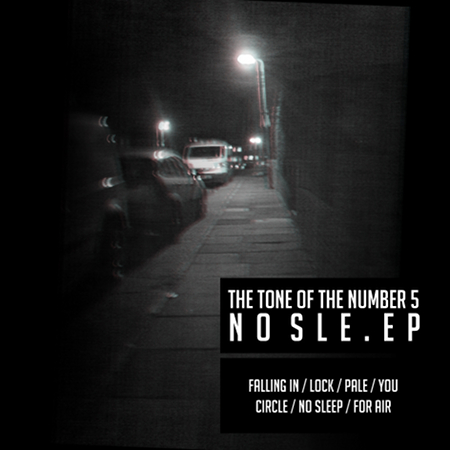
UK genre-hopper The Tone of the Number 5 (a.k.a. Paul Rice) just sent over a cut from his NO SLE.EP EP, which was released yesterday via YRZ. (Full disclosure: The net label is run by XLR8R contributor Joe Moynihan.) “Lock” is a murky tune that makes references to disjointed 2-step, though its subdued, rolling bassline and peaceful piano riffs make it quite headphone friendly. You can check out The Tone of The Number 5’s entire release over on on Bandcamp.
“Ketamine Xmas,” “Pink Panty,” “Vibrant Member”—the collected discography of Lee Curtiss isn’t exactly dominated by subtlety. The Berlin-based tech-house producer’s music weaves an elaborate, and almost cartoonish, composite persona of assorted famous sleazoids from the past 50 years of pop culture. To give you an idea, the press release for Lunatic Fringe, his new EP on Visionquest, comes with a generous sprinkling of comparisons to Charles Bukowski. In some respects this seems a warranted comparison, as Curtiss’ latest is a free-spirited dive into straight talk and raw sexuality. But, the similarities stop there, with Curtiss relying on the presumed novelty of his persona to fill the dead weight between his three tracks.
A collage of loopy drum patterns and sampled fills signals the beginning of EP a-side “Body Twitch (feat. Debbie Rennolds).” Curtiss wastes no time, joining the track with a breathy and drawled croon of “Workin’ like we’re makin’ kids.” Clocking in at over seven minutes long, it’s an extended exercise in basic wordplay, with Curtiss offering dirty nursery rhymes like “I can make your body twitch” and “Let me make your pussy twitch.” However, without much variation, it becomes monotonous well before the three-minute mark, its mellow tempo and meandering arrangement preventing it from drifting into the kind of sexual hypnotism induced by the more uptempo and direct forms of x-rated house.
“Freaks (feat. Debbie Rennalds)” continues where the a-side left off, with similarly looped-up drums and breathy invocations. But this time, he’s dialed up the ’80s references with analog pads and stabs that creep in and out of the mix, playing off the vibe of a deep-tuned, single-note bass riff. As with the rest of the release, Curtiss struggles to find a sense of distance travelled—the cut sounds more like a tricked-out sketch than a fully realized song.
Finally, the EP ends with the paranoiac atmosphere of “Haters.” Playing with a more ethereal palette, he layers washes of noise with a spiraling melody smeared by reverb and tape delay. Here, the rhythm and arrangement is more sophisticated, with crisp patterns shifting through drops into moments of silence. Unfortunately, it’s the release’s weakest lyrical point, with Curtiss channeling the likes of Three 6 Mafia and DJ Deeon to deliver, “Player haters in the house/if you see ’em point ’em out.” There’s an almost lazy self-indulgence to it, its interpolation coming off like a quick attempt to create 2012’s answer to Maceo Plex’s 2011 anti-hate anthem “Stop Your Hate.” This points to a problem of the greater EP—Curtiss’ best works in the past have managed to graft his freaky persona onto tracks with sharp dancefloor appeal, achieving a balance between his vocal delivery and instrumentation that’s unfortunately lacking on Lunatic Fringe.
Trainwreck is a new feature on XLR8R where artists tell us, in their own words, about some horror stories from their past. Catastrophic gear failures, sketchy promoters, travel nightmares… it’s all fodder for Trainwreck. For the first edition, we spoke to DJ/producer/bandleader and Ghostly stalwart Matthew Dear, who just released his fifth solo album, the deceptively sunny Beams, last month. Here, he details his worst touring experience—the time he crashed his tour van into a parked car on his first trip to New York… and got away with it.
This probably was, oh man, 2002? I had never been to New York. We were on a Ghostly tour. It was one of the tours we used to do with two other artists. Midwest Product and Mike Dykehouse were with us, I think. We were driving all over the country, and we finally got to the northeast, and we had one of those big rental vans. We were at a rest stop up in New Jersey, and I was just like, “Okay, this is my first time going into the city, and I want to drive. I can do this.” I was really high on adrenaline.
And so I drove in. I forget which bridge we took over. I was instantly inundated with all the first sights and stuff, everything you can see when you first get over the skyline. I was so excited. I’m zipping in and out of traffic in this huge van and I felt like I was killing it. I wasn’t killing it, but you know. I think we were playing at an old venue called Filter 14 in the meatpacking district. And in the meatpacking district, you have these overhangs—or back then they did. The old meat hooks and stuff. And these old overhangs would hang into the street, and they were really shady. They would cover a lot of the street. And I think I was just so excited to finally be there so I was like, “Yes! Let’s go straight to the venue and do this.”
I pulled over to the right, and in the shadow of this one overhang was this coupe Mercedes, just parked there. And I totalllllllllly clipped the side of this car. I scratched the side of the van. I cracked his headlight and ruined the front. I know, I know. I was just so excited, like, “Yes! I made it to New York after all this traveling, and I drove!” And literally two feet from the venue, I just completely wrecked the front of this guy’s car, and the guy’s sitting in his car. So we get out, and he gets out, and I’m like, “Oh my god. This guy is actually in his car.” He comes over and he’s like the most typical, New York, balding, middle-aged, mid-life-crisis kind of guy. And one of the first things he says is, “No no no no no. It’s fine. Whatever keeps me away from the wife and kids a little longer.” He was the sleaziest—he was an attorney, a lawyer—[and] I was too young to be on the insurance for the van. I shouldn’t have even been driving. [But it was totally cool because] he was like, “Oh yeah, if you guys wanna switch seats, I won’t tell the cops.” So Chad from Midwest Product, the drummer, he was old enough to be driving, so we told the police report and the insurance report that he was driving.
Oh my gosh. We got so lucky. It was the worst experience. It ruined this total rush, this total high, coming to New York for the first time to play this show and we wrecked the van. But the cherry on top was this guy was the sleaziest, coolest guy about it. I was freaking out. I was totally freaking out. I was like, “Oh man, what are we gonna do?” The whole tour could’ve stopped there. The insurance company could have known that I was driving when I wasn’t supposed to and they could have taken the van back and fined us. It was really scary. They wouldn’t cover the damage if it wasn’t legal. But luckily, our van was kind of okay. The back wheel bumper was a little messed up, but it was still drivable. It was his car that got trashed and dinged up. It was far from totaled, so we got lucky in that sense. That was the worst thing to happen on tour—everything else is pretty mundane by comparison.