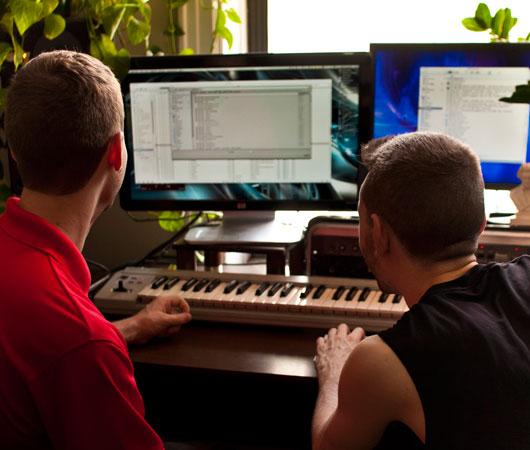
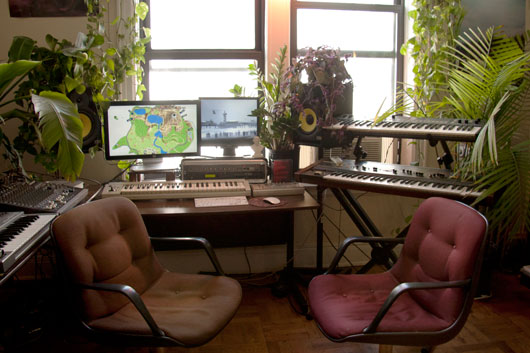
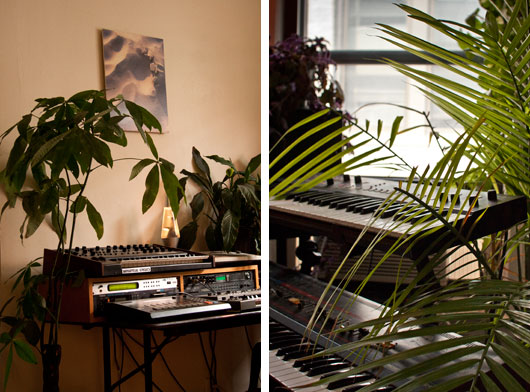
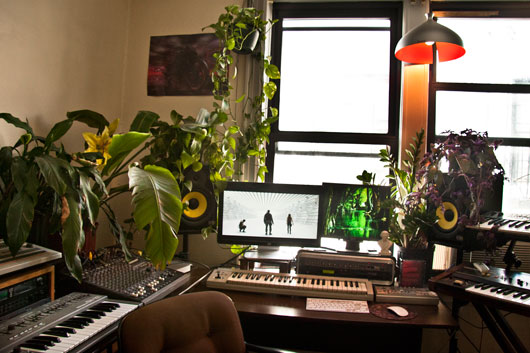
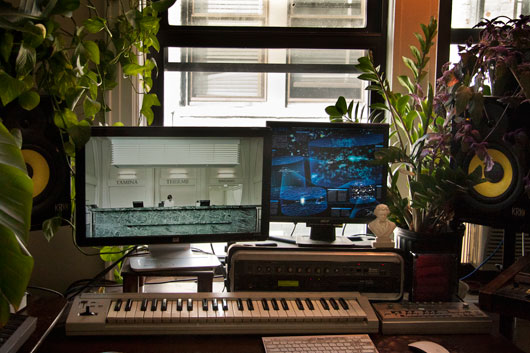
On Exo, the just-released debut full-length from Gatekeeper, the Brooklyn-based duo obsesses over a simulated HD world, an effort akin to sifting through the ruins of an ancient MP3.com society. Conjuring the endless awe and wonder of CD-ROMs, the Roland 303, and glass-casted studios set in the jungle, the LP was created using hyper-produced Hollywood Sound Libraries fashioned in multi-million dollar studios, further modulated by radical macro-envelopes that were inspired by a recent visit to Stonehenge. In hopes of shedding a little light on the pair’s artistic outlook, not to mention its production techniques, we visited Aaron Ross and Matthew Arkell in their Bushwick studio, where we admired their jungle plants and a full-sized gong.
XLR8R: How do you start an idea or a song? How did Exo start?
Matthew Arkell: The first track we made for the LP was “Imax.”
Aaron Ross: It happened last winter after we’d gotten back from our tour in Europe and the UK. The last day that we were in Europe, we went to Stonehenge in the morning and then Glastonbury in the afternoon, which is a new-age town built around this incredible tower. We spent the day out there and had this transcendent experience together, and we came back super inspired with this idea of what a new album would actually sound like. “Imax” is what came—just like stretching out Hollywood sound effects from libraries and playing with them, reversing them.
MA: We’re mixing chakra-attuned frequencies into it as well, so there’s this sort of silly… almost healing aspect to it. In our previous work, we were always trying to mimic a very specific feel, like an alternate history time portal kind of ordeal. It was like, “Oh this is amazing, let’s take these three things and put them together.” Whereas the process on Exo was very intuitive.
XLR8R: You didn’t have your genre mapped out already.
AR: We knew we wanted something more futuristic.
MA: We didn’t want to make ’80s horror music, and we felt like that kept getting thrown on us all the time. We wanted to change it up a bit. We kind of imagine Exo as an environment, a planet, this place. But it didn’t have to be specific, it was never like a specific origin story or ‘these people came here,’ like Drexciya or something.
XLR8R: Even with your older stuff, the ’80s-horror thing didn’t seem like the vibe you were necessarily going for on the Giza EP. Like the video for “Chains”—that’s not ’80s horror movie.
MA: The video for “Chains” was a thousand-hour render. It was our concept, but our friend Alex was the one that put in all the hours. We wanted it to be like something some kid, some 10-year-old, would want.
XLR8R: Something a 10-year-old would find “awesome.”
MA: In a similar sense, with “Imax,” we started playing around with sound effects and started diving into the world of overly designed, HD surround sound. 1080p.
AR: The Hollywood Library is known for commercial sound design—it’s infinite. You can find this stuff forever. I’ve downloaded a few sample libraries, you can always find more and more. A lot of it is really trashy and cheesy, but if you find the right five-second file and run it through a whole lot of digital processes…
XLR8R: It’s a strange sensation to listen to Exo, because there’s this cloud of melody that doesn’t try to grab you as much as, say, the riff-based stuff on the Giza EP.
MA: The new LP, we wanted to infuse it with a more alien feeling. So we kind of bypassed a lot of traditional big leads and melodies in favor of these sort of bizarre tonal qualities from a lot of the sound effects we were playing around with. I think we felt more inspired by those sorts of sounds.
AR: I think it’s also us getting oversaturated by synth stuff. Instead of relying on sine and square waves—basic components of synthesis—instead we’d take a complex sample and map it across a keyboard and play the melody from that. So instead of having these diatonic, linear, progressive melodies, you have a rhythmic sort of self-contained force that has a melodic structure but doesn’t fall into a scale.
XLR8R: Did you do that mostly in Logic?
MA: Yeah. With [Logic’s] EXS sampler.
XLR8R: But you still have a lot of hardware, too. Did you still use it on Exo?
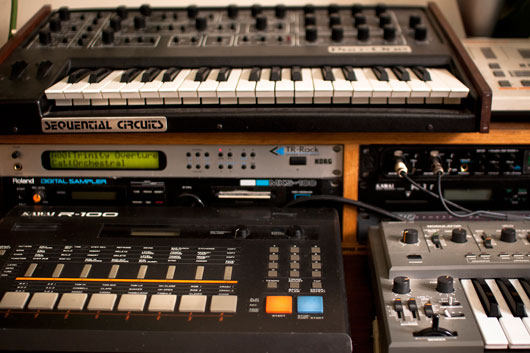
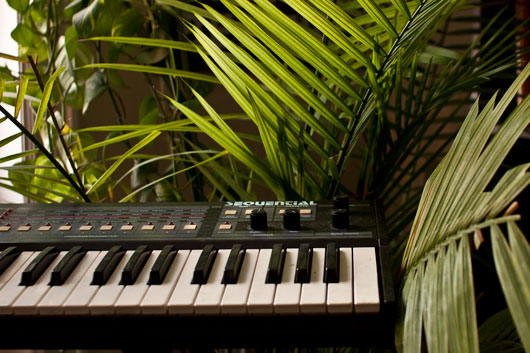
MA: Well, for instance, this [Sequential Circuits] Pro-One we used a lot on Giza. It’s one of our favorites. We felt like, “Oh this one doesn’t leave the house,” back when we first got into analog synthesizers and stuff. There was this moment where we were almost guilty of trying to collect. We’ve been through a lot of gear, and this is one of the pieces that has stuck around from those days.
AR: The Pro-One has this really watery, creamy, de-tuned, auto analog sound.
MA: It’s like weed.
AR: The way you can sequence it is really awesome. You can just play patterns and then have these modulations run while playing and recording them. It just has such a heavy sound. It’s great for one shots, no effects. It’s great for noisy LFO sweeps and sequences.
MA: Really strange, tight balancing sequences. We used it on the track “Tree Drum.”
XLR8R: Were you recording everything as audio? Were you trying to MIDI sync everything?
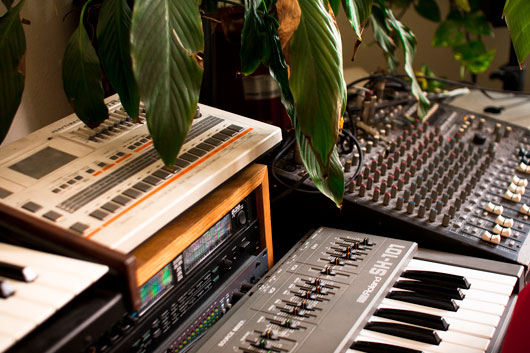
AR: We synced everything as we recorded it. We clocked a Roland TR-707 and had it drive the sequencer.
XLR8R: So you were kind of jamming, but not really?
AR: We’ll jam on like one take, but it would be very, very edited.
MA: We’ll scalpel out the jam.
AR: We do that so that we have enough material to cut up. Since there are no presets on the Pro-One, you can’t save anything, and the sounds you get could be gone forever. And with the 707 clocking, the rhythm doesn’t always trigger correctly. You can get it in time while recording for three minutes, and then it might never sync the same way again.
MA: So whenever something sounds good, there’s this mad dash of hands to make sure we’re recording.
XLR8R: Did you have to time-align everything after you’ve recorded?
MA: A lot of it is micro-nudging and budging the audio around.
XLR8R: Did you find that that was an interruption to your workflow?
MA: We work so slowly and methodically that…
AR: We’ll spend an hour making sure that it’s the right millisecond against the kick or something like that, and those tend to be such useful moments. Once you’ve adjusted enough time that you can actually get it in pocket, the whole thing congeals and really lights up like, “here we are.” We work incredibly slowly, we spend hours on downbeats or whooshes leading up to downbeats. We’re very, very meticulous.
MA: Occasionally, we’ll accept a happy accident too. I feel like a lot of the classic producers from Chicago and Detroit, it’s that slight off-ness that makes it work.
XLR8R: Sometimes when you work in that micro-editing way, it can sound really loop-y and like it doesn’t have a lot of movement. Or if it does, it’s such…
MA: I know what you’re saying, it doesn’t really breathe.
XLR8R: Exactly. It can feel like every moment is so thought out. It doesn’t have a natural arc to things, the sounds don’t bleed into each other in a pleasing way.
AR: We do so much macro enveloping, there are probably like 10 effects or plug-ins on every channel. Each one of those has their own set of modulations happening against the others. What you achieve from that is you have maybe one little loop as an audio track that’s in time and really powerful and working perfectly—if you modulate reverbs or phasers or other kinds of effects over time on that sound, you have this evolution of it.
MA: We always go pretty envelope crazy in Logic.
XLR8R: Are you drawing in envelopes manually or recording them from a controller?
AR: Manually, we just draw them in with the mouse sometimes. I’d say that’s one of the reasons why it takes us so long.
XLR8R: Is there more pleasure working with hardware instead?
AR: I think there’s a lot of pleasure in both. I like hardware because of the way it sounds, but I also like softer sounds, so the value there is a different thing. But I think you end up coming across ideas you wouldn’t otherwise have when you’re using hardware. You come across patterns and modulations and sounds that you would never design yourself. Like our [Roland] SH-101, we definitely used quite a bit.
MA: We used a lot of it for effect. Most of the acid sounds came from a 303.
AR: This SH-101 has a lot of squeaky, portamento rhythm effects, quirky hi-hats. It’s way better at syncing than a 303 or the Pro-One.
MA: Our 303 is really buggy.
AR: I think every 303 is really buggy.
MA: You hold it from a certain angle, like a video game controller…
AR: You hold it on your lap and press down on the right side…
XLR8R: So like the Pro-One, you have to record the 303 quickly or you’ll lose it.
AR: Our 303 works for the most part. It has memory, it sounds great, but what doesn’t work is the right next button. Which if you’re programming, that’s the way you assign notes up and down. And you can only program it if it’s in your lap and you’re pressing on this one button. Which makes it this kind of fun ritual too. Really having this very sexual kind of experience with the instrument and your body.
XLR8R: You said you went through a lot of gear since arriving on this set-up. What made you realize you were done?
AR: We had a [Korg] Poly 6 that we sold, and some other stuff we traded out. Then we got the 303 and didn’t want any more gear.
MA: We acquired all this gear specifically for Exo. We thought if we’re going to make this album, it should have a 303 on it. Because we’re trying to give it that generic sort of future feel that I feel is historically best embodied by a 303.
XLR8R: Do those 303/acid references come with a certain sense of humor?
AR: I think there’s a playfulness to it. It speaks so directly, it activates such a specific reference, you’re going to hear it in really similar ways.
MA: Your parents would know it’s techno.
AR: For us, creating drum beats or whatever made only out of sample material and not vintage drum machines, and having these smeared, tonal things that don’t congeal at all—having the acid in there is sort of this backbone that can help you draw the connection to dance music.
XLR8R: The 303 is a futuristic piece of gear from such a specific point in time, like ray-guns in the ’50s, it’s like this late-’80s/’90s future sound. Is the 303 still genuinely futuristic to you?
AR: The 303 has an elitism to it, because they’re so expensive and hard to get and there’s no way to fake it. There are so many clones, so much software, and so many people trying to fake it, and none of them—you can always tell when it’s a real 303, there’s no confusion at all. Anyone that’s spent any time with it at all can hear the difference.
MA: I think we’re more about the idea of the future. The [303] can definitely still sound pretty amazing, but I feel like now people can get really into strange digital samplescapes and whatever.
XLR8R: If you could have a completely ideal setup, if money was no object, what would it be?
AR: We’d have an all-glass studio in a jungle.
MA: Or on the side of a mountain. I hate to reference Air, but the cover of 10,000Hz Legend, with a modern, all-glass structure coming out of the side of a mountain. I think all-glass would be preferable.
AR: We’d fill it with plants.
MA: Plants, running water, streams.
XLR8R: So your dream set-up wouldn’t necessarily be about the technical stuff?
AR: Well, I’m sure we’d have like a Buchla modular, there are lots of gear dreams.
MA: Or it could just be a laptop.
Exo is out now via Hippos in Tanks.