Jesu is one of the few outfits that can justifiably lay claim to both metal and shoegaze simultaneously, which certainly speaks volumes about the versatility put forth by bandleader Justin K. Broadrick. Prior to Jesu, the multi-faceted UK musician had been a part of the metal scene for years, and now, we find him working solo and busily producing under a new moniker, Pale Sketcher. Taken from the new project’s forthcoming debut album, Jesu: Pale Sketches Demixed, “Plans That Fade (Faded Dub)” is a tranquilly brooding composition focused on thick washes of filtered synths, subtle bass rumblings, and a slow-paced drum-machine beat. Broadrick’s reverberated voice floats in, around, and throughout the ominous track, and showcases a falsetto croon most wouldn’t initially expect from a veteran metalhead.
Jesu: Pale Sketches Demixed will be released August 24.
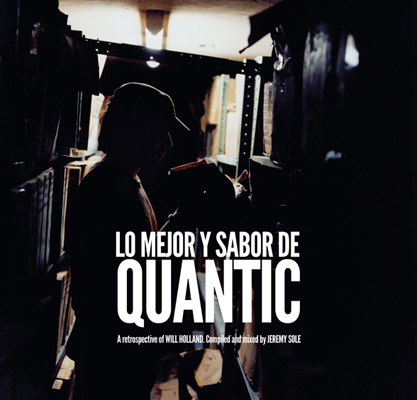
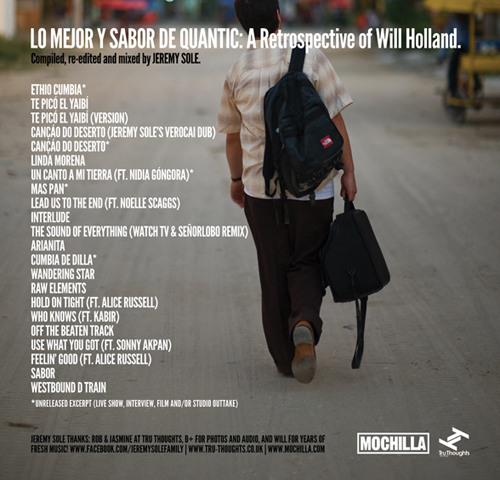
While lots of folks have only recently been turned on to cumbia and other Latin rhythms, guys like Will Holland (a.k.a. Quantic) have spent years digging through dusty crates of Central and South American vinyl, constantly in search of fresh beats and breaks. Yet Holland is more than just an old-school enthusiast, as he’s fronted countless projects with different artists, musicians, and aims, including his most recent dub-minded effort, Quantic Presenta Flowering Inferno, and its Dog with a Rope album. That full-length came out this week and is available for sale here, and in conjunction with its release, the Tru Thoughts label has asked KCRW’s Jeremy Sole to take a closer look at Quantic’s entire body of work. To that end, Sole has assembled Lo Mejor y Sabor de Quantic: A Retrospective of Will Holland, a free 44-minute mixtape that weaves through the Quantic catalog and combines what Sole sees as the man’s best work. The mix is available for download here, and you can view the full tracklist and the rest of the artwork below.
Lone (a.k.a. Matt Cutler), the Nottingham-based abstract beat crafter best known for his 2008 opus, Lemurian, has just announced the launch of his own label, Magic Wire Recordings, and the release of his new single, “Pineapple Crush” b/w “Angel Brain,” which is expected to arrive August 16. “Pineapple Crush” is full of ravey but warm synth stabs and funky percussion, which isn’t quite what one might expect from the producer, whose past albums take on a more Flying Lotus-esque shape. The b, “‘Angel Brain,” churns along at 130 bpm, and has its roots very firmly planted in Detroit and London sounds. Check out clips of the tunes here.
XLR8R Couldn't find the embed function for type: "vimeo" and source: "<embed src="http://vimeo.com/moogaloop.swf?clip_id=13303375&server=vimeo.com&show_title=1&show_byline=1&show_portrait=0&color=00ADEF&fullscreen=1" type="application/x-shockwave-flash" allowfullscreen="true" allowscriptaccess="always" width="530" height="298">".
Now here’s something that takes the whole played-out “face melting” thing to a new level. Low Limit, who doubles as one half of Lazer Sword, produced this track a while back before it was included on the inaugural Numbers release, The Golden Handshake EP, and now it’s been given a fiery (literally speaking) music video courtesy of The No Problem. In the video for “Trapper Keeper,” plastic miniatures of all shapes and sizes are shot close up with a macro lens, seemingly referencing the very micro-worlds that are created within Low Limit’s beat-heavy productions. As LL’s track grows in intensity, the air about the figurines starts to get a bit wavy from the heat and a few of them start to sag, all of which is merely a precursor to the entire setting bursting into flames and burning to a crisp.
The title track from South African DJ/producer/vocalist/graphic artist Spoek Mathambo‘s forthcoming debut album is a bubbling piece of club-friendly riddims, rubbery basslines, and sparse synth hooks pulled together around playful vocal work. Mathambo handles the bulk of the MC duties, but brings in a group of ladies to help fill out the chorus of “Mshini Wam” and its “Little Drummer Boy”-referencing refrain. Months before the album comes out September 13, the track’s official single will be released July 27, along with “Gwababa (Don’t Be Scared)” and remixes from the likes of Schlachthofbronx, Subtitle, Krazy Fiesta, Canblaster, and many more.
Not long after sharing a video for Compass tune “I Wanna Be Your Telephone,” funky UK soul man Jamie Lidell released the official 12″ single, which is available for purchase here. The release comes with a remix of the track “You Are Waking” from Berlin-based producer Bill Youngman, and a rework of “I Wanna Be Your Telephone” from Canada’s sex-obsessed electro fiend, Tiga. You can stream Tiga’s version of the single below.
“I Wanna Be Your Telephone (Tiga Party Like It’s 19909 Remix)”
XLR8R Couldn't find the embed function for type: "soundcloud" and source: "<embed allowscriptaccess="always" height="81" src="http://player.soundcloud.com/player.swf?url=http%3A%2F%2Fsoundcloud.com%2Fwarp-records%2Fi-wanna-be-your-telephone-tiga-remix" type="application/x-shockwave-flash" width="100%">".
New artists have been rapidly emerging from the ether of the LA beat scene for quite some time, but recent times have also seen a uptick in the number of labels popping up to support the music with things like, you know, official releases. The Non Projects imprint is a member of this new class, and next week the label will unveil its second offering, the Silver Trees/Damiel EP. It’s a split release from a pair of like-minded LA artists, the young and classically trained Asura (a.k.a. Ryan York) and Non Projects label head Anenon (a.k.a. Brian Simon). A free download of Asura’s “Silver Trees” blew up the XLR8R website last month, so we imagine that the beat fanatics out there will greedily gobble up the streaming audio of the entire eight-track EP below.
The XLR8R Music Player requires Adobe Flash Player version 9 or later. Click here to install.
It’s Wednesday night, and the scene at LA’s Airliner Club is typical: A sea of nodding baseball caps; empty Pabst tallboys lining the bar; speaker stacks blasting out waves of wobbly, ribcage-rattling bass. This is Low End Theory, and thanks to the rise of Flying Lotus, it’s arguably the hottest club in the US right now. Certainly the crowd seems to think so—the place is packed, and the atmosphere is celebratory. Mary Anne Hobbs, the BBC Radio DJ who is this scene’s biggest overseas advocate, is headlining, and FlyLo’s latest album, Cosmogramma, is already well on its way to making LA beat music a global phenomenon. Tonight, this dive bar on the outskirts of downtown Los Angeles feels like the center of the universe.
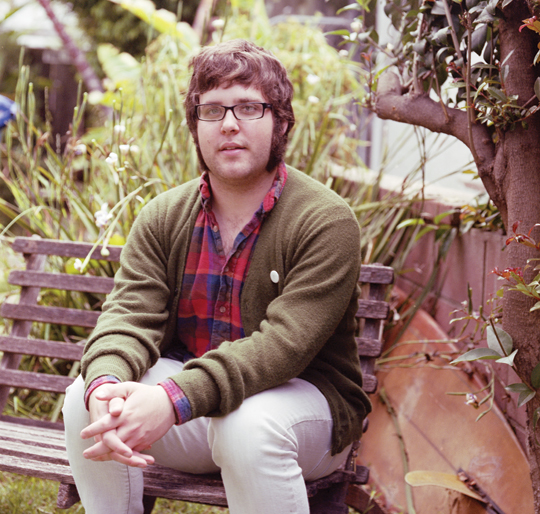
Warming up the crowd for Hobbs is a talented newcomer from the Valley named Will Wiesenfeld (a.k.a. Baths). Wiesenfeld is almost absurdly new to the scene—the first beat event he ever attended was a one-off called Destroy LA that took place in September of last year. After his experimental band, Post-Foetus, performed early, he stuck around to catch sets by FlyLo, Gaslamp Killer, and Daedelus—and had an epiphany. “I was just freaking out for the entire evening,” he remembers. “I was like, ‘Oh my God, I need to be able to do that; I need to be able to move that many people completely on my own.'” So he ditched the band—and several years’ worth of music—and set about creating his solo project, Baths (pictured below).
Less than a year later, Baths is signed to Anticon and playing his first gig at Low End Theory—the first night of a four-week residency. His debut album, Cerulean, lands this month, yet even in May, Mary Anne Hobbs already had it in heavy rotation. Wiesenfeld, who is all of 21, still can’t quite believe any of it. “Everybody is on my side and trying to make things happen for me,” he says of the beat scene, which Daedelus introduced him to after discovering Post-Foetus’ one and only album, released on a tiny Malaysian label called Mü-Nest. “And it’s so surreal, because I’ve been making music on my own for such a long time—like, assembling a band and trying to get shows and not being able to figure all of these things out. But it’s like a team of people behind me now. It’s so, so cool.”
It’s not just Baths who’s benefiting from the beat scene’s inclusive M.O. All over LA and beyond, young producers are plugging into the growing network surrounding Low End Theory, the dublab radio collective, and Alpha Pup, the record label and distribution company run by Low End promoter Daddy Kev. And already, they’re transforming beat music in ways not even FlyLo could have envisioned.
Maybe it’s a generation raised on the ADD jump-cuts of Michael Bay movie trailers. Maybe it’s the advent of Ableton Live and other apps that make music editing easier than tagging a freeway overpass. Whatever the reason, younger heads that, only a few years ago, would have been blazing up to the abstract rhymes of Madlib and Freestyle Fellowship are now getting rowdy to the abstract beats of FlyLo and his disciples. And where many electronic music scenes too often choke on their own conventions (bloghouse, anyone?), the beat scene seems to thrive on innovation. “At Low End Theory, you can put on anything and they’re like, ‘This is weird as fuck! I love it!'” marvels Baths. “The crazier it is, the more people are into it.”
Baths – “Hall”
With his first-ever Low End set, Baths proves his own observation. His best-known track, “Hall,” comes on a like a dubstep remix of Passion Pit, all tumbling beats, falsetto vocals, and blissed-out synths. Pitchfork calls it a beat/chillwave hybrid, which Wiesenfeld doesn’t mind (“I love Toro y Moi…if that is considered chillwave, then I’m totally flattered to be any part of that,” he says). Whatever you want to call it, it’s a far cry from Low End’s usual bungee-like bass drops—and the beat kids are eating it up.
“It didn’t used to be like that,” says Leeor Brown, who runs the Friends of Friends label and also works at Terrorbird Media as Baths’ publicist. “Watching the [Low End] crowd now is mind-boggling.” One of the Low End scene’s most veteran producers, Take, agrees. Back in 2003, Take and some other LA producers, led by a British expat named Justin “Kutmah” McNulty, were doing an instrumental hip-hop night called Sketchbook that became an early stomping ground for the beat scene’s most influential figures—FlyLo, Daedelus, Ras G, Gaslamp Killer, Dibiase, and so many other future movers and shakers that Take struggles to remember all their names.
“We would hang out in the parking lot,” remembers Take, who prefers not to use his real name. “One of us would be playing records inside, and it just evolved into this thing where producers started bringing their beats, and Dibiase would bring a boombox, and we would all sit outside… It was all guys, lots of weed smoke, and basically just producers sitting around listening to each other’s beats.”
But Sketchbook, it turned out, was just a little too ahead of its time. Besides the inner circle of producers, only a few fans would show up each week, and most of them were baffled. “People would walk up to the DJ booth and say, ‘Man, play some hip-hop,'” Take remembers. “We’re like, ‘This is hip-hop. This is the new shit.’ And people were like, ‘Nah, we can’t dance to it.’ MCs would come through and want to rap and we’d just be like, ‘No. No rappers, no MCs—strictly instrumental.’ So the night just sort of pitted out.”
Less than a year after the Sketchbook crew called it quits, Daddy Kev started Low End Theory and “literally picked up where Sketchbook left off—with much better promotion, much better sound,” says Take. “You know, we were all just stoned producers just wanting to hear music. We had no experience with promoting. So what Low End did was just take that aesthetic and blow it up.”
Among the younger LA beat producers, the one who seems likeliest to blow it up further (besides the red-hot Baths) is Henry Laufer (a.k.a. Shlohmo), a 20-year-old lo-fi beat junkie and field-recording enthusiast, whose crackling, low-BPM compositions update Boards of Canada’s filmstrip-soundtrack wooziness for the dubstep generation. An LA native, Laufer grew up listening to “stuff like DJ Shadow, Amon Tobin, M83…stuff with some sort of cinematic vision.” He started making beats when he was 14, but “didn’t really do it with any sort of purpose until I was like 17 or 18, though.” That was also around the time he and his friends, already fans of Flying Lotus, discovered Low End Theory. Even before his first Low End visit, Laufer remembers reading up on the club and thinking, “Damn, this place sounds like the shit. I’ma be there every Wednesday for the rest of my life.”
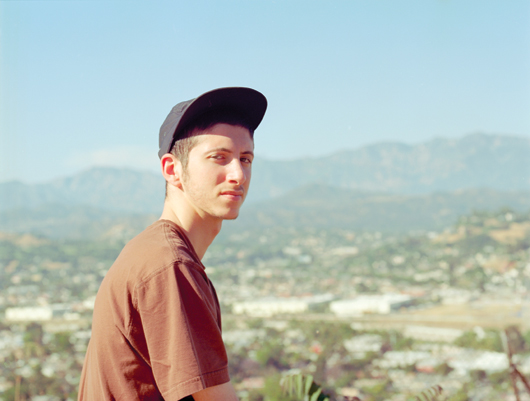
Laufer (pictured above) doesn’t necessarily think of his music as beat-driven. “I’m really influenced by the ambient/noise stuff… I’m really influenced by sound in general. Corny as it may sound, I’m really intrigued by the debate of what is to be considered music.” But he agrees with Baths’ assessment of the beat scene as a place where he can give his exploration of such heady ideas free rein: “The beat scene is a lot about the acceptance of the weird shit.”
Laufer relocated to San Francisco for college last year, but still spends summers in LA and stays connected with many of his fellow LA beat kids through the WeDidIt Collective, an online community of musicians and artists whose Blogspot-based website is as low-tech as the battered studio monitors he records on. “It’s like blue-collar beats in this shit!” he jokes, when asked about some of the crappy gear he prefers.
As much attention as Shlohmo’s debut album, Shlomoshun Deluxe, has received, Leeor Brown thinks Laufer is just getting warmed up. When Laufer recorded Shlomoshun, “he was only 19,” Brown notes—then adds, only half-kidding, “Now he’s 20, he’s a whole ‘nother trip.” Brown has the young producer signed to a multi-record deal. “I really do think the kid hasn’t even explored what he’s capable of. He really hasn’t been doing it that long.”
Shlohmo’s next release, an EP called Camping, out this month, hints at what Brown is talking about. On new tracks like “Sippy Cup” and “Tomato Smash,” Laufer is expanding his use of distorted vocal loops, weaving them like alien transmissions into his ambient soundscapes and beautifully broken beats. The Tobin and Shadow influences are still apparent, as are echoes of the beat scene’s biggest field recording proponent, Leaving Records’ Matthew David (see sidebar)—but more and more, Laufer sounds like a guy on his own trip.
Shlohmo – “Sippy Cup”
From his perch in Colorado, away from the thriving but occasionally insular LA beat community, Alex Botwin (a.k.a. producer Alex B) sees combined beat/dubstep scenes springing up all over the country. “Beat music and dubstep are really pulling a lot of tickets,” says the multi-tasking 25-year-old, who seems to know the headcount of every show he’s ever played. “Everywhere I’m going, the places have been packed and sweaty—it’s crazy.”
In the past few years, Botwin has been building his Elm and Oak brand—a record label, design shop and clothing line all in one—into a sort of Brainfeeder for the burgeoning Colorado scene. He got his start playing bass and laptop in the Pnuma Trio, a road-warrior electro-jam band (“in 2002, we did 226 shows”) signed to STS9’s 1320 Records. But “once I heard FlyLo, it caught on real quick for me,” Botwin says. His first gig at Low End Theory came when he was on tour with electro-funk producer Eliot Lipp’s live act, Lipp Service. When Lipp Service booked a Low End show, Alex managed to score himself a slot as the opening act. Impressed with the young producer’s style, Daddy Kev invited him back, and eventually agreed to master his debut album, Moments, and distribute it through Alpha Pup. “We just hit it off,” Botwin says. “Everything was falling into place.”
Rather than release Moments on Alpha Pup, Botwin says that both Kev and Flying Lotus recommended that he turn his design brand, Elm and Oak, into a record label. “Kev was like, ‘Hey, here’s an opportunity for us to help you do your own thing.'” So far, the label has only released Alex B’s own blunted, electro-charged beats, but he has plans to expand his roster. “The music scene in Colorado is just poppin’… I wanna help promote a lot of the amazing artists I know from around here that aren’t getting the love that they should.”
Shlohmo, Baths, and Alex B may be the young beat producers currently making the most waves, but they’re just the tip of the iceberg. Dig deeper, and you find guys like Mtendere “Teebs” Mandowa, a 22-year-old painter and crafter of gorgeously melodic, meditative loops, whose debut album is due out on Brainfeeder later this year. Or Ryan “Asura” York, a former UCLA jazz major who brings a classically trained composer’s ear to his brittle ambient beats. Or Juj, one of Shlohmo’s WeDidIt cohorts, who injects his low-frequency wobblers with a little hip-hop swagger (and a dose of humor—one of his tracks is called “Pomegranate Limeade Just Spilled All Over My Laptop”).
Then there’s Dak (a.k.a. Dakim), a Detroit-bred, LA-based producer who remains unknown outside of beat circles but is universally admired by the true believers. Matthew David, who released Dak’s debut album, Standthis, on his Leaving Records label last year, calls Dak’s hallucinatory, deconstructed beats “some brand-new, groundbreaking shit,” and nearly everyone we talked to agrees. “Dak makes just the most way-out shit,” says Take, “and he’s totally embraced by the beat community.”
“That’s one of the most beautiful things about it,” Take continues, talking not just about Dak but about the LA beat scene as a whole. “We all come from really diverse musical backgrounds. I think we’re all fascinated by sound and the love of music in general. I think that’s why there’s an openness to when someone shows up with a [sound] that’s so out of the ordinary… We’ll still embrace it because it’s got this sort of quality about it that is just raw and unique and from the heart.”
Take, who’s been releasing records for over a decade and remains, according to Brown, “the unsung hero the group,” is also benefiting from the beat scene’s increased profile. His latest album, Only Mountain, released on Alpha Pup in April, is already his most widely acclaimed work to date, and he’s preparing to embark on his first full US tour. “I’ve toured Europe, like, four times,” he says. “I think Europe was definitely first to embrace this sound. But in the last year, it’s gotten so much more popular in the States—so yeah, it has made it a lot easier to set up shows.”
When it comes to the beat community’s cadre of younger producers, Take has mixed feelings. “The music has advanced so much, and it’s crazy how much technology has changed our ability to make music so easily. That’s inspired a whole generation of young kids to get a laptop, get Reason, and just get cooking. And some of them are making incredible stuff—and some of them are kind of just copying the sound.”
Ultimately, he offers this advice to young beat producers: “I think the bottom line is that you gotta come with your own shit. Just push it forward.” So far, the beat scene continues to embrace such innovation—and its best young talents continue to provide it.
This remix of Parson’s “I Rep the Dirty South” from Austin’s Dubbel Dutch (pictured above) first premiered in the podcast the DJ/producer put together for our XLR8RCity Guide series, but was just released from its mix confines and shared over on FACT. Producer Marc Glasser treats his remix almost like an anthem for his home state, as he forms the body-shaking bass tones, shuffling future-house rhythms, and rave-inspired synth melodies around pitched-down vocal samples of “I rep the dirty south” and “Lone Star State,” and makes the whole thing sound mighty big.
For his latest single produced for the ongoing Scion A/V single series, veteran garage icon Todd Edwards crafted a classic-sounding, heavily melodic tune called “I Might Be,” which was released with remixes from Joy Orbison, MJ Cole, My Dear Disco, and Feadz. Now a video has surfaced for the song, and it also happens to be the first music video ever officially made for an Edwards tune. The clip is far more sinister than the upbeat music might imply, as a young sweater-and-skirt-clad girl races through a desert at dusk before inexplicably winding up in a lone house, tied to a chair. And that’s just in the first minute. The events seem to repeat themselves, and slowly become more and more over-stimulating and ominously threatening before an outright monster-rave goes down—kind of like “Thriller,” actually. All in all, Todd Edwards could’ve done infinitely worse for an inaugural music video, and we look forward to more singles and accompanying videos in the future.