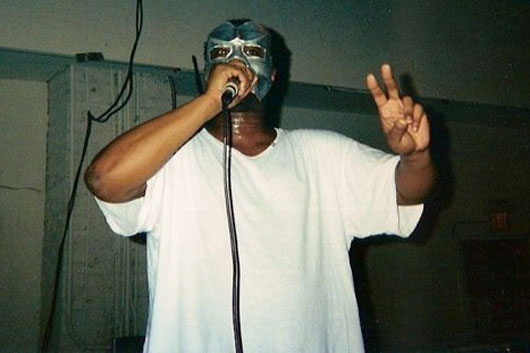
The metal-faced man now known only as DOOM is set to drop his second live album in his double-decade career as a consistently interesting MC. The forthcoming release is called Expektoration, and features recordings taken from an as-yet-undisclosed NY performance, including renditions of classic DOOM tracks “Kon Karne,” “Accordion,” and “Change the Beat.” Along with DOOM’s inimitable flows, his alter-ego King Geedorah and cohort Big Benn Klingon also make appearances. More info on the release—which is ready to drop September 14 via Gold Dust—can be found on the Expektoration micro-site, here.
As a tribute to the hallowed past-time of the world, football (a.k.a. soccer, for you Yanks), our pals over at The FADER have teamed up with that sporting goods/lifestyle company called, like, Nike, or something, to bring you a series of mixtapes curated by DJ/producers from six of the world’s continents. Europe, North America, South America, Asia, Australia, and Africa are all in the queue for the series (Antarctica is still getting its team together), and each will feature original artwork from XLR8RVis-Ed feature artist Siggi Eggertsson, all of which will become limited-edition posters available in the future. First up from the list is South America with Dutty Artz compatriot Maga Bo handling the mixing duties and delivering a stellar composite of modern cumbia to represent his county. Check that whole deal out here.
Next week, Brooklyn dancehall/grime/funky maestro and Dutty Artz co-founder Matt Shadetek is unveiling Flowers, an instrumental album that showcases his wizard-like mastery and unabashed affection for futuristic bass sounds. We’ve already premiered one track (“iHop”), but now another tune has slipped into the internet ether. The word uptempo doesn’t do “Funny Cats” justice, as the track is brimming with energy, not to mention synth and bass melodies that sound like ’80s synth-pop on a sugar high. The song teeters on the edge of silliness, but gets through its three and a half minutes without barreling over the cliff. Propelled by shuffling kicks and bustling low end, “Funny Cats” is one potent song. (via FADER)
Three years after his last full-length album, the genre-defying Asa Breed, veteran producer Matthew Dear has finished work on his follow-up album, his fourth full-length, Black City. The new record will be released August 17 on Dear’s longtime label, Ghostly, and features 10 tracks of the artist’s subtly funky style of twisted pop music—among whatever other random styles he sees fit to sprinkle throughout. The album’s press release reports that Black City is “the culmination of years of hard work and experimentation, a darkly playful sound-world that envelops the listener like the arms of a malevolent lover.” Get a preview with “I Can’t Feel,” over on Dear’s website, and check out the album artwork and tracklist below.
Honey I Can’t Feel Little People (Black City) Slowdance Soil To Seed You Put A Smell On Me Shortwave Monkey More Sugery Gem
XLR8R Couldn't find the embed function for type: "vimeo" and source: "<embed src="http://vimeo.com/moogaloop.swf?clip_id=11650600&server=vimeo.com&show_title=1&show_byline=1&show_portrait=0&color=00ADEF&fullscreen=1" type="application/x-shockwave-flash" allowfullscreen="true" allowscriptaccess="always" width="530" height="298">".
New Bot’Ox single “Overdrive” finds the duo mixing up hyperactive videogame synths with goth rock, crafting a song that ultimately sounds like a Euro take on the music you’d hear during the chase scene of an ’80s action flick. But can we talk about the video? The plot isn’t exactly clear, but it seems to be some sort of exposé on souped-up car culture, only it’s shot in Europe, so instead of Fast and the Furious-style muscle cars, everyone has a tricked-out hatchback clown car that probably gets 126 miles to the gallon. We hate to say it, but if you’re going to dork out on cars and try to be some kind of drag-racing badass, bigger is probably better. The “Overdrive” single will be released on June 7.
If forced to compile 2010’s best albums so far, it’s a safe bet that Four Tet‘s There Is Love in You and Caribou’s Swim would both make our short list. So when we saw that Caribou had remixed Four Tet’s “Angel Echoes,” it was enough to get us jumping up and down like excitable toddlers. Taken from the forthcoming “Angel Echoes” 12″, which will be released in August, Dan Snaith’s Caribou remix stretches out the, erm, angelic original, bumps up the percussion, and blends in some bouncing basslines. While some of the track’s serene bliss gets lost in the process, the remix is certainly better equipped for the dancefloor. (via Gorilla vs. Bear)
The widely followed flame war between M.I.A. and NY Times writer Lynn Hirschberg over a not-so-positive article the reporter wrote on the musician was taken to a whole new level the other day—think Biggie versus Tupac, but if Biggie was a pseudo-political pop diva and Tupac was a journalist. In what seems like her final say on the matter, Ms. Maya Arulpragasam penned a diss track and dropped it over the “Hater” beat by the UK’s Various Production. The song’s chorus, which remains from the original version, simply states, “I’m a singer/Never said anything else/I didn’t lie to you/Thinking of somebody else.” No word yet on Hirschberg’s response track. Have a listen to “I’m a Singer” here.
With the release of her debut LP on Hyperdub, Sara Abdel-Hamid, the rebellious London producer known as Ikonika, wants to shake up dubstep with funky, R&B-dabbled rhythms and a punk ethos. Flying Lotus chats with her about her plan of attack.
XLR8R: What do you guys think is the lynchpin between your two scenes?
Ikonika: Well, London’s always got this hardcore continuum going on, and we very much love our bass music, but, I dunno, I think the bpm [between the scenes] is a lot different. Like 130-140, just in terms of dubstep, I guess. But you guys have always had hip-hop, and we’ve always had, like, garridge.
Flying Lotus: And drum & bass and stuff.
I: Yeah, drum & bass and all that kinda stuff. But I grew up on American R&B and hip-hop, so I guess that combined with garridge has led to a particularly London sound.
FL: It’s funny, I think of those same exact things, and I think that the drug culture has a lot to do with the sounds.
I: Yeah, I think you guys are all about the drums and we’re all about the bass.
FL: No, I’m talking about drugs, like ecstasy!
I: Oh, drugs! [laughs]
FL: Yeah, the drug culture is so different in London, like, the party scene is so different, it definitely lends itself to more uptempo stuff. The whole rave thing never really took off [here] like it did over there. The drug influence definitely played a part in the music and the sound that was coming out of [the UK rave scene].
I: Definitely. I guess, back in the day, it was illegal to rave, and everyone threw these warehouse parties and stuff. Obviously, I was too young to do that, but that’s probably carried on, and I think a lot of kids these days, when I go to clubs, they just seem, like, totally on Ketamine all the time, and cocaine. And we’ve had the smoking ban recently as well, which kind of changed things.
FL: I don’t even think people think about that kind of shit. But the whole drug-taking culture plays such a part in the sound. That’s why, I think, LA people make slower music, cuz we’re all stoners over here.
I: You’ve got better weed out there?
FL: Yeah, we’re known for our weed shit, and it’s like, “Okay, you come over to Cali, Ikonika. You come over here and chill with us for like two weeks, I think you’d understand why we make the stuff we do.”
XLR8R: How did you two meet?
FL: Didn’t we meet at Plastic [People]?
I: I first met Flying Lotus at FWD>> when he was playing, and I didn’t know who this American guy was hanging out with us, asking for weed [laughs]. I think you were one of the first people to play [my track] “Please” as well.
FL: Yeah! That’s right. I love that tune. It’s pretty funny cuz I didn’t know who you were either. I think I was just trying to get high in the corner.
I: When your beats started to circulate through the UK and through London, people were really excited, particularly in the dubstep scene. Why do you think that was?
FL: I was surprised. I played this show with Kode9 on Rinse FM and it was really crazy. I didn’t expect it to go down the way it did, you know, considering Rinse FM was such a weird little nook, like in a library or something like that. It was the strangest setting; it was just like a really bright room that looked like a place you’d teach special-ed kids or something.
I: Yeah, like, when I first went into that particular studio, I was like, “This is Rinse FM?” I was expecting it to be in like some council flat, like somewhere in the middle of London, on the 30th floor or something. They’ve got a nicer studio now, like really well set up and stuff.
FL: But yeah, it really surprised me. How has the reception been for your music over here?
I: I’m not too sure, to be honest. I think once the album comes out, and people start listening to it, and me coming over, hopefully in June, we’ll see. But there’s quite a big buzz about Hyperdub at the moment, which is really exciting. It’s also just a really good feeling to finish this album [laughs].
FL: How long have you been producing?
I: I guess for about four years. Steve [Goodman, a.k.a. Kode9] put “Please” out in 2008, and we just went from there. I’m still kind of learning and stuff, and it just feels good to have someone like Kode9 trust me so much and take that risk.
“Please”
FL: Do you feel a lot of pressure to hold it down for Hyperdub as well as the ladies of the world?
I: [laughs] Yeah, I guess so. More the Hyperdub thing, though.
FL: Do you see the whole history-in-the-making happening?
I: Do I see it? Do you see it? Did you see it with yourself?
FL: I’m talking to you. Do you see pages of history being written at the moment?
I: I dunno, maybe. I guess so. It’s always been my intention to be different and mess up the dance-music scene. I’m here to destroy things and confuse things—but in a good way, know what I mean? It’s just always been my thing; I’ve always been different.
FL: You’re just a rebel.
I: Yeah [laughs]. That’s where my name comes from as well. Ikonika—destroy things. The UK has this thing about killing things: When we like a tune, we say “boo” and we put our gun fingers up [laughs].
XLR8R: Ikonika, you used to have a punk past, right?
I: Yeah, kind of. I used to play the drums in hardcore, metal-core bands. That’s when I really started falling in love with music. Cuz I had been exposed to a lot of R&B, hip-hop, garridge. And then when I found out about bands, I was so intrigued by it. Like, just the whole hardcore culture as well. I was never straight edge, or followed it, but like, just the music and the energy really kinda fascinated me. And just hanging out with loads of different people from school, I guess. Cuz my school was kind of the reject school in the town, so we didn’t have, like, set groups. Everyone would hang out with each other, and everyone would be really friendly. Like, we had the really posh kids hanging out with the poor kids, and the metalheads hanging out with the slick R&B girls.
FL: I actually went to a high school like that, too. I got kicked out of my regular public school system when I was in 11th grade and I had to do my last year at a “reject school” as well. I was pretty much exposed to punk and stuff around then, too. That’s pretty funny, I didn’t know you had that same kind of upbringing. I lived in this weird suburb of LA, in the Valley. And I guess we’re known for pornography. The world’s largest porn companies are in the valley. So part of this reject school was, like, a lot of girls who were getting involved in that sorta thing. I went to school with a girl who went on to be a very famous porn star. The first gay person I ever met was in that school. You know, just like, alternative cats. Kids with tattoos, just bad-ass, you know, like, 13, 14, or fucking hooked on heroin when they’re, like, 12. It was a bit ghetto. It was all kind of this weird American Beauty kinda vibe.
XLR8R: When did you start getting into music, FlyLo?
FL: I first was introduced to really, I guess, underground electronic music when I was in middle school. I was in band class playing saxophone and there was this kid behind me who was listening to these crazy-ass sounds, like [
makes weird rhythmic clashing noises
], and I was like, “What the fuck is this shit?” that was blasting from his headphones. And I looked back and was like, “Yo, what’s this?” And he gives me this tape of this kid, RAW, from LA. It was this crazy drum & bass and I just got hooked instantly to that sound. And I was already a big fan of like Dr. Dre, all that West Coast hip-hop that was coming out around the ’90s. I just kinda got into making music that way. Through that and my family having keyboards and toys around to mess with. Our “church” experience was going to my Aunt [Alice Coltrane]’s ashram on Sundays out in Agoura, and she would do a discourse based off the teachings of Sathya Sai Baba, and after that she would play on the organ and all the people in the ashram would play instruments. Really crazy spiritual music happening on Sundays.
XLR8R: Is that the obvious cosmic vibe connection with your new record,
Cosmogramma
?
FL: Definitely. It’s more so just getting in touch with my roots, if you will. I felt with my last [record] I was kinda holding back a little bit, holding back my personality, my history. I felt like, man, I’ve been hearing so much shit coming out that’s kinda like trying to clone what I was doing, I’m like, “Wow, okay, what are we gonna do about that?” You just kinda have to dive so deep within yourself that it’s a sound that no one else could make but you. And that’s the thing that I’m trying to find; I’m searching for that shit. Ikonika, you know about that, right? Like, you hear all types of shit, and I’m sure you hear people trying to do your thing.
I: You know, I don’t think anybody’s trying to copy me; I think they’re too scared [laughs]. But yeah, I see what you mean about your style. I think you’ve definitely started something where a lot of people wanna kind of imitate or emulate… it just happens when you’re so original like that.
FL: But you know, I think it’s more so the intent that freaks me out about all that shit. It’s not even the sound so much as, like, just someone doing it to be cool, you know? That’s not why we do it. I can’t speak for you, but… [laughs].
I: I try and put as much of my personality in my music as possible, and that would be quite hard to copy. If producers in general just strive to do that, then they’ll be okay.
“Psoriasis”
FL: Absolutely. It is a process, you know, and you’ll say, “Oh, I did it this time around,” and then next time you’ll say, “Oh, I got even further.” This is your first album, right? The next one, who knows what is gonna be inspiring to you at that point. So, I guess I wanna know, where’s it going next? What’s happening in the UK with the whole dubstep thing? Because, I feel like people are getting kinda antsy and anxious.
I: Yeah, it’s just we’ve been going on with the whole hardcore continuum thing—whether it’s gonna continue or not—and just trying to put a label on stuff and call it… you know, we’re in that stage where it’s like, “What do you call it,” know what I mean? Cuz it’s mutating again, and this time it’s mutated even more quickly than grime or bassline. It’s now the next level of dubstep—what is it, funky? Is it post-dubstep? Is it wonky? Like, all these names that are just circulating.
FL: Why are people trying to, like… aarrrggghhh… it just ruins the whole thing, I think, when people start trying to do this [categorizing] shit, you know?
I: Yeah, it’s really frustrating. So, I come from the dubstep scene, and when I started listening to dubstep and making dubstep, all the producers that were in dubstep—all the pioneers—were all doing something different, and they didn’t sound the same. Like, dubstep didn’t have one particular sound—the bpm was there, and sub-bass was there, but everyone was putting whatever they wanted on top of it.
FL: Yeah, exactly! Cuz, like, I was doing that “womp womp womp womp” shit like way before [laughs], know what I mean? They made a whole genre off that shit.
I: That’s the thing: People think dubstep is wobble, and people always ask me, “Do you think you’re dubstep? You sound like funky now,” or, “You’re doing this,” or, “You’re 8-bit.” And it’s like, if I was doing this in 2005, you would call it dubstep. But if you wanna talk about it, then I guess it’s like people like me who now see dubstep—or the genre formerly known as dubstep—as an influence, and I’m taking bits from funky, from all my childhood things… all that kind of stuff. That’s what I mean about mashing things up, and destroying things [laughs]. Rebuilding, rebooting, trying again… I dunno, whatever.
Ikonika’s Contact, Want, Love, Have is out now on Hyperdub. Flying Lotus’ Cosmogramma is out now on Warp.
Seminal Detroit hip-hop group Slum Village is set to release its first album in five years, the partially posthumous Villa Manifesto. In its history, the trio had consisted of T3 and the late artists J. Dilla and Baatin, and now also includes MC Elzhi in its ranks. Heading up this project, T3 brought together elements of his friends’ and musical cohorts’ past recordings to make Villa Manifesto what is being called “both a reunion and a memorial album.” On his new record’s title, T3 said, “The reason why we call it Villa Manifesto is that it was a statement we want to give our people because we had been away for so long. What we’re doing, what’s going on, how we’re feeling, and where we’re at today.” Alongside Slum Village members past and present, the new album also features contributions from De La Soul, Little Brother, Colin Munroe, Young RJ, Dave West, and Hi Tek, to name a handful. Villa Manifesto hits stores July 27.
Two of LA’s more melodically minded beat craftsmen converge on this piece of piano-led electronic music. Newcomer Baths (above) relinquished the stems from his lovelorn number “?”—from his forthcoming debut album Cerulean—to another beat romantic, Daedelus. Well, the remix is as painfully sad the original, especially within the realm of the oft testosterone-driven beat scene, but it’s also strangely beautiful in the way one might fondly recall a fuzzy memory from years past. The muffled piano melody, the floating synth sounds, and the dragged-down vocal performance all feel warmed by a feeling of quiet solitude within which both versions were most likely born.